5
#000000
#FFFFFF
To donate by check, phone, or other method, see our More Ways to Give page.
Daily news & progressive opinion—funded by the people, not the corporations—delivered straight to your inbox.
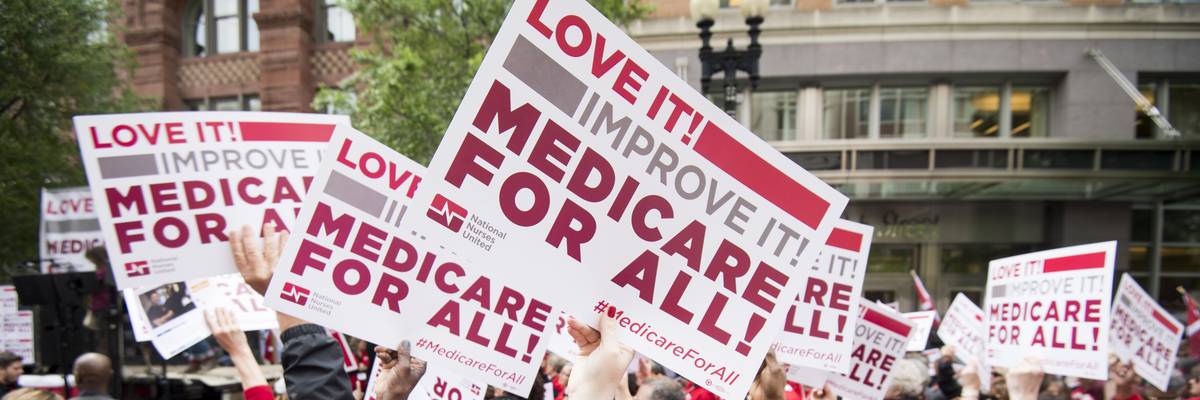
Members of National Nurses United union members wave "Medicare for All" signs during a rally in front of the Pharmaceutical Research and Manufacturers of America in Washington calling for "Medicare for All" on Monday, April 29, 2019.
Our healthcare ‘system’—with or without the Affordable Care Act—is unsustainable: we have reached the end of the line.
Those without employer sponsored insurance (or Federal insurance like Medicare or the VA) in Red states, who signed up for the Affordable Care Act (aka Obamacare), are now learning what they voted for: higher premiums for health insurance, maybe unaffordable. Meanwhile, premiums continue to rise relentlessly for employers and employees.
Our healthcare "system" is unsustainable: we have reached the end of the line.
Americans pay more for healthcare (about18 percent of GDP) than any other developed country, with mediocre outcomes. Yet the other countries, with better outcomes, have universal coverage.
It is time for change. Extend traditional Medicare to all Americans (gradually, over the course of several years). Medicare is familiar; it works. Private for profit-health insurance, less than a century old, makes no sense today.
Sick and injured patients have turned to medicine—to healers—since time immemorial. Health insurance is new: Blue Cross started as a community non profit organization in 1929, to cover surgery in hospitals.
Private for profit-health insurance, less than a century old, makes no sense today.
Yes, we are a capitalist country, and markets are efficient at producing many things, like commodities: groceries, shoes, cars, even some insurance, when it is straightforward and highly regulated, like auto insurance. But for-profit health insurance does not work.
The idea of insurance is to spread risk over a maximum number of subscribers, each of whom is at the same low risk of unpredictable casualty, like fire. This was essentially the situation of Americans a century ago—illness and injury were acute and unpredictable, patients either recovered or died. Everyone was at similar risk, only surgery was expensive.
Today is different: illness is not only predictable, it can be chronic, even life long. Moreover, today’s scientific care is expensive. The social determinants of health—income security, education, adequate food and shelter, social support (your zip code, not your genetic code)—plus public health, keep healthy people healthy.
Medical care is for the sick.
For-profit health insurers maximize premiums, minimize cost (provider fees), keep the difference, and most important, avoid the sick. Insurers exclude those with “pre-existing” conditions whenever allowed (not under the ACA), deny "authorization" where they can. They tailor "plans" with carefully engineered restrictions you don’t discover until you file a claim. They are not even providing insurance: the payments from the Federal government are risk adjusted, so the insurers are paid more for riskier patients (and they are now illegally upcoding). The providers are not. Making this happen entails huge administrative expense, which adds no value for patients or providers, only massive returns to investors. United Health Group is the third largest company in the Fortune 500.
Healthy people don’t know what plan is "right for them"; they hate the annual "choice." They only know what they can afford. (Sick people know what they need.) They do want to choose their doctor.
Traditional Medicare eliminates these problems for its beneficiaries: by law, everything medically necessary is covered. The Federal government determines fees for doctors and hospitals based on cost, as it did historically when markets didn’t work. Beneficiaries pay premiums based on income.
Fee-for-service works when we pay the right fees for the right services. Today, based on 1950’s medicine, Medicare pays too little for office visits, so-called ‘cognitive’ services (versus procedures) both primary and specialized, so there are too few providers, especially as Medicare rolls expand with retiring
Boomers. No office doctor can make a living from Medicare anymore. That is, however, easy to fix: pay providers more to care for the sickest people, who need the services only highly skilled, experienced physicians can provide. Pay surgeons less.
Best of all, Medicare is simple—ask your grandmother.
But where will the money come from?
Start by eliminating Medicare Advantage (MA) and Part D, while updating Medicare to cover prescription drugs, along with vision, hearing aids, etc. MA was supposed to save taxpayers money by providing care more efficiently. Instead, Medicare pays MA companies 20 percent more than traditional Medicare for comparable patients.
Then, require all employers (including those who currently don’t provide insurance) to pay premiums to Medicare based on payroll. Require employees to pay Medicare premiums based on wages. Just like Social Security (of which Medicare is technically a provision). The Federal government continues to pay a share.
Everyone pays, everyone gets the care they need and nobody is left out. People can choose any qualified provider. Providers remain private, and are paid enough to attract and sustain the clinicians we want and need.
We have tried every kind of private for profit health insurance there is: employer sponsored, government subsidized, market based, capitation, value-based, catastrophic, health savings accounts—it no longer works for employers, taxpayers, or the sick. This year premiums will go up, coverage will go down.
Americans’ health will suffer.
Americans need care, not coverage. We clinicians have dedicated our lives to providing it. Medicare has served millions of us well for 60 years. We cannot allow opportunistic capitalists to stand in the way for the rest.
Dear Common Dreams reader, It’s been nearly 30 years since I co-founded Common Dreams with my late wife, Lina Newhouser. We had the radical notion that journalism should serve the public good, not corporate profits. It was clear to us from the outset what it would take to build such a project. No paid advertisements. No corporate sponsors. No millionaire publisher telling us what to think or do. Many people said we wouldn't last a year, but we proved those doubters wrong. Together with a tremendous team of journalists and dedicated staff, we built an independent media outlet free from the constraints of profits and corporate control. Our mission has always been simple: To inform. To inspire. To ignite change for the common good. Building Common Dreams was not easy. Our survival was never guaranteed. When you take on the most powerful forces—Wall Street greed, fossil fuel industry destruction, Big Tech lobbyists, and uber-rich oligarchs who have spent billions upon billions rigging the economy and democracy in their favor—the only bulwark you have is supporters who believe in your work. But here’s the urgent message from me today. It's never been this bad out there. And it's never been this hard to keep us going. At the very moment Common Dreams is most needed, the threats we face are intensifying. We need your support now more than ever. We don't accept corporate advertising and never will. We don't have a paywall because we don't think people should be blocked from critical news based on their ability to pay. Everything we do is funded by the donations of readers like you. When everyone does the little they can afford, we are strong. But if that support retreats or dries up, so do we. Will you donate now to make sure Common Dreams not only survives but thrives? —Craig Brown, Co-founder |
Those without employer sponsored insurance (or Federal insurance like Medicare or the VA) in Red states, who signed up for the Affordable Care Act (aka Obamacare), are now learning what they voted for: higher premiums for health insurance, maybe unaffordable. Meanwhile, premiums continue to rise relentlessly for employers and employees.
Our healthcare "system" is unsustainable: we have reached the end of the line.
Americans pay more for healthcare (about18 percent of GDP) than any other developed country, with mediocre outcomes. Yet the other countries, with better outcomes, have universal coverage.
It is time for change. Extend traditional Medicare to all Americans (gradually, over the course of several years). Medicare is familiar; it works. Private for profit-health insurance, less than a century old, makes no sense today.
Sick and injured patients have turned to medicine—to healers—since time immemorial. Health insurance is new: Blue Cross started as a community non profit organization in 1929, to cover surgery in hospitals.
Private for profit-health insurance, less than a century old, makes no sense today.
Yes, we are a capitalist country, and markets are efficient at producing many things, like commodities: groceries, shoes, cars, even some insurance, when it is straightforward and highly regulated, like auto insurance. But for-profit health insurance does not work.
The idea of insurance is to spread risk over a maximum number of subscribers, each of whom is at the same low risk of unpredictable casualty, like fire. This was essentially the situation of Americans a century ago—illness and injury were acute and unpredictable, patients either recovered or died. Everyone was at similar risk, only surgery was expensive.
Today is different: illness is not only predictable, it can be chronic, even life long. Moreover, today’s scientific care is expensive. The social determinants of health—income security, education, adequate food and shelter, social support (your zip code, not your genetic code)—plus public health, keep healthy people healthy.
Medical care is for the sick.
For-profit health insurers maximize premiums, minimize cost (provider fees), keep the difference, and most important, avoid the sick. Insurers exclude those with “pre-existing” conditions whenever allowed (not under the ACA), deny "authorization" where they can. They tailor "plans" with carefully engineered restrictions you don’t discover until you file a claim. They are not even providing insurance: the payments from the Federal government are risk adjusted, so the insurers are paid more for riskier patients (and they are now illegally upcoding). The providers are not. Making this happen entails huge administrative expense, which adds no value for patients or providers, only massive returns to investors. United Health Group is the third largest company in the Fortune 500.
Healthy people don’t know what plan is "right for them"; they hate the annual "choice." They only know what they can afford. (Sick people know what they need.) They do want to choose their doctor.
Traditional Medicare eliminates these problems for its beneficiaries: by law, everything medically necessary is covered. The Federal government determines fees for doctors and hospitals based on cost, as it did historically when markets didn’t work. Beneficiaries pay premiums based on income.
Fee-for-service works when we pay the right fees for the right services. Today, based on 1950’s medicine, Medicare pays too little for office visits, so-called ‘cognitive’ services (versus procedures) both primary and specialized, so there are too few providers, especially as Medicare rolls expand with retiring
Boomers. No office doctor can make a living from Medicare anymore. That is, however, easy to fix: pay providers more to care for the sickest people, who need the services only highly skilled, experienced physicians can provide. Pay surgeons less.
Best of all, Medicare is simple—ask your grandmother.
But where will the money come from?
Start by eliminating Medicare Advantage (MA) and Part D, while updating Medicare to cover prescription drugs, along with vision, hearing aids, etc. MA was supposed to save taxpayers money by providing care more efficiently. Instead, Medicare pays MA companies 20 percent more than traditional Medicare for comparable patients.
Then, require all employers (including those who currently don’t provide insurance) to pay premiums to Medicare based on payroll. Require employees to pay Medicare premiums based on wages. Just like Social Security (of which Medicare is technically a provision). The Federal government continues to pay a share.
Everyone pays, everyone gets the care they need and nobody is left out. People can choose any qualified provider. Providers remain private, and are paid enough to attract and sustain the clinicians we want and need.
We have tried every kind of private for profit health insurance there is: employer sponsored, government subsidized, market based, capitation, value-based, catastrophic, health savings accounts—it no longer works for employers, taxpayers, or the sick. This year premiums will go up, coverage will go down.
Americans’ health will suffer.
Americans need care, not coverage. We clinicians have dedicated our lives to providing it. Medicare has served millions of us well for 60 years. We cannot allow opportunistic capitalists to stand in the way for the rest.
Those without employer sponsored insurance (or Federal insurance like Medicare or the VA) in Red states, who signed up for the Affordable Care Act (aka Obamacare), are now learning what they voted for: higher premiums for health insurance, maybe unaffordable. Meanwhile, premiums continue to rise relentlessly for employers and employees.
Our healthcare "system" is unsustainable: we have reached the end of the line.
Americans pay more for healthcare (about18 percent of GDP) than any other developed country, with mediocre outcomes. Yet the other countries, with better outcomes, have universal coverage.
It is time for change. Extend traditional Medicare to all Americans (gradually, over the course of several years). Medicare is familiar; it works. Private for profit-health insurance, less than a century old, makes no sense today.
Sick and injured patients have turned to medicine—to healers—since time immemorial. Health insurance is new: Blue Cross started as a community non profit organization in 1929, to cover surgery in hospitals.
Private for profit-health insurance, less than a century old, makes no sense today.
Yes, we are a capitalist country, and markets are efficient at producing many things, like commodities: groceries, shoes, cars, even some insurance, when it is straightforward and highly regulated, like auto insurance. But for-profit health insurance does not work.
The idea of insurance is to spread risk over a maximum number of subscribers, each of whom is at the same low risk of unpredictable casualty, like fire. This was essentially the situation of Americans a century ago—illness and injury were acute and unpredictable, patients either recovered or died. Everyone was at similar risk, only surgery was expensive.
Today is different: illness is not only predictable, it can be chronic, even life long. Moreover, today’s scientific care is expensive. The social determinants of health—income security, education, adequate food and shelter, social support (your zip code, not your genetic code)—plus public health, keep healthy people healthy.
Medical care is for the sick.
For-profit health insurers maximize premiums, minimize cost (provider fees), keep the difference, and most important, avoid the sick. Insurers exclude those with “pre-existing” conditions whenever allowed (not under the ACA), deny "authorization" where they can. They tailor "plans" with carefully engineered restrictions you don’t discover until you file a claim. They are not even providing insurance: the payments from the Federal government are risk adjusted, so the insurers are paid more for riskier patients (and they are now illegally upcoding). The providers are not. Making this happen entails huge administrative expense, which adds no value for patients or providers, only massive returns to investors. United Health Group is the third largest company in the Fortune 500.
Healthy people don’t know what plan is "right for them"; they hate the annual "choice." They only know what they can afford. (Sick people know what they need.) They do want to choose their doctor.
Traditional Medicare eliminates these problems for its beneficiaries: by law, everything medically necessary is covered. The Federal government determines fees for doctors and hospitals based on cost, as it did historically when markets didn’t work. Beneficiaries pay premiums based on income.
Fee-for-service works when we pay the right fees for the right services. Today, based on 1950’s medicine, Medicare pays too little for office visits, so-called ‘cognitive’ services (versus procedures) both primary and specialized, so there are too few providers, especially as Medicare rolls expand with retiring
Boomers. No office doctor can make a living from Medicare anymore. That is, however, easy to fix: pay providers more to care for the sickest people, who need the services only highly skilled, experienced physicians can provide. Pay surgeons less.
Best of all, Medicare is simple—ask your grandmother.
But where will the money come from?
Start by eliminating Medicare Advantage (MA) and Part D, while updating Medicare to cover prescription drugs, along with vision, hearing aids, etc. MA was supposed to save taxpayers money by providing care more efficiently. Instead, Medicare pays MA companies 20 percent more than traditional Medicare for comparable patients.
Then, require all employers (including those who currently don’t provide insurance) to pay premiums to Medicare based on payroll. Require employees to pay Medicare premiums based on wages. Just like Social Security (of which Medicare is technically a provision). The Federal government continues to pay a share.
Everyone pays, everyone gets the care they need and nobody is left out. People can choose any qualified provider. Providers remain private, and are paid enough to attract and sustain the clinicians we want and need.
We have tried every kind of private for profit health insurance there is: employer sponsored, government subsidized, market based, capitation, value-based, catastrophic, health savings accounts—it no longer works for employers, taxpayers, or the sick. This year premiums will go up, coverage will go down.
Americans’ health will suffer.
Americans need care, not coverage. We clinicians have dedicated our lives to providing it. Medicare has served millions of us well for 60 years. We cannot allow opportunistic capitalists to stand in the way for the rest.