

SUBSCRIBE TO OUR FREE NEWSLETTER
Daily news & progressive opinion—funded by the people, not the corporations—delivered straight to your inbox.
5
#000000
#FFFFFF
To donate by check, phone, or other method, see our More Ways to Give page.
Daily news & progressive opinion—funded by the people, not the corporations—delivered straight to your inbox.
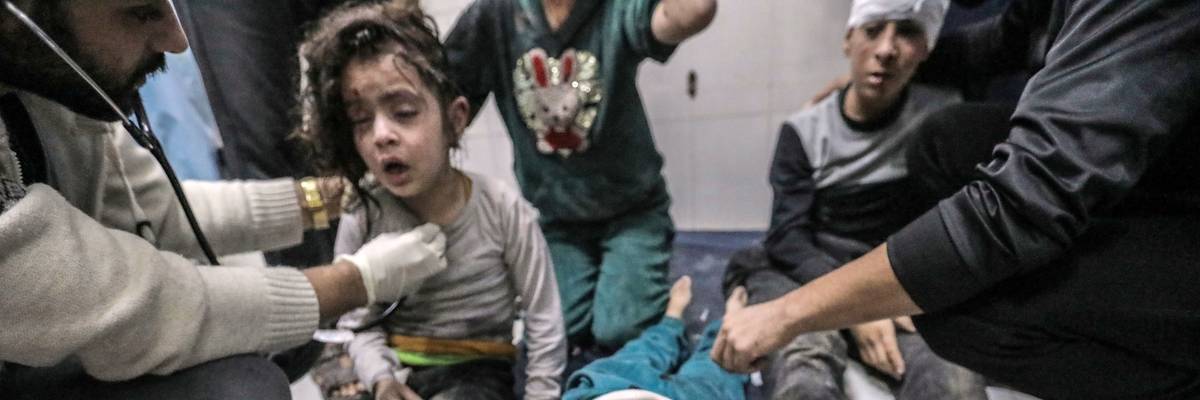
Rather than sending more bombs and weaponry to Netanyahu, the United States—if it had the courage—could send him the opposite, the words of Martin Luther King Jr. instead.
Perhaps the primary value of war – from the point of view of national leaders and their loyal followers – is that it places 100 percent of the blame for whatever’s wrong on the other guy: the enemy. And thus there’s no alternative but to kill “him,” which nowadays amounts to slaughtering and dismembering anybody and everybody who lives in his sector of the planet, including children . . . though that part isn’t said out loud.
It’s not even “winning” that matters, because in truth there is no winning when it comes to war, just ongoing preparation for the next one. Good ol’ George W. Bush described the phenomenon with such clarity in his 2002 State of the Union address, when he said that North Korea, Iran and Iraq – three countries the United States once controlled – constituted, in their defiance, “an axis of evil, arming to threaten the peace of the world.”
We all know what happened next. We invaded and shattered Iraq. A million or so people died. Nothing changed. Certainly nothing was learned.
For instance, these are the words of George W. . . . excuse me, Benjamin . . . Netanyahu, speaking two-plus decades later before the Israeli Knesset, in the wake of the Hamas attack on Israel:
“Hamas is part of the axis of evil of Iran, Hezbollah and their minions. They seek to destroy the State of Israel and murder us all. They want to return the Middle East to the abyss of the barbaric fanaticism of the Middle Ages. . . .”
From Netanyahu’s point of view, the Hamas attack was completely unprovoked. It had nothing to do with Israel’s occupation of Palestine, turning Gaza into a concentration camp for 2 million people, continually “mowing the lawn” there, etc. After all, the enemy always bears 100 percent of the blame.
And how national leaders love their enemies – just not in that “love thy enemy as thyself” way. A good enemy – and a war against that enemy – create national unity: “Our goal is victory,” Netanyahu declared, “a crushing victory over Hamas, toppling its regime and removing its threat to the State of Israel once and for all.”
He added: “This is a struggle between the children of light and the children of darkness, between humanity and the law of the jungle.”
Law of the jungle?
These words made me pause, oh so briefly. Netanyahu – murderer of children – actually uttered a sliver of truth, unintentionally, of course. His genocidal war on Palestine is, indeed, a struggle between humanity and the law of the jungle. It’s a struggle between brutal force – this is the “humanity” part, simplistic and domination-obsessed – and transcendent sanity: the law of the jungle, i.e., the laws of survival that have evolved into our global ecosystem.
“The jungle environment, a complex and diverse ecosystem, embodies a myriad of interconnected laws that dictate the survival, interactions, and equilibrium of its inhabitants.”
So writes Brandon Angel at the website Nutritional Diversity, noting that “the jungle’s resilience lies in the abundance and diversity of species coexisting in a delicate balance.”
My heart pounds. All I can do is scream the words: What if?
I hear a billion human beings, maybe more, joining the cry. Most of humanity is, by now, oh so ready to move beyond the suicidal stupidity of war, the stupidity of the belief that we can kill the world’s evil and thus create some sort of pretend heaven, which of course will never happen. What if, instead, we committed ourselves to understanding the interconnectedness of life – or as Brandon Angel put it, “the interplay of dominance, territoriality and cooperation . . .”
No, there’s nothing obvious here. There’s nothing simple and clean-cut. Life is a complex, mortal struggle; competing interests arise. But what if we stopped valuing – and funding the hell out of – war? What if we conquered our impulse to kill the problem of the moment and looked deeply within it, not simply for a temporary solution but for transcendence?
I ask this question, as an American, of my own government. What if we decided to learn, not just at the margins, but officially and politically, from our own horrific history of genocide and racism, and acknowledge that we have survived not by killing the enemy within but we expanding our sense of who we are? And what if, empowered by this awareness, we refused to be complicit with Israel in its own attempt at committing genocide? What if we chose not to dance with the possibility of war with Iran?
What if, at the starting point of conflict, we began by acknowledging, in the words of the International Union for Conservation of Nature: “In the spirit of nature, everything is connected” . . .?
What might that mean? I don’t claim to know, but the first step is to loosen the grip my own certainties have on me, especially when those certainties are armed.
Instead of sending more bombs and weaponry to Netanyahu, the United States – if it had the courage – could send him the opposite, the words of Martin Luther King:
“And as I ponder the madness of Vietnam and search within myself for ways to understand and respond in compassion, my mind goes constantly to the people of that peninsula. . . . who have been living under the curse of war for almost three continuous decades now. I think of them, too, because it is clear to me that there will be no meaningful solution there until some attempt is made to know them and hear their broken cries.”
Dear Common Dreams reader, It’s been nearly 30 years since I co-founded Common Dreams with my late wife, Lina Newhouser. We had the radical notion that journalism should serve the public good, not corporate profits. It was clear to us from the outset what it would take to build such a project. No paid advertisements. No corporate sponsors. No millionaire publisher telling us what to think or do. Many people said we wouldn't last a year, but we proved those doubters wrong. Together with a tremendous team of journalists and dedicated staff, we built an independent media outlet free from the constraints of profits and corporate control. Our mission has always been simple: To inform. To inspire. To ignite change for the common good. Building Common Dreams was not easy. Our survival was never guaranteed. When you take on the most powerful forces—Wall Street greed, fossil fuel industry destruction, Big Tech lobbyists, and uber-rich oligarchs who have spent billions upon billions rigging the economy and democracy in their favor—the only bulwark you have is supporters who believe in your work. But here’s the urgent message from me today. It's never been this bad out there. And it's never been this hard to keep us going. At the very moment Common Dreams is most needed, the threats we face are intensifying. We need your support now more than ever. We don't accept corporate advertising and never will. We don't have a paywall because we don't think people should be blocked from critical news based on their ability to pay. Everything we do is funded by the donations of readers like you. When everyone does the little they can afford, we are strong. But if that support retreats or dries up, so do we. Will you donate now to make sure Common Dreams not only survives but thrives? —Craig Brown, Co-founder |
Perhaps the primary value of war – from the point of view of national leaders and their loyal followers – is that it places 100 percent of the blame for whatever’s wrong on the other guy: the enemy. And thus there’s no alternative but to kill “him,” which nowadays amounts to slaughtering and dismembering anybody and everybody who lives in his sector of the planet, including children . . . though that part isn’t said out loud.
It’s not even “winning” that matters, because in truth there is no winning when it comes to war, just ongoing preparation for the next one. Good ol’ George W. Bush described the phenomenon with such clarity in his 2002 State of the Union address, when he said that North Korea, Iran and Iraq – three countries the United States once controlled – constituted, in their defiance, “an axis of evil, arming to threaten the peace of the world.”
We all know what happened next. We invaded and shattered Iraq. A million or so people died. Nothing changed. Certainly nothing was learned.
For instance, these are the words of George W. . . . excuse me, Benjamin . . . Netanyahu, speaking two-plus decades later before the Israeli Knesset, in the wake of the Hamas attack on Israel:
“Hamas is part of the axis of evil of Iran, Hezbollah and their minions. They seek to destroy the State of Israel and murder us all. They want to return the Middle East to the abyss of the barbaric fanaticism of the Middle Ages. . . .”
From Netanyahu’s point of view, the Hamas attack was completely unprovoked. It had nothing to do with Israel’s occupation of Palestine, turning Gaza into a concentration camp for 2 million people, continually “mowing the lawn” there, etc. After all, the enemy always bears 100 percent of the blame.
And how national leaders love their enemies – just not in that “love thy enemy as thyself” way. A good enemy – and a war against that enemy – create national unity: “Our goal is victory,” Netanyahu declared, “a crushing victory over Hamas, toppling its regime and removing its threat to the State of Israel once and for all.”
He added: “This is a struggle between the children of light and the children of darkness, between humanity and the law of the jungle.”
Law of the jungle?
These words made me pause, oh so briefly. Netanyahu – murderer of children – actually uttered a sliver of truth, unintentionally, of course. His genocidal war on Palestine is, indeed, a struggle between humanity and the law of the jungle. It’s a struggle between brutal force – this is the “humanity” part, simplistic and domination-obsessed – and transcendent sanity: the law of the jungle, i.e., the laws of survival that have evolved into our global ecosystem.
“The jungle environment, a complex and diverse ecosystem, embodies a myriad of interconnected laws that dictate the survival, interactions, and equilibrium of its inhabitants.”
So writes Brandon Angel at the website Nutritional Diversity, noting that “the jungle’s resilience lies in the abundance and diversity of species coexisting in a delicate balance.”
My heart pounds. All I can do is scream the words: What if?
I hear a billion human beings, maybe more, joining the cry. Most of humanity is, by now, oh so ready to move beyond the suicidal stupidity of war, the stupidity of the belief that we can kill the world’s evil and thus create some sort of pretend heaven, which of course will never happen. What if, instead, we committed ourselves to understanding the interconnectedness of life – or as Brandon Angel put it, “the interplay of dominance, territoriality and cooperation . . .”
No, there’s nothing obvious here. There’s nothing simple and clean-cut. Life is a complex, mortal struggle; competing interests arise. But what if we stopped valuing – and funding the hell out of – war? What if we conquered our impulse to kill the problem of the moment and looked deeply within it, not simply for a temporary solution but for transcendence?
I ask this question, as an American, of my own government. What if we decided to learn, not just at the margins, but officially and politically, from our own horrific history of genocide and racism, and acknowledge that we have survived not by killing the enemy within but we expanding our sense of who we are? And what if, empowered by this awareness, we refused to be complicit with Israel in its own attempt at committing genocide? What if we chose not to dance with the possibility of war with Iran?
What if, at the starting point of conflict, we began by acknowledging, in the words of the International Union for Conservation of Nature: “In the spirit of nature, everything is connected” . . .?
What might that mean? I don’t claim to know, but the first step is to loosen the grip my own certainties have on me, especially when those certainties are armed.
Instead of sending more bombs and weaponry to Netanyahu, the United States – if it had the courage – could send him the opposite, the words of Martin Luther King:
“And as I ponder the madness of Vietnam and search within myself for ways to understand and respond in compassion, my mind goes constantly to the people of that peninsula. . . . who have been living under the curse of war for almost three continuous decades now. I think of them, too, because it is clear to me that there will be no meaningful solution there until some attempt is made to know them and hear their broken cries.”
Perhaps the primary value of war – from the point of view of national leaders and their loyal followers – is that it places 100 percent of the blame for whatever’s wrong on the other guy: the enemy. And thus there’s no alternative but to kill “him,” which nowadays amounts to slaughtering and dismembering anybody and everybody who lives in his sector of the planet, including children . . . though that part isn’t said out loud.
It’s not even “winning” that matters, because in truth there is no winning when it comes to war, just ongoing preparation for the next one. Good ol’ George W. Bush described the phenomenon with such clarity in his 2002 State of the Union address, when he said that North Korea, Iran and Iraq – three countries the United States once controlled – constituted, in their defiance, “an axis of evil, arming to threaten the peace of the world.”
We all know what happened next. We invaded and shattered Iraq. A million or so people died. Nothing changed. Certainly nothing was learned.
For instance, these are the words of George W. . . . excuse me, Benjamin . . . Netanyahu, speaking two-plus decades later before the Israeli Knesset, in the wake of the Hamas attack on Israel:
“Hamas is part of the axis of evil of Iran, Hezbollah and their minions. They seek to destroy the State of Israel and murder us all. They want to return the Middle East to the abyss of the barbaric fanaticism of the Middle Ages. . . .”
From Netanyahu’s point of view, the Hamas attack was completely unprovoked. It had nothing to do with Israel’s occupation of Palestine, turning Gaza into a concentration camp for 2 million people, continually “mowing the lawn” there, etc. After all, the enemy always bears 100 percent of the blame.
And how national leaders love their enemies – just not in that “love thy enemy as thyself” way. A good enemy – and a war against that enemy – create national unity: “Our goal is victory,” Netanyahu declared, “a crushing victory over Hamas, toppling its regime and removing its threat to the State of Israel once and for all.”
He added: “This is a struggle between the children of light and the children of darkness, between humanity and the law of the jungle.”
Law of the jungle?
These words made me pause, oh so briefly. Netanyahu – murderer of children – actually uttered a sliver of truth, unintentionally, of course. His genocidal war on Palestine is, indeed, a struggle between humanity and the law of the jungle. It’s a struggle between brutal force – this is the “humanity” part, simplistic and domination-obsessed – and transcendent sanity: the law of the jungle, i.e., the laws of survival that have evolved into our global ecosystem.
“The jungle environment, a complex and diverse ecosystem, embodies a myriad of interconnected laws that dictate the survival, interactions, and equilibrium of its inhabitants.”
So writes Brandon Angel at the website Nutritional Diversity, noting that “the jungle’s resilience lies in the abundance and diversity of species coexisting in a delicate balance.”
My heart pounds. All I can do is scream the words: What if?
I hear a billion human beings, maybe more, joining the cry. Most of humanity is, by now, oh so ready to move beyond the suicidal stupidity of war, the stupidity of the belief that we can kill the world’s evil and thus create some sort of pretend heaven, which of course will never happen. What if, instead, we committed ourselves to understanding the interconnectedness of life – or as Brandon Angel put it, “the interplay of dominance, territoriality and cooperation . . .”
No, there’s nothing obvious here. There’s nothing simple and clean-cut. Life is a complex, mortal struggle; competing interests arise. But what if we stopped valuing – and funding the hell out of – war? What if we conquered our impulse to kill the problem of the moment and looked deeply within it, not simply for a temporary solution but for transcendence?
I ask this question, as an American, of my own government. What if we decided to learn, not just at the margins, but officially and politically, from our own horrific history of genocide and racism, and acknowledge that we have survived not by killing the enemy within but we expanding our sense of who we are? And what if, empowered by this awareness, we refused to be complicit with Israel in its own attempt at committing genocide? What if we chose not to dance with the possibility of war with Iran?
What if, at the starting point of conflict, we began by acknowledging, in the words of the International Union for Conservation of Nature: “In the spirit of nature, everything is connected” . . .?
What might that mean? I don’t claim to know, but the first step is to loosen the grip my own certainties have on me, especially when those certainties are armed.
Instead of sending more bombs and weaponry to Netanyahu, the United States – if it had the courage – could send him the opposite, the words of Martin Luther King:
“And as I ponder the madness of Vietnam and search within myself for ways to understand and respond in compassion, my mind goes constantly to the people of that peninsula. . . . who have been living under the curse of war for almost three continuous decades now. I think of them, too, because it is clear to me that there will be no meaningful solution there until some attempt is made to know them and hear their broken cries.”

