SUBSCRIBE TO OUR FREE NEWSLETTER
Daily news & progressive opinion—funded by the people, not the corporations—delivered straight to your inbox.
5
#000000
#FFFFFF
To donate by check, phone, or other method, see our More Ways to Give page.
Daily news & progressive opinion—funded by the people, not the corporations—delivered straight to your inbox.
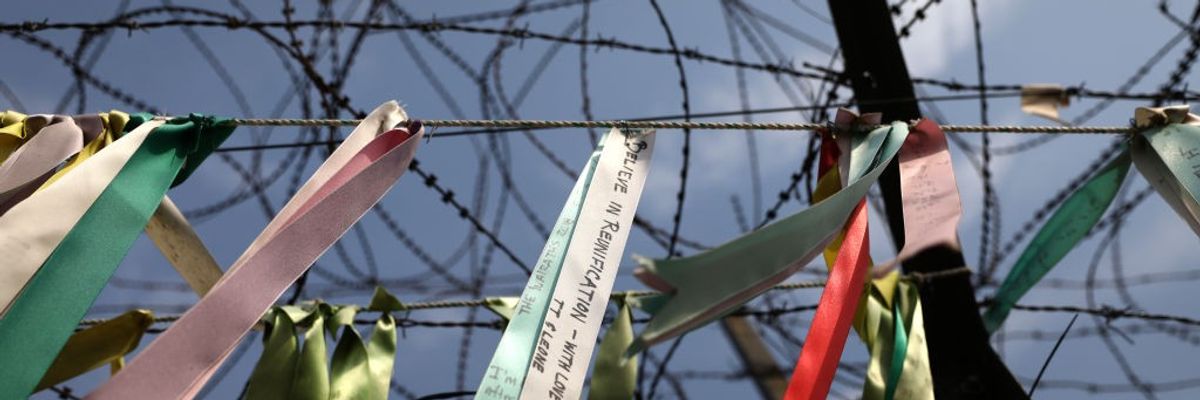
The barbed wire fence covered with prayer ribbons wishing for reunification of the two Koreas on the wire fence at the Imjingak Pavilion, near the demilitarized zone (DMZ) separating South and North Korea on February 27, 2019 in Paju, South Korea.
While much attention is paid to North Korea’s nuclear program and aggressive rhetoric, Americans also need to understand how the U.S. government’s actions exacerbate tensions—and why we have a critical role to play in ending this war.
July 27 marked 70 years since the signing of the armistice that halted—but did not end—the Korean War. Since then, the divided Peninsula has been locked in a perpetual state of war that grows ever more dangerous.
In recent weeks, the U.S. has flown nuclear-capable bombers, launched nuclear war planning talks with South Korean officials, and sent a nuclear-capable submarine to South Korea for the first time in 42 years.
This followed the largest-ever live-fire military drills near the Demilitarized Zone (DMZ) that divides Korea. North Korea has responded with missile tests—and recently threatened nuclear retaliation.
To avert nuclear war and protect our environment, Americans must demand an end to the growing U.S. military presence around the world and rein in our nearly $900 billion military budget.
As a Korean American with family ties to both sides of the DMZ, I know that as long as this war continues, everyday people—Americans as well as Koreans—pay the steepest price. The Korean War inaugurated the U.S. military industrial complex, quadrupled U.S. defense spending, and set the U.S. on a course to become the world’s military police.
While much attention is paid to North Korea’s nuclear program and aggressive rhetoric, Americans also need to understand how the U.S. government’s actions exacerbate tensions—and why we have a critical role to play in ending this war.
To start, we must remember the central role of the U.S. in the Korean War—and just how destructive the fighting was.
Former Secretary of State Condoleezza Rice has described the war as an example of what a “successful” U.S. war can “achieve.” Other talking heads have made similar claims, offering the war as a model for how to proceed in Ukraine. This revisionism is dangerous.
The Korean War killed over 4 million people, more than half of them civilians. From 1950 to 1953, the U.S. dropped 32,000 tons of napalm and 635,000 tons of bombs—more than were dropped in the Pacific theater in World War II. The U.S. military showed “next to no concern for civilian casualties,” historian Bruce Cummings notes, burning 80% of North Korea’s cities to the ground.
Even after this mass destruction, the Peninsula is still at war today—with ongoing consequences for Koreans on both sides of the DMZ.
The U.S. has evicted families from their homes in South Korea to build military bases, while chemicals leaking from bases have poisoned local environments and contaminated drinking water. The Biden administration continues to enforce a Trump-era travel ban keeping Korean Americans separated from their loved ones in North Korea, while sanctions hinder the delivery of essential aid to the country.
U.S. taxpayers bankroll this devastation, spending $13.4 billion to maintain 28,500 troops in South Korea between 2016 and 2019.
Unless we act, our communities and environment will suffer devastating consequences as our military presence expands across the Pacific.
For example, the Defense Department recently announced a missile-defense system to be built on Guam, comprising up to 20 sites across the island and billed as a response to “perceived threats from potential adversaries like China and North Korea.” This plan, like many in the past, will destroy precious landscapes.
In Hawai’i, leaking jet fuel from Navy storage tanks has contaminated drinking water for thousands of families. And next year, the U.S. will hold the Rim of the Pacific (RIMPAC), the largest annual maritime warfare exercise, in the state. Past exercises killed untold scores of marine life.
To avert nuclear war and protect our environment, Americans must demand an end to the growing U.S. military presence around the world and rein in our nearly $900 billion military budget. Our grassroots peace movement continues to grow, leading to the introduction of the Peace on the Korean Peninsula Act (H.R. 1369), which now has nearly 40 co-sponsors.
To end the Korean War, we need individuals with all skill sets—storytellers, community builders, healers, and more—working in concert. We must educate our communities, fight for change, and together build peace in Korea and across the world.
Dear Common Dreams reader, It’s been nearly 30 years since I co-founded Common Dreams with my late wife, Lina Newhouser. We had the radical notion that journalism should serve the public good, not corporate profits. It was clear to us from the outset what it would take to build such a project. No paid advertisements. No corporate sponsors. No millionaire publisher telling us what to think or do. Many people said we wouldn't last a year, but we proved those doubters wrong. Together with a tremendous team of journalists and dedicated staff, we built an independent media outlet free from the constraints of profits and corporate control. Our mission has always been simple: To inform. To inspire. To ignite change for the common good. Building Common Dreams was not easy. Our survival was never guaranteed. When you take on the most powerful forces—Wall Street greed, fossil fuel industry destruction, Big Tech lobbyists, and uber-rich oligarchs who have spent billions upon billions rigging the economy and democracy in their favor—the only bulwark you have is supporters who believe in your work. But here’s the urgent message from me today. It's never been this bad out there. And it's never been this hard to keep us going. At the very moment Common Dreams is most needed, the threats we face are intensifying. We need your support now more than ever. We don't accept corporate advertising and never will. We don't have a paywall because we don't think people should be blocked from critical news based on their ability to pay. Everything we do is funded by the donations of readers like you. When everyone does the little they can afford, we are strong. But if that support retreats or dries up, so do we. Will you donate now to make sure Common Dreams not only survives but thrives? —Craig Brown, Co-founder |
July 27 marked 70 years since the signing of the armistice that halted—but did not end—the Korean War. Since then, the divided Peninsula has been locked in a perpetual state of war that grows ever more dangerous.
In recent weeks, the U.S. has flown nuclear-capable bombers, launched nuclear war planning talks with South Korean officials, and sent a nuclear-capable submarine to South Korea for the first time in 42 years.
This followed the largest-ever live-fire military drills near the Demilitarized Zone (DMZ) that divides Korea. North Korea has responded with missile tests—and recently threatened nuclear retaliation.
To avert nuclear war and protect our environment, Americans must demand an end to the growing U.S. military presence around the world and rein in our nearly $900 billion military budget.
As a Korean American with family ties to both sides of the DMZ, I know that as long as this war continues, everyday people—Americans as well as Koreans—pay the steepest price. The Korean War inaugurated the U.S. military industrial complex, quadrupled U.S. defense spending, and set the U.S. on a course to become the world’s military police.
While much attention is paid to North Korea’s nuclear program and aggressive rhetoric, Americans also need to understand how the U.S. government’s actions exacerbate tensions—and why we have a critical role to play in ending this war.
To start, we must remember the central role of the U.S. in the Korean War—and just how destructive the fighting was.
Former Secretary of State Condoleezza Rice has described the war as an example of what a “successful” U.S. war can “achieve.” Other talking heads have made similar claims, offering the war as a model for how to proceed in Ukraine. This revisionism is dangerous.
The Korean War killed over 4 million people, more than half of them civilians. From 1950 to 1953, the U.S. dropped 32,000 tons of napalm and 635,000 tons of bombs—more than were dropped in the Pacific theater in World War II. The U.S. military showed “next to no concern for civilian casualties,” historian Bruce Cummings notes, burning 80% of North Korea’s cities to the ground.
Even after this mass destruction, the Peninsula is still at war today—with ongoing consequences for Koreans on both sides of the DMZ.
The U.S. has evicted families from their homes in South Korea to build military bases, while chemicals leaking from bases have poisoned local environments and contaminated drinking water. The Biden administration continues to enforce a Trump-era travel ban keeping Korean Americans separated from their loved ones in North Korea, while sanctions hinder the delivery of essential aid to the country.
U.S. taxpayers bankroll this devastation, spending $13.4 billion to maintain 28,500 troops in South Korea between 2016 and 2019.
Unless we act, our communities and environment will suffer devastating consequences as our military presence expands across the Pacific.
For example, the Defense Department recently announced a missile-defense system to be built on Guam, comprising up to 20 sites across the island and billed as a response to “perceived threats from potential adversaries like China and North Korea.” This plan, like many in the past, will destroy precious landscapes.
In Hawai’i, leaking jet fuel from Navy storage tanks has contaminated drinking water for thousands of families. And next year, the U.S. will hold the Rim of the Pacific (RIMPAC), the largest annual maritime warfare exercise, in the state. Past exercises killed untold scores of marine life.
To avert nuclear war and protect our environment, Americans must demand an end to the growing U.S. military presence around the world and rein in our nearly $900 billion military budget. Our grassroots peace movement continues to grow, leading to the introduction of the Peace on the Korean Peninsula Act (H.R. 1369), which now has nearly 40 co-sponsors.
To end the Korean War, we need individuals with all skill sets—storytellers, community builders, healers, and more—working in concert. We must educate our communities, fight for change, and together build peace in Korea and across the world.
July 27 marked 70 years since the signing of the armistice that halted—but did not end—the Korean War. Since then, the divided Peninsula has been locked in a perpetual state of war that grows ever more dangerous.
In recent weeks, the U.S. has flown nuclear-capable bombers, launched nuclear war planning talks with South Korean officials, and sent a nuclear-capable submarine to South Korea for the first time in 42 years.
This followed the largest-ever live-fire military drills near the Demilitarized Zone (DMZ) that divides Korea. North Korea has responded with missile tests—and recently threatened nuclear retaliation.
To avert nuclear war and protect our environment, Americans must demand an end to the growing U.S. military presence around the world and rein in our nearly $900 billion military budget.
As a Korean American with family ties to both sides of the DMZ, I know that as long as this war continues, everyday people—Americans as well as Koreans—pay the steepest price. The Korean War inaugurated the U.S. military industrial complex, quadrupled U.S. defense spending, and set the U.S. on a course to become the world’s military police.
While much attention is paid to North Korea’s nuclear program and aggressive rhetoric, Americans also need to understand how the U.S. government’s actions exacerbate tensions—and why we have a critical role to play in ending this war.
To start, we must remember the central role of the U.S. in the Korean War—and just how destructive the fighting was.
Former Secretary of State Condoleezza Rice has described the war as an example of what a “successful” U.S. war can “achieve.” Other talking heads have made similar claims, offering the war as a model for how to proceed in Ukraine. This revisionism is dangerous.
The Korean War killed over 4 million people, more than half of them civilians. From 1950 to 1953, the U.S. dropped 32,000 tons of napalm and 635,000 tons of bombs—more than were dropped in the Pacific theater in World War II. The U.S. military showed “next to no concern for civilian casualties,” historian Bruce Cummings notes, burning 80% of North Korea’s cities to the ground.
Even after this mass destruction, the Peninsula is still at war today—with ongoing consequences for Koreans on both sides of the DMZ.
The U.S. has evicted families from their homes in South Korea to build military bases, while chemicals leaking from bases have poisoned local environments and contaminated drinking water. The Biden administration continues to enforce a Trump-era travel ban keeping Korean Americans separated from their loved ones in North Korea, while sanctions hinder the delivery of essential aid to the country.
U.S. taxpayers bankroll this devastation, spending $13.4 billion to maintain 28,500 troops in South Korea between 2016 and 2019.
Unless we act, our communities and environment will suffer devastating consequences as our military presence expands across the Pacific.
For example, the Defense Department recently announced a missile-defense system to be built on Guam, comprising up to 20 sites across the island and billed as a response to “perceived threats from potential adversaries like China and North Korea.” This plan, like many in the past, will destroy precious landscapes.
In Hawai’i, leaking jet fuel from Navy storage tanks has contaminated drinking water for thousands of families. And next year, the U.S. will hold the Rim of the Pacific (RIMPAC), the largest annual maritime warfare exercise, in the state. Past exercises killed untold scores of marine life.
To avert nuclear war and protect our environment, Americans must demand an end to the growing U.S. military presence around the world and rein in our nearly $900 billion military budget. Our grassroots peace movement continues to grow, leading to the introduction of the Peace on the Korean Peninsula Act (H.R. 1369), which now has nearly 40 co-sponsors.
To end the Korean War, we need individuals with all skill sets—storytellers, community builders, healers, and more—working in concert. We must educate our communities, fight for change, and together build peace in Korea and across the world.