SUBSCRIBE TO OUR FREE NEWSLETTER
Daily news & progressive opinion—funded by the people, not the corporations—delivered straight to your inbox.
5
#000000
#FFFFFF
To donate by check, phone, or other method, see our More Ways to Give page.
Daily news & progressive opinion—funded by the people, not the corporations—delivered straight to your inbox.
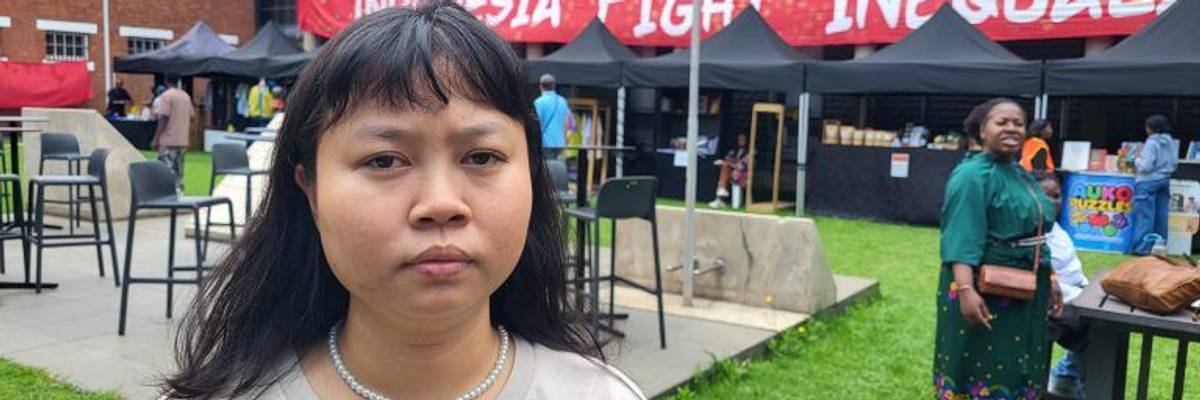
Indonesian labor activist Raraa Rahmawati attends the We the 99% People’s Summit, in Johannesburg, South Africa, on November 21, 2025.
Labor activist Raraa Rahmawati argues that the hazards in her country’s nickel industry are part of the broader problem of a global economy rigged to favor the wealthy
Electric vehicle sales are rising rapidly around the world. But few people who purchase these cars know anything about the workers who produce them.
Labor activist Raraa Rahmawati is trying to change that for one group of e-vehicle supply chain workers: the more than 230,000 Indonesians who toil in the nickel mining and processing industry. Recently, she reported on the reality of these workers’ lives at an international “People’s Summit” held parallel to the G20 leaders meeting in Johannesburg, South Africa.
Indonesia boasts the world’s largest reserves of nickel, a key component of the lithium batteries that power electric vehicles. To capture more of the value of this essential mineral, the national government banned raw nickel exports in 2020. This has triggered a boom in domestic nickel processing.
Who’s benefiting most from this boom? The Chinese firm Tsingshan ranks as the top investor in Indonesia’s nickel processing operations. The company has contracts to supply carmakers around the world, including a $5 billion deal with Tesla.
“People who buy electric cars think they’re contributing to a ‘just transition’ away from fossil fuels,” she told the international crowd in Johannesburg. “But they should know this is really just another form of extractivism."
Tsingshan’s founder and chairman, Xiang Guangda, has accumulated a fortune worth an estimated $3.7 billion. Known as the “Nickel King,” the Chinese tycoon closely guards his privacy. But Bloomberg last year spilled one revealing tidbit: that Xiang had purchased a $62 million mansion for his daughter in Singapore.
The contrast between the living and working conditions for Xiang’s family and his employees could not be more extreme. Rahmawati works with an organization, Sembada Bersama, that is documenting the severe workplace hazards in this industry.
In a new report, Sembada Bersama reveals disturbing information about the Indonesia Weda Bay Industrial Park, a massive nickel mining and smelting complex in a former rainforest in the northern part of the Maluku Islands. Tsingshan owns the largest share of the project.
The most disturbing finding: an apparent pattern of “sudden deaths” among the plant’s workers, who are mostly 25 to 35 years old. Nearly every worker Sembada Bersama interviewed was aware of these tragic incidents. Rahmawati said that while lack of transparency and oversight make it impossible to prove, these deaths are likely the result of cardiac arrests related to grueling working conditions.
Smelter operators typically work two 12-hour shifts over two days, often having to rotate between day and night shifts, with a third day off. To document additional hazards, Sembada Bersama collaborated with workers to take meter readings inside the smelters. The data they collected reveal workplace heat temperatures of as high as 108.5°F, excessive levels of inhalable dust particles that can cause respiratory disease and cancer, and noise levels high enough to cause permanent hearing loss.
These occupational health risks come on top of the Indonesian nickel industry’s devastating environmental costs and high accident rates. Two years ago, an explosion at a Tsingshan plant left 21 workers dead.
Tsingshan recently signed an agreement with the United Nations Industrial Development Organization to improve ecological practices and industrial skills training at its Indonesia operations. This suggests the firm is feeling some pressure. But with few alternative job opportunities, local communities and workers remain vulnerable to the enormous power of Tsingshan and other nickel corporations.
The Sembada Bersama report ends with detailed recommendations for the Indonesian government and corporations. Rahmawati also argues that the hazards in her country’s nickel industry are part of the broader problem of a global economy rigged to favor the wealthy. International solidarity and cooperation, she feels, will be key to unrigging the system.
“People who buy electric cars think they’re contributing to a ‘just transition’ away from fossil fuels,” she told the international crowd in Johannesburg. “But they should know this is really just another form of extractivism. We need a cross-border movement. It’s time for us to be united.”
Dear Common Dreams reader, It’s been nearly 30 years since I co-founded Common Dreams with my late wife, Lina Newhouser. We had the radical notion that journalism should serve the public good, not corporate profits. It was clear to us from the outset what it would take to build such a project. No paid advertisements. No corporate sponsors. No millionaire publisher telling us what to think or do. Many people said we wouldn't last a year, but we proved those doubters wrong. Together with a tremendous team of journalists and dedicated staff, we built an independent media outlet free from the constraints of profits and corporate control. Our mission has always been simple: To inform. To inspire. To ignite change for the common good. Building Common Dreams was not easy. Our survival was never guaranteed. When you take on the most powerful forces—Wall Street greed, fossil fuel industry destruction, Big Tech lobbyists, and uber-rich oligarchs who have spent billions upon billions rigging the economy and democracy in their favor—the only bulwark you have is supporters who believe in your work. But here’s the urgent message from me today. It's never been this bad out there. And it's never been this hard to keep us going. At the very moment Common Dreams is most needed, the threats we face are intensifying. We need your support now more than ever. We don't accept corporate advertising and never will. We don't have a paywall because we don't think people should be blocked from critical news based on their ability to pay. Everything we do is funded by the donations of readers like you. When everyone does the little they can afford, we are strong. But if that support retreats or dries up, so do we. Will you donate now to make sure Common Dreams not only survives but thrives? —Craig Brown, Co-founder |
Electric vehicle sales are rising rapidly around the world. But few people who purchase these cars know anything about the workers who produce them.
Labor activist Raraa Rahmawati is trying to change that for one group of e-vehicle supply chain workers: the more than 230,000 Indonesians who toil in the nickel mining and processing industry. Recently, she reported on the reality of these workers’ lives at an international “People’s Summit” held parallel to the G20 leaders meeting in Johannesburg, South Africa.
Indonesia boasts the world’s largest reserves of nickel, a key component of the lithium batteries that power electric vehicles. To capture more of the value of this essential mineral, the national government banned raw nickel exports in 2020. This has triggered a boom in domestic nickel processing.
Who’s benefiting most from this boom? The Chinese firm Tsingshan ranks as the top investor in Indonesia’s nickel processing operations. The company has contracts to supply carmakers around the world, including a $5 billion deal with Tesla.
“People who buy electric cars think they’re contributing to a ‘just transition’ away from fossil fuels,” she told the international crowd in Johannesburg. “But they should know this is really just another form of extractivism."
Tsingshan’s founder and chairman, Xiang Guangda, has accumulated a fortune worth an estimated $3.7 billion. Known as the “Nickel King,” the Chinese tycoon closely guards his privacy. But Bloomberg last year spilled one revealing tidbit: that Xiang had purchased a $62 million mansion for his daughter in Singapore.
The contrast between the living and working conditions for Xiang’s family and his employees could not be more extreme. Rahmawati works with an organization, Sembada Bersama, that is documenting the severe workplace hazards in this industry.
In a new report, Sembada Bersama reveals disturbing information about the Indonesia Weda Bay Industrial Park, a massive nickel mining and smelting complex in a former rainforest in the northern part of the Maluku Islands. Tsingshan owns the largest share of the project.
The most disturbing finding: an apparent pattern of “sudden deaths” among the plant’s workers, who are mostly 25 to 35 years old. Nearly every worker Sembada Bersama interviewed was aware of these tragic incidents. Rahmawati said that while lack of transparency and oversight make it impossible to prove, these deaths are likely the result of cardiac arrests related to grueling working conditions.
Smelter operators typically work two 12-hour shifts over two days, often having to rotate between day and night shifts, with a third day off. To document additional hazards, Sembada Bersama collaborated with workers to take meter readings inside the smelters. The data they collected reveal workplace heat temperatures of as high as 108.5°F, excessive levels of inhalable dust particles that can cause respiratory disease and cancer, and noise levels high enough to cause permanent hearing loss.
These occupational health risks come on top of the Indonesian nickel industry’s devastating environmental costs and high accident rates. Two years ago, an explosion at a Tsingshan plant left 21 workers dead.
Tsingshan recently signed an agreement with the United Nations Industrial Development Organization to improve ecological practices and industrial skills training at its Indonesia operations. This suggests the firm is feeling some pressure. But with few alternative job opportunities, local communities and workers remain vulnerable to the enormous power of Tsingshan and other nickel corporations.
The Sembada Bersama report ends with detailed recommendations for the Indonesian government and corporations. Rahmawati also argues that the hazards in her country’s nickel industry are part of the broader problem of a global economy rigged to favor the wealthy. International solidarity and cooperation, she feels, will be key to unrigging the system.
“People who buy electric cars think they’re contributing to a ‘just transition’ away from fossil fuels,” she told the international crowd in Johannesburg. “But they should know this is really just another form of extractivism. We need a cross-border movement. It’s time for us to be united.”
Electric vehicle sales are rising rapidly around the world. But few people who purchase these cars know anything about the workers who produce them.
Labor activist Raraa Rahmawati is trying to change that for one group of e-vehicle supply chain workers: the more than 230,000 Indonesians who toil in the nickel mining and processing industry. Recently, she reported on the reality of these workers’ lives at an international “People’s Summit” held parallel to the G20 leaders meeting in Johannesburg, South Africa.
Indonesia boasts the world’s largest reserves of nickel, a key component of the lithium batteries that power electric vehicles. To capture more of the value of this essential mineral, the national government banned raw nickel exports in 2020. This has triggered a boom in domestic nickel processing.
Who’s benefiting most from this boom? The Chinese firm Tsingshan ranks as the top investor in Indonesia’s nickel processing operations. The company has contracts to supply carmakers around the world, including a $5 billion deal with Tesla.
“People who buy electric cars think they’re contributing to a ‘just transition’ away from fossil fuels,” she told the international crowd in Johannesburg. “But they should know this is really just another form of extractivism."
Tsingshan’s founder and chairman, Xiang Guangda, has accumulated a fortune worth an estimated $3.7 billion. Known as the “Nickel King,” the Chinese tycoon closely guards his privacy. But Bloomberg last year spilled one revealing tidbit: that Xiang had purchased a $62 million mansion for his daughter in Singapore.
The contrast between the living and working conditions for Xiang’s family and his employees could not be more extreme. Rahmawati works with an organization, Sembada Bersama, that is documenting the severe workplace hazards in this industry.
In a new report, Sembada Bersama reveals disturbing information about the Indonesia Weda Bay Industrial Park, a massive nickel mining and smelting complex in a former rainforest in the northern part of the Maluku Islands. Tsingshan owns the largest share of the project.
The most disturbing finding: an apparent pattern of “sudden deaths” among the plant’s workers, who are mostly 25 to 35 years old. Nearly every worker Sembada Bersama interviewed was aware of these tragic incidents. Rahmawati said that while lack of transparency and oversight make it impossible to prove, these deaths are likely the result of cardiac arrests related to grueling working conditions.
Smelter operators typically work two 12-hour shifts over two days, often having to rotate between day and night shifts, with a third day off. To document additional hazards, Sembada Bersama collaborated with workers to take meter readings inside the smelters. The data they collected reveal workplace heat temperatures of as high as 108.5°F, excessive levels of inhalable dust particles that can cause respiratory disease and cancer, and noise levels high enough to cause permanent hearing loss.
These occupational health risks come on top of the Indonesian nickel industry’s devastating environmental costs and high accident rates. Two years ago, an explosion at a Tsingshan plant left 21 workers dead.
Tsingshan recently signed an agreement with the United Nations Industrial Development Organization to improve ecological practices and industrial skills training at its Indonesia operations. This suggests the firm is feeling some pressure. But with few alternative job opportunities, local communities and workers remain vulnerable to the enormous power of Tsingshan and other nickel corporations.
The Sembada Bersama report ends with detailed recommendations for the Indonesian government and corporations. Rahmawati also argues that the hazards in her country’s nickel industry are part of the broader problem of a global economy rigged to favor the wealthy. International solidarity and cooperation, she feels, will be key to unrigging the system.
“People who buy electric cars think they’re contributing to a ‘just transition’ away from fossil fuels,” she told the international crowd in Johannesburg. “But they should know this is really just another form of extractivism. We need a cross-border movement. It’s time for us to be united.”