
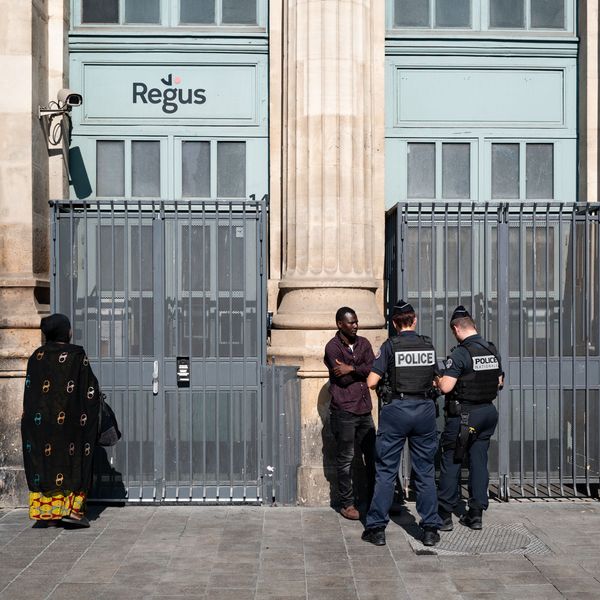

Federal agents detain a nine-month pregnant women after exiting a court hearing in immigration court at the Jacob K. Javitz Federal Building.
(Photo by Michael Nigro/Pacific Press/LightRocket via Getty Images)
Immigration Detention Is Reproductive Violence
Politicians who call themselves “pro-life” support policies that detain pregnant people, criminalize pregnancy, and separate families.
Dec 21, 2025
Early this month, The 19th reported that a 22-year-old mother named Nayra Guzman was kidnapped by Immigration and Customs Enforcement on her way to the neonatal intensive care unit to see her newborn daughter, just days after a long and complicated delivery. While her daughter remained hospitalized, Guzman—still recovering from a C-section and managing Type 1 diabetes—was taken to an immigration detention center and held for 34 hours without adequate medical care, food, or water, or access to a breast pump.
This is not an isolated failure. It is reproductive violence by design.
Immigration in the US has always been about control—controlling who belongs, who gets to build a family, and who is deemed worthy of safety and care. Early laws like the 1882 Chinese Exclusion Act and the 1924 Immigration Act codified eugenicist ideas about which communities were deemed “desirable” and which the country sought to exclude. During World War II, Japanese Americans were subject to mass incarceration, families were separated, pregnancies endangered, and women sterilized. More recently, between 2017 and 2021, more than 4,600 children were kidnapped at the US border—1,360 of whom still remain unaccounted for.
Reports show this has been the deadliest year in immigration detention since 2004. Next year is projected to be even worse. People are dying from untreated infections, suicide, dehydration, and preventable complications. Investigations have documented hundreds of human-rights abuses—including pregnant people miscarrying, being shacked across their stomachs during transport, placed in solitary confinement, and denied translation during medical procedures.
We must dismantle the systems that cage people, separate families, and dictate who is allowed to parent safely.
Major medical, public health, and advocacy organizations have long recognized that pregnant and postpartum people should not be incarcerated. Under the Obama administration, ICE was directed to avoid the detention of pregnant people whenever possible, citing serious health risks and the agency’s inability to provide appropriate care. Under both Trump terms, those protections were rolled back. And last month, Intercept uncovered that the Trump administration has been actively concealing how many pregnant people are in ICE custody.
What we don’t know should scare us even more. Until recently, the Department of Homeland Security was required to publish semiannual reports detailing how many pregnant, postpartum, and lactating people were detained, and what care they received. Since the start of President Donald Trump’s second term, those reports have stopped, and Congress quietly dropped the reporting requirement altogether.
Without even basic reporting requirements, what happens inside detention becomes nearly impossible to track, and people vanish. They are transferred in the middle of the night, across state lines, with no transparency, and no way for their families to know where their loved ones are or if they’re safe.
What we are seeing today are the consequences of a system rooted in racialized policing and mass incarceration—one that criminalizes migration and is built to financially benefit from human suffering. Today, detention quotas and private contracts dictate immigration policy.
For nearly a century after Ellis Island first opened, immigration detention was relatively rare. But by the 1980s, as the "War on Drugs" expanded the criminal legal system, immigration enforcement adopted the same punitive logic. The Reagan administration imposed the nation’s first immigration detention quota, ensuring that thousands of migrants—many fleeing violence or seeking family reunification—would be incarcerated at any given time. After 9/11, detention intensified with the “War on Terror” and the creation of the Department of Homeland Security. Private prison companies secured lucrative federal contracts, new facilities opened nationwide, and immigration violations—many of them civil, not criminal—were now punished with incarceration. ICE’s own data shows roughly 72% of people in detention have no criminal record. Yet thousands are incarcerated for civil violations that carry no criminal penalty under federal law.
As prison beds became profitable, people became commodities. Today, the US operates the largest and fastest-growing immigration detention system in the world. In July, Congress budgeted $45 billion for ICE to build more immigration detention centers, and an additional $30 billion for arrests and deportation. The two biggest private prison companies, CoreCivic and GEO Group, have reported record-breaking profits and described the Trump administration as offering “unprecedented growth opportunities.”
As climate change, war, and economic and political instability drive global displacement and migration, the US has responded with cages instead of care. And apathy feels endless. Politicians who call themselves “pro-life” support policies that detain pregnant people, criminalize pregnancy, and separate families. The American people, exhausted and complacent, have learned to tune it out. Silence has become a coping mechanism.
Working in policy, I live with a constant tension: I know change is incremental, that the system moves slowly, but I am also an abolitionist. I do not believe in prisons or borders. I believe health and reproduction are human rights, and that no one should be imprisoned for migrating or for being pregnant. I think of my policy work as harm reduction—protecting people’s dignity and autonomy now, as we fight for collective liberation in the future.
Calls to release pregnant people from detention are growing. In November, the Democratic Women’s Caucus declared the treatment of pregnant, postpartum, and nursing people in ICE custody “unacceptable,” and last week, Illinois Rep. Delia Ramirez introduced a resolution urging congressional action.
But that demand cannot come from advocates and politicians alone—change depends on ordinary people determined to not look away. Our outrage is long overdue. Call your representatives and let them know that cruelty is a political choice we refuse to normalize. Join groups organizing on the ground, donate to local defense funds, and talk about this in your circles.
In the long term, we must dismantle the systems that cage people, separate families, and dictate who is allowed to parent safely. That vision is at the heart of reproductive justice—because every struggle is connected, and every win brings us closer to the world we deserve.
As Fannie Lou Hamer said, “Nobody’s free until everybody’s free.”
An Urgent Message From Our Co-Founder
Dear Common Dreams reader, The U.S. is on a fast track to authoritarianism like nothing I've ever seen. Meanwhile, corporate news outlets are utterly capitulating to Trump, twisting their coverage to avoid drawing his ire while lining up to stuff cash in his pockets. That's why I believe that Common Dreams is doing the best and most consequential reporting that we've ever done. Our small but mighty team is a progressive reporting powerhouse, covering the news every day that the corporate media never will. Our mission has always been simple: To inform. To inspire. And to ignite change for the common good. Now here's the key piece that I want all our readers to understand: None of this would be possible without your financial support. That's not just some fundraising cliche. It's the absolute and literal truth. We don't accept corporate advertising and never will. We don't have a paywall because we don't think people should be blocked from critical news based on their ability to pay. Everything we do is funded by the donations of readers like you. Will you donate now to help power the nonprofit, independent reporting of Common Dreams? Thank you for being a vital member of our community. Together, we can keep independent journalism alive when it’s needed most. - Craig Brown, Co-founder |
Our work is licensed under Creative Commons (CC BY-NC-ND 3.0). Feel free to republish and share widely.
Gabriella G. Watson is a Public Voices fellow of The OpEd Project with the National Latina Institute for Reproductive Justice and the Every Page Foundation.
human rights
immigration
immigration and customs enforcement
reproductive justice
trump administration
immigrant rights
Early this month, The 19th reported that a 22-year-old mother named Nayra Guzman was kidnapped by Immigration and Customs Enforcement on her way to the neonatal intensive care unit to see her newborn daughter, just days after a long and complicated delivery. While her daughter remained hospitalized, Guzman—still recovering from a C-section and managing Type 1 diabetes—was taken to an immigration detention center and held for 34 hours without adequate medical care, food, or water, or access to a breast pump.
This is not an isolated failure. It is reproductive violence by design.
Immigration in the US has always been about control—controlling who belongs, who gets to build a family, and who is deemed worthy of safety and care. Early laws like the 1882 Chinese Exclusion Act and the 1924 Immigration Act codified eugenicist ideas about which communities were deemed “desirable” and which the country sought to exclude. During World War II, Japanese Americans were subject to mass incarceration, families were separated, pregnancies endangered, and women sterilized. More recently, between 2017 and 2021, more than 4,600 children were kidnapped at the US border—1,360 of whom still remain unaccounted for.
Reports show this has been the deadliest year in immigration detention since 2004. Next year is projected to be even worse. People are dying from untreated infections, suicide, dehydration, and preventable complications. Investigations have documented hundreds of human-rights abuses—including pregnant people miscarrying, being shacked across their stomachs during transport, placed in solitary confinement, and denied translation during medical procedures.
We must dismantle the systems that cage people, separate families, and dictate who is allowed to parent safely.
Major medical, public health, and advocacy organizations have long recognized that pregnant and postpartum people should not be incarcerated. Under the Obama administration, ICE was directed to avoid the detention of pregnant people whenever possible, citing serious health risks and the agency’s inability to provide appropriate care. Under both Trump terms, those protections were rolled back. And last month, Intercept uncovered that the Trump administration has been actively concealing how many pregnant people are in ICE custody.
What we don’t know should scare us even more. Until recently, the Department of Homeland Security was required to publish semiannual reports detailing how many pregnant, postpartum, and lactating people were detained, and what care they received. Since the start of President Donald Trump’s second term, those reports have stopped, and Congress quietly dropped the reporting requirement altogether.
Without even basic reporting requirements, what happens inside detention becomes nearly impossible to track, and people vanish. They are transferred in the middle of the night, across state lines, with no transparency, and no way for their families to know where their loved ones are or if they’re safe.
What we are seeing today are the consequences of a system rooted in racialized policing and mass incarceration—one that criminalizes migration and is built to financially benefit from human suffering. Today, detention quotas and private contracts dictate immigration policy.
For nearly a century after Ellis Island first opened, immigration detention was relatively rare. But by the 1980s, as the "War on Drugs" expanded the criminal legal system, immigration enforcement adopted the same punitive logic. The Reagan administration imposed the nation’s first immigration detention quota, ensuring that thousands of migrants—many fleeing violence or seeking family reunification—would be incarcerated at any given time. After 9/11, detention intensified with the “War on Terror” and the creation of the Department of Homeland Security. Private prison companies secured lucrative federal contracts, new facilities opened nationwide, and immigration violations—many of them civil, not criminal—were now punished with incarceration. ICE’s own data shows roughly 72% of people in detention have no criminal record. Yet thousands are incarcerated for civil violations that carry no criminal penalty under federal law.
As prison beds became profitable, people became commodities. Today, the US operates the largest and fastest-growing immigration detention system in the world. In July, Congress budgeted $45 billion for ICE to build more immigration detention centers, and an additional $30 billion for arrests and deportation. The two biggest private prison companies, CoreCivic and GEO Group, have reported record-breaking profits and described the Trump administration as offering “unprecedented growth opportunities.”
As climate change, war, and economic and political instability drive global displacement and migration, the US has responded with cages instead of care. And apathy feels endless. Politicians who call themselves “pro-life” support policies that detain pregnant people, criminalize pregnancy, and separate families. The American people, exhausted and complacent, have learned to tune it out. Silence has become a coping mechanism.
Working in policy, I live with a constant tension: I know change is incremental, that the system moves slowly, but I am also an abolitionist. I do not believe in prisons or borders. I believe health and reproduction are human rights, and that no one should be imprisoned for migrating or for being pregnant. I think of my policy work as harm reduction—protecting people’s dignity and autonomy now, as we fight for collective liberation in the future.
Calls to release pregnant people from detention are growing. In November, the Democratic Women’s Caucus declared the treatment of pregnant, postpartum, and nursing people in ICE custody “unacceptable,” and last week, Illinois Rep. Delia Ramirez introduced a resolution urging congressional action.
But that demand cannot come from advocates and politicians alone—change depends on ordinary people determined to not look away. Our outrage is long overdue. Call your representatives and let them know that cruelty is a political choice we refuse to normalize. Join groups organizing on the ground, donate to local defense funds, and talk about this in your circles.
In the long term, we must dismantle the systems that cage people, separate families, and dictate who is allowed to parent safely. That vision is at the heart of reproductive justice—because every struggle is connected, and every win brings us closer to the world we deserve.
As Fannie Lou Hamer said, “Nobody’s free until everybody’s free.”
From Your Site Articles
- 'A Form of Torture': Detainees Allege Mistreatment at 'Alligator Alcatraz' ›
- State Data Reveals Just 0.5% of Florida ICE Detainees Are Gang-Affiliated ›
- 200 Rights Groups Call On Biden to End 'Cruel' Expansion of Immigrant Detention ›
- Over 70 Arrested, Including City Officials, During Protests Against ICE Detention in NYC ›
- 'Dystopian' Trump Plan for Massive Expansion of ICE Detention Centers Exposed ›
- 'We Had to Eat Like Dogs': Report Details 'Abusive Practices' at Florida Immigrant Prisons ›
Gabriella G. Watson is a Public Voices fellow of The OpEd Project with the National Latina Institute for Reproductive Justice and the Every Page Foundation.
Early this month, The 19th reported that a 22-year-old mother named Nayra Guzman was kidnapped by Immigration and Customs Enforcement on her way to the neonatal intensive care unit to see her newborn daughter, just days after a long and complicated delivery. While her daughter remained hospitalized, Guzman—still recovering from a C-section and managing Type 1 diabetes—was taken to an immigration detention center and held for 34 hours without adequate medical care, food, or water, or access to a breast pump.
This is not an isolated failure. It is reproductive violence by design.
Immigration in the US has always been about control—controlling who belongs, who gets to build a family, and who is deemed worthy of safety and care. Early laws like the 1882 Chinese Exclusion Act and the 1924 Immigration Act codified eugenicist ideas about which communities were deemed “desirable” and which the country sought to exclude. During World War II, Japanese Americans were subject to mass incarceration, families were separated, pregnancies endangered, and women sterilized. More recently, between 2017 and 2021, more than 4,600 children were kidnapped at the US border—1,360 of whom still remain unaccounted for.
Reports show this has been the deadliest year in immigration detention since 2004. Next year is projected to be even worse. People are dying from untreated infections, suicide, dehydration, and preventable complications. Investigations have documented hundreds of human-rights abuses—including pregnant people miscarrying, being shacked across their stomachs during transport, placed in solitary confinement, and denied translation during medical procedures.
We must dismantle the systems that cage people, separate families, and dictate who is allowed to parent safely.
Major medical, public health, and advocacy organizations have long recognized that pregnant and postpartum people should not be incarcerated. Under the Obama administration, ICE was directed to avoid the detention of pregnant people whenever possible, citing serious health risks and the agency’s inability to provide appropriate care. Under both Trump terms, those protections were rolled back. And last month, Intercept uncovered that the Trump administration has been actively concealing how many pregnant people are in ICE custody.
What we don’t know should scare us even more. Until recently, the Department of Homeland Security was required to publish semiannual reports detailing how many pregnant, postpartum, and lactating people were detained, and what care they received. Since the start of President Donald Trump’s second term, those reports have stopped, and Congress quietly dropped the reporting requirement altogether.
Without even basic reporting requirements, what happens inside detention becomes nearly impossible to track, and people vanish. They are transferred in the middle of the night, across state lines, with no transparency, and no way for their families to know where their loved ones are or if they’re safe.
What we are seeing today are the consequences of a system rooted in racialized policing and mass incarceration—one that criminalizes migration and is built to financially benefit from human suffering. Today, detention quotas and private contracts dictate immigration policy.
For nearly a century after Ellis Island first opened, immigration detention was relatively rare. But by the 1980s, as the "War on Drugs" expanded the criminal legal system, immigration enforcement adopted the same punitive logic. The Reagan administration imposed the nation’s first immigration detention quota, ensuring that thousands of migrants—many fleeing violence or seeking family reunification—would be incarcerated at any given time. After 9/11, detention intensified with the “War on Terror” and the creation of the Department of Homeland Security. Private prison companies secured lucrative federal contracts, new facilities opened nationwide, and immigration violations—many of them civil, not criminal—were now punished with incarceration. ICE’s own data shows roughly 72% of people in detention have no criminal record. Yet thousands are incarcerated for civil violations that carry no criminal penalty under federal law.
As prison beds became profitable, people became commodities. Today, the US operates the largest and fastest-growing immigration detention system in the world. In July, Congress budgeted $45 billion for ICE to build more immigration detention centers, and an additional $30 billion for arrests and deportation. The two biggest private prison companies, CoreCivic and GEO Group, have reported record-breaking profits and described the Trump administration as offering “unprecedented growth opportunities.”
As climate change, war, and economic and political instability drive global displacement and migration, the US has responded with cages instead of care. And apathy feels endless. Politicians who call themselves “pro-life” support policies that detain pregnant people, criminalize pregnancy, and separate families. The American people, exhausted and complacent, have learned to tune it out. Silence has become a coping mechanism.
Working in policy, I live with a constant tension: I know change is incremental, that the system moves slowly, but I am also an abolitionist. I do not believe in prisons or borders. I believe health and reproduction are human rights, and that no one should be imprisoned for migrating or for being pregnant. I think of my policy work as harm reduction—protecting people’s dignity and autonomy now, as we fight for collective liberation in the future.
Calls to release pregnant people from detention are growing. In November, the Democratic Women’s Caucus declared the treatment of pregnant, postpartum, and nursing people in ICE custody “unacceptable,” and last week, Illinois Rep. Delia Ramirez introduced a resolution urging congressional action.
But that demand cannot come from advocates and politicians alone—change depends on ordinary people determined to not look away. Our outrage is long overdue. Call your representatives and let them know that cruelty is a political choice we refuse to normalize. Join groups organizing on the ground, donate to local defense funds, and talk about this in your circles.
In the long term, we must dismantle the systems that cage people, separate families, and dictate who is allowed to parent safely. That vision is at the heart of reproductive justice—because every struggle is connected, and every win brings us closer to the world we deserve.
As Fannie Lou Hamer said, “Nobody’s free until everybody’s free.”
From Your Site Articles
- 'A Form of Torture': Detainees Allege Mistreatment at 'Alligator Alcatraz' ›
- State Data Reveals Just 0.5% of Florida ICE Detainees Are Gang-Affiliated ›
- 200 Rights Groups Call On Biden to End 'Cruel' Expansion of Immigrant Detention ›
- Over 70 Arrested, Including City Officials, During Protests Against ICE Detention in NYC ›
- 'Dystopian' Trump Plan for Massive Expansion of ICE Detention Centers Exposed ›
- 'We Had to Eat Like Dogs': Report Details 'Abusive Practices' at Florida Immigrant Prisons ›
human rights
immigration
immigration and customs enforcement
reproductive justice
trump administration
immigrant rights
We've had enough. The 1% own and operate the corporate media. They are doing everything they can to defend the status quo, squash dissent and protect the wealthy and the powerful. The Common Dreams media model is different. We cover the news that matters to the 99%. Our mission? To inform. To inspire. To ignite change for the common good. How? Nonprofit. Independent. Reader-supported. Free to read. Free to republish. Free to share. With no advertising. No paywalls. No selling of your data. Thousands of small donations fund our newsroom and allow us to continue publishing. Can you chip in? We can't do it without you. Thank you.