SUBSCRIBE TO OUR FREE NEWSLETTER
Daily news & progressive opinion—funded by the people, not the corporations—delivered straight to your inbox.
5
#000000
#FFFFFF
To donate by check, phone, or other method, see our More Ways to Give page.
Daily news & progressive opinion—funded by the people, not the corporations—delivered straight to your inbox.
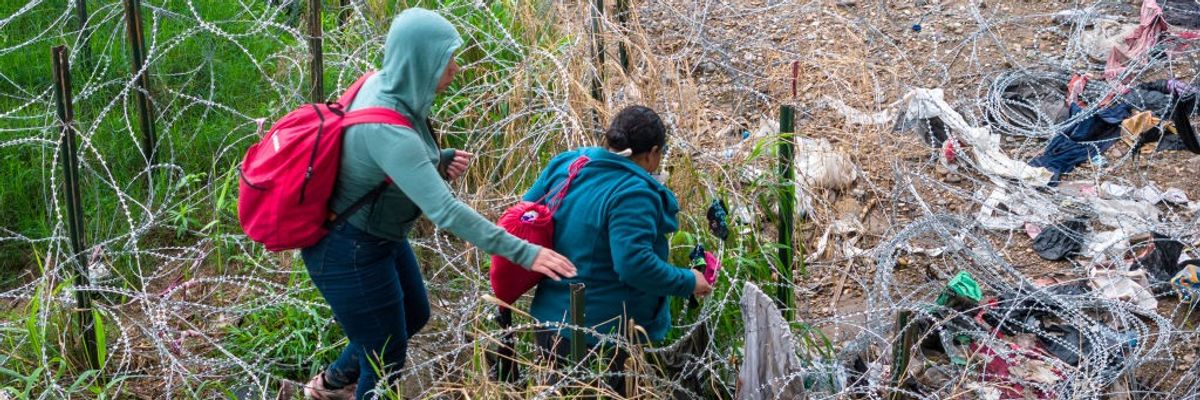
The ongoing attacks on the humanity of immigrants pose a threat to all of us, and we lose sight of our nation’s abundance and the promise upon which it was built.
At an age when many children are learning their ABCs, my father was a farmworker in Mexico. His job was to plant seeds with his small hands while chasing away crows that threatened to eat the freshly buried grain. I imagine him, a child, spending his days toiling behind the ox as it plowed the soil. My mother’s childhood was similar: She worked as a housekeeper and seamstress. Their meager earnings were needed for their families’ survival and as a result, neither was able to go to school.
When they were in their 20s, mom and dad immigrated to the United States, determined that my siblings and I would get an education. They believed in an American dream where prosperity was the reward for anyone who worked hard, and they did everything they could to make it come true.
Today, the belief “that anyone who works hard can get ahead” has diminished. A November 2023 poll by The Wall Street Journal/NORC found that only 36% of U.S. voters believe in the American dream, a number that has steadily declined over the past few decades.
We can reclaim the American dream and reimagine it as the freedom to thrive for all of us.
It’s not hard to understand why. The federal minimum wage of $7.25/hour has not increased since 2009, despite increases in inflation in every consumer category. Full-time workers earning minimum wage do not earn enough to pay for a two-bedroom rental anywhere in the country. Half of U.S adults struggle with healthcare costs, and 66.5% of bankruptcies are due to medical expenses. Forty-four percent of us are not prepared to pay for a $1,000 emergency. Student loan debt totals $1.74 trillion. Poverty and hunger have increased despite generations of unprecedented economic growth. By all accounts, many Americans are struggling to do impossibly more with increasingly less.
It doesn’t have to be this way. The original American dream, coined in 1931, was a vision of our collective prosperity as a society, and “a happier life” for us all. In The Epic of America, James Truslow Adams described “a dream of a social order in which each man and each woman shall be able to attain to the fullest stature of which they are innately capable, and be recognized by others for what they are, regardless of the fortuitous circumstances of birth or position.”
In other words, the freedom to thrive for all of us—no matter how much money we have, what we look like, or where we were born.
By the 1970s, my parents were both working in factories, earning minimum wage. They bought a house and raised nine children. We had health insurance, went to school, and lived in a relatively safe community. We were far from wealthy, but society’s promise of upward mobility in exchange for hard work was kept. Then came “trickle-down economics” and decades of policy decisions that transferred wealth away from working families in favor of corporations and the highest earners.
As a result, the U.S. has experienced an “uninterrupted increase in (economic) inequality since 1980.” According to a March 2024 report, the wealth of the top 1% in our country now exceeds $44 trillion, an increase of $2 trillion over the previous quarter. To conceptualize this, if you or I spent $1 million per day, it would take us 3,000 years to spend $1 trillion.
To make matters worse, opportunistic politicians distract us with divisive rhetoric and dehumanizing attacks on immigrants striving for a better life, scapegoating the very people who, like my parents, believe in the potential of our nation and work hard to make that belief a reality. People like the six men from Central America and Mexico who perished the night of the Baltimore bridge collapse as they worked filling potholes while many of us slept.
States like Texas and Georgia have moved to deputize local law enforcement to serve as federal immigration agents, resulting in racial profiling and instilling fear in local communities. Governors in Florida and Texas have played dangerous political games with human beings, shipping them like cargo to “liberal” areas in a cynical ploy that erodes our shared humanity. The governor of Texas has signaled plans to challenge the right of all children to receive an education, despite established precedent set by Plyler v. Doe. This mix of political and economic pressures robs us of the opportunity for meaningful dialogue and results in a society that is increasingly politically polarized, instead of joining together to ensure our country fulfills its promise.
These ongoing attacks on the humanity of immigrants pose a threat to all of us, and we lose sight of our nation’s abundance and the promise upon which it was built.
It’s no wonder so many Americans have lost faith in the American dream.
But there is a different perspective worth considering. It’s a perspective that motivates millions of immigrants to call this country home.
In 2023, my colleagues traveled the country and met with hundreds of immigrants to hear their stories and explore the lens through which immigrants view the country. We heard optimism about the abundance of our nation. A vision of belonging, and a desire to live with self-determination. A place where true prosperity includes a sense of community, joy, love, safety, dignity, inclusion, and purpose.
We are a nation that has yet to live up to its potential. But if we dare to collectively view our country through this lens, we can reclaim the American dream and reimagine it as the freedom to thrive for all of us.
The freedom to thrive will be possible when every one of us can see a doctor without facing financial ruin. When all workers are paid fairly, have safe working conditions, and can comfortably afford a place to live. When all children have access to an education and no one goes hungry. When our full humanity is recognized, embraced, and our interconnectedness celebrated. When we are free to love and to worship in ways that align with our experiences and beliefs, and when we each have the power to live our lives meaningfully. For immigrants, this also means the safety, inclusion, and dignity that comes with citizenship, and the recognition that we are a stronger nation because of the contributions of immigrants.
This will require policy choices that once again leverage our country’s wealth in favor of the many, instead of consolidating it among the few, and policies that are inclusive and rooted in our shared humanity. It will require us to envision a society that is radically different from our current reality. And it will require all of us—including the millions of immigrants who call our country home—working together to bring it to fruition.
My father, mother, and siblings were in attendance when I graduated with my master’s degree. It was a moment of immense joy and pride for my family, and the fruition of my parents’ humble dreams. For me it was a moment of profound gratitude for their vision and belief in what was possible, and a powerful reminder that the freedom to thrive is indeed worth fighting for.
Dear Common Dreams reader, It’s been nearly 30 years since I co-founded Common Dreams with my late wife, Lina Newhouser. We had the radical notion that journalism should serve the public good, not corporate profits. It was clear to us from the outset what it would take to build such a project. No paid advertisements. No corporate sponsors. No millionaire publisher telling us what to think or do. Many people said we wouldn't last a year, but we proved those doubters wrong. Together with a tremendous team of journalists and dedicated staff, we built an independent media outlet free from the constraints of profits and corporate control. Our mission has always been simple: To inform. To inspire. To ignite change for the common good. Building Common Dreams was not easy. Our survival was never guaranteed. When you take on the most powerful forces—Wall Street greed, fossil fuel industry destruction, Big Tech lobbyists, and uber-rich oligarchs who have spent billions upon billions rigging the economy and democracy in their favor—the only bulwark you have is supporters who believe in your work. But here’s the urgent message from me today. It's never been this bad out there. And it's never been this hard to keep us going. At the very moment Common Dreams is most needed, the threats we face are intensifying. We need your support now more than ever. We don't accept corporate advertising and never will. We don't have a paywall because we don't think people should be blocked from critical news based on their ability to pay. Everything we do is funded by the donations of readers like you. When everyone does the little they can afford, we are strong. But if that support retreats or dries up, so do we. Will you donate now to make sure Common Dreams not only survives but thrives? —Craig Brown, Co-founder |
At an age when many children are learning their ABCs, my father was a farmworker in Mexico. His job was to plant seeds with his small hands while chasing away crows that threatened to eat the freshly buried grain. I imagine him, a child, spending his days toiling behind the ox as it plowed the soil. My mother’s childhood was similar: She worked as a housekeeper and seamstress. Their meager earnings were needed for their families’ survival and as a result, neither was able to go to school.
When they were in their 20s, mom and dad immigrated to the United States, determined that my siblings and I would get an education. They believed in an American dream where prosperity was the reward for anyone who worked hard, and they did everything they could to make it come true.
Today, the belief “that anyone who works hard can get ahead” has diminished. A November 2023 poll by The Wall Street Journal/NORC found that only 36% of U.S. voters believe in the American dream, a number that has steadily declined over the past few decades.
We can reclaim the American dream and reimagine it as the freedom to thrive for all of us.
It’s not hard to understand why. The federal minimum wage of $7.25/hour has not increased since 2009, despite increases in inflation in every consumer category. Full-time workers earning minimum wage do not earn enough to pay for a two-bedroom rental anywhere in the country. Half of U.S adults struggle with healthcare costs, and 66.5% of bankruptcies are due to medical expenses. Forty-four percent of us are not prepared to pay for a $1,000 emergency. Student loan debt totals $1.74 trillion. Poverty and hunger have increased despite generations of unprecedented economic growth. By all accounts, many Americans are struggling to do impossibly more with increasingly less.
It doesn’t have to be this way. The original American dream, coined in 1931, was a vision of our collective prosperity as a society, and “a happier life” for us all. In The Epic of America, James Truslow Adams described “a dream of a social order in which each man and each woman shall be able to attain to the fullest stature of which they are innately capable, and be recognized by others for what they are, regardless of the fortuitous circumstances of birth or position.”
In other words, the freedom to thrive for all of us—no matter how much money we have, what we look like, or where we were born.
By the 1970s, my parents were both working in factories, earning minimum wage. They bought a house and raised nine children. We had health insurance, went to school, and lived in a relatively safe community. We were far from wealthy, but society’s promise of upward mobility in exchange for hard work was kept. Then came “trickle-down economics” and decades of policy decisions that transferred wealth away from working families in favor of corporations and the highest earners.
As a result, the U.S. has experienced an “uninterrupted increase in (economic) inequality since 1980.” According to a March 2024 report, the wealth of the top 1% in our country now exceeds $44 trillion, an increase of $2 trillion over the previous quarter. To conceptualize this, if you or I spent $1 million per day, it would take us 3,000 years to spend $1 trillion.
To make matters worse, opportunistic politicians distract us with divisive rhetoric and dehumanizing attacks on immigrants striving for a better life, scapegoating the very people who, like my parents, believe in the potential of our nation and work hard to make that belief a reality. People like the six men from Central America and Mexico who perished the night of the Baltimore bridge collapse as they worked filling potholes while many of us slept.
States like Texas and Georgia have moved to deputize local law enforcement to serve as federal immigration agents, resulting in racial profiling and instilling fear in local communities. Governors in Florida and Texas have played dangerous political games with human beings, shipping them like cargo to “liberal” areas in a cynical ploy that erodes our shared humanity. The governor of Texas has signaled plans to challenge the right of all children to receive an education, despite established precedent set by Plyler v. Doe. This mix of political and economic pressures robs us of the opportunity for meaningful dialogue and results in a society that is increasingly politically polarized, instead of joining together to ensure our country fulfills its promise.
These ongoing attacks on the humanity of immigrants pose a threat to all of us, and we lose sight of our nation’s abundance and the promise upon which it was built.
It’s no wonder so many Americans have lost faith in the American dream.
But there is a different perspective worth considering. It’s a perspective that motivates millions of immigrants to call this country home.
In 2023, my colleagues traveled the country and met with hundreds of immigrants to hear their stories and explore the lens through which immigrants view the country. We heard optimism about the abundance of our nation. A vision of belonging, and a desire to live with self-determination. A place where true prosperity includes a sense of community, joy, love, safety, dignity, inclusion, and purpose.
We are a nation that has yet to live up to its potential. But if we dare to collectively view our country through this lens, we can reclaim the American dream and reimagine it as the freedom to thrive for all of us.
The freedom to thrive will be possible when every one of us can see a doctor without facing financial ruin. When all workers are paid fairly, have safe working conditions, and can comfortably afford a place to live. When all children have access to an education and no one goes hungry. When our full humanity is recognized, embraced, and our interconnectedness celebrated. When we are free to love and to worship in ways that align with our experiences and beliefs, and when we each have the power to live our lives meaningfully. For immigrants, this also means the safety, inclusion, and dignity that comes with citizenship, and the recognition that we are a stronger nation because of the contributions of immigrants.
This will require policy choices that once again leverage our country’s wealth in favor of the many, instead of consolidating it among the few, and policies that are inclusive and rooted in our shared humanity. It will require us to envision a society that is radically different from our current reality. And it will require all of us—including the millions of immigrants who call our country home—working together to bring it to fruition.
My father, mother, and siblings were in attendance when I graduated with my master’s degree. It was a moment of immense joy and pride for my family, and the fruition of my parents’ humble dreams. For me it was a moment of profound gratitude for their vision and belief in what was possible, and a powerful reminder that the freedom to thrive is indeed worth fighting for.
At an age when many children are learning their ABCs, my father was a farmworker in Mexico. His job was to plant seeds with his small hands while chasing away crows that threatened to eat the freshly buried grain. I imagine him, a child, spending his days toiling behind the ox as it plowed the soil. My mother’s childhood was similar: She worked as a housekeeper and seamstress. Their meager earnings were needed for their families’ survival and as a result, neither was able to go to school.
When they were in their 20s, mom and dad immigrated to the United States, determined that my siblings and I would get an education. They believed in an American dream where prosperity was the reward for anyone who worked hard, and they did everything they could to make it come true.
Today, the belief “that anyone who works hard can get ahead” has diminished. A November 2023 poll by The Wall Street Journal/NORC found that only 36% of U.S. voters believe in the American dream, a number that has steadily declined over the past few decades.
We can reclaim the American dream and reimagine it as the freedom to thrive for all of us.
It’s not hard to understand why. The federal minimum wage of $7.25/hour has not increased since 2009, despite increases in inflation in every consumer category. Full-time workers earning minimum wage do not earn enough to pay for a two-bedroom rental anywhere in the country. Half of U.S adults struggle with healthcare costs, and 66.5% of bankruptcies are due to medical expenses. Forty-four percent of us are not prepared to pay for a $1,000 emergency. Student loan debt totals $1.74 trillion. Poverty and hunger have increased despite generations of unprecedented economic growth. By all accounts, many Americans are struggling to do impossibly more with increasingly less.
It doesn’t have to be this way. The original American dream, coined in 1931, was a vision of our collective prosperity as a society, and “a happier life” for us all. In The Epic of America, James Truslow Adams described “a dream of a social order in which each man and each woman shall be able to attain to the fullest stature of which they are innately capable, and be recognized by others for what they are, regardless of the fortuitous circumstances of birth or position.”
In other words, the freedom to thrive for all of us—no matter how much money we have, what we look like, or where we were born.
By the 1970s, my parents were both working in factories, earning minimum wage. They bought a house and raised nine children. We had health insurance, went to school, and lived in a relatively safe community. We were far from wealthy, but society’s promise of upward mobility in exchange for hard work was kept. Then came “trickle-down economics” and decades of policy decisions that transferred wealth away from working families in favor of corporations and the highest earners.
As a result, the U.S. has experienced an “uninterrupted increase in (economic) inequality since 1980.” According to a March 2024 report, the wealth of the top 1% in our country now exceeds $44 trillion, an increase of $2 trillion over the previous quarter. To conceptualize this, if you or I spent $1 million per day, it would take us 3,000 years to spend $1 trillion.
To make matters worse, opportunistic politicians distract us with divisive rhetoric and dehumanizing attacks on immigrants striving for a better life, scapegoating the very people who, like my parents, believe in the potential of our nation and work hard to make that belief a reality. People like the six men from Central America and Mexico who perished the night of the Baltimore bridge collapse as they worked filling potholes while many of us slept.
States like Texas and Georgia have moved to deputize local law enforcement to serve as federal immigration agents, resulting in racial profiling and instilling fear in local communities. Governors in Florida and Texas have played dangerous political games with human beings, shipping them like cargo to “liberal” areas in a cynical ploy that erodes our shared humanity. The governor of Texas has signaled plans to challenge the right of all children to receive an education, despite established precedent set by Plyler v. Doe. This mix of political and economic pressures robs us of the opportunity for meaningful dialogue and results in a society that is increasingly politically polarized, instead of joining together to ensure our country fulfills its promise.
These ongoing attacks on the humanity of immigrants pose a threat to all of us, and we lose sight of our nation’s abundance and the promise upon which it was built.
It’s no wonder so many Americans have lost faith in the American dream.
But there is a different perspective worth considering. It’s a perspective that motivates millions of immigrants to call this country home.
In 2023, my colleagues traveled the country and met with hundreds of immigrants to hear their stories and explore the lens through which immigrants view the country. We heard optimism about the abundance of our nation. A vision of belonging, and a desire to live with self-determination. A place where true prosperity includes a sense of community, joy, love, safety, dignity, inclusion, and purpose.
We are a nation that has yet to live up to its potential. But if we dare to collectively view our country through this lens, we can reclaim the American dream and reimagine it as the freedom to thrive for all of us.
The freedom to thrive will be possible when every one of us can see a doctor without facing financial ruin. When all workers are paid fairly, have safe working conditions, and can comfortably afford a place to live. When all children have access to an education and no one goes hungry. When our full humanity is recognized, embraced, and our interconnectedness celebrated. When we are free to love and to worship in ways that align with our experiences and beliefs, and when we each have the power to live our lives meaningfully. For immigrants, this also means the safety, inclusion, and dignity that comes with citizenship, and the recognition that we are a stronger nation because of the contributions of immigrants.
This will require policy choices that once again leverage our country’s wealth in favor of the many, instead of consolidating it among the few, and policies that are inclusive and rooted in our shared humanity. It will require us to envision a society that is radically different from our current reality. And it will require all of us—including the millions of immigrants who call our country home—working together to bring it to fruition.
My father, mother, and siblings were in attendance when I graduated with my master’s degree. It was a moment of immense joy and pride for my family, and the fruition of my parents’ humble dreams. For me it was a moment of profound gratitude for their vision and belief in what was possible, and a powerful reminder that the freedom to thrive is indeed worth fighting for.