SUBSCRIBE TO OUR FREE NEWSLETTER
Daily news & progressive opinion—funded by the people, not the corporations—delivered straight to your inbox.
5
#000000
#FFFFFF
To donate by check, phone, or other method, see our More Ways to Give page.
Daily news & progressive opinion—funded by the people, not the corporations—delivered straight to your inbox.
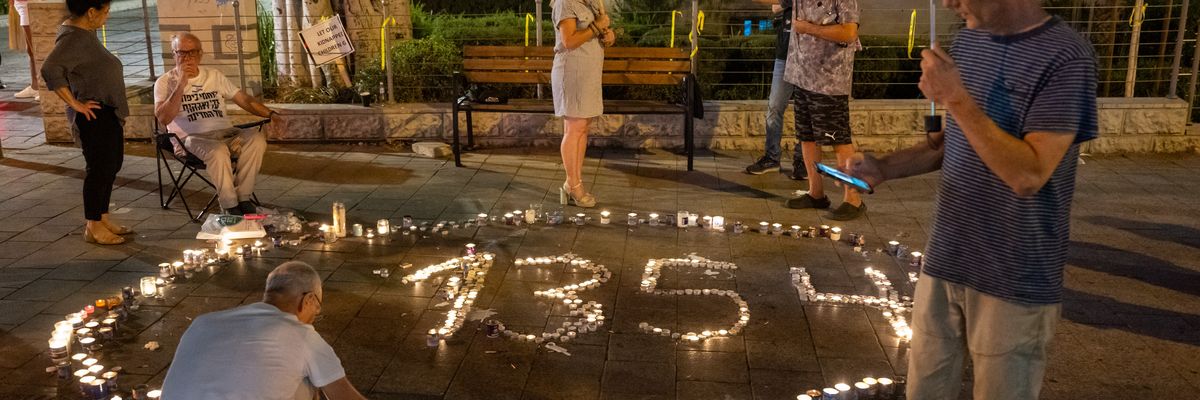
People light candles outside The Kirya on October 14, 2023 in Tel Aviv, Israel.
An unequivocal 'no' to the actors within Hamas who chose to commit these heinous acts does not dismiss history and the oppression of Palestinian people.
I am weeping with my Jewish brothers and sisters, both in Israel and around the world, as they mourn the horrific acts of terror in Israel this past weekend. The stories of civilians murdered and families kidnapped are gut-wrenching. In grief, we are wrapped in darkness, and there are no words to express the weight we feel.
Yet in the public square, words abound that both compound the grief of many and have the potential to precipitate more violence. So I must rise from the silence of mourning to speak.
I am a Christian, and my moral foundation demands that I unequivocally condemn these acts of terrorism. These were not militants attacking an army, nor were they acts of protest against Israel’s policy in Gaza. They were senseless acts of violence against civilians that have destroyed the lives of human beings.
Some say, in a moment like this, you cannot condemn the violence without also mentioning the violence that precipitated it. I will not agree to that position. I cannot. On one side of my own family, I come from formerly enslaved people who chose never to issue violence against the women and children of those who happened to be white, or even against those who held people in bondage. They chose to fight in the American civil war, soldier v soldier; and they believed in the right of self-defense. My people are not weak, nor did they ever dismiss the ugliness of the injustices they endured; but even when enslaved people or persons claiming to care about the conditions of the enslaved used violence against innocent people, claiming it was for the cause of liberation, they said unequivocally: “No. We will not return evil for evil.”
We are not talking about slaves versus slave masters in Israel today, but I know from my own context that an unequivocal “no” to the actors within Hamas who chose to commit these heinous acts does not dismiss history and the oppression of Palestinian people when they have been beaten and harmed by the actions of some – not all – in Israel. Nor does it dismiss a moral critique of Benjamin Netanyahu and others who have enacted harmful policies.
In this moment, however, we must be clear that terrorism is not a protest against injustice, but rather an act of despair that creates more suffering for everyone.
I have spoken out many times against the injustices that I believe the Israeli government – not all Jewish people – are committing against Palestinians. I have done this with Jewish and Palestinian colleagues, and I will continue to challenge the wrong if Israel tells its military to murder innocent Palestinians as some form of retribution.
If the United States stands by Israel as they unleash their military against Hamas, that’s one thing; but if the military action is indiscriminate, with no regard for innocent people, just because of the horror of what has happened, moral voices must say that this too is wrong. Likewise, we must decry the irresponsible voices in the United States – many in extreme media – who are urging Israel to wipe out Gaza.
Two wrongs cannot make a right. Yes, the perpetrators of violence should face justice, just as some in Israel must be held accountable for its policies of violent apartheid against the Palestinian people (remember, many Israelis have and do oppose these policies, including some who were attacked last weekend). But there is no moral justification for killing, kidnapping and torturing innocent civilians, women, children and tourists. On this point there can be no moral equivalency. We must say a clear and unified: “No.”
The history of Black people in America who suffered through brutal domestic terrorism and legal lynchings in the era of Jim Crow has something to say in this moment. We, especially, must say an emphatic “no” to what Hamas – not the Palestinian people – has done.
When Emmett Till’s mother received the body of her 14-year-old son, brutalized beyond recognition by a white mob in Mississippi, she did not try to kill white children. When three civil rights workers were murdered in 1964, the movement did not look for Klan members to lynch. Even those within the movement who did not embrace nonviolence did so in the name of self-defense – never to justify a shooting and killing spree. Moral movements for justice have always refused to take on the tactics of those who choose to terrorize. They fight for justice without being consumed by the evil that was perpetrated against them.
I come from a faith tradition that says: “Even when the one you call Savior is crucified, you don’t respond with the tools of wanton violence and evil action. Even when life itself is crucified, you cannot start your own campaign of monstrous forms of violence and retaliation.” If anything, my ancestors passed down to me a resolve to organize even more massive nonviolent resistance in the face of injustice and oppression. We need their wisdom today, and to say this is not in any way to dismiss what has happened to Palestinian people. Even many Palestinians are saying that these acts of terrorism do not represent them.
While the road to a just peace may be long and difficult, let us begin to build it in this moment on the basis of a broad consensus that acts of terror like those we saw in Israel this past weekend have no place in the struggle for justice. Hate cannot drive out hate. We must meet one another in our shared grief and find a better way.
Dear Common Dreams reader, It’s been nearly 30 years since I co-founded Common Dreams with my late wife, Lina Newhouser. We had the radical notion that journalism should serve the public good, not corporate profits. It was clear to us from the outset what it would take to build such a project. No paid advertisements. No corporate sponsors. No millionaire publisher telling us what to think or do. Many people said we wouldn't last a year, but we proved those doubters wrong. Together with a tremendous team of journalists and dedicated staff, we built an independent media outlet free from the constraints of profits and corporate control. Our mission has always been simple: To inform. To inspire. To ignite change for the common good. Building Common Dreams was not easy. Our survival was never guaranteed. When you take on the most powerful forces—Wall Street greed, fossil fuel industry destruction, Big Tech lobbyists, and uber-rich oligarchs who have spent billions upon billions rigging the economy and democracy in their favor—the only bulwark you have is supporters who believe in your work. But here’s the urgent message from me today. It's never been this bad out there. And it's never been this hard to keep us going. At the very moment Common Dreams is most needed, the threats we face are intensifying. We need your support now more than ever. We don't accept corporate advertising and never will. We don't have a paywall because we don't think people should be blocked from critical news based on their ability to pay. Everything we do is funded by the donations of readers like you. When everyone does the little they can afford, we are strong. But if that support retreats or dries up, so do we. Will you donate now to make sure Common Dreams not only survives but thrives? —Craig Brown, Co-founder |
I am weeping with my Jewish brothers and sisters, both in Israel and around the world, as they mourn the horrific acts of terror in Israel this past weekend. The stories of civilians murdered and families kidnapped are gut-wrenching. In grief, we are wrapped in darkness, and there are no words to express the weight we feel.
Yet in the public square, words abound that both compound the grief of many and have the potential to precipitate more violence. So I must rise from the silence of mourning to speak.
I am a Christian, and my moral foundation demands that I unequivocally condemn these acts of terrorism. These were not militants attacking an army, nor were they acts of protest against Israel’s policy in Gaza. They were senseless acts of violence against civilians that have destroyed the lives of human beings.
Some say, in a moment like this, you cannot condemn the violence without also mentioning the violence that precipitated it. I will not agree to that position. I cannot. On one side of my own family, I come from formerly enslaved people who chose never to issue violence against the women and children of those who happened to be white, or even against those who held people in bondage. They chose to fight in the American civil war, soldier v soldier; and they believed in the right of self-defense. My people are not weak, nor did they ever dismiss the ugliness of the injustices they endured; but even when enslaved people or persons claiming to care about the conditions of the enslaved used violence against innocent people, claiming it was for the cause of liberation, they said unequivocally: “No. We will not return evil for evil.”
We are not talking about slaves versus slave masters in Israel today, but I know from my own context that an unequivocal “no” to the actors within Hamas who chose to commit these heinous acts does not dismiss history and the oppression of Palestinian people when they have been beaten and harmed by the actions of some – not all – in Israel. Nor does it dismiss a moral critique of Benjamin Netanyahu and others who have enacted harmful policies.
In this moment, however, we must be clear that terrorism is not a protest against injustice, but rather an act of despair that creates more suffering for everyone.
I have spoken out many times against the injustices that I believe the Israeli government – not all Jewish people – are committing against Palestinians. I have done this with Jewish and Palestinian colleagues, and I will continue to challenge the wrong if Israel tells its military to murder innocent Palestinians as some form of retribution.
If the United States stands by Israel as they unleash their military against Hamas, that’s one thing; but if the military action is indiscriminate, with no regard for innocent people, just because of the horror of what has happened, moral voices must say that this too is wrong. Likewise, we must decry the irresponsible voices in the United States – many in extreme media – who are urging Israel to wipe out Gaza.
Two wrongs cannot make a right. Yes, the perpetrators of violence should face justice, just as some in Israel must be held accountable for its policies of violent apartheid against the Palestinian people (remember, many Israelis have and do oppose these policies, including some who were attacked last weekend). But there is no moral justification for killing, kidnapping and torturing innocent civilians, women, children and tourists. On this point there can be no moral equivalency. We must say a clear and unified: “No.”
The history of Black people in America who suffered through brutal domestic terrorism and legal lynchings in the era of Jim Crow has something to say in this moment. We, especially, must say an emphatic “no” to what Hamas – not the Palestinian people – has done.
When Emmett Till’s mother received the body of her 14-year-old son, brutalized beyond recognition by a white mob in Mississippi, she did not try to kill white children. When three civil rights workers were murdered in 1964, the movement did not look for Klan members to lynch. Even those within the movement who did not embrace nonviolence did so in the name of self-defense – never to justify a shooting and killing spree. Moral movements for justice have always refused to take on the tactics of those who choose to terrorize. They fight for justice without being consumed by the evil that was perpetrated against them.
I come from a faith tradition that says: “Even when the one you call Savior is crucified, you don’t respond with the tools of wanton violence and evil action. Even when life itself is crucified, you cannot start your own campaign of monstrous forms of violence and retaliation.” If anything, my ancestors passed down to me a resolve to organize even more massive nonviolent resistance in the face of injustice and oppression. We need their wisdom today, and to say this is not in any way to dismiss what has happened to Palestinian people. Even many Palestinians are saying that these acts of terrorism do not represent them.
While the road to a just peace may be long and difficult, let us begin to build it in this moment on the basis of a broad consensus that acts of terror like those we saw in Israel this past weekend have no place in the struggle for justice. Hate cannot drive out hate. We must meet one another in our shared grief and find a better way.
I am weeping with my Jewish brothers and sisters, both in Israel and around the world, as they mourn the horrific acts of terror in Israel this past weekend. The stories of civilians murdered and families kidnapped are gut-wrenching. In grief, we are wrapped in darkness, and there are no words to express the weight we feel.
Yet in the public square, words abound that both compound the grief of many and have the potential to precipitate more violence. So I must rise from the silence of mourning to speak.
I am a Christian, and my moral foundation demands that I unequivocally condemn these acts of terrorism. These were not militants attacking an army, nor were they acts of protest against Israel’s policy in Gaza. They were senseless acts of violence against civilians that have destroyed the lives of human beings.
Some say, in a moment like this, you cannot condemn the violence without also mentioning the violence that precipitated it. I will not agree to that position. I cannot. On one side of my own family, I come from formerly enslaved people who chose never to issue violence against the women and children of those who happened to be white, or even against those who held people in bondage. They chose to fight in the American civil war, soldier v soldier; and they believed in the right of self-defense. My people are not weak, nor did they ever dismiss the ugliness of the injustices they endured; but even when enslaved people or persons claiming to care about the conditions of the enslaved used violence against innocent people, claiming it was for the cause of liberation, they said unequivocally: “No. We will not return evil for evil.”
We are not talking about slaves versus slave masters in Israel today, but I know from my own context that an unequivocal “no” to the actors within Hamas who chose to commit these heinous acts does not dismiss history and the oppression of Palestinian people when they have been beaten and harmed by the actions of some – not all – in Israel. Nor does it dismiss a moral critique of Benjamin Netanyahu and others who have enacted harmful policies.
In this moment, however, we must be clear that terrorism is not a protest against injustice, but rather an act of despair that creates more suffering for everyone.
I have spoken out many times against the injustices that I believe the Israeli government – not all Jewish people – are committing against Palestinians. I have done this with Jewish and Palestinian colleagues, and I will continue to challenge the wrong if Israel tells its military to murder innocent Palestinians as some form of retribution.
If the United States stands by Israel as they unleash their military against Hamas, that’s one thing; but if the military action is indiscriminate, with no regard for innocent people, just because of the horror of what has happened, moral voices must say that this too is wrong. Likewise, we must decry the irresponsible voices in the United States – many in extreme media – who are urging Israel to wipe out Gaza.
Two wrongs cannot make a right. Yes, the perpetrators of violence should face justice, just as some in Israel must be held accountable for its policies of violent apartheid against the Palestinian people (remember, many Israelis have and do oppose these policies, including some who were attacked last weekend). But there is no moral justification for killing, kidnapping and torturing innocent civilians, women, children and tourists. On this point there can be no moral equivalency. We must say a clear and unified: “No.”
The history of Black people in America who suffered through brutal domestic terrorism and legal lynchings in the era of Jim Crow has something to say in this moment. We, especially, must say an emphatic “no” to what Hamas – not the Palestinian people – has done.
When Emmett Till’s mother received the body of her 14-year-old son, brutalized beyond recognition by a white mob in Mississippi, she did not try to kill white children. When three civil rights workers were murdered in 1964, the movement did not look for Klan members to lynch. Even those within the movement who did not embrace nonviolence did so in the name of self-defense – never to justify a shooting and killing spree. Moral movements for justice have always refused to take on the tactics of those who choose to terrorize. They fight for justice without being consumed by the evil that was perpetrated against them.
I come from a faith tradition that says: “Even when the one you call Savior is crucified, you don’t respond with the tools of wanton violence and evil action. Even when life itself is crucified, you cannot start your own campaign of monstrous forms of violence and retaliation.” If anything, my ancestors passed down to me a resolve to organize even more massive nonviolent resistance in the face of injustice and oppression. We need their wisdom today, and to say this is not in any way to dismiss what has happened to Palestinian people. Even many Palestinians are saying that these acts of terrorism do not represent them.
While the road to a just peace may be long and difficult, let us begin to build it in this moment on the basis of a broad consensus that acts of terror like those we saw in Israel this past weekend have no place in the struggle for justice. Hate cannot drive out hate. We must meet one another in our shared grief and find a better way.