SUBSCRIBE TO OUR FREE NEWSLETTER
Daily news & progressive opinion—funded by the people, not the corporations—delivered straight to your inbox.
5
#000000
#FFFFFF
To donate by check, phone, or other method, see our More Ways to Give page.
Daily news & progressive opinion—funded by the people, not the corporations—delivered straight to your inbox.
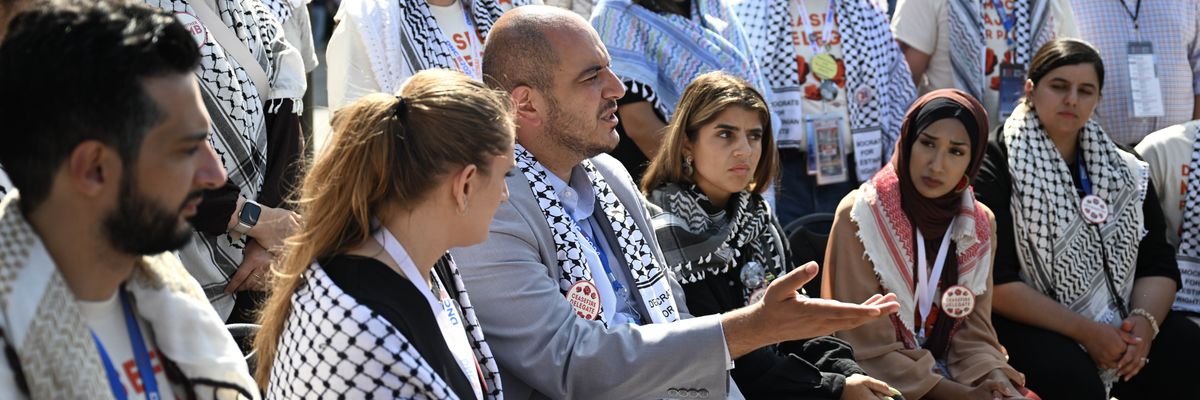
Uncommitted Democratic delegates hold a press conference outside of the party's convention in Chicago on August 22, 2024.
Despite the hurt and pain of seeing the plight of those suffering in Gaza sidelined at the DNC, the entire saga represented a win—one we must recognize and embrace, and on which we must now build.
The 2024 Democratic National Convention was an exhausting roller coaster ride for Arab Americans and supporters of Palestinian rights. It was a messy affair, with highs and lows, some small victories and some setbacks. But on balance, the naysayers are wrong, because Palestine and supporters of Palestinian rights were big winners during the four days in Chicago.
We didn’t get language on the Israeli-Palestinian conflict changed in the party platform, nor did we get a Palestinian American speaker in prime time from the convention’s main stage. But the issue of Palestine was front and center from Monday through Thursday, and in the days that followed. They were little wins, to be sure, but they were victories, nonetheless.
On Monday, the convention agreed to host a panel on Palestinian suffering at an official site. It was co-chaired by Minnesota Attorney General (former Congressman) Keith Ellison and myself. It featured the compelling testimonies of: Dr. Tanya Haj-Hassan who told harrowing stories of children and medical workers who were victims of the genocidal war on Gaza; Layla Elabed, a Palestinian American leader of the national Uncommitted Movement that garnered 750,000 voters, protesting the administration’s complicity in the war; former Congressman Andy Levin, who lost his reelection due to AIPAC spending millions to defeat him; and Hala Hijazi, a Palestinian American Democratic Party fundraiser who had lost scores of family members in Gaza.
There had been over 30 of these official side panels hosted by the campaign. Most had been sparsely attended by delegates and party members; for example, the one on the war in Ukraine had less than one hundred participants. This session on Palestine had well over 300 attendees, with most deeply moved by what they heard. There were many tears shed as well as a number of standing ovations in support of the speakers and issues raised.
Now isn’t the time to withdraw in defeatist anger. Instead, it’s imperative to recognize the victories won and continue to engage with allies in the political process, because change will come...
It was understood that securing the official sponsorship for the panel wasn’t the victory we sought. Our goal remains a change in U.S. policy. But recognition of Palestinian suffering and Israel and the U.S.’s responsibility for producing this genocidal war was important and could not be dismissed.
News that an Israeli American family would take the convention’s main stage to tell about their son who was a Hamas-held hostage upped the ante and led us to insist that a Palestinian American also be invited to tell the story of their family in Gaza. Days of negotiations followed. When the decision was made to not extend an invitation, Abbas Alawieh, another of the leaders of the National Uncommitted Movement, led a protest walkout from the arena and a sit-in in front of the convention.
I called this campaign decision a “bone-headed, unforced error.” It was deeply hurtful to Palestinian Americans who felt their humanity wasn’t being recognized. It threatened to erase the positives gained by the campaign’s recognition of our panel, leaving supporters of Palestinian rights with a sour taste in their mouths. But it also meant—and this is important to recognize—that the issue of Palestine and the effort to silence our voices would once again be elevated to the center of discussion. Over the next 24 hours, we held multiple press conferences and spoke one-on-one with dozens of journalists ensuring that the issue of Palestinian rights would continue to be discussed—and it was. Endorsements for having a Palestinian American speaker came from members of Congress, national organizations (including Jewish groups), Black and Hispanic leaders, two prominent Jewish newspapers, and even the Israeli American family that had spoken at the convention.
Reviewing the convention itself, it was moving to see hundreds of delegates, including hundreds of Harris supporters, wearing kaffiyehs or “Democrats for Palestine” buttons, including Vice President Harris’s niece. It was also important to note that when Palestine was mentioned by speakers, it was greeted by rousing applause. And while in her speech Vice President Harris included the usual commitments to Israel’s security, her words about Palestinian suffering were passionate and punctuated by her commitment to their “freedom, security, dignity, and self-determination.” That’s more than any other presidential nominee has ever said. And so, despite the hurt, the entire saga represented a win—one we must recognize and embrace, and on which we must now build.
Today’s movement for justice for Palestinians isn’t riding on the back of a leader. It is a people-powered movement, from the bottom up.
Thirty-six years ago, I was the last Arab American to speak about Palestinian rights at a national party convention when, in 1988, I presented the Jackson campaign’s minority plank on Palestinian rights from the podium in Atlanta. I knew it was a historic moment and in the days that followed I experienced the backlash from pro-Israel forces within the party. They pressured me to resign my post as a member of the Democratic National Committee. It was then that Rev. Jackson taught me two important lessons I’ve not forgotten.
The first was that “When you win a victory, embrace it but never turn your back, because the knives will be out to get you.” The other was, “Never quit, because that’s exactly what your enemies want you to do. What they fear most is that you’ll stick around to fight.”
These lessons apply today, with a difference. In 1988, we were able to raise the issue because it was a powerful Jackson-led movement. Today’s movement for justice for Palestinians isn’t riding on the back of a leader. It is a people-powered movement, from the bottom up. This effort has mobilized to pass ceasefire resolutions in over 350 cities and won the support of major unions, Black, Latino, and Asian organizations. It is responsible for demonstrations mobilizing millions of Americans, encampments on over 100 college campuses, and garnering over 750,000 votes in Democratic primaries across the US. Polls show that the majority of Democrats want a ceasefire, conditioning arms to Israel, and securing rights for Palestinians.
Now isn’t the time to withdraw in defeatist anger. Instead, it’s imperative to recognize the victories won and continue to engage with allies in the political process, because change will come—but only if this work continues.Dear Common Dreams reader, It’s been nearly 30 years since I co-founded Common Dreams with my late wife, Lina Newhouser. We had the radical notion that journalism should serve the public good, not corporate profits. It was clear to us from the outset what it would take to build such a project. No paid advertisements. No corporate sponsors. No millionaire publisher telling us what to think or do. Many people said we wouldn't last a year, but we proved those doubters wrong. Together with a tremendous team of journalists and dedicated staff, we built an independent media outlet free from the constraints of profits and corporate control. Our mission has always been simple: To inform. To inspire. To ignite change for the common good. Building Common Dreams was not easy. Our survival was never guaranteed. When you take on the most powerful forces—Wall Street greed, fossil fuel industry destruction, Big Tech lobbyists, and uber-rich oligarchs who have spent billions upon billions rigging the economy and democracy in their favor—the only bulwark you have is supporters who believe in your work. But here’s the urgent message from me today. It's never been this bad out there. And it's never been this hard to keep us going. At the very moment Common Dreams is most needed, the threats we face are intensifying. We need your support now more than ever. We don't accept corporate advertising and never will. We don't have a paywall because we don't think people should be blocked from critical news based on their ability to pay. Everything we do is funded by the donations of readers like you. When everyone does the little they can afford, we are strong. But if that support retreats or dries up, so do we. Will you donate now to make sure Common Dreams not only survives but thrives? —Craig Brown, Co-founder |
The 2024 Democratic National Convention was an exhausting roller coaster ride for Arab Americans and supporters of Palestinian rights. It was a messy affair, with highs and lows, some small victories and some setbacks. But on balance, the naysayers are wrong, because Palestine and supporters of Palestinian rights were big winners during the four days in Chicago.
We didn’t get language on the Israeli-Palestinian conflict changed in the party platform, nor did we get a Palestinian American speaker in prime time from the convention’s main stage. But the issue of Palestine was front and center from Monday through Thursday, and in the days that followed. They were little wins, to be sure, but they were victories, nonetheless.
On Monday, the convention agreed to host a panel on Palestinian suffering at an official site. It was co-chaired by Minnesota Attorney General (former Congressman) Keith Ellison and myself. It featured the compelling testimonies of: Dr. Tanya Haj-Hassan who told harrowing stories of children and medical workers who were victims of the genocidal war on Gaza; Layla Elabed, a Palestinian American leader of the national Uncommitted Movement that garnered 750,000 voters, protesting the administration’s complicity in the war; former Congressman Andy Levin, who lost his reelection due to AIPAC spending millions to defeat him; and Hala Hijazi, a Palestinian American Democratic Party fundraiser who had lost scores of family members in Gaza.
There had been over 30 of these official side panels hosted by the campaign. Most had been sparsely attended by delegates and party members; for example, the one on the war in Ukraine had less than one hundred participants. This session on Palestine had well over 300 attendees, with most deeply moved by what they heard. There were many tears shed as well as a number of standing ovations in support of the speakers and issues raised.
Now isn’t the time to withdraw in defeatist anger. Instead, it’s imperative to recognize the victories won and continue to engage with allies in the political process, because change will come...
It was understood that securing the official sponsorship for the panel wasn’t the victory we sought. Our goal remains a change in U.S. policy. But recognition of Palestinian suffering and Israel and the U.S.’s responsibility for producing this genocidal war was important and could not be dismissed.
News that an Israeli American family would take the convention’s main stage to tell about their son who was a Hamas-held hostage upped the ante and led us to insist that a Palestinian American also be invited to tell the story of their family in Gaza. Days of negotiations followed. When the decision was made to not extend an invitation, Abbas Alawieh, another of the leaders of the National Uncommitted Movement, led a protest walkout from the arena and a sit-in in front of the convention.
I called this campaign decision a “bone-headed, unforced error.” It was deeply hurtful to Palestinian Americans who felt their humanity wasn’t being recognized. It threatened to erase the positives gained by the campaign’s recognition of our panel, leaving supporters of Palestinian rights with a sour taste in their mouths. But it also meant—and this is important to recognize—that the issue of Palestine and the effort to silence our voices would once again be elevated to the center of discussion. Over the next 24 hours, we held multiple press conferences and spoke one-on-one with dozens of journalists ensuring that the issue of Palestinian rights would continue to be discussed—and it was. Endorsements for having a Palestinian American speaker came from members of Congress, national organizations (including Jewish groups), Black and Hispanic leaders, two prominent Jewish newspapers, and even the Israeli American family that had spoken at the convention.
Reviewing the convention itself, it was moving to see hundreds of delegates, including hundreds of Harris supporters, wearing kaffiyehs or “Democrats for Palestine” buttons, including Vice President Harris’s niece. It was also important to note that when Palestine was mentioned by speakers, it was greeted by rousing applause. And while in her speech Vice President Harris included the usual commitments to Israel’s security, her words about Palestinian suffering were passionate and punctuated by her commitment to their “freedom, security, dignity, and self-determination.” That’s more than any other presidential nominee has ever said. And so, despite the hurt, the entire saga represented a win—one we must recognize and embrace, and on which we must now build.
Today’s movement for justice for Palestinians isn’t riding on the back of a leader. It is a people-powered movement, from the bottom up.
Thirty-six years ago, I was the last Arab American to speak about Palestinian rights at a national party convention when, in 1988, I presented the Jackson campaign’s minority plank on Palestinian rights from the podium in Atlanta. I knew it was a historic moment and in the days that followed I experienced the backlash from pro-Israel forces within the party. They pressured me to resign my post as a member of the Democratic National Committee. It was then that Rev. Jackson taught me two important lessons I’ve not forgotten.
The first was that “When you win a victory, embrace it but never turn your back, because the knives will be out to get you.” The other was, “Never quit, because that’s exactly what your enemies want you to do. What they fear most is that you’ll stick around to fight.”
These lessons apply today, with a difference. In 1988, we were able to raise the issue because it was a powerful Jackson-led movement. Today’s movement for justice for Palestinians isn’t riding on the back of a leader. It is a people-powered movement, from the bottom up. This effort has mobilized to pass ceasefire resolutions in over 350 cities and won the support of major unions, Black, Latino, and Asian organizations. It is responsible for demonstrations mobilizing millions of Americans, encampments on over 100 college campuses, and garnering over 750,000 votes in Democratic primaries across the US. Polls show that the majority of Democrats want a ceasefire, conditioning arms to Israel, and securing rights for Palestinians.
Now isn’t the time to withdraw in defeatist anger. Instead, it’s imperative to recognize the victories won and continue to engage with allies in the political process, because change will come—but only if this work continues.The 2024 Democratic National Convention was an exhausting roller coaster ride for Arab Americans and supporters of Palestinian rights. It was a messy affair, with highs and lows, some small victories and some setbacks. But on balance, the naysayers are wrong, because Palestine and supporters of Palestinian rights were big winners during the four days in Chicago.
We didn’t get language on the Israeli-Palestinian conflict changed in the party platform, nor did we get a Palestinian American speaker in prime time from the convention’s main stage. But the issue of Palestine was front and center from Monday through Thursday, and in the days that followed. They were little wins, to be sure, but they were victories, nonetheless.
On Monday, the convention agreed to host a panel on Palestinian suffering at an official site. It was co-chaired by Minnesota Attorney General (former Congressman) Keith Ellison and myself. It featured the compelling testimonies of: Dr. Tanya Haj-Hassan who told harrowing stories of children and medical workers who were victims of the genocidal war on Gaza; Layla Elabed, a Palestinian American leader of the national Uncommitted Movement that garnered 750,000 voters, protesting the administration’s complicity in the war; former Congressman Andy Levin, who lost his reelection due to AIPAC spending millions to defeat him; and Hala Hijazi, a Palestinian American Democratic Party fundraiser who had lost scores of family members in Gaza.
There had been over 30 of these official side panels hosted by the campaign. Most had been sparsely attended by delegates and party members; for example, the one on the war in Ukraine had less than one hundred participants. This session on Palestine had well over 300 attendees, with most deeply moved by what they heard. There were many tears shed as well as a number of standing ovations in support of the speakers and issues raised.
Now isn’t the time to withdraw in defeatist anger. Instead, it’s imperative to recognize the victories won and continue to engage with allies in the political process, because change will come...
It was understood that securing the official sponsorship for the panel wasn’t the victory we sought. Our goal remains a change in U.S. policy. But recognition of Palestinian suffering and Israel and the U.S.’s responsibility for producing this genocidal war was important and could not be dismissed.
News that an Israeli American family would take the convention’s main stage to tell about their son who was a Hamas-held hostage upped the ante and led us to insist that a Palestinian American also be invited to tell the story of their family in Gaza. Days of negotiations followed. When the decision was made to not extend an invitation, Abbas Alawieh, another of the leaders of the National Uncommitted Movement, led a protest walkout from the arena and a sit-in in front of the convention.
I called this campaign decision a “bone-headed, unforced error.” It was deeply hurtful to Palestinian Americans who felt their humanity wasn’t being recognized. It threatened to erase the positives gained by the campaign’s recognition of our panel, leaving supporters of Palestinian rights with a sour taste in their mouths. But it also meant—and this is important to recognize—that the issue of Palestine and the effort to silence our voices would once again be elevated to the center of discussion. Over the next 24 hours, we held multiple press conferences and spoke one-on-one with dozens of journalists ensuring that the issue of Palestinian rights would continue to be discussed—and it was. Endorsements for having a Palestinian American speaker came from members of Congress, national organizations (including Jewish groups), Black and Hispanic leaders, two prominent Jewish newspapers, and even the Israeli American family that had spoken at the convention.
Reviewing the convention itself, it was moving to see hundreds of delegates, including hundreds of Harris supporters, wearing kaffiyehs or “Democrats for Palestine” buttons, including Vice President Harris’s niece. It was also important to note that when Palestine was mentioned by speakers, it was greeted by rousing applause. And while in her speech Vice President Harris included the usual commitments to Israel’s security, her words about Palestinian suffering were passionate and punctuated by her commitment to their “freedom, security, dignity, and self-determination.” That’s more than any other presidential nominee has ever said. And so, despite the hurt, the entire saga represented a win—one we must recognize and embrace, and on which we must now build.
Today’s movement for justice for Palestinians isn’t riding on the back of a leader. It is a people-powered movement, from the bottom up.
Thirty-six years ago, I was the last Arab American to speak about Palestinian rights at a national party convention when, in 1988, I presented the Jackson campaign’s minority plank on Palestinian rights from the podium in Atlanta. I knew it was a historic moment and in the days that followed I experienced the backlash from pro-Israel forces within the party. They pressured me to resign my post as a member of the Democratic National Committee. It was then that Rev. Jackson taught me two important lessons I’ve not forgotten.
The first was that “When you win a victory, embrace it but never turn your back, because the knives will be out to get you.” The other was, “Never quit, because that’s exactly what your enemies want you to do. What they fear most is that you’ll stick around to fight.”
These lessons apply today, with a difference. In 1988, we were able to raise the issue because it was a powerful Jackson-led movement. Today’s movement for justice for Palestinians isn’t riding on the back of a leader. It is a people-powered movement, from the bottom up. This effort has mobilized to pass ceasefire resolutions in over 350 cities and won the support of major unions, Black, Latino, and Asian organizations. It is responsible for demonstrations mobilizing millions of Americans, encampments on over 100 college campuses, and garnering over 750,000 votes in Democratic primaries across the US. Polls show that the majority of Democrats want a ceasefire, conditioning arms to Israel, and securing rights for Palestinians.
Now isn’t the time to withdraw in defeatist anger. Instead, it’s imperative to recognize the victories won and continue to engage with allies in the political process, because change will come—but only if this work continues.