SUBSCRIBE TO OUR FREE NEWSLETTER
Daily news & progressive opinion—funded by the people, not the corporations—delivered straight to your inbox.
5
#000000
#FFFFFF
To donate by check, phone, or other method, see our More Ways to Give page.
Daily news & progressive opinion—funded by the people, not the corporations—delivered straight to your inbox.
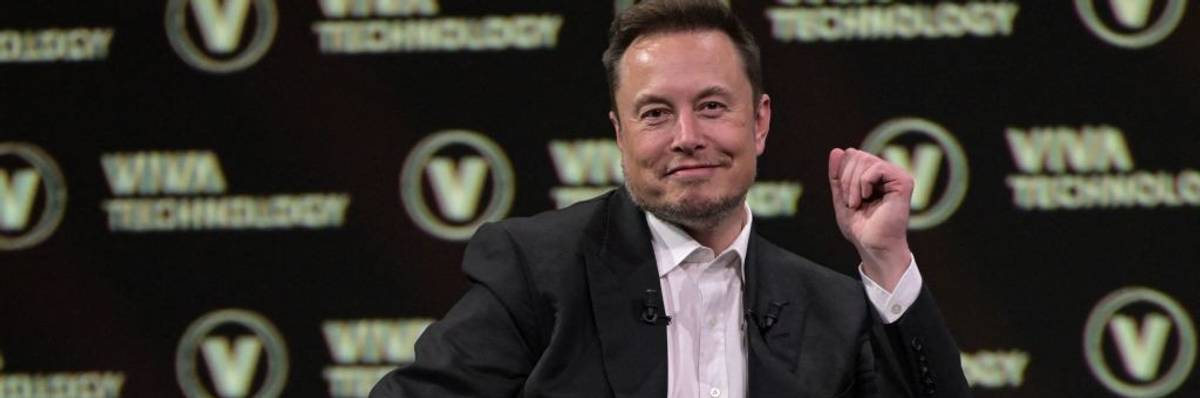
SpaceX, Twitter and electric car maker Tesla CEO Elon Musk reacts as he speaks during his visit at the Vivatech technology startups and innovation fair at the Porte de Versailles exhibition center in Paris, on June 16, 2023.
"Live by public will, die by public will," is a mantra the faux libertarian techno billionaires should memorize. They are not our saviors, but rather obstacles to a better future for consumers and workers alike.
Elon Musk likes to be portrayed as a swashbuckling entrepreneur, a sort of romantic character in an Ayn Rand novel who opens up new enterprises and industries where others fear to tread. But these days, heroism is hard to find in at least one Musk-owned business: sales at Tesla are dropping, the Department of Justice is investigating the company for wire fraud given safety issues with their self-driving vehicles, and Musk is laying off the entire Tesla charging team.
Why the turn in fortunes? It’s easy to lay the blame on particulars: the rise of Chinese EV competitors, the difficulties of opening Tesla’s closed charging systems to other brands, and the complexity of making self-propelled autos that are, well, not that well-propelled. But the lesson might be a bit simple for Musk and others wrapped up in their own self-made stories: live by the public will, die by the public will.
As much as Musk has carefully cultivated an image of himself as a capitalist pioneer, his path has been paved by government largesse. SpaceX relies on federal subsidies, particularly from NASA, while Tesla had long relied on federal and state incentives inducing the broader auto industry to shed its addiction to fossil fuels.
Let’s stop focusing just on individual triumph in a world where success has also been greased by public policy and where the future will be determined by public approval.
His more purely private ventures have been less successful. The PayPal board ousted him as CEO in 2000—although he made off with enough stock to fund future adventures. After first making an offer whose dollar figure was seemingly influenced by a marijuana meme, he managed to purchase Twitter in 2022 at a price well above valuation. He then promptly renamed it as “X” and seems to be running it into the ground in terms of both finances and reputation.
From a respected site used by readers to track instant news coverage—along with the occasional glimpse at cute puppies, rap feuds, and dance trends—X has become host to a cesspool of right-wing conspiracy theories, all in the name of “free speech.” Earlier this month, Musk brought back onto the site, Nick Fuentes, an acknowledged white supremacist and antisemite whose reentry drew quick condemnation.
Hmm... and you wonder why Tesla is losing market share?
Certainly, it’s the fact that automakers, both in China and in the U.S., are finally making electric vehicles that are worthy competitors. But it’s also the case that the same people who are attracted to sustainability in their mobility options are generally not as enthusiastic about giving neo-fascists a safe place to practice and broadcast hate.
After all, Musk portraying himself as a political renegade who touts free speech and aligns himself with white supremacists is not actually a money-making strategy: Republican consumers may applaud that sentiment, but then they also lean away from zero emissions vehicles and lean into purchasing gas-guzzlers that show the planet who’s boss. Meanwhile, many of the potential consumers ready to take the leap to buy an EV struggle with Elon’s reputation.
And it’s not just about who he platforms but also who he ignores. Resolutely anti-union, he has resisted efforts to organize Tesla’s workforce despite constant complaints about the pace of work and the pay for work. The United Auto Workers, coming off a successful campaign for better contracts with the traditional Big Three automakers, now has Tesla squarely in its sights. The resulting conflicts will make for even worse publicity for a brand—Musk—already tarnished.
It’s easy to focus on Musk. But consider Marc Andreessen, a Silicon Valley investor who has been labeled the “godfather of the web browser” for his role in creating Netscape. He has attacked “statism” as an evil, even as the Internet that he helped make more accessible was actually birthed in the world by federal investments in technology.
Meanwhile, artificial intelligence, an achievement attributed to tech geniuses, basically consists of scraping that same internet for the world’s knowledge and regurgitating it for profit. And in keeping with the idea that the commons is key, think of all the private investor interest in the new green economy, an economic shift made possible by social movements—some born and spread on the internet—pressing for global climate responsibility.
So let’s stop focusing just on individual triumph in a world where success has also been greased by public policy and where the future will be determined by public approval. Consumers, labor unions, and government officials are seeing through to the real story—that markets and fortunes are made by all of us.
Dear Common Dreams reader, It’s been nearly 30 years since I co-founded Common Dreams with my late wife, Lina Newhouser. We had the radical notion that journalism should serve the public good, not corporate profits. It was clear to us from the outset what it would take to build such a project. No paid advertisements. No corporate sponsors. No millionaire publisher telling us what to think or do. Many people said we wouldn't last a year, but we proved those doubters wrong. Together with a tremendous team of journalists and dedicated staff, we built an independent media outlet free from the constraints of profits and corporate control. Our mission has always been simple: To inform. To inspire. To ignite change for the common good. Building Common Dreams was not easy. Our survival was never guaranteed. When you take on the most powerful forces—Wall Street greed, fossil fuel industry destruction, Big Tech lobbyists, and uber-rich oligarchs who have spent billions upon billions rigging the economy and democracy in their favor—the only bulwark you have is supporters who believe in your work. But here’s the urgent message from me today. It's never been this bad out there. And it's never been this hard to keep us going. At the very moment Common Dreams is most needed, the threats we face are intensifying. We need your support now more than ever. We don't accept corporate advertising and never will. We don't have a paywall because we don't think people should be blocked from critical news based on their ability to pay. Everything we do is funded by the donations of readers like you. When everyone does the little they can afford, we are strong. But if that support retreats or dries up, so do we. Will you donate now to make sure Common Dreams not only survives but thrives? —Craig Brown, Co-founder |
Manuel Pastor is a professor of sociology at the University of Southern California and author of the forthcoming book Charging Forward: Lithium Valley, Electric Vehicles, and a Just Future, and previously State of Resistance: What California's Dizzying Descent and Remarkable Resurgence Means for America's Future.
Elon Musk likes to be portrayed as a swashbuckling entrepreneur, a sort of romantic character in an Ayn Rand novel who opens up new enterprises and industries where others fear to tread. But these days, heroism is hard to find in at least one Musk-owned business: sales at Tesla are dropping, the Department of Justice is investigating the company for wire fraud given safety issues with their self-driving vehicles, and Musk is laying off the entire Tesla charging team.
Why the turn in fortunes? It’s easy to lay the blame on particulars: the rise of Chinese EV competitors, the difficulties of opening Tesla’s closed charging systems to other brands, and the complexity of making self-propelled autos that are, well, not that well-propelled. But the lesson might be a bit simple for Musk and others wrapped up in their own self-made stories: live by the public will, die by the public will.
As much as Musk has carefully cultivated an image of himself as a capitalist pioneer, his path has been paved by government largesse. SpaceX relies on federal subsidies, particularly from NASA, while Tesla had long relied on federal and state incentives inducing the broader auto industry to shed its addiction to fossil fuels.
Let’s stop focusing just on individual triumph in a world where success has also been greased by public policy and where the future will be determined by public approval.
His more purely private ventures have been less successful. The PayPal board ousted him as CEO in 2000—although he made off with enough stock to fund future adventures. After first making an offer whose dollar figure was seemingly influenced by a marijuana meme, he managed to purchase Twitter in 2022 at a price well above valuation. He then promptly renamed it as “X” and seems to be running it into the ground in terms of both finances and reputation.
From a respected site used by readers to track instant news coverage—along with the occasional glimpse at cute puppies, rap feuds, and dance trends—X has become host to a cesspool of right-wing conspiracy theories, all in the name of “free speech.” Earlier this month, Musk brought back onto the site, Nick Fuentes, an acknowledged white supremacist and antisemite whose reentry drew quick condemnation.
Hmm... and you wonder why Tesla is losing market share?
Certainly, it’s the fact that automakers, both in China and in the U.S., are finally making electric vehicles that are worthy competitors. But it’s also the case that the same people who are attracted to sustainability in their mobility options are generally not as enthusiastic about giving neo-fascists a safe place to practice and broadcast hate.
After all, Musk portraying himself as a political renegade who touts free speech and aligns himself with white supremacists is not actually a money-making strategy: Republican consumers may applaud that sentiment, but then they also lean away from zero emissions vehicles and lean into purchasing gas-guzzlers that show the planet who’s boss. Meanwhile, many of the potential consumers ready to take the leap to buy an EV struggle with Elon’s reputation.
And it’s not just about who he platforms but also who he ignores. Resolutely anti-union, he has resisted efforts to organize Tesla’s workforce despite constant complaints about the pace of work and the pay for work. The United Auto Workers, coming off a successful campaign for better contracts with the traditional Big Three automakers, now has Tesla squarely in its sights. The resulting conflicts will make for even worse publicity for a brand—Musk—already tarnished.
It’s easy to focus on Musk. But consider Marc Andreessen, a Silicon Valley investor who has been labeled the “godfather of the web browser” for his role in creating Netscape. He has attacked “statism” as an evil, even as the Internet that he helped make more accessible was actually birthed in the world by federal investments in technology.
Meanwhile, artificial intelligence, an achievement attributed to tech geniuses, basically consists of scraping that same internet for the world’s knowledge and regurgitating it for profit. And in keeping with the idea that the commons is key, think of all the private investor interest in the new green economy, an economic shift made possible by social movements—some born and spread on the internet—pressing for global climate responsibility.
So let’s stop focusing just on individual triumph in a world where success has also been greased by public policy and where the future will be determined by public approval. Consumers, labor unions, and government officials are seeing through to the real story—that markets and fortunes are made by all of us.
Manuel Pastor is a professor of sociology at the University of Southern California and author of the forthcoming book Charging Forward: Lithium Valley, Electric Vehicles, and a Just Future, and previously State of Resistance: What California's Dizzying Descent and Remarkable Resurgence Means for America's Future.
Elon Musk likes to be portrayed as a swashbuckling entrepreneur, a sort of romantic character in an Ayn Rand novel who opens up new enterprises and industries where others fear to tread. But these days, heroism is hard to find in at least one Musk-owned business: sales at Tesla are dropping, the Department of Justice is investigating the company for wire fraud given safety issues with their self-driving vehicles, and Musk is laying off the entire Tesla charging team.
Why the turn in fortunes? It’s easy to lay the blame on particulars: the rise of Chinese EV competitors, the difficulties of opening Tesla’s closed charging systems to other brands, and the complexity of making self-propelled autos that are, well, not that well-propelled. But the lesson might be a bit simple for Musk and others wrapped up in their own self-made stories: live by the public will, die by the public will.
As much as Musk has carefully cultivated an image of himself as a capitalist pioneer, his path has been paved by government largesse. SpaceX relies on federal subsidies, particularly from NASA, while Tesla had long relied on federal and state incentives inducing the broader auto industry to shed its addiction to fossil fuels.
Let’s stop focusing just on individual triumph in a world where success has also been greased by public policy and where the future will be determined by public approval.
His more purely private ventures have been less successful. The PayPal board ousted him as CEO in 2000—although he made off with enough stock to fund future adventures. After first making an offer whose dollar figure was seemingly influenced by a marijuana meme, he managed to purchase Twitter in 2022 at a price well above valuation. He then promptly renamed it as “X” and seems to be running it into the ground in terms of both finances and reputation.
From a respected site used by readers to track instant news coverage—along with the occasional glimpse at cute puppies, rap feuds, and dance trends—X has become host to a cesspool of right-wing conspiracy theories, all in the name of “free speech.” Earlier this month, Musk brought back onto the site, Nick Fuentes, an acknowledged white supremacist and antisemite whose reentry drew quick condemnation.
Hmm... and you wonder why Tesla is losing market share?
Certainly, it’s the fact that automakers, both in China and in the U.S., are finally making electric vehicles that are worthy competitors. But it’s also the case that the same people who are attracted to sustainability in their mobility options are generally not as enthusiastic about giving neo-fascists a safe place to practice and broadcast hate.
After all, Musk portraying himself as a political renegade who touts free speech and aligns himself with white supremacists is not actually a money-making strategy: Republican consumers may applaud that sentiment, but then they also lean away from zero emissions vehicles and lean into purchasing gas-guzzlers that show the planet who’s boss. Meanwhile, many of the potential consumers ready to take the leap to buy an EV struggle with Elon’s reputation.
And it’s not just about who he platforms but also who he ignores. Resolutely anti-union, he has resisted efforts to organize Tesla’s workforce despite constant complaints about the pace of work and the pay for work. The United Auto Workers, coming off a successful campaign for better contracts with the traditional Big Three automakers, now has Tesla squarely in its sights. The resulting conflicts will make for even worse publicity for a brand—Musk—already tarnished.
It’s easy to focus on Musk. But consider Marc Andreessen, a Silicon Valley investor who has been labeled the “godfather of the web browser” for his role in creating Netscape. He has attacked “statism” as an evil, even as the Internet that he helped make more accessible was actually birthed in the world by federal investments in technology.
Meanwhile, artificial intelligence, an achievement attributed to tech geniuses, basically consists of scraping that same internet for the world’s knowledge and regurgitating it for profit. And in keeping with the idea that the commons is key, think of all the private investor interest in the new green economy, an economic shift made possible by social movements—some born and spread on the internet—pressing for global climate responsibility.
So let’s stop focusing just on individual triumph in a world where success has also been greased by public policy and where the future will be determined by public approval. Consumers, labor unions, and government officials are seeing through to the real story—that markets and fortunes are made by all of us.