SUBSCRIBE TO OUR FREE NEWSLETTER
Daily news & progressive opinion—funded by the people, not the corporations—delivered straight to your inbox.
5
#000000
#FFFFFF
To donate by check, phone, or other method, see our More Ways to Give page.
Daily news & progressive opinion—funded by the people, not the corporations—delivered straight to your inbox.
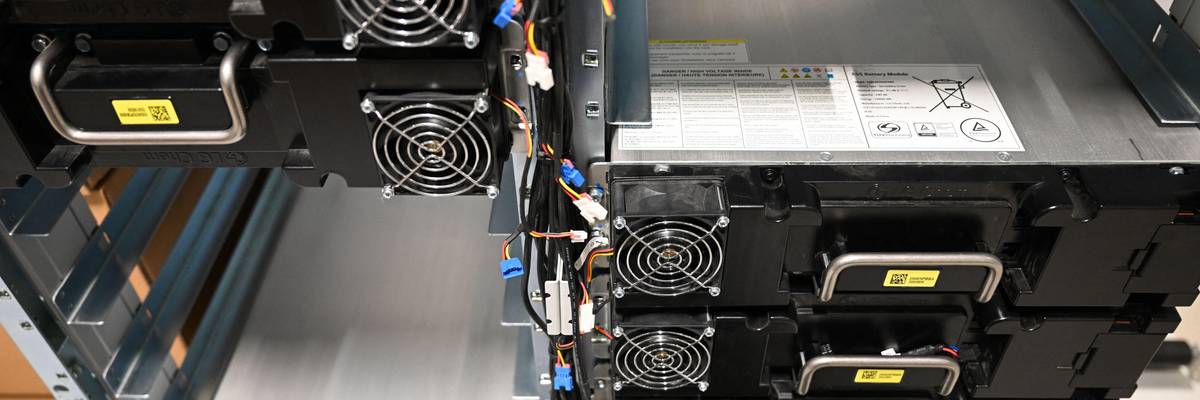
Lithium ion batteries being assembled during installation to an energy storage system are seen inside the AES Alamitos Battery Energy Storage System, which provides stored renewable energy to supply electricity during peak demand periods, in Long Beach, California on September 16, 2022.
Nearly every part of a renewable energy grid can be circular, with all outputs circulating back as inputs in a regenerative cycle. The battery life cycle can work this way too, if the valuable metals in batteries are recovered and reused.
Lithium-ion batteries are essential for decarbonizing transportation through electric vehicles and building a resilient, renewable energy grid through energy storage batteries. The grid energy storage industry represents a much smaller fraction of the lithium-ion battery market than electric vehicles, but it too has a responsibility to ensure batteries are responsibly and sustainably produced and then productively recirculated at end-of-life.
Nearly every part of a renewable energy grid can be circular, with all outputs circulating back as inputs in a regenerative cycle. The battery life cycle can work this way too, if the valuable metals in batteries are recovered and reused. However, lithium-ion battery supply chains are not yet circular. Increasing the reuse and recycling of batteries at their end of life is essential to increasing the sustainability of batteries and creating a circular economy.
Recycling must ramp up
There are huge opportunities for recycling to decrease the need for newly mined materials in batteries. By 2050, battery recycling could supply 22 to 27% of lithium, 40 to 46% of nickel, and 45 to 52% of cobalt needed for electric vehicles in the US. The US is building up the infrastructure needed to fully capture this value. Currently, the US only has about 7% of the global recycling capacity while China has 80%.
The US government is also committed to bolstering domestic recycling. Since 2019, the Department of Energy’s
ReCell Center has been researching effective and affordable battery recycling technology. The federal Bipartisan Infrastructure Law dedicated $3 billion to a battery material processing program and $3 billion for domestic battery manufacturing and recycling; $200 million to a battery design, recycling, and reuse program; $110 million for battery collection and recycling programs; $15 million on retailer battery collection programs; and $10 million for the Lithium Ion Battery Recycling Prize. Recently, a total of nearly $74 million dollars of funds was awarded for research, development, and demonstration of 10 recycling and repurposing projects. Companies leading the domestic battery recycling industry show high material recovery rates of 95-98%.
Sustainable supply chain solutions exist
In many circular systems, problems = solutions. The same goes for the energy storage battery supply chain. Governments and industry can leverage these five tactics to move energy storage batteries towards a more circular end-of-life stewardship.
1. Require producer take-back. In order to ensure batteries are recycled, it is essential to assign a party responsible. A producer take-back model requires the battery manufacturer ensures batteries are repurposed or recycled at the end of their life if they are no longer wanted by the owner. The California legislature convened a stakeholder group to develop policy to reach 100% battery recycling in the state, which included producer take-back as a topline recommendation, mirroring the policy of the European Union Battery Directive.
2. Support safe, efficient, and cost-effective battery transportation. Because batteries can be hazardous if improperly handled, transporting them involves additional regulations and can constitute 40 to 60% of battery recycling costs. Governments can fund battery transportation safety research and worker training programs and can facilitate safe and efficient handling by encouraging manufacturers to clearly display battery components, chemical compositions, and health status. Regulators can also enact new waste categories specifically for batteries, which can make transporting used batteries to reuse or recycling centers safer and more cost-effective.
3. Encourage battery manufacturers to design for disassembly. The government can urge battery makers to employ design standards that facilitate disassembly, quality testing at end-of-life, and repurposing. This could accelerate the reuse of used electric vehicle batteries in grid energy storage. More than 200 gigawatt-hours of used electric vehicle batteries will be available for energy storage reuse by 2030, which would satisfy projected grid storage battery demand.
4. Increase access to information. The US can further spur battery reuse and recycling by encouraging companies to display information clearly on all used batteries, including the type of chemistry and the results of quality tests on the battery’s health and remaining capacity.
5. Invest in domestic battery recycling research and infrastructure. The US can continue to provide funding for research labs and companies developing and scaling domestic recycling. Additional funding for lithium-ion battery recycling research and projects can also help ensure that the emerging industry continues to meet and exceed standards for worker safety and environmental sustainability.
Effective policy, industry commitment, and public awareness can help address the issues of raw materials and manufacturing challenges alongside the battery waste issue. The secret? Unlocking battery reuse and recycling.
Fleets of batteries—acres and acres of unassuming stationary metal boxes—are a key to unlocking the renewable energy future. But are batteries, themselves, renewable? Can they be reused or recycled at the end of their life? Where do their raw materials come from, and how can we ensure their valuable contents are recovered rather than wasted?
And what about the solar panels and wind turbines, which generate the electricity that batteries store? Check out our previous posts on solar panel and wind turbine lifecycles!
Dear Common Dreams reader, It’s been nearly 30 years since I co-founded Common Dreams with my late wife, Lina Newhouser. We had the radical notion that journalism should serve the public good, not corporate profits. It was clear to us from the outset what it would take to build such a project. No paid advertisements. No corporate sponsors. No millionaire publisher telling us what to think or do. Many people said we wouldn't last a year, but we proved those doubters wrong. Together with a tremendous team of journalists and dedicated staff, we built an independent media outlet free from the constraints of profits and corporate control. Our mission has always been simple: To inform. To inspire. To ignite change for the common good. Building Common Dreams was not easy. Our survival was never guaranteed. When you take on the most powerful forces—Wall Street greed, fossil fuel industry destruction, Big Tech lobbyists, and uber-rich oligarchs who have spent billions upon billions rigging the economy and democracy in their favor—the only bulwark you have is supporters who believe in your work. But here’s the urgent message from me today. It's never been this bad out there. And it's never been this hard to keep us going. At the very moment Common Dreams is most needed, the threats we face are intensifying. We need your support now more than ever. We don't accept corporate advertising and never will. We don't have a paywall because we don't think people should be blocked from critical news based on their ability to pay. Everything we do is funded by the donations of readers like you. When everyone does the little they can afford, we are strong. But if that support retreats or dries up, so do we. Will you donate now to make sure Common Dreams not only survives but thrives? —Craig Brown, Co-founder |
Lithium-ion batteries are essential for decarbonizing transportation through electric vehicles and building a resilient, renewable energy grid through energy storage batteries. The grid energy storage industry represents a much smaller fraction of the lithium-ion battery market than electric vehicles, but it too has a responsibility to ensure batteries are responsibly and sustainably produced and then productively recirculated at end-of-life.
Nearly every part of a renewable energy grid can be circular, with all outputs circulating back as inputs in a regenerative cycle. The battery life cycle can work this way too, if the valuable metals in batteries are recovered and reused. However, lithium-ion battery supply chains are not yet circular. Increasing the reuse and recycling of batteries at their end of life is essential to increasing the sustainability of batteries and creating a circular economy.
Recycling must ramp up
There are huge opportunities for recycling to decrease the need for newly mined materials in batteries. By 2050, battery recycling could supply 22 to 27% of lithium, 40 to 46% of nickel, and 45 to 52% of cobalt needed for electric vehicles in the US. The US is building up the infrastructure needed to fully capture this value. Currently, the US only has about 7% of the global recycling capacity while China has 80%.
The US government is also committed to bolstering domestic recycling. Since 2019, the Department of Energy’s
ReCell Center has been researching effective and affordable battery recycling technology. The federal Bipartisan Infrastructure Law dedicated $3 billion to a battery material processing program and $3 billion for domestic battery manufacturing and recycling; $200 million to a battery design, recycling, and reuse program; $110 million for battery collection and recycling programs; $15 million on retailer battery collection programs; and $10 million for the Lithium Ion Battery Recycling Prize. Recently, a total of nearly $74 million dollars of funds was awarded for research, development, and demonstration of 10 recycling and repurposing projects. Companies leading the domestic battery recycling industry show high material recovery rates of 95-98%.
Sustainable supply chain solutions exist
In many circular systems, problems = solutions. The same goes for the energy storage battery supply chain. Governments and industry can leverage these five tactics to move energy storage batteries towards a more circular end-of-life stewardship.
1. Require producer take-back. In order to ensure batteries are recycled, it is essential to assign a party responsible. A producer take-back model requires the battery manufacturer ensures batteries are repurposed or recycled at the end of their life if they are no longer wanted by the owner. The California legislature convened a stakeholder group to develop policy to reach 100% battery recycling in the state, which included producer take-back as a topline recommendation, mirroring the policy of the European Union Battery Directive.
2. Support safe, efficient, and cost-effective battery transportation. Because batteries can be hazardous if improperly handled, transporting them involves additional regulations and can constitute 40 to 60% of battery recycling costs. Governments can fund battery transportation safety research and worker training programs and can facilitate safe and efficient handling by encouraging manufacturers to clearly display battery components, chemical compositions, and health status. Regulators can also enact new waste categories specifically for batteries, which can make transporting used batteries to reuse or recycling centers safer and more cost-effective.
3. Encourage battery manufacturers to design for disassembly. The government can urge battery makers to employ design standards that facilitate disassembly, quality testing at end-of-life, and repurposing. This could accelerate the reuse of used electric vehicle batteries in grid energy storage. More than 200 gigawatt-hours of used electric vehicle batteries will be available for energy storage reuse by 2030, which would satisfy projected grid storage battery demand.
4. Increase access to information. The US can further spur battery reuse and recycling by encouraging companies to display information clearly on all used batteries, including the type of chemistry and the results of quality tests on the battery’s health and remaining capacity.
5. Invest in domestic battery recycling research and infrastructure. The US can continue to provide funding for research labs and companies developing and scaling domestic recycling. Additional funding for lithium-ion battery recycling research and projects can also help ensure that the emerging industry continues to meet and exceed standards for worker safety and environmental sustainability.
Effective policy, industry commitment, and public awareness can help address the issues of raw materials and manufacturing challenges alongside the battery waste issue. The secret? Unlocking battery reuse and recycling.
Fleets of batteries—acres and acres of unassuming stationary metal boxes—are a key to unlocking the renewable energy future. But are batteries, themselves, renewable? Can they be reused or recycled at the end of their life? Where do their raw materials come from, and how can we ensure their valuable contents are recovered rather than wasted?
And what about the solar panels and wind turbines, which generate the electricity that batteries store? Check out our previous posts on solar panel and wind turbine lifecycles!
Lithium-ion batteries are essential for decarbonizing transportation through electric vehicles and building a resilient, renewable energy grid through energy storage batteries. The grid energy storage industry represents a much smaller fraction of the lithium-ion battery market than electric vehicles, but it too has a responsibility to ensure batteries are responsibly and sustainably produced and then productively recirculated at end-of-life.
Nearly every part of a renewable energy grid can be circular, with all outputs circulating back as inputs in a regenerative cycle. The battery life cycle can work this way too, if the valuable metals in batteries are recovered and reused. However, lithium-ion battery supply chains are not yet circular. Increasing the reuse and recycling of batteries at their end of life is essential to increasing the sustainability of batteries and creating a circular economy.
Recycling must ramp up
There are huge opportunities for recycling to decrease the need for newly mined materials in batteries. By 2050, battery recycling could supply 22 to 27% of lithium, 40 to 46% of nickel, and 45 to 52% of cobalt needed for electric vehicles in the US. The US is building up the infrastructure needed to fully capture this value. Currently, the US only has about 7% of the global recycling capacity while China has 80%.
The US government is also committed to bolstering domestic recycling. Since 2019, the Department of Energy’s
ReCell Center has been researching effective and affordable battery recycling technology. The federal Bipartisan Infrastructure Law dedicated $3 billion to a battery material processing program and $3 billion for domestic battery manufacturing and recycling; $200 million to a battery design, recycling, and reuse program; $110 million for battery collection and recycling programs; $15 million on retailer battery collection programs; and $10 million for the Lithium Ion Battery Recycling Prize. Recently, a total of nearly $74 million dollars of funds was awarded for research, development, and demonstration of 10 recycling and repurposing projects. Companies leading the domestic battery recycling industry show high material recovery rates of 95-98%.
Sustainable supply chain solutions exist
In many circular systems, problems = solutions. The same goes for the energy storage battery supply chain. Governments and industry can leverage these five tactics to move energy storage batteries towards a more circular end-of-life stewardship.
1. Require producer take-back. In order to ensure batteries are recycled, it is essential to assign a party responsible. A producer take-back model requires the battery manufacturer ensures batteries are repurposed or recycled at the end of their life if they are no longer wanted by the owner. The California legislature convened a stakeholder group to develop policy to reach 100% battery recycling in the state, which included producer take-back as a topline recommendation, mirroring the policy of the European Union Battery Directive.
2. Support safe, efficient, and cost-effective battery transportation. Because batteries can be hazardous if improperly handled, transporting them involves additional regulations and can constitute 40 to 60% of battery recycling costs. Governments can fund battery transportation safety research and worker training programs and can facilitate safe and efficient handling by encouraging manufacturers to clearly display battery components, chemical compositions, and health status. Regulators can also enact new waste categories specifically for batteries, which can make transporting used batteries to reuse or recycling centers safer and more cost-effective.
3. Encourage battery manufacturers to design for disassembly. The government can urge battery makers to employ design standards that facilitate disassembly, quality testing at end-of-life, and repurposing. This could accelerate the reuse of used electric vehicle batteries in grid energy storage. More than 200 gigawatt-hours of used electric vehicle batteries will be available for energy storage reuse by 2030, which would satisfy projected grid storage battery demand.
4. Increase access to information. The US can further spur battery reuse and recycling by encouraging companies to display information clearly on all used batteries, including the type of chemistry and the results of quality tests on the battery’s health and remaining capacity.
5. Invest in domestic battery recycling research and infrastructure. The US can continue to provide funding for research labs and companies developing and scaling domestic recycling. Additional funding for lithium-ion battery recycling research and projects can also help ensure that the emerging industry continues to meet and exceed standards for worker safety and environmental sustainability.
Effective policy, industry commitment, and public awareness can help address the issues of raw materials and manufacturing challenges alongside the battery waste issue. The secret? Unlocking battery reuse and recycling.
Fleets of batteries—acres and acres of unassuming stationary metal boxes—are a key to unlocking the renewable energy future. But are batteries, themselves, renewable? Can they be reused or recycled at the end of their life? Where do their raw materials come from, and how can we ensure their valuable contents are recovered rather than wasted?
And what about the solar panels and wind turbines, which generate the electricity that batteries store? Check out our previous posts on solar panel and wind turbine lifecycles!