SUBSCRIBE TO OUR FREE NEWSLETTER
Daily news & progressive opinion—funded by the people, not the corporations—delivered straight to your inbox.
5
#000000
#FFFFFF
To donate by check, phone, or other method, see our More Ways to Give page.
Daily news & progressive opinion—funded by the people, not the corporations—delivered straight to your inbox.
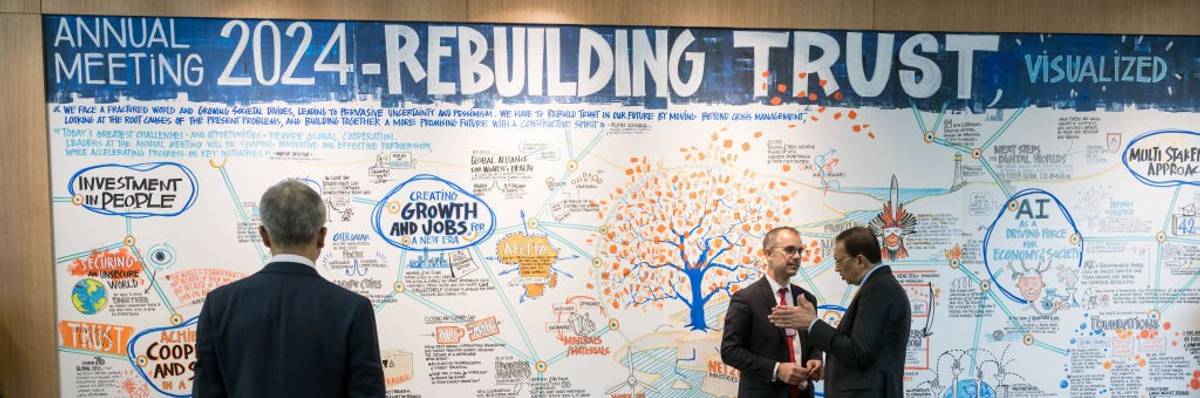
Participants stands next to a board in the Congress center during the World Economic Forum (WEF) annual meeting in Davos on January 18, 2024.
Everyone from the World Economic Forum to the IMF to our governments to the Pope says they agree things need to change. But in practice, we are far from agreement with the rich and powerful about what change needs to happen and who should be driving that change.
As the world watches South Africa take Israel to the International Court of Justice with a charge of genocidal acts against Palestinians, it is rightly hard to look away. The daily bombings continue in Gaza, as does the human devastation.
With war threatening to escalate in the region, as well as crises in Ecuador, DRC and many other parts of the world, it will have failed to register for many that the annual World Economic Forum in Davos, Switzerland rolls around again this week. In the context of sharpening inequalities, and perilous global politics, what relevance does this gathering have outside the elite bubble?
Their annual Global Risks Report itself posits misinformation, societal polarization, extreme weather conditions, conflict, and rising cost of living among the key risks to the global economy this year. What the WEF has failed to define is that for many, the coming year does not bring the threat of multiple crises. Those crises are already here, and are being lived daily on the streets and in the homes of people on the frontlines of inequality around the world. But we did not seriously expect a self-selecting gathering of the elite to be in touch with that lived reality.
In many ways, multilateralism that the WEF wishes to (but can only in a de facto way) be a part of has never looked more in peril. The UN system is impotent as members fail to enforce the international rule of law on Israel and its allies in the United States. This blatant example of how the international system currently works for the rich and powerful is seen and understood by many, including a disenfranchised younger generation. The specter of protests across the world on the streets in support of a ceasefire in Gaza and broader Palestinian liberation is the power of people on display. It is not hard to imagine that the same people power that will free Palestine will free the world from neoliberalism.
Every January during Davos, our allies Oxfam release jaw dropping statistics about inequality. It does a great job of crystallising for us the depth of the mess we’re in and provides a wedge into what sits beneath—the wider, systemic and intersectional problem. But statistics can only hold up a mirror. It does not change the picture we see staring back at us.
It is not hard to imagine that the same people power that will free Palestine will free the world from neoliberalism.
For people living on the frontlines of inequality across the world, change is in short supply. We’ve won the debates on how bad inequality is and the fact that it requires deep change. Everyone from the WEF to the IMF to our governments to the Pope says they agree things need to change. But in practice, we are far from agreement with the rich and powerful about what change needs to happen and who should be driving that change. Davos talks about rebuilding trust. The people talk of system change.
So where is the change going to come from? Inequality is, at heart, an issue of power. We in the Fight Inequality Alliance know that change comes when people power becomes stronger than those driving and benefitting from the status quo. People are already gathering in different formations and expressing their strong displeasure about the current state of affairs which is built to oppress the majority in favor of a few. The policy prescriptions that would do the most to ensure societies that work for all are largely known and already campaigned on by many. The agenda of taxing the richest people and multinationals more, funding public services, canceling the debt, and providing decent work for all have been the backbone of struggles for a just and equitable world for many years. Charting a path to an economy that puts people and planet ahead of greed and profit is the course to take to answer the dangerous times we are in.
But given the intense concentration of power and wealth in so few hands across the globe, the dangerous sweep of right-wing extremism, sexism, austerity, misogyny, and discrimination, accompanied by a crackdown on democratic rights and freedoms, these struggles needed to join up and build collective power on a larger scale. With over 50 national elections set for this year across a hugely diverse range of countries from India to South Africa, UK to the US, representing over half of humanity’s population, this year will be a test for democracy. What kind of societies are we able to fight for?
Any talk of rebuilding trust must surely sound hollow to those at the sharp end of oppression, injustice, and inequality.
The reality on the streets and the discussions as the WEF meets in the mountains of Davos are totally disconnected from one another. People cannot, and will not ask Davos to solve their problems. How can trust be rebuilt in a system that is designed to exploit and extract from the majority of humanity? Any talk of rebuilding trust must surely sound hollow to those at the sharp end of oppression, injustice, and inequality.
But protestors know that all is not lost. We believe in ourselves, and that change will come. Glimmers appear when people organize themselves and demand progressive change. And progress is made when governments are forced to respond. We have seen moves towards wealth taxes in Mexico and Zimbabwe to name recent examples. In Latin America and the Caribbean (LAC), a groundbreaking summit between governments led to a new direction for more progressive taxation and for the region to raise a united voice on the international tax reform process. The expectation and the demand for fairer and more just societies drive us forward. We can never give that up.
Listen to those on the streets this week. Their stories and demands are the hope that we have.
Dear Common Dreams reader, It’s been nearly 30 years since I co-founded Common Dreams with my late wife, Lina Newhouser. We had the radical notion that journalism should serve the public good, not corporate profits. It was clear to us from the outset what it would take to build such a project. No paid advertisements. No corporate sponsors. No millionaire publisher telling us what to think or do. Many people said we wouldn't last a year, but we proved those doubters wrong. Together with a tremendous team of journalists and dedicated staff, we built an independent media outlet free from the constraints of profits and corporate control. Our mission has always been simple: To inform. To inspire. To ignite change for the common good. Building Common Dreams was not easy. Our survival was never guaranteed. When you take on the most powerful forces—Wall Street greed, fossil fuel industry destruction, Big Tech lobbyists, and uber-rich oligarchs who have spent billions upon billions rigging the economy and democracy in their favor—the only bulwark you have is supporters who believe in your work. But here’s the urgent message from me today. It's never been this bad out there. And it's never been this hard to keep us going. At the very moment Common Dreams is most needed, the threats we face are intensifying. We need your support now more than ever. We don't accept corporate advertising and never will. We don't have a paywall because we don't think people should be blocked from critical news based on their ability to pay. Everything we do is funded by the donations of readers like you. When everyone does the little they can afford, we are strong. But if that support retreats or dries up, so do we. Will you donate now to make sure Common Dreams not only survives but thrives? —Craig Brown, Co-founder |
As the world watches South Africa take Israel to the International Court of Justice with a charge of genocidal acts against Palestinians, it is rightly hard to look away. The daily bombings continue in Gaza, as does the human devastation.
With war threatening to escalate in the region, as well as crises in Ecuador, DRC and many other parts of the world, it will have failed to register for many that the annual World Economic Forum in Davos, Switzerland rolls around again this week. In the context of sharpening inequalities, and perilous global politics, what relevance does this gathering have outside the elite bubble?
Their annual Global Risks Report itself posits misinformation, societal polarization, extreme weather conditions, conflict, and rising cost of living among the key risks to the global economy this year. What the WEF has failed to define is that for many, the coming year does not bring the threat of multiple crises. Those crises are already here, and are being lived daily on the streets and in the homes of people on the frontlines of inequality around the world. But we did not seriously expect a self-selecting gathering of the elite to be in touch with that lived reality.
In many ways, multilateralism that the WEF wishes to (but can only in a de facto way) be a part of has never looked more in peril. The UN system is impotent as members fail to enforce the international rule of law on Israel and its allies in the United States. This blatant example of how the international system currently works for the rich and powerful is seen and understood by many, including a disenfranchised younger generation. The specter of protests across the world on the streets in support of a ceasefire in Gaza and broader Palestinian liberation is the power of people on display. It is not hard to imagine that the same people power that will free Palestine will free the world from neoliberalism.
Every January during Davos, our allies Oxfam release jaw dropping statistics about inequality. It does a great job of crystallising for us the depth of the mess we’re in and provides a wedge into what sits beneath—the wider, systemic and intersectional problem. But statistics can only hold up a mirror. It does not change the picture we see staring back at us.
It is not hard to imagine that the same people power that will free Palestine will free the world from neoliberalism.
For people living on the frontlines of inequality across the world, change is in short supply. We’ve won the debates on how bad inequality is and the fact that it requires deep change. Everyone from the WEF to the IMF to our governments to the Pope says they agree things need to change. But in practice, we are far from agreement with the rich and powerful about what change needs to happen and who should be driving that change. Davos talks about rebuilding trust. The people talk of system change.
So where is the change going to come from? Inequality is, at heart, an issue of power. We in the Fight Inequality Alliance know that change comes when people power becomes stronger than those driving and benefitting from the status quo. People are already gathering in different formations and expressing their strong displeasure about the current state of affairs which is built to oppress the majority in favor of a few. The policy prescriptions that would do the most to ensure societies that work for all are largely known and already campaigned on by many. The agenda of taxing the richest people and multinationals more, funding public services, canceling the debt, and providing decent work for all have been the backbone of struggles for a just and equitable world for many years. Charting a path to an economy that puts people and planet ahead of greed and profit is the course to take to answer the dangerous times we are in.
But given the intense concentration of power and wealth in so few hands across the globe, the dangerous sweep of right-wing extremism, sexism, austerity, misogyny, and discrimination, accompanied by a crackdown on democratic rights and freedoms, these struggles needed to join up and build collective power on a larger scale. With over 50 national elections set for this year across a hugely diverse range of countries from India to South Africa, UK to the US, representing over half of humanity’s population, this year will be a test for democracy. What kind of societies are we able to fight for?
Any talk of rebuilding trust must surely sound hollow to those at the sharp end of oppression, injustice, and inequality.
The reality on the streets and the discussions as the WEF meets in the mountains of Davos are totally disconnected from one another. People cannot, and will not ask Davos to solve their problems. How can trust be rebuilt in a system that is designed to exploit and extract from the majority of humanity? Any talk of rebuilding trust must surely sound hollow to those at the sharp end of oppression, injustice, and inequality.
But protestors know that all is not lost. We believe in ourselves, and that change will come. Glimmers appear when people organize themselves and demand progressive change. And progress is made when governments are forced to respond. We have seen moves towards wealth taxes in Mexico and Zimbabwe to name recent examples. In Latin America and the Caribbean (LAC), a groundbreaking summit between governments led to a new direction for more progressive taxation and for the region to raise a united voice on the international tax reform process. The expectation and the demand for fairer and more just societies drive us forward. We can never give that up.
Listen to those on the streets this week. Their stories and demands are the hope that we have.
As the world watches South Africa take Israel to the International Court of Justice with a charge of genocidal acts against Palestinians, it is rightly hard to look away. The daily bombings continue in Gaza, as does the human devastation.
With war threatening to escalate in the region, as well as crises in Ecuador, DRC and many other parts of the world, it will have failed to register for many that the annual World Economic Forum in Davos, Switzerland rolls around again this week. In the context of sharpening inequalities, and perilous global politics, what relevance does this gathering have outside the elite bubble?
Their annual Global Risks Report itself posits misinformation, societal polarization, extreme weather conditions, conflict, and rising cost of living among the key risks to the global economy this year. What the WEF has failed to define is that for many, the coming year does not bring the threat of multiple crises. Those crises are already here, and are being lived daily on the streets and in the homes of people on the frontlines of inequality around the world. But we did not seriously expect a self-selecting gathering of the elite to be in touch with that lived reality.
In many ways, multilateralism that the WEF wishes to (but can only in a de facto way) be a part of has never looked more in peril. The UN system is impotent as members fail to enforce the international rule of law on Israel and its allies in the United States. This blatant example of how the international system currently works for the rich and powerful is seen and understood by many, including a disenfranchised younger generation. The specter of protests across the world on the streets in support of a ceasefire in Gaza and broader Palestinian liberation is the power of people on display. It is not hard to imagine that the same people power that will free Palestine will free the world from neoliberalism.
Every January during Davos, our allies Oxfam release jaw dropping statistics about inequality. It does a great job of crystallising for us the depth of the mess we’re in and provides a wedge into what sits beneath—the wider, systemic and intersectional problem. But statistics can only hold up a mirror. It does not change the picture we see staring back at us.
It is not hard to imagine that the same people power that will free Palestine will free the world from neoliberalism.
For people living on the frontlines of inequality across the world, change is in short supply. We’ve won the debates on how bad inequality is and the fact that it requires deep change. Everyone from the WEF to the IMF to our governments to the Pope says they agree things need to change. But in practice, we are far from agreement with the rich and powerful about what change needs to happen and who should be driving that change. Davos talks about rebuilding trust. The people talk of system change.
So where is the change going to come from? Inequality is, at heart, an issue of power. We in the Fight Inequality Alliance know that change comes when people power becomes stronger than those driving and benefitting from the status quo. People are already gathering in different formations and expressing their strong displeasure about the current state of affairs which is built to oppress the majority in favor of a few. The policy prescriptions that would do the most to ensure societies that work for all are largely known and already campaigned on by many. The agenda of taxing the richest people and multinationals more, funding public services, canceling the debt, and providing decent work for all have been the backbone of struggles for a just and equitable world for many years. Charting a path to an economy that puts people and planet ahead of greed and profit is the course to take to answer the dangerous times we are in.
But given the intense concentration of power and wealth in so few hands across the globe, the dangerous sweep of right-wing extremism, sexism, austerity, misogyny, and discrimination, accompanied by a crackdown on democratic rights and freedoms, these struggles needed to join up and build collective power on a larger scale. With over 50 national elections set for this year across a hugely diverse range of countries from India to South Africa, UK to the US, representing over half of humanity’s population, this year will be a test for democracy. What kind of societies are we able to fight for?
Any talk of rebuilding trust must surely sound hollow to those at the sharp end of oppression, injustice, and inequality.
The reality on the streets and the discussions as the WEF meets in the mountains of Davos are totally disconnected from one another. People cannot, and will not ask Davos to solve their problems. How can trust be rebuilt in a system that is designed to exploit and extract from the majority of humanity? Any talk of rebuilding trust must surely sound hollow to those at the sharp end of oppression, injustice, and inequality.
But protestors know that all is not lost. We believe in ourselves, and that change will come. Glimmers appear when people organize themselves and demand progressive change. And progress is made when governments are forced to respond. We have seen moves towards wealth taxes in Mexico and Zimbabwe to name recent examples. In Latin America and the Caribbean (LAC), a groundbreaking summit between governments led to a new direction for more progressive taxation and for the region to raise a united voice on the international tax reform process. The expectation and the demand for fairer and more just societies drive us forward. We can never give that up.
Listen to those on the streets this week. Their stories and demands are the hope that we have.