SUBSCRIBE TO OUR FREE NEWSLETTER
Daily news & progressive opinion—funded by the people, not the corporations—delivered straight to your inbox.
5
#000000
#FFFFFF
To donate by check, phone, or other method, see our More Ways to Give page.
Daily news & progressive opinion—funded by the people, not the corporations—delivered straight to your inbox.
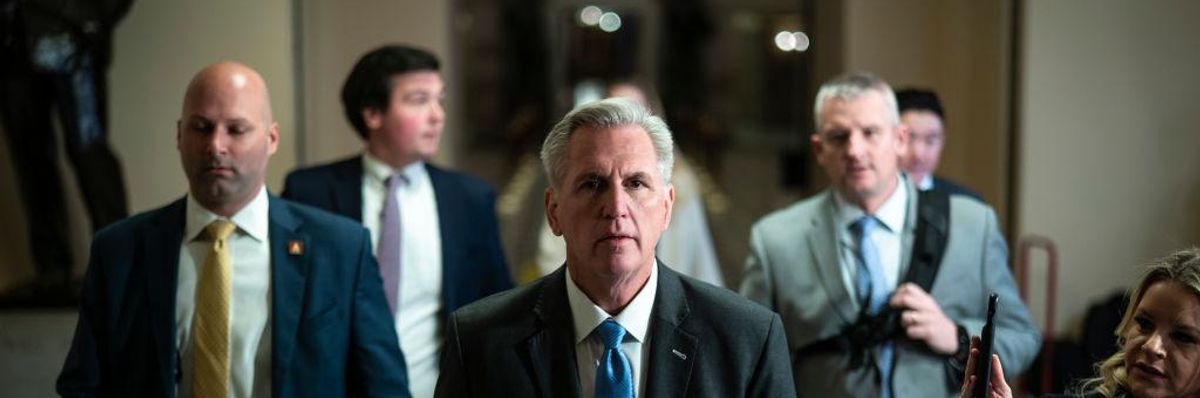
Newly-elected Speaker of the House Kevin McCarthy (R-Calif.) walks to open the House floor for the first time as Speaker of the 118th Congress, Monday, January 09, 2023, at the U.S. Capitol in Washington DC.
Across-the-board cuts are never the best way to reduce government spending, but chopping up to $100 billion or more from the Pentagon, one way or another, should be up for discussion.
Writing for the Washington Post on Monday, Jennifer Rubin charged that the potential Freedom Caucus proposal to freeze federal spending at 2022 levels, which, if implemented across the board, could wipe out $75 to $100 billion in increased Pentagon spending included in the recent budget bill, could have “serious national security ramifications.”
She then quoted American Enterprise Institute budget hawk Mackenzie Eaglen, who said such a proposal “makes only authoritarians, despots and dictators smile,” adding, “it completely ignores the troops and is entirely divorced from strategic thought or the many and varied threats the country faces.”
Across-the-board cuts are never the best way to reduce government spending. They mean cutting effective and wasteful programs in the same proportions instead of making smart choices about what works and what doesn’t. But the idea of cutting up to $100 billion or more from the Pentagon, one way or another, should be up for discussion.
And the idea that dictators worldwide are basing their decisions on whether the Pentagon budget is an enormous $750 billion or an obscenely enormous $850-plus billion is ludicrous. What counts is having a clear strategy and a wilingness to carry it out, not how many dollars one can spend (or, too often, waste).
The idea that dictators worldwide are basing their decisions on whether the Pentagon budget is an enormous $750 billion or an obscenely enormous $850-plus billion is ludicrous.
The $858 billion for the Pentagon and related work on nuclear warheads at the Department of Energy that President Biden signed off on last month is one of the highest levels ever — far higher than at the height of the Korean or Vietnam Wars or the peak years of the Cold War. And contrary to popular belief, most of those funds do not go to the troops. More than half of Pentagon outlays go to private weapons firms that have a mixed record of delivering effective defense systems at reasonable prices, to put it mildly.
The top five contractors alone will split between $150 and $200 billion if the current budget holds, even as they pay their CEOs $20 million or more per year and engage in billions in stock buybacks to boost their share prices. These expenditures are perfectly designed to enrich arms companies and their shareholders, but they have nothing to do with defending the country.
But back to the $100 billion question. The Congressional Budget Office released a study in late 2021 that outlined three options for saving over $1 trillion in Pentagon spending over the next ten years without damaging our defense capabilities. All three options involved cutting the size of the armed forces, avoiding large boots-on-the-ground wars like Iraq and Afghanistan, and relying on allies to do more in their own defense.
The CBO recommendations are just the tip of the iceberg of what could be cut under a more restrained, realistic approach to defense. The current National Defense Strategy (NDS), released late last year, is an object lesson on how not to make choices among competing priorities. Major commitments included in the NDS include being able to win a war against Russia or China; defeating Iran or North Korea in a regional conflict; and continuing to sustain a global war on terrorism that includes military operations in at least 85 countries, according to an analysis by the Costs of War Project at Brown University.
A strategy that forswears sending large numbers of troops into regional wars, takes a more realistic view of the military threats posed by Russia and China, relies more on allies, and rolls back the Pentagon’s dangerous and unnecessary nuclear weapons buildup could save sums well beyond the $100 billion per year set out in the CBO’s illustrative options.
And these strategic shifts don’t even account for what could be saved by streamlining the Pentagon by taking measures to reduce price gouging and cost overruns by weapons firms, or reducing the Pentagon’s cadre of over half a million private contractors, many of whom perform redundant tasks at prices higher than it would cost to do the same work with civilian government employees.
By all means we should debate how the federal budget should be crafted at this chaotic political moment. But we should not assume that there is no room to trim the Pentagon budget. Doing it correctly would not only make us safer, it would free up funds to address other urgent national priorities.
Dear Common Dreams reader, It’s been nearly 30 years since I co-founded Common Dreams with my late wife, Lina Newhouser. We had the radical notion that journalism should serve the public good, not corporate profits. It was clear to us from the outset what it would take to build such a project. No paid advertisements. No corporate sponsors. No millionaire publisher telling us what to think or do. Many people said we wouldn't last a year, but we proved those doubters wrong. Together with a tremendous team of journalists and dedicated staff, we built an independent media outlet free from the constraints of profits and corporate control. Our mission has always been simple: To inform. To inspire. To ignite change for the common good. Building Common Dreams was not easy. Our survival was never guaranteed. When you take on the most powerful forces—Wall Street greed, fossil fuel industry destruction, Big Tech lobbyists, and uber-rich oligarchs who have spent billions upon billions rigging the economy and democracy in their favor—the only bulwark you have is supporters who believe in your work. But here’s the urgent message from me today. It's never been this bad out there. And it's never been this hard to keep us going. At the very moment Common Dreams is most needed, the threats we face are intensifying. We need your support now more than ever. We don't accept corporate advertising and never will. We don't have a paywall because we don't think people should be blocked from critical news based on their ability to pay. Everything we do is funded by the donations of readers like you. When everyone does the little they can afford, we are strong. But if that support retreats or dries up, so do we. Will you donate now to make sure Common Dreams not only survives but thrives? —Craig Brown, Co-founder |
Writing for the Washington Post on Monday, Jennifer Rubin charged that the potential Freedom Caucus proposal to freeze federal spending at 2022 levels, which, if implemented across the board, could wipe out $75 to $100 billion in increased Pentagon spending included in the recent budget bill, could have “serious national security ramifications.”
She then quoted American Enterprise Institute budget hawk Mackenzie Eaglen, who said such a proposal “makes only authoritarians, despots and dictators smile,” adding, “it completely ignores the troops and is entirely divorced from strategic thought or the many and varied threats the country faces.”
Across-the-board cuts are never the best way to reduce government spending. They mean cutting effective and wasteful programs in the same proportions instead of making smart choices about what works and what doesn’t. But the idea of cutting up to $100 billion or more from the Pentagon, one way or another, should be up for discussion.
And the idea that dictators worldwide are basing their decisions on whether the Pentagon budget is an enormous $750 billion or an obscenely enormous $850-plus billion is ludicrous. What counts is having a clear strategy and a wilingness to carry it out, not how many dollars one can spend (or, too often, waste).
The idea that dictators worldwide are basing their decisions on whether the Pentagon budget is an enormous $750 billion or an obscenely enormous $850-plus billion is ludicrous.
The $858 billion for the Pentagon and related work on nuclear warheads at the Department of Energy that President Biden signed off on last month is one of the highest levels ever — far higher than at the height of the Korean or Vietnam Wars or the peak years of the Cold War. And contrary to popular belief, most of those funds do not go to the troops. More than half of Pentagon outlays go to private weapons firms that have a mixed record of delivering effective defense systems at reasonable prices, to put it mildly.
The top five contractors alone will split between $150 and $200 billion if the current budget holds, even as they pay their CEOs $20 million or more per year and engage in billions in stock buybacks to boost their share prices. These expenditures are perfectly designed to enrich arms companies and their shareholders, but they have nothing to do with defending the country.
But back to the $100 billion question. The Congressional Budget Office released a study in late 2021 that outlined three options for saving over $1 trillion in Pentagon spending over the next ten years without damaging our defense capabilities. All three options involved cutting the size of the armed forces, avoiding large boots-on-the-ground wars like Iraq and Afghanistan, and relying on allies to do more in their own defense.
The CBO recommendations are just the tip of the iceberg of what could be cut under a more restrained, realistic approach to defense. The current National Defense Strategy (NDS), released late last year, is an object lesson on how not to make choices among competing priorities. Major commitments included in the NDS include being able to win a war against Russia or China; defeating Iran or North Korea in a regional conflict; and continuing to sustain a global war on terrorism that includes military operations in at least 85 countries, according to an analysis by the Costs of War Project at Brown University.
A strategy that forswears sending large numbers of troops into regional wars, takes a more realistic view of the military threats posed by Russia and China, relies more on allies, and rolls back the Pentagon’s dangerous and unnecessary nuclear weapons buildup could save sums well beyond the $100 billion per year set out in the CBO’s illustrative options.
And these strategic shifts don’t even account for what could be saved by streamlining the Pentagon by taking measures to reduce price gouging and cost overruns by weapons firms, or reducing the Pentagon’s cadre of over half a million private contractors, many of whom perform redundant tasks at prices higher than it would cost to do the same work with civilian government employees.
By all means we should debate how the federal budget should be crafted at this chaotic political moment. But we should not assume that there is no room to trim the Pentagon budget. Doing it correctly would not only make us safer, it would free up funds to address other urgent national priorities.
Writing for the Washington Post on Monday, Jennifer Rubin charged that the potential Freedom Caucus proposal to freeze federal spending at 2022 levels, which, if implemented across the board, could wipe out $75 to $100 billion in increased Pentagon spending included in the recent budget bill, could have “serious national security ramifications.”
She then quoted American Enterprise Institute budget hawk Mackenzie Eaglen, who said such a proposal “makes only authoritarians, despots and dictators smile,” adding, “it completely ignores the troops and is entirely divorced from strategic thought or the many and varied threats the country faces.”
Across-the-board cuts are never the best way to reduce government spending. They mean cutting effective and wasteful programs in the same proportions instead of making smart choices about what works and what doesn’t. But the idea of cutting up to $100 billion or more from the Pentagon, one way or another, should be up for discussion.
And the idea that dictators worldwide are basing their decisions on whether the Pentagon budget is an enormous $750 billion or an obscenely enormous $850-plus billion is ludicrous. What counts is having a clear strategy and a wilingness to carry it out, not how many dollars one can spend (or, too often, waste).
The idea that dictators worldwide are basing their decisions on whether the Pentagon budget is an enormous $750 billion or an obscenely enormous $850-plus billion is ludicrous.
The $858 billion for the Pentagon and related work on nuclear warheads at the Department of Energy that President Biden signed off on last month is one of the highest levels ever — far higher than at the height of the Korean or Vietnam Wars or the peak years of the Cold War. And contrary to popular belief, most of those funds do not go to the troops. More than half of Pentagon outlays go to private weapons firms that have a mixed record of delivering effective defense systems at reasonable prices, to put it mildly.
The top five contractors alone will split between $150 and $200 billion if the current budget holds, even as they pay their CEOs $20 million or more per year and engage in billions in stock buybacks to boost their share prices. These expenditures are perfectly designed to enrich arms companies and their shareholders, but they have nothing to do with defending the country.
But back to the $100 billion question. The Congressional Budget Office released a study in late 2021 that outlined three options for saving over $1 trillion in Pentagon spending over the next ten years without damaging our defense capabilities. All three options involved cutting the size of the armed forces, avoiding large boots-on-the-ground wars like Iraq and Afghanistan, and relying on allies to do more in their own defense.
The CBO recommendations are just the tip of the iceberg of what could be cut under a more restrained, realistic approach to defense. The current National Defense Strategy (NDS), released late last year, is an object lesson on how not to make choices among competing priorities. Major commitments included in the NDS include being able to win a war against Russia or China; defeating Iran or North Korea in a regional conflict; and continuing to sustain a global war on terrorism that includes military operations in at least 85 countries, according to an analysis by the Costs of War Project at Brown University.
A strategy that forswears sending large numbers of troops into regional wars, takes a more realistic view of the military threats posed by Russia and China, relies more on allies, and rolls back the Pentagon’s dangerous and unnecessary nuclear weapons buildup could save sums well beyond the $100 billion per year set out in the CBO’s illustrative options.
And these strategic shifts don’t even account for what could be saved by streamlining the Pentagon by taking measures to reduce price gouging and cost overruns by weapons firms, or reducing the Pentagon’s cadre of over half a million private contractors, many of whom perform redundant tasks at prices higher than it would cost to do the same work with civilian government employees.
By all means we should debate how the federal budget should be crafted at this chaotic political moment. But we should not assume that there is no room to trim the Pentagon budget. Doing it correctly would not only make us safer, it would free up funds to address other urgent national priorities.