SUBSCRIBE TO OUR FREE NEWSLETTER
Daily news & progressive opinion—funded by the people, not the corporations—delivered straight to your inbox.
5
#000000
#FFFFFF
To donate by check, phone, or other method, see our More Ways to Give page.
Daily news & progressive opinion—funded by the people, not the corporations—delivered straight to your inbox.
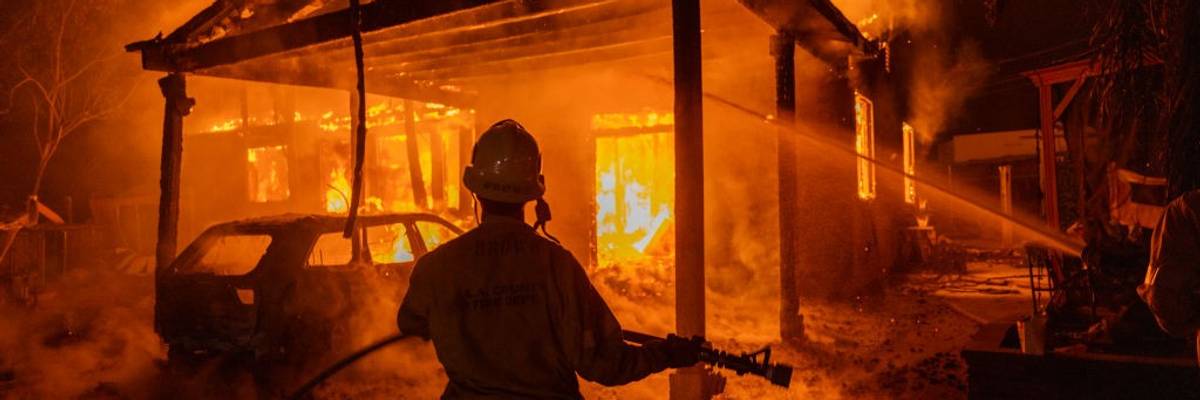
Firefighters battle the Eaton Fire on January 8, 2025 in Altadena, California.
If the world continues on its current trends, it will mean species suicide. It’s imperative that we take the blinders off and face these crises openly and honestly.
On U.S. President Donald Trump’s first day back in office, he pulled the U.S. out of the Paris climate accords again, halted leasing and permitting for offshore wind energy projects, and signed executive orders promoting fossil fuel development. The previous Trump administration rolled back more than 100 environmental regulations. It seems likely he’ll now continue this process with even more vehemence.
The Intergovernmental Panel on Climate Change (IPCC) released a report in 2018, which found that “global warming is likely to reach 1.5°C between 2030 and 2052 if it continues to increase at the current rate.” A 1.5°C rise in temperature will render the Earth virtually uninhabitable.
We are already somewhere between 0.8°C and 1.2°C above pre-industrial levels and trending in the wrong direction. 2024 was the warmest year on record, surpassing 2023, the previous record holder.
Former Executive Secretary of the United Nations Framework Convention on Climate Change Christiana Figueres (writing with co-author Tom Rivett-Carnac) once predicted how the world might look in 2050:
In many places around the world, the air is hot, heavy, and depending on the day, clogged with particulate pollution. Your eyes often water. Your cough never seems to disappear. You can no longer simply walk out your front door and breathe fresh air. Instead, before opening doors or windows in the morning, you check your phone to see what the air quality will be. Everything might look fine—sunny and clear—but you know better. When storms and heatwaves overlap and cluster, the air pollution and intensified surface ozone levels can make it dangerous to go outside without a specially designed face mask (which only some can afford).
Current government policy is to accelerate this threat.
Partisan rhetoric can give the impression that scientists are divided on this issue. The debate around climate change is usually a debate about whether climate change exists. Not what to do about it.
According to a 2021 study by Cornell University, there’s 99.9% agreement among scientists that climate change is caused by humans. You won’t find that level of consensus among scientists about gravity.
The right wing knows this perfectly well. Donald Trump, for instance, applied for a permit in 2016 to build a coastal protection wall to prevent erosion due to rising seas levels at one of his seaside golf courses. The permit application explicitly mentioned global warming.
There used to be a right-wing opposition to climate change. In the early 2000s, Newt Gingrich was proposing measures to deal with climate change. Then, the fossil fuel industry came in and essentially remade the Republican Party in their image.
A famous study from 2013 by the Investigative Reporting Workshop at American University documented how David and Charles Koch, through their think tank Americans for Prosperity, got members of Congress to sign a pledge to vote against virtually any climate legislation which would regulate businesses. In 2013, more than 400 current officeholders had signed this pledge.
This was a major turning point in the fight against climate change. From 2003 to 2021, the number of Republicans who believed global warming was caused by human activity dropped from 65% to 32%.
According to the U.N., between 3.3 and 3.6 billion people live in contexts that are highly vulnerable to climate change. As ecological catastrophes become more and more common and large areas of the globe become uninhabitable, there’s going to be greater mass migration to the First World than we’ve ever seen. The instruments of separation (walls, cages, border patrols) have already been erected, but they won’t be able to stop it. People will find a way.
Failure to curb the use of fossil fuels and halt carbon emissions will mean crop shortages, heatwaves, droughts and floods, even more devastating hurricanes, rising sea levels, and wildfires. There is growing concern among experts that thawing permafrost could release viruses which have been dormant for thousands of years, potentially causing pandemics worse than Covid-19.
Are we in the final century of human civilization? It’s very possible. This is the generation that will decide whether humankind continues. If the world continues on its current trends, it will mean species suicide. It’s imperative that we take the blinders off and face these crises openly and honestly. By the time they become too severe to ignore, it will be too late to do anything.
Dear Common Dreams reader, It’s been nearly 30 years since I co-founded Common Dreams with my late wife, Lina Newhouser. We had the radical notion that journalism should serve the public good, not corporate profits. It was clear to us from the outset what it would take to build such a project. No paid advertisements. No corporate sponsors. No millionaire publisher telling us what to think or do. Many people said we wouldn't last a year, but we proved those doubters wrong. Together with a tremendous team of journalists and dedicated staff, we built an independent media outlet free from the constraints of profits and corporate control. Our mission has always been simple: To inform. To inspire. To ignite change for the common good. Building Common Dreams was not easy. Our survival was never guaranteed. When you take on the most powerful forces—Wall Street greed, fossil fuel industry destruction, Big Tech lobbyists, and uber-rich oligarchs who have spent billions upon billions rigging the economy and democracy in their favor—the only bulwark you have is supporters who believe in your work. But here’s the urgent message from me today. It's never been this bad out there. And it's never been this hard to keep us going. At the very moment Common Dreams is most needed, the threats we face are intensifying. We need your support now more than ever. We don't accept corporate advertising and never will. We don't have a paywall because we don't think people should be blocked from critical news based on their ability to pay. Everything we do is funded by the donations of readers like you. When everyone does the little they can afford, we are strong. But if that support retreats or dries up, so do we. Will you donate now to make sure Common Dreams not only survives but thrives? —Craig Brown, Co-founder |
On U.S. President Donald Trump’s first day back in office, he pulled the U.S. out of the Paris climate accords again, halted leasing and permitting for offshore wind energy projects, and signed executive orders promoting fossil fuel development. The previous Trump administration rolled back more than 100 environmental regulations. It seems likely he’ll now continue this process with even more vehemence.
The Intergovernmental Panel on Climate Change (IPCC) released a report in 2018, which found that “global warming is likely to reach 1.5°C between 2030 and 2052 if it continues to increase at the current rate.” A 1.5°C rise in temperature will render the Earth virtually uninhabitable.
We are already somewhere between 0.8°C and 1.2°C above pre-industrial levels and trending in the wrong direction. 2024 was the warmest year on record, surpassing 2023, the previous record holder.
Former Executive Secretary of the United Nations Framework Convention on Climate Change Christiana Figueres (writing with co-author Tom Rivett-Carnac) once predicted how the world might look in 2050:
In many places around the world, the air is hot, heavy, and depending on the day, clogged with particulate pollution. Your eyes often water. Your cough never seems to disappear. You can no longer simply walk out your front door and breathe fresh air. Instead, before opening doors or windows in the morning, you check your phone to see what the air quality will be. Everything might look fine—sunny and clear—but you know better. When storms and heatwaves overlap and cluster, the air pollution and intensified surface ozone levels can make it dangerous to go outside without a specially designed face mask (which only some can afford).
Current government policy is to accelerate this threat.
Partisan rhetoric can give the impression that scientists are divided on this issue. The debate around climate change is usually a debate about whether climate change exists. Not what to do about it.
According to a 2021 study by Cornell University, there’s 99.9% agreement among scientists that climate change is caused by humans. You won’t find that level of consensus among scientists about gravity.
The right wing knows this perfectly well. Donald Trump, for instance, applied for a permit in 2016 to build a coastal protection wall to prevent erosion due to rising seas levels at one of his seaside golf courses. The permit application explicitly mentioned global warming.
There used to be a right-wing opposition to climate change. In the early 2000s, Newt Gingrich was proposing measures to deal with climate change. Then, the fossil fuel industry came in and essentially remade the Republican Party in their image.
A famous study from 2013 by the Investigative Reporting Workshop at American University documented how David and Charles Koch, through their think tank Americans for Prosperity, got members of Congress to sign a pledge to vote against virtually any climate legislation which would regulate businesses. In 2013, more than 400 current officeholders had signed this pledge.
This was a major turning point in the fight against climate change. From 2003 to 2021, the number of Republicans who believed global warming was caused by human activity dropped from 65% to 32%.
According to the U.N., between 3.3 and 3.6 billion people live in contexts that are highly vulnerable to climate change. As ecological catastrophes become more and more common and large areas of the globe become uninhabitable, there’s going to be greater mass migration to the First World than we’ve ever seen. The instruments of separation (walls, cages, border patrols) have already been erected, but they won’t be able to stop it. People will find a way.
Failure to curb the use of fossil fuels and halt carbon emissions will mean crop shortages, heatwaves, droughts and floods, even more devastating hurricanes, rising sea levels, and wildfires. There is growing concern among experts that thawing permafrost could release viruses which have been dormant for thousands of years, potentially causing pandemics worse than Covid-19.
Are we in the final century of human civilization? It’s very possible. This is the generation that will decide whether humankind continues. If the world continues on its current trends, it will mean species suicide. It’s imperative that we take the blinders off and face these crises openly and honestly. By the time they become too severe to ignore, it will be too late to do anything.
On U.S. President Donald Trump’s first day back in office, he pulled the U.S. out of the Paris climate accords again, halted leasing and permitting for offshore wind energy projects, and signed executive orders promoting fossil fuel development. The previous Trump administration rolled back more than 100 environmental regulations. It seems likely he’ll now continue this process with even more vehemence.
The Intergovernmental Panel on Climate Change (IPCC) released a report in 2018, which found that “global warming is likely to reach 1.5°C between 2030 and 2052 if it continues to increase at the current rate.” A 1.5°C rise in temperature will render the Earth virtually uninhabitable.
We are already somewhere between 0.8°C and 1.2°C above pre-industrial levels and trending in the wrong direction. 2024 was the warmest year on record, surpassing 2023, the previous record holder.
Former Executive Secretary of the United Nations Framework Convention on Climate Change Christiana Figueres (writing with co-author Tom Rivett-Carnac) once predicted how the world might look in 2050:
In many places around the world, the air is hot, heavy, and depending on the day, clogged with particulate pollution. Your eyes often water. Your cough never seems to disappear. You can no longer simply walk out your front door and breathe fresh air. Instead, before opening doors or windows in the morning, you check your phone to see what the air quality will be. Everything might look fine—sunny and clear—but you know better. When storms and heatwaves overlap and cluster, the air pollution and intensified surface ozone levels can make it dangerous to go outside without a specially designed face mask (which only some can afford).
Current government policy is to accelerate this threat.
Partisan rhetoric can give the impression that scientists are divided on this issue. The debate around climate change is usually a debate about whether climate change exists. Not what to do about it.
According to a 2021 study by Cornell University, there’s 99.9% agreement among scientists that climate change is caused by humans. You won’t find that level of consensus among scientists about gravity.
The right wing knows this perfectly well. Donald Trump, for instance, applied for a permit in 2016 to build a coastal protection wall to prevent erosion due to rising seas levels at one of his seaside golf courses. The permit application explicitly mentioned global warming.
There used to be a right-wing opposition to climate change. In the early 2000s, Newt Gingrich was proposing measures to deal with climate change. Then, the fossil fuel industry came in and essentially remade the Republican Party in their image.
A famous study from 2013 by the Investigative Reporting Workshop at American University documented how David and Charles Koch, through their think tank Americans for Prosperity, got members of Congress to sign a pledge to vote against virtually any climate legislation which would regulate businesses. In 2013, more than 400 current officeholders had signed this pledge.
This was a major turning point in the fight against climate change. From 2003 to 2021, the number of Republicans who believed global warming was caused by human activity dropped from 65% to 32%.
According to the U.N., between 3.3 and 3.6 billion people live in contexts that are highly vulnerable to climate change. As ecological catastrophes become more and more common and large areas of the globe become uninhabitable, there’s going to be greater mass migration to the First World than we’ve ever seen. The instruments of separation (walls, cages, border patrols) have already been erected, but they won’t be able to stop it. People will find a way.
Failure to curb the use of fossil fuels and halt carbon emissions will mean crop shortages, heatwaves, droughts and floods, even more devastating hurricanes, rising sea levels, and wildfires. There is growing concern among experts that thawing permafrost could release viruses which have been dormant for thousands of years, potentially causing pandemics worse than Covid-19.
Are we in the final century of human civilization? It’s very possible. This is the generation that will decide whether humankind continues. If the world continues on its current trends, it will mean species suicide. It’s imperative that we take the blinders off and face these crises openly and honestly. By the time they become too severe to ignore, it will be too late to do anything.