SUBSCRIBE TO OUR FREE NEWSLETTER
Daily news & progressive opinion—funded by the people, not the corporations—delivered straight to your inbox.
5
#000000
#FFFFFF
To donate by check, phone, or other method, see our More Ways to Give page.
Daily news & progressive opinion—funded by the people, not the corporations—delivered straight to your inbox.
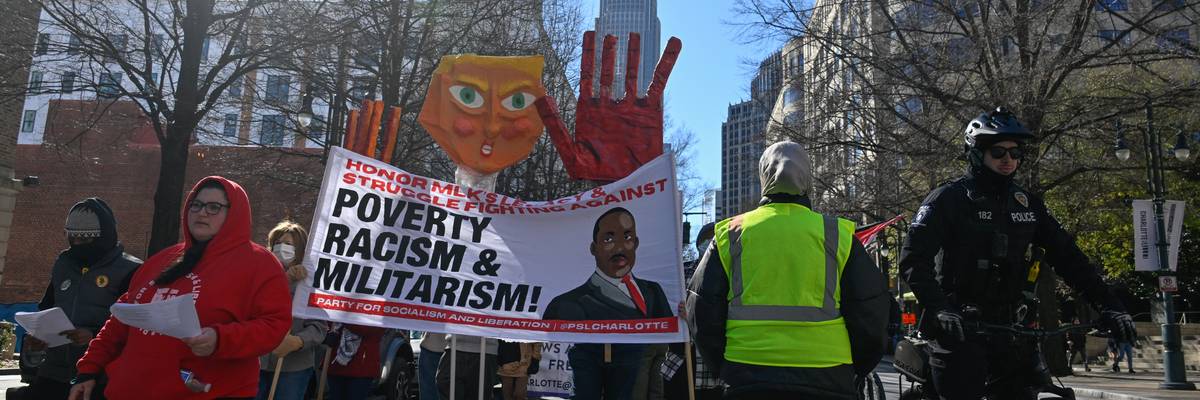
People march to demonstrate during a Martin Luther King Jr. Day rally, a pro-Palestinian rally, and an anti-Trump rally on the day of Donald Trump's second presidential inauguration on January 20, 2025 in Charlotte, United States of America.
The African American tradition of struggle advances the entire nation. In that spirit, we must continue to build coalitions that address shared socioeconomic challenges across racial and ethnic lines.
I lead the Joint Center for Political and Economic Studies, America’s Black think tank. When we opened our doors in 1970, there were only 1,469 Black elected officials in office across the United States. Today, there are over 10,000.
These milestones are historic, yet they also compel us to confront the sad reality that African Americans are still far behind their white counterparts in terms of overall economic well-being and political representation.
This duality—celebrating progress while recognizing the challenges in front of us—defines the spirit of Black History Month for 2025.
While congressional power remains fluid, with the Senate and especially the House narrowly divided, strategic coalition building can help us address persistent disparities and create a more equitable future.
While the growth of Black political leadership is encouraging, representation alone doesn’t guarantee systemic change. And today, even that progress in Black political representation is threatened.
Under the last administration, African Americans held 11% of the highest ranking, commissioned officer positions within the White House—nearly reaching our 14% share of the U.S. population.
The current administration, by contrast, has appointed only one Black cabinet nominee, returning our country to the poor Black representation of the 1980s. And following guidance from the White House, many federal agencies have now canceled their Black History Month celebrations.
But outside the White House, Black political representation has reached historic highs.
Today, we have one Black governor, Wes Moore of Maryland—only the third Black governor elected in U.S. history. We’ve set a new record with five Black U.S. Senators: Angela Alsobrooks (D-Md.), Lisa Blunt Rochester (D-Del.), Raphael Warnock (D-Ga.), Cory Booker (D-N.J.), and Tim Scott (R-S.C.). The Congressional Black Caucus (CBC) now has 62 members—its largest membership yet.
At the local level, Black political leadership is flourishing with a record 143 Black mayors across the country. Black leaders are at the helm of New York, Los Angeles, Chicago, Houston, Philadelphia, and Atlanta. These leaders are shaping not only their own cities, but urban policy across the nation.
Economic progress has accompanied these political milestones. Black Americans have achieved record levels of economic well-being in recent years, including historically low unemployment rates, a median income of $56,490, and median household wealth of $44,900.
But while these figures are encouraging, they remain overshadowed by persistent racial disparities. White households, for instance, maintain a median wealth of $285,000, highlighting the country’s deep racial economic divide.
The African American tradition of struggle advances the entire nation. In that spirit, we must continue to build coalitions that address shared socioeconomic challenges across racial and ethnic lines. Economic security, the need for a living wage, access to affordable housing, and moving communities out of asset poverty—these are the battles that our historic number of Black elected officials must continue to fight.
Recent attacks on diversity, equity, inclusion, and accessibility (DEIA) are another area demanding focus. We cannot allow the Trump administration’s witch hunt for those who’ve advocated opportunities for underrepresented communities to turn back the slow, gradual progress in Black political power.
The Joint Center was born from the Black freedom tradition—not from a desire for surface-level diversity, but from the need for true systemic change. As we navigate these challenges, we draw strength from this tradition and our remarkable progress.
The next two to four years present unique opportunities for collaboration and advancement. While congressional power remains fluid, with the Senate and especially the House narrowly divided, strategic coalition building can help us address persistent disparities and create a more equitable future.
Let this Black History Month remind us that progress is possible, even in the face of persistent challenges. Together, we can honor the sacrifices of those who came before us and pave the way for a brighter future for generations to come.
Dear Common Dreams reader, It’s been nearly 30 years since I co-founded Common Dreams with my late wife, Lina Newhouser. We had the radical notion that journalism should serve the public good, not corporate profits. It was clear to us from the outset what it would take to build such a project. No paid advertisements. No corporate sponsors. No millionaire publisher telling us what to think or do. Many people said we wouldn't last a year, but we proved those doubters wrong. Together with a tremendous team of journalists and dedicated staff, we built an independent media outlet free from the constraints of profits and corporate control. Our mission has always been simple: To inform. To inspire. To ignite change for the common good. Building Common Dreams was not easy. Our survival was never guaranteed. When you take on the most powerful forces—Wall Street greed, fossil fuel industry destruction, Big Tech lobbyists, and uber-rich oligarchs who have spent billions upon billions rigging the economy and democracy in their favor—the only bulwark you have is supporters who believe in your work. But here’s the urgent message from me today. It's never been this bad out there. And it's never been this hard to keep us going. At the very moment Common Dreams is most needed, the threats we face are intensifying. We need your support now more than ever. We don't accept corporate advertising and never will. We don't have a paywall because we don't think people should be blocked from critical news based on their ability to pay. Everything we do is funded by the donations of readers like you. When everyone does the little they can afford, we are strong. But if that support retreats or dries up, so do we. Will you donate now to make sure Common Dreams not only survives but thrives? —Craig Brown, Co-founder |
I lead the Joint Center for Political and Economic Studies, America’s Black think tank. When we opened our doors in 1970, there were only 1,469 Black elected officials in office across the United States. Today, there are over 10,000.
These milestones are historic, yet they also compel us to confront the sad reality that African Americans are still far behind their white counterparts in terms of overall economic well-being and political representation.
This duality—celebrating progress while recognizing the challenges in front of us—defines the spirit of Black History Month for 2025.
While congressional power remains fluid, with the Senate and especially the House narrowly divided, strategic coalition building can help us address persistent disparities and create a more equitable future.
While the growth of Black political leadership is encouraging, representation alone doesn’t guarantee systemic change. And today, even that progress in Black political representation is threatened.
Under the last administration, African Americans held 11% of the highest ranking, commissioned officer positions within the White House—nearly reaching our 14% share of the U.S. population.
The current administration, by contrast, has appointed only one Black cabinet nominee, returning our country to the poor Black representation of the 1980s. And following guidance from the White House, many federal agencies have now canceled their Black History Month celebrations.
But outside the White House, Black political representation has reached historic highs.
Today, we have one Black governor, Wes Moore of Maryland—only the third Black governor elected in U.S. history. We’ve set a new record with five Black U.S. Senators: Angela Alsobrooks (D-Md.), Lisa Blunt Rochester (D-Del.), Raphael Warnock (D-Ga.), Cory Booker (D-N.J.), and Tim Scott (R-S.C.). The Congressional Black Caucus (CBC) now has 62 members—its largest membership yet.
At the local level, Black political leadership is flourishing with a record 143 Black mayors across the country. Black leaders are at the helm of New York, Los Angeles, Chicago, Houston, Philadelphia, and Atlanta. These leaders are shaping not only their own cities, but urban policy across the nation.
Economic progress has accompanied these political milestones. Black Americans have achieved record levels of economic well-being in recent years, including historically low unemployment rates, a median income of $56,490, and median household wealth of $44,900.
But while these figures are encouraging, they remain overshadowed by persistent racial disparities. White households, for instance, maintain a median wealth of $285,000, highlighting the country’s deep racial economic divide.
The African American tradition of struggle advances the entire nation. In that spirit, we must continue to build coalitions that address shared socioeconomic challenges across racial and ethnic lines. Economic security, the need for a living wage, access to affordable housing, and moving communities out of asset poverty—these are the battles that our historic number of Black elected officials must continue to fight.
Recent attacks on diversity, equity, inclusion, and accessibility (DEIA) are another area demanding focus. We cannot allow the Trump administration’s witch hunt for those who’ve advocated opportunities for underrepresented communities to turn back the slow, gradual progress in Black political power.
The Joint Center was born from the Black freedom tradition—not from a desire for surface-level diversity, but from the need for true systemic change. As we navigate these challenges, we draw strength from this tradition and our remarkable progress.
The next two to four years present unique opportunities for collaboration and advancement. While congressional power remains fluid, with the Senate and especially the House narrowly divided, strategic coalition building can help us address persistent disparities and create a more equitable future.
Let this Black History Month remind us that progress is possible, even in the face of persistent challenges. Together, we can honor the sacrifices of those who came before us and pave the way for a brighter future for generations to come.
I lead the Joint Center for Political and Economic Studies, America’s Black think tank. When we opened our doors in 1970, there were only 1,469 Black elected officials in office across the United States. Today, there are over 10,000.
These milestones are historic, yet they also compel us to confront the sad reality that African Americans are still far behind their white counterparts in terms of overall economic well-being and political representation.
This duality—celebrating progress while recognizing the challenges in front of us—defines the spirit of Black History Month for 2025.
While congressional power remains fluid, with the Senate and especially the House narrowly divided, strategic coalition building can help us address persistent disparities and create a more equitable future.
While the growth of Black political leadership is encouraging, representation alone doesn’t guarantee systemic change. And today, even that progress in Black political representation is threatened.
Under the last administration, African Americans held 11% of the highest ranking, commissioned officer positions within the White House—nearly reaching our 14% share of the U.S. population.
The current administration, by contrast, has appointed only one Black cabinet nominee, returning our country to the poor Black representation of the 1980s. And following guidance from the White House, many federal agencies have now canceled their Black History Month celebrations.
But outside the White House, Black political representation has reached historic highs.
Today, we have one Black governor, Wes Moore of Maryland—only the third Black governor elected in U.S. history. We’ve set a new record with five Black U.S. Senators: Angela Alsobrooks (D-Md.), Lisa Blunt Rochester (D-Del.), Raphael Warnock (D-Ga.), Cory Booker (D-N.J.), and Tim Scott (R-S.C.). The Congressional Black Caucus (CBC) now has 62 members—its largest membership yet.
At the local level, Black political leadership is flourishing with a record 143 Black mayors across the country. Black leaders are at the helm of New York, Los Angeles, Chicago, Houston, Philadelphia, and Atlanta. These leaders are shaping not only their own cities, but urban policy across the nation.
Economic progress has accompanied these political milestones. Black Americans have achieved record levels of economic well-being in recent years, including historically low unemployment rates, a median income of $56,490, and median household wealth of $44,900.
But while these figures are encouraging, they remain overshadowed by persistent racial disparities. White households, for instance, maintain a median wealth of $285,000, highlighting the country’s deep racial economic divide.
The African American tradition of struggle advances the entire nation. In that spirit, we must continue to build coalitions that address shared socioeconomic challenges across racial and ethnic lines. Economic security, the need for a living wage, access to affordable housing, and moving communities out of asset poverty—these are the battles that our historic number of Black elected officials must continue to fight.
Recent attacks on diversity, equity, inclusion, and accessibility (DEIA) are another area demanding focus. We cannot allow the Trump administration’s witch hunt for those who’ve advocated opportunities for underrepresented communities to turn back the slow, gradual progress in Black political power.
The Joint Center was born from the Black freedom tradition—not from a desire for surface-level diversity, but from the need for true systemic change. As we navigate these challenges, we draw strength from this tradition and our remarkable progress.
The next two to four years present unique opportunities for collaboration and advancement. While congressional power remains fluid, with the Senate and especially the House narrowly divided, strategic coalition building can help us address persistent disparities and create a more equitable future.
Let this Black History Month remind us that progress is possible, even in the face of persistent challenges. Together, we can honor the sacrifices of those who came before us and pave the way for a brighter future for generations to come.