SUBSCRIBE TO OUR FREE NEWSLETTER
Daily news & progressive opinion—funded by the people, not the corporations—delivered straight to your inbox.
5
#000000
#FFFFFF
To donate by check, phone, or other method, see our More Ways to Give page.
Daily news & progressive opinion—funded by the people, not the corporations—delivered straight to your inbox.
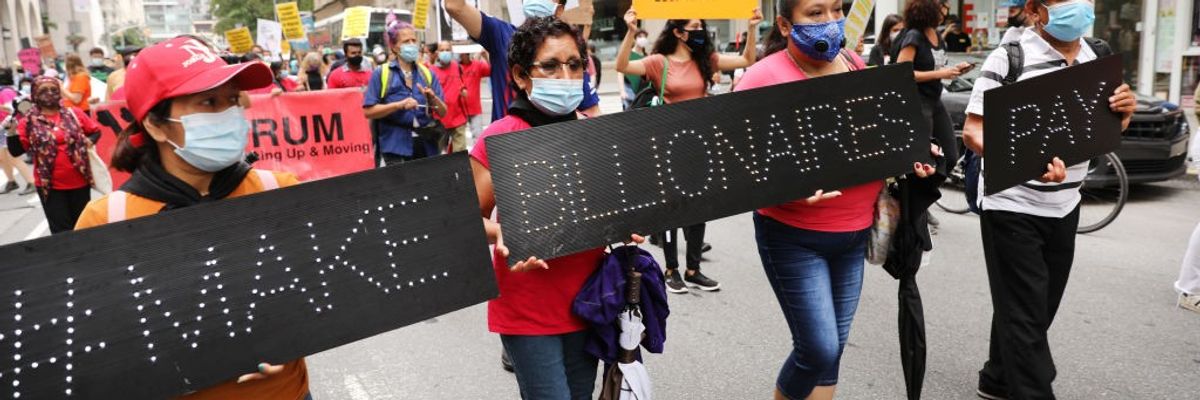
People march down the street with black signs saying, “Make billionaires pay.”
To limit the impact of our wealthiest on our politics, we simply must limit the wealth of our wealthiest.
Americans have been actively debating questions like these for almost a century and a half, ever since we entered the era that Mark Twain quite artfully tagged the “Gilded Age.” We never totally ended that gilded epoch. But we came close. By the 1950s, Americans of massive means faced tax rates as high as 91% on their income over $200,000, the equivalent of about $2.4 million today.
In those same years, the wealth America’s wealthiest left behind when they entered the great beyond faced an estate tax top rate that could go as high as 77%. Wealthy married couples here in 2024, by contrast, can totally exempt as much as $27.22 million from any federal estate tax.
In the buying and selling of our democracy, the sellers sit in Congress, and some have even called the White House home.
Our wealthiest today have good reason to be high-fiving these wealth-enhancing new tax realities. Top 1 percenters are now grabbing 21% of our nation’s income, over double the top 1% income share in 1976.
Back in that same 1976, the always helpful World Inequality Database reminds us, the 40% of Americans in the nation’s statistical middle held just over a third of America’s wealth, 33.7%. The top 1%’s considerably smaller share that year: 22.6%. Today’s story? Our richest 1% hold just about 35% of our nation’s wealth, our middle 40% less than 28%.
The wealthiest of our wealthy, a just-released report from Americans for Tax Fairness points out, are doing their best to keep these good times—for America’s rich—rolling.
“Just 50 billionaire families,” the new ATF report details, “have already injected more than $600 million collectively into the crucial 2024 elections, with that number sure to show accelerating growth in the final six months of the campaign.”
Stats like these, adds the report, offer “further proof that the nation’s richest families consider democracy just another commodity they can buy.”
Any transaction requires, of course, both buyers and sellers. In the buying and selling of our democracy, the sellers sit in Congress, and some have even called the White House home. This spring, one particular former president has been doing “selling” aplenty to get back to his former 1600 Pennsylvania Avenue address.
In one recent private event, The Washington Post reports, Donald Trump “asked oil industry executives to raise $1 billion for his campaign and said raising such a sum would be a ‘deal’ given how much money they would save if he were reelected as president.”
At another event with deep-pocket donors, held at New York’s luxurious Pierre Hotel, Trump reminded all present that a reelected Joe Biden would let Trump’s 2017 tax cuts for the rich expire at the end of 2025. Warned Trump: “You’re going to have the biggest tax increase in history.”
What can we do to significantly limit how deeply political candidates can feed at the billionaire trough? The Billionaire Family Business—the new Americans for Tax Fairness report—advances two core recommendations.
The first: We need to reform our current campaign finance landscape. A good place to start would be ending our burgeoning “dark money” political contribution charade.
To end run our already feeble federal limits on political giving—and, at the same time, keep their donations secret—our contemporary billionaires have over recent years been advancing frightfully huge sums to nonprofits that don’t have politics as their “primary” purpose. These nonprofits have then been moving those dollars to billionaire-friendly candidates without having to publicly reveal the identity of the billionaires behind the contributions.
But closing gaping loopholes like this “dark money” two-step, the new Americans for Tax Fairness study recognizes, would only get us so far. The wealth of our richest, just like water, seeks its own level. Cut off one channel and that wealth will find another. To limit the impact of our wealthiest on our politics, in other words, we simply must limit the wealth of our wealthiest.
“We need,” as the new Americans for Tax Fairness paper puts it, “more effective taxation of billionaires.” And that more effective taxation must include moves to seriously tax the billionaire inheritances that “leave economic dynasties with plenty of spare cash to try to influence elections.”
Without those sorts of moves, the ATF concludes, we’ll continue to have “no practical limit to how much billionaire families can spend” on getting their “allies into office.”
Plutocracy can flourish in that environment. Democracy most definitely cannot.
Dear Common Dreams reader, It’s been nearly 30 years since I co-founded Common Dreams with my late wife, Lina Newhouser. We had the radical notion that journalism should serve the public good, not corporate profits. It was clear to us from the outset what it would take to build such a project. No paid advertisements. No corporate sponsors. No millionaire publisher telling us what to think or do. Many people said we wouldn't last a year, but we proved those doubters wrong. Together with a tremendous team of journalists and dedicated staff, we built an independent media outlet free from the constraints of profits and corporate control. Our mission has always been simple: To inform. To inspire. To ignite change for the common good. Building Common Dreams was not easy. Our survival was never guaranteed. When you take on the most powerful forces—Wall Street greed, fossil fuel industry destruction, Big Tech lobbyists, and uber-rich oligarchs who have spent billions upon billions rigging the economy and democracy in their favor—the only bulwark you have is supporters who believe in your work. But here’s the urgent message from me today. It's never been this bad out there. And it's never been this hard to keep us going. At the very moment Common Dreams is most needed, the threats we face are intensifying. We need your support now more than ever. We don't accept corporate advertising and never will. We don't have a paywall because we don't think people should be blocked from critical news based on their ability to pay. Everything we do is funded by the donations of readers like you. When everyone does the little they can afford, we are strong. But if that support retreats or dries up, so do we. Will you donate now to make sure Common Dreams not only survives but thrives? —Craig Brown, Co-founder |
Americans have been actively debating questions like these for almost a century and a half, ever since we entered the era that Mark Twain quite artfully tagged the “Gilded Age.” We never totally ended that gilded epoch. But we came close. By the 1950s, Americans of massive means faced tax rates as high as 91% on their income over $200,000, the equivalent of about $2.4 million today.
In those same years, the wealth America’s wealthiest left behind when they entered the great beyond faced an estate tax top rate that could go as high as 77%. Wealthy married couples here in 2024, by contrast, can totally exempt as much as $27.22 million from any federal estate tax.
In the buying and selling of our democracy, the sellers sit in Congress, and some have even called the White House home.
Our wealthiest today have good reason to be high-fiving these wealth-enhancing new tax realities. Top 1 percenters are now grabbing 21% of our nation’s income, over double the top 1% income share in 1976.
Back in that same 1976, the always helpful World Inequality Database reminds us, the 40% of Americans in the nation’s statistical middle held just over a third of America’s wealth, 33.7%. The top 1%’s considerably smaller share that year: 22.6%. Today’s story? Our richest 1% hold just about 35% of our nation’s wealth, our middle 40% less than 28%.
The wealthiest of our wealthy, a just-released report from Americans for Tax Fairness points out, are doing their best to keep these good times—for America’s rich—rolling.
“Just 50 billionaire families,” the new ATF report details, “have already injected more than $600 million collectively into the crucial 2024 elections, with that number sure to show accelerating growth in the final six months of the campaign.”
Stats like these, adds the report, offer “further proof that the nation’s richest families consider democracy just another commodity they can buy.”
Any transaction requires, of course, both buyers and sellers. In the buying and selling of our democracy, the sellers sit in Congress, and some have even called the White House home. This spring, one particular former president has been doing “selling” aplenty to get back to his former 1600 Pennsylvania Avenue address.
In one recent private event, The Washington Post reports, Donald Trump “asked oil industry executives to raise $1 billion for his campaign and said raising such a sum would be a ‘deal’ given how much money they would save if he were reelected as president.”
At another event with deep-pocket donors, held at New York’s luxurious Pierre Hotel, Trump reminded all present that a reelected Joe Biden would let Trump’s 2017 tax cuts for the rich expire at the end of 2025. Warned Trump: “You’re going to have the biggest tax increase in history.”
What can we do to significantly limit how deeply political candidates can feed at the billionaire trough? The Billionaire Family Business—the new Americans for Tax Fairness report—advances two core recommendations.
The first: We need to reform our current campaign finance landscape. A good place to start would be ending our burgeoning “dark money” political contribution charade.
To end run our already feeble federal limits on political giving—and, at the same time, keep their donations secret—our contemporary billionaires have over recent years been advancing frightfully huge sums to nonprofits that don’t have politics as their “primary” purpose. These nonprofits have then been moving those dollars to billionaire-friendly candidates without having to publicly reveal the identity of the billionaires behind the contributions.
But closing gaping loopholes like this “dark money” two-step, the new Americans for Tax Fairness study recognizes, would only get us so far. The wealth of our richest, just like water, seeks its own level. Cut off one channel and that wealth will find another. To limit the impact of our wealthiest on our politics, in other words, we simply must limit the wealth of our wealthiest.
“We need,” as the new Americans for Tax Fairness paper puts it, “more effective taxation of billionaires.” And that more effective taxation must include moves to seriously tax the billionaire inheritances that “leave economic dynasties with plenty of spare cash to try to influence elections.”
Without those sorts of moves, the ATF concludes, we’ll continue to have “no practical limit to how much billionaire families can spend” on getting their “allies into office.”
Plutocracy can flourish in that environment. Democracy most definitely cannot.
Americans have been actively debating questions like these for almost a century and a half, ever since we entered the era that Mark Twain quite artfully tagged the “Gilded Age.” We never totally ended that gilded epoch. But we came close. By the 1950s, Americans of massive means faced tax rates as high as 91% on their income over $200,000, the equivalent of about $2.4 million today.
In those same years, the wealth America’s wealthiest left behind when they entered the great beyond faced an estate tax top rate that could go as high as 77%. Wealthy married couples here in 2024, by contrast, can totally exempt as much as $27.22 million from any federal estate tax.
In the buying and selling of our democracy, the sellers sit in Congress, and some have even called the White House home.
Our wealthiest today have good reason to be high-fiving these wealth-enhancing new tax realities. Top 1 percenters are now grabbing 21% of our nation’s income, over double the top 1% income share in 1976.
Back in that same 1976, the always helpful World Inequality Database reminds us, the 40% of Americans in the nation’s statistical middle held just over a third of America’s wealth, 33.7%. The top 1%’s considerably smaller share that year: 22.6%. Today’s story? Our richest 1% hold just about 35% of our nation’s wealth, our middle 40% less than 28%.
The wealthiest of our wealthy, a just-released report from Americans for Tax Fairness points out, are doing their best to keep these good times—for America’s rich—rolling.
“Just 50 billionaire families,” the new ATF report details, “have already injected more than $600 million collectively into the crucial 2024 elections, with that number sure to show accelerating growth in the final six months of the campaign.”
Stats like these, adds the report, offer “further proof that the nation’s richest families consider democracy just another commodity they can buy.”
Any transaction requires, of course, both buyers and sellers. In the buying and selling of our democracy, the sellers sit in Congress, and some have even called the White House home. This spring, one particular former president has been doing “selling” aplenty to get back to his former 1600 Pennsylvania Avenue address.
In one recent private event, The Washington Post reports, Donald Trump “asked oil industry executives to raise $1 billion for his campaign and said raising such a sum would be a ‘deal’ given how much money they would save if he were reelected as president.”
At another event with deep-pocket donors, held at New York’s luxurious Pierre Hotel, Trump reminded all present that a reelected Joe Biden would let Trump’s 2017 tax cuts for the rich expire at the end of 2025. Warned Trump: “You’re going to have the biggest tax increase in history.”
What can we do to significantly limit how deeply political candidates can feed at the billionaire trough? The Billionaire Family Business—the new Americans for Tax Fairness report—advances two core recommendations.
The first: We need to reform our current campaign finance landscape. A good place to start would be ending our burgeoning “dark money” political contribution charade.
To end run our already feeble federal limits on political giving—and, at the same time, keep their donations secret—our contemporary billionaires have over recent years been advancing frightfully huge sums to nonprofits that don’t have politics as their “primary” purpose. These nonprofits have then been moving those dollars to billionaire-friendly candidates without having to publicly reveal the identity of the billionaires behind the contributions.
But closing gaping loopholes like this “dark money” two-step, the new Americans for Tax Fairness study recognizes, would only get us so far. The wealth of our richest, just like water, seeks its own level. Cut off one channel and that wealth will find another. To limit the impact of our wealthiest on our politics, in other words, we simply must limit the wealth of our wealthiest.
“We need,” as the new Americans for Tax Fairness paper puts it, “more effective taxation of billionaires.” And that more effective taxation must include moves to seriously tax the billionaire inheritances that “leave economic dynasties with plenty of spare cash to try to influence elections.”
Without those sorts of moves, the ATF concludes, we’ll continue to have “no practical limit to how much billionaire families can spend” on getting their “allies into office.”
Plutocracy can flourish in that environment. Democracy most definitely cannot.