
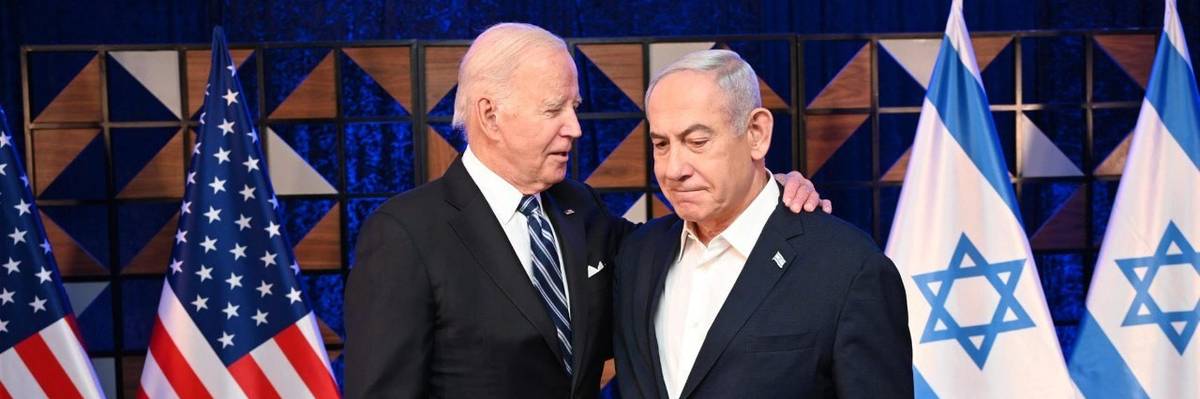
U.S. President Joe Biden (L) and Prime Minister Benjamin Netanyahu (R) meet in Tel Aviv, Israel on October 18, 2023.
The Waning Beatification of President Biden
the legacy curation of the Biden administration in the greater elsewhere of our world will focus on a succession of war crimes and strategic privations in Gaza sponsored by the United States.
When U.S. President Joe Biden announced last July that he would not seek a second term, left-leaning pundits, politicians, and late-night comics waxed lyrical in elevating Biden to near-mythic status, framing his big choice as proof of sacrificing personal ambition for the salvation of American democracy.
After the presidential elections and as his presidency unceremoniously fades, serious talk about Joe’s legacy has fallen sloppy dead (channeling Grace Slick) and been replaced by disorganized clamor over Vice President Kamala Harris’ decisive defeat.
Still, it remains odd that Biden’s decision to pass the electoral torch to his vice president was ever cast as a salvific moment in modern American politics. Long before the election results, the legacy pillow talk showed an embarrassing blind spot in the internal discourse of the country.
In this moment of horrific violence, veils have been lifted, and, as a result, what America and Americans think about the Middle East has lost its luster internationally.
As the Biden redemption arc threaded through the media logic of the mainstream public sphere, global discourses about Biden’s legacy had pursued a different path. The Biden-Harris-Blinken team, for the most part, has been viewed in much of the world for presiding over what scholars, jurists, courts, members of Congress, and respected human rights groups have called or made adjacent references to being genocide or genocidal violence in Gaza—an “Industrial scale slaughterhouse.”
Despite the populist narratology justifying the American diplomatic shield for Israeli bellicosity and an unending supply of war kits, the legacy curation of the Biden administration in the greater elsewhere of our world will focus on a succession of war crimes and strategic privations in Gaza sponsored by the United States, executed by the Israelis, and underwritten by the epistemic violence of dehumanizing a resolute people who have been killed, displaced, occupied, and politically and economically hamstrung for more than 75 years, if not a century, as historian Rashid Khalidi argues.
The “October 7” signifier, in other words, received little purchase beyond Western milieus.
As for real legacy stakes, they exist and are high. The unchecked violence in Gaza has been described as the “graveyard of liberal values” and “Western ideals.” And “many of the most important principles of humanitarian law,” have also been laid to rest without the dignity of any exequies.
As a consequence, the hegemonic influence of American media narratives on a global scale has unraveled, with the credibility of major Western news organizations tanking and “irreparably damaged.” Even from within, major Western outlets face allegations of journalistic malpractice, by staff from CNN and BBC, for example, protesting editorial impositions on reporters to take an Israel-biased slant in their Gaza coverage.
Such failings have managed to quicken concepts typically locked in academia. For example, New York University professor Miranda Fricker’s theoretical works on “epistemic injustice” hold more active meaning now. The structures of mediation spotlight one perspective, while entire groups are denied credibility as knowers of their own contexts and denied meaningful space in the media ecology.
Likewise, Northwestern’s José Medina’s “epistemic responsibility” is now heard as a call for the dismantling of media structures that amplify one-sided narratives while deliberately silencing others. This unchecked dynamic aligns with what I term the “epistemology of repetition,” where context-stripped narratives gain the veneer of truth for no higher reason than sheer repetition, with any attempt at rigor and fact-checking labeled as antisemitic.
At stake is the fundamental right of Palestinians to be recognized as legitimate sources of their own lived experiences and claims. Denying these rights or covering them with performative both-side-ism silences their histories, aspirations, and love for their land—a love expressed through resistance to occupation and a firm commitment to family, education, and spirituality. Such epistemic violence not only mirrors physical destruction but enables it by erasing the cultural and historical claims of those affected and makes up the narrative scaffolding that typecast Palestinians as forever aggressors and Israelis as perpetual victims, as anthropologist Julie Peteet writes.
From my perch as a media and religious studies academic and a Chicago native teaching in the Middle East for nearly 17 years, I have little hope that American journalism will embrace greater epistemic responsibility toward Palestine. Answering this call would require radical transformations of journalistic premises and praxis. This epistemic responsibility would be considered nothing less than storytelling apostasy.
In this moment of horrific violence, veils have been lifted, and, as a result, what America and Americans think about the Middle East has lost its luster internationally. The distributive imbalances of reportage and the suppression of meaningful counter-narratives have never been so stark. The corporate media giants took a huge gamble with their coverage of Gaza (especially in the early months of the violence), but they lost the bet and injured their credibility abroad, leaving a damning evidentiary trail of blatant bias in news coverage that is “rife with deadly double standards.”
As a result, the American brand has been tarnished, which ultimately is Joe’s legacy.
We are at a crossroads
This country and this world are at a monumental crossroads. In a few short weeks, US voters will have an opportunity to beat back the forces of fascism and confront the billionaires who are rigging the economy, our media system, and our democracy, making it increasingly impossible for ordinary people to get by. We’re not just talking about the election. We’re talking about what must be done once these fascist elements are vanquished from power. We need a bolder set of solutions than what either major party has so far been willing to offer and a working-class movement ready to fight like hell for it. Trump didn't emerge from nowhere. The conditions that fueled MAGA authoritarianism were created by decades of radical neoliberal economic policies and a corrupt political system dominated by corporate interests. They slashed taxes on the super-rich, promising that the benefits would trickle down. They said giveaways to the corporate titans would make life more affordable for the rest of us. It was all bullshit. And when a bitter, betrayed populace searches for someone to blame, right-wing demagogues have little trouble finding scapegoats. People know when they're being lied to, but you won't hear any of this from the corporate media. Only independent journalism—powered and funded by people who believe in building a better world—can deliver truly trustworthy daily news. Our Fall Campaign is underway, and we need your help. To power our newsroom through the rest of the year, we need to raise $125,000 by midnight on October 31. So if you share our vision, please contribute whatever you can to sustain our work. |
When U.S. President Joe Biden announced last July that he would not seek a second term, left-leaning pundits, politicians, and late-night comics waxed lyrical in elevating Biden to near-mythic status, framing his big choice as proof of sacrificing personal ambition for the salvation of American democracy.
After the presidential elections and as his presidency unceremoniously fades, serious talk about Joe’s legacy has fallen sloppy dead (channeling Grace Slick) and been replaced by disorganized clamor over Vice President Kamala Harris’ decisive defeat.
Still, it remains odd that Biden’s decision to pass the electoral torch to his vice president was ever cast as a salvific moment in modern American politics. Long before the election results, the legacy pillow talk showed an embarrassing blind spot in the internal discourse of the country.
In this moment of horrific violence, veils have been lifted, and, as a result, what America and Americans think about the Middle East has lost its luster internationally.
As the Biden redemption arc threaded through the media logic of the mainstream public sphere, global discourses about Biden’s legacy had pursued a different path. The Biden-Harris-Blinken team, for the most part, has been viewed in much of the world for presiding over what scholars, jurists, courts, members of Congress, and respected human rights groups have called or made adjacent references to being genocide or genocidal violence in Gaza—an “Industrial scale slaughterhouse.”
Despite the populist narratology justifying the American diplomatic shield for Israeli bellicosity and an unending supply of war kits, the legacy curation of the Biden administration in the greater elsewhere of our world will focus on a succession of war crimes and strategic privations in Gaza sponsored by the United States, executed by the Israelis, and underwritten by the epistemic violence of dehumanizing a resolute people who have been killed, displaced, occupied, and politically and economically hamstrung for more than 75 years, if not a century, as historian Rashid Khalidi argues.
The “October 7” signifier, in other words, received little purchase beyond Western milieus.
As for real legacy stakes, they exist and are high. The unchecked violence in Gaza has been described as the “graveyard of liberal values” and “Western ideals.” And “many of the most important principles of humanitarian law,” have also been laid to rest without the dignity of any exequies.
As a consequence, the hegemonic influence of American media narratives on a global scale has unraveled, with the credibility of major Western news organizations tanking and “irreparably damaged.” Even from within, major Western outlets face allegations of journalistic malpractice, by staff from CNN and BBC, for example, protesting editorial impositions on reporters to take an Israel-biased slant in their Gaza coverage.
Such failings have managed to quicken concepts typically locked in academia. For example, New York University professor Miranda Fricker’s theoretical works on “epistemic injustice” hold more active meaning now. The structures of mediation spotlight one perspective, while entire groups are denied credibility as knowers of their own contexts and denied meaningful space in the media ecology.
Likewise, Northwestern’s José Medina’s “epistemic responsibility” is now heard as a call for the dismantling of media structures that amplify one-sided narratives while deliberately silencing others. This unchecked dynamic aligns with what I term the “epistemology of repetition,” where context-stripped narratives gain the veneer of truth for no higher reason than sheer repetition, with any attempt at rigor and fact-checking labeled as antisemitic.
At stake is the fundamental right of Palestinians to be recognized as legitimate sources of their own lived experiences and claims. Denying these rights or covering them with performative both-side-ism silences their histories, aspirations, and love for their land—a love expressed through resistance to occupation and a firm commitment to family, education, and spirituality. Such epistemic violence not only mirrors physical destruction but enables it by erasing the cultural and historical claims of those affected and makes up the narrative scaffolding that typecast Palestinians as forever aggressors and Israelis as perpetual victims, as anthropologist Julie Peteet writes.
From my perch as a media and religious studies academic and a Chicago native teaching in the Middle East for nearly 17 years, I have little hope that American journalism will embrace greater epistemic responsibility toward Palestine. Answering this call would require radical transformations of journalistic premises and praxis. This epistemic responsibility would be considered nothing less than storytelling apostasy.
In this moment of horrific violence, veils have been lifted, and, as a result, what America and Americans think about the Middle East has lost its luster internationally. The distributive imbalances of reportage and the suppression of meaningful counter-narratives have never been so stark. The corporate media giants took a huge gamble with their coverage of Gaza (especially in the early months of the violence), but they lost the bet and injured their credibility abroad, leaving a damning evidentiary trail of blatant bias in news coverage that is “rife with deadly double standards.”
As a result, the American brand has been tarnished, which ultimately is Joe’s legacy.
- History Will Not Be Kind to Biden's Complicity in Gaza ›
- 25 Groups Demand Biden 'Urgently Comply With US Law' and End Israel Arms Sales ›
- 'Lead or Lose': 21 Arrested Blockading Biden Campaign HQ Over Climate, Gaza ›
- Global Fury After State Dept Claims Israel Not Violating US Law by Blocking Gaza Aid ›
- 80+ Groups Urge Biden to 'Reverse Course Before Thousands More Die' in Gaza ›
- Biden Continues to Cement a Bloody and Immoral Legacy in Gaza ›
- Opinion | Biden’s Legacy Is Written In Blood | Common Dreams ›
When U.S. President Joe Biden announced last July that he would not seek a second term, left-leaning pundits, politicians, and late-night comics waxed lyrical in elevating Biden to near-mythic status, framing his big choice as proof of sacrificing personal ambition for the salvation of American democracy.
After the presidential elections and as his presidency unceremoniously fades, serious talk about Joe’s legacy has fallen sloppy dead (channeling Grace Slick) and been replaced by disorganized clamor over Vice President Kamala Harris’ decisive defeat.
Still, it remains odd that Biden’s decision to pass the electoral torch to his vice president was ever cast as a salvific moment in modern American politics. Long before the election results, the legacy pillow talk showed an embarrassing blind spot in the internal discourse of the country.
In this moment of horrific violence, veils have been lifted, and, as a result, what America and Americans think about the Middle East has lost its luster internationally.
As the Biden redemption arc threaded through the media logic of the mainstream public sphere, global discourses about Biden’s legacy had pursued a different path. The Biden-Harris-Blinken team, for the most part, has been viewed in much of the world for presiding over what scholars, jurists, courts, members of Congress, and respected human rights groups have called or made adjacent references to being genocide or genocidal violence in Gaza—an “Industrial scale slaughterhouse.”
Despite the populist narratology justifying the American diplomatic shield for Israeli bellicosity and an unending supply of war kits, the legacy curation of the Biden administration in the greater elsewhere of our world will focus on a succession of war crimes and strategic privations in Gaza sponsored by the United States, executed by the Israelis, and underwritten by the epistemic violence of dehumanizing a resolute people who have been killed, displaced, occupied, and politically and economically hamstrung for more than 75 years, if not a century, as historian Rashid Khalidi argues.
The “October 7” signifier, in other words, received little purchase beyond Western milieus.
As for real legacy stakes, they exist and are high. The unchecked violence in Gaza has been described as the “graveyard of liberal values” and “Western ideals.” And “many of the most important principles of humanitarian law,” have also been laid to rest without the dignity of any exequies.
As a consequence, the hegemonic influence of American media narratives on a global scale has unraveled, with the credibility of major Western news organizations tanking and “irreparably damaged.” Even from within, major Western outlets face allegations of journalistic malpractice, by staff from CNN and BBC, for example, protesting editorial impositions on reporters to take an Israel-biased slant in their Gaza coverage.
Such failings have managed to quicken concepts typically locked in academia. For example, New York University professor Miranda Fricker’s theoretical works on “epistemic injustice” hold more active meaning now. The structures of mediation spotlight one perspective, while entire groups are denied credibility as knowers of their own contexts and denied meaningful space in the media ecology.
Likewise, Northwestern’s José Medina’s “epistemic responsibility” is now heard as a call for the dismantling of media structures that amplify one-sided narratives while deliberately silencing others. This unchecked dynamic aligns with what I term the “epistemology of repetition,” where context-stripped narratives gain the veneer of truth for no higher reason than sheer repetition, with any attempt at rigor and fact-checking labeled as antisemitic.
At stake is the fundamental right of Palestinians to be recognized as legitimate sources of their own lived experiences and claims. Denying these rights or covering them with performative both-side-ism silences their histories, aspirations, and love for their land—a love expressed through resistance to occupation and a firm commitment to family, education, and spirituality. Such epistemic violence not only mirrors physical destruction but enables it by erasing the cultural and historical claims of those affected and makes up the narrative scaffolding that typecast Palestinians as forever aggressors and Israelis as perpetual victims, as anthropologist Julie Peteet writes.
From my perch as a media and religious studies academic and a Chicago native teaching in the Middle East for nearly 17 years, I have little hope that American journalism will embrace greater epistemic responsibility toward Palestine. Answering this call would require radical transformations of journalistic premises and praxis. This epistemic responsibility would be considered nothing less than storytelling apostasy.
In this moment of horrific violence, veils have been lifted, and, as a result, what America and Americans think about the Middle East has lost its luster internationally. The distributive imbalances of reportage and the suppression of meaningful counter-narratives have never been so stark. The corporate media giants took a huge gamble with their coverage of Gaza (especially in the early months of the violence), but they lost the bet and injured their credibility abroad, leaving a damning evidentiary trail of blatant bias in news coverage that is “rife with deadly double standards.”
As a result, the American brand has been tarnished, which ultimately is Joe’s legacy.
- History Will Not Be Kind to Biden's Complicity in Gaza ›
- 25 Groups Demand Biden 'Urgently Comply With US Law' and End Israel Arms Sales ›
- 'Lead or Lose': 21 Arrested Blockading Biden Campaign HQ Over Climate, Gaza ›
- Global Fury After State Dept Claims Israel Not Violating US Law by Blocking Gaza Aid ›
- 80+ Groups Urge Biden to 'Reverse Course Before Thousands More Die' in Gaza ›
- Biden Continues to Cement a Bloody and Immoral Legacy in Gaza ›
- Opinion | Biden’s Legacy Is Written In Blood | Common Dreams ›