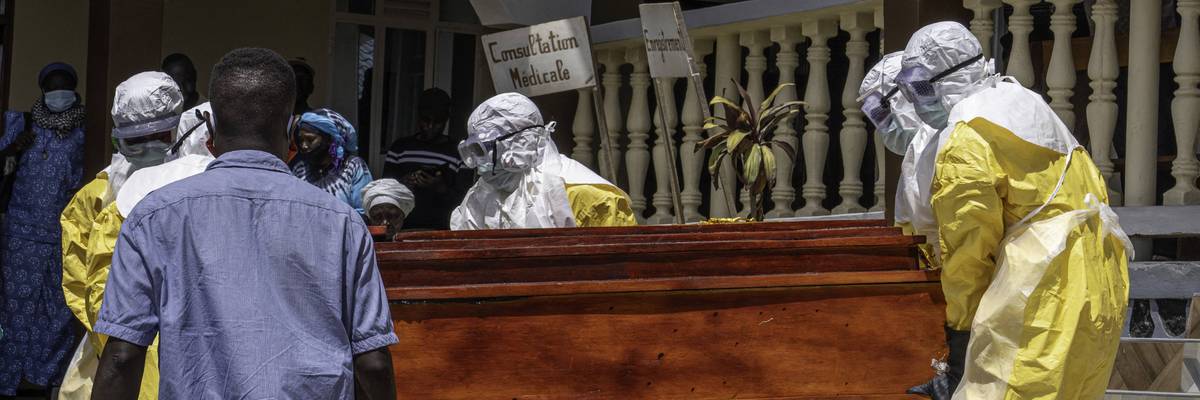
The coffin of a person suspected of having died from Ebola is carried onto a pick up truck by health worker at a hospital in Bunia, in the eastern Democratic Republic of the Congo, on May 25, 2026.
An Ebola Outbreak Made More Deadly and Dangerous Thanks to Trump
We lived through another pandemic nightmare with this president, but the warnings about what he was unleashing with his 2025 assault on USAID and CDC were not heeded. Once again, people are paying with their lives.
The current, rapidly metastasizing Ebola outbreak in East and Central Africa is a sobering reminder of how unprepared we remain for the inevitability of the next pandemic that is always sure to come. Especially when the US continues to hamstring the global efforts needed to contain deadly eruptions.
As of Sunday, May 24, there were 231 deaths and more than 1,000 cases reported, primarily in the Democratic Republic of Congo (DRC), though 10 African countries are now considered at risk. “You cannot cut the systems that detect and stop outbreaks early— then act shocked when they spiral. Pathogens exploit weak systems,” said Krutika Kuppalli, MD FIDSA, in a post on Sunday.
On Monday, Dr. Tedros Ghebreyesus, director-general of the World Health Organization (WHO), told the world that the outbreak was “outpacing us."
The Trump administration, previously the WHO's largest funder, is the biggest reason of these failures and need to play catch up. Assistance from the US to the DRC reportedly fell from $1.4 billion in 2024 to just $21 million in 2026, said Kuppalli.
“Many of the international systems created or strengthened after earlier Ebola crises have been weakened,” the Washington Post reported last week. While the US once "played a central coordinating role in previous Ebola response efforts,” the newspaper noted, "that infrastructure has been significantly diminished following Trump administration cuts" in early 2025.
With the US pulling out of the WHO and eviscerating the US Agency for International Development (USAID), which routed money and supplies quickly, the ability to help organizations on the ground pivot from prevention "to contact tracing and communications" has vanished, said Stephanie Psaki, US coordinator for global health security in the Biden administration.
The Trump administration has even barred key infectious disease officials from communicating with the WHO. “The whole disaster response capability at USAID no longer exists,” said Jeremy Konyndyk, the former lead of USAID’s Ebola response team.
On May 20, National Nurses United, issued a statement admonishing the Trump administration for making everyone less safe in the face of the outbreak.
“Nurses understand the life-or-death importance of prevention, and when it comes to infectious diseases, that means having strong infrastructure in place to rapidly detect and respond to new outbreaks before they are out of control," said NNU. "The Trump administration has purposely taken a sledgehammer to that infrastructure over the past year.”
Nurses are prominent among the health workers, and health policy researchers, who have long warned of the danger of sudden outbreaks that can lead to massive, deadly pandemics.
“The arrival of the next great pandemic has always been a ‘when,’ not an ‘if,’ and firewalls for stopping it are getting thinner,” journalists Conn Hallinan and Carl Bloice wrote in 2005 in the California Nurses Association’s Revolution magazine. That piece was written amid concern for the spreading of avian flu, but the warning signs of a failing prevention and response system were already evident. “Public health budgets in this nation and across the globe are being systematically starved of funding,” they wrote.
Four years later, H1NI, also known as swine flu, brought the fears to life. The Centers for Disease Control and Prevention (CDC) estimated there were 60.8 million cases and an estimated range of between 151,700 to 575,400 deaths worldwide its first year alone. Deborah Burger, RN, then president of the California Nurses Association, warned, “We should learn the lessons of the 1918-1919 flu pandemic, one of which was the enormous mitigating effect on mortality of adequate nursing care.”
Those working on the frontlines to care for infected patients are particularly vulnerable. Speaking to Hallinan and Bloice, University of Minnesota researcher Michael Osterholm predicted back in 2005 that “health care workers would become ill and die at rates similar to, or even higher than in the general public" in the face of a pandemic.
On July 17, 2009, Karen Ann Hays, a cancer care RN at Mercy San Juan Medical Center in Carmichael, CA near Sacramento, and a healthy triathlete and marathon runner, became the first health care worker in California to die of H1N1. Only after the union announced plans for a one-day strike affecting 16,000 RNs in California and Nevada, did then-Gov. Schwarzenegger and major hospitals implement new safety protocols.
In March 2014, the largest outbreak of the deadly Ebola virus was reported in West Africa. By August, the WHO declared a public health emergency as it spread in Africa, and reached Europe and the US. As noted, the outbreak was particularly dangerous for healthcare workers exposed to Ebola patients.
Recalling the spread of H1N1, NNU urged federal, state, and local officials to adhere to strict infectious disease guidelines to protect patients, healthcare workers, and the public. Seeing little done by September 2014, more than 1,000 nurses held a march and die-in during a convention in Las Vegas to alert the public to inadequate US preparations to stop the spread of Ebola and similar pandemics.
Days later, a patient recently returned to the US from Liberia, was diagnosed with Ebola in a Dallas hospital and died. Within two weeks, two Dallas nurses in that hospital, Nina Pham and Amber Vincent, were infected. NNU called on President Barack Obama to “invoke his executive authority” to order all US hospitals to meet the highest “uniform, national standards and protocols” to “safely protect patients, all healthcare workers and the public.”
Burger testified to the House Committee on Oversight and Government Reform on the lack of mandated protections for nurses and patients. “The risk of exposure to the population at large merely starts with front-line caregivers like registered nurses, physicians and other healthcare workers—it does not end there," Burger told lawmakers. "If we cannot protect our nurses and other healthcare workers, we cannot protect anyone.”
A two-day strike the next month at 86 hospitals and clinics over the lack of Ebola preparedness again helped spur needed measures. Within weeks, the federal government, and some states, including California, enacted reforms to improve pandemic protections in US facilities, and as NNU was also urging, escalated support for global protections in West Africa.
Cuba was in the forefront of providing direct frontline care in West Africa in 2014, sending 165 Cuban nurses and doctors, risking their own lives. At a time today with the US threatening an invasion of Cuba following months of an illegal blockade that has had a debilitating impact on its health care system, it’s worth recalling that as recently as 2024, Cuba had dispatched more than 20,000 medical staff to more than 50 countries in humanitarian missions.
When Trump first came into office, he ignored the preparedness lessons. Beginning the morning after his 2017 inauguration, Trump systematically dismantled a pandemic infrastructure response program put in place by Obama. By January 2020, when the WHO had begun warning of the outbreak known as Covid-19, the Trump administration was caught flatfooted. As the initial US infections appeared, Trump’s first public statement that month was this: “We have it totally under control. It’s one person coming in from China. It’s going to be just fine.”
In contrast, NNU had already begun to press Trump to implement national and safety protocols and measures, with public accountability. Instead, Trump’s response was months of denials, deflections, and promotion of false cures while dismissing the best protective measures. By June 2020, with 110,000 dead Americans, Trump insisted, “It is dying out, it’s going to fade away.”
By February 2024, the US counted nearly 7 million cases, and over 1.1 million deaths. So many lives could have been saved with advance preparedness and rapid implementation of the proper safety measures.
Hospital employers and numerous state governments, especially in GOP-controlled states, took their lead from the Trump administration to slow walk or ignore critical protections. Workers in essential front-line occupations, from public transportation to nursing homes and hospitals, as well as lower income jobs in grocery and drug stores, poultry and other meat processing, and service industries generally, paid a high price, especially workers of color.
Through August 2023, the Covid death count hit 5,753 for health care workers overall, including 501 RNs. Filipinos, 4 percent of all RNs, accounted for 21 percent of the deaths among nurses.
In the 2014 outbreak, 881 doctors, nurses, and midwives were infected in West Africa, and 513 died. The crisis created a severe shortage of healthcare workers across the region.
By May 21 in the current Ebola outbreak, at least four health worker deaths have been reported in the DRC. Three Red Cross volunteers have also died. One doctor evacuated from the DRC, waiting in a specialized hospital room in Prague to see whether he has Ebola, said his former colleagues in the DRC are beginning to die of the deadly disease.
The International Rescue Committee warned on Tuesady that thus outbreak is spreading faster than responders can contain it and risks becoming "the deadliest on record."
As the NNU warned last week, neither the nation nor the world can afford another public health mismanagement disaster from the like of Trump. “Nurses have already lived through one bungled, global health emergency response during the first Trump administration," said the union, "and we are appalled to know that when it comes to Ebola, hantavirus, or any other infectious disease, the United States under Donald Trump is now even less prepared than in 2020."We are at a crossroads
This country and this world are at a monumental crossroads. In a few short weeks, US voters will have an opportunity to beat back the forces of fascism and confront the billionaires who are rigging the economy, our media system, and our democracy, making it increasingly impossible for ordinary people to get by. We’re not just talking about the election. We’re talking about what must be done once these fascist elements are vanquished from power. We need a bolder set of solutions than what either major party has so far been willing to offer and a working-class movement ready to fight like hell for it. Trump didn't emerge from nowhere. The conditions that fueled MAGA authoritarianism were created by decades of radical neoliberal economic policies and a corrupt political system dominated by corporate interests. They slashed taxes on the super-rich, promising that the benefits would trickle down. They said giveaways to the corporate titans would make life more affordable for the rest of us. It was all bullshit. And when a bitter, betrayed populace searches for someone to blame, right-wing demagogues have little trouble finding scapegoats. People know when they're being lied to, but you won't hear any of this from the corporate media. Only independent journalism—powered and funded by people who believe in building a better world—can deliver truly trustworthy daily news. Our Fall Campaign is underway, and we need your help. To power our newsroom through the rest of the year, we need to raise $125,000 by midnight on October 31. So if you share our vision, please contribute whatever you can to sustain our work. |
The current, rapidly metastasizing Ebola outbreak in East and Central Africa is a sobering reminder of how unprepared we remain for the inevitability of the next pandemic that is always sure to come. Especially when the US continues to hamstring the global efforts needed to contain deadly eruptions.
As of Sunday, May 24, there were 231 deaths and more than 1,000 cases reported, primarily in the Democratic Republic of Congo (DRC), though 10 African countries are now considered at risk. “You cannot cut the systems that detect and stop outbreaks early— then act shocked when they spiral. Pathogens exploit weak systems,” said Krutika Kuppalli, MD FIDSA, in a post on Sunday.
On Monday, Dr. Tedros Ghebreyesus, director-general of the World Health Organization (WHO), told the world that the outbreak was “outpacing us."
The Trump administration, previously the WHO's largest funder, is the biggest reason of these failures and need to play catch up. Assistance from the US to the DRC reportedly fell from $1.4 billion in 2024 to just $21 million in 2026, said Kuppalli.
“Many of the international systems created or strengthened after earlier Ebola crises have been weakened,” the Washington Post reported last week. While the US once "played a central coordinating role in previous Ebola response efforts,” the newspaper noted, "that infrastructure has been significantly diminished following Trump administration cuts" in early 2025.
With the US pulling out of the WHO and eviscerating the US Agency for International Development (USAID), which routed money and supplies quickly, the ability to help organizations on the ground pivot from prevention "to contact tracing and communications" has vanished, said Stephanie Psaki, US coordinator for global health security in the Biden administration.
The Trump administration has even barred key infectious disease officials from communicating with the WHO. “The whole disaster response capability at USAID no longer exists,” said Jeremy Konyndyk, the former lead of USAID’s Ebola response team.
On May 20, National Nurses United, issued a statement admonishing the Trump administration for making everyone less safe in the face of the outbreak.
“Nurses understand the life-or-death importance of prevention, and when it comes to infectious diseases, that means having strong infrastructure in place to rapidly detect and respond to new outbreaks before they are out of control," said NNU. "The Trump administration has purposely taken a sledgehammer to that infrastructure over the past year.”
Nurses are prominent among the health workers, and health policy researchers, who have long warned of the danger of sudden outbreaks that can lead to massive, deadly pandemics.
“The arrival of the next great pandemic has always been a ‘when,’ not an ‘if,’ and firewalls for stopping it are getting thinner,” journalists Conn Hallinan and Carl Bloice wrote in 2005 in the California Nurses Association’s Revolution magazine. That piece was written amid concern for the spreading of avian flu, but the warning signs of a failing prevention and response system were already evident. “Public health budgets in this nation and across the globe are being systematically starved of funding,” they wrote.
Four years later, H1NI, also known as swine flu, brought the fears to life. The Centers for Disease Control and Prevention (CDC) estimated there were 60.8 million cases and an estimated range of between 151,700 to 575,400 deaths worldwide its first year alone. Deborah Burger, RN, then president of the California Nurses Association, warned, “We should learn the lessons of the 1918-1919 flu pandemic, one of which was the enormous mitigating effect on mortality of adequate nursing care.”
Those working on the frontlines to care for infected patients are particularly vulnerable. Speaking to Hallinan and Bloice, University of Minnesota researcher Michael Osterholm predicted back in 2005 that “health care workers would become ill and die at rates similar to, or even higher than in the general public" in the face of a pandemic.
On July 17, 2009, Karen Ann Hays, a cancer care RN at Mercy San Juan Medical Center in Carmichael, CA near Sacramento, and a healthy triathlete and marathon runner, became the first health care worker in California to die of H1N1. Only after the union announced plans for a one-day strike affecting 16,000 RNs in California and Nevada, did then-Gov. Schwarzenegger and major hospitals implement new safety protocols.
In March 2014, the largest outbreak of the deadly Ebola virus was reported in West Africa. By August, the WHO declared a public health emergency as it spread in Africa, and reached Europe and the US. As noted, the outbreak was particularly dangerous for healthcare workers exposed to Ebola patients.
Recalling the spread of H1N1, NNU urged federal, state, and local officials to adhere to strict infectious disease guidelines to protect patients, healthcare workers, and the public. Seeing little done by September 2014, more than 1,000 nurses held a march and die-in during a convention in Las Vegas to alert the public to inadequate US preparations to stop the spread of Ebola and similar pandemics.
Days later, a patient recently returned to the US from Liberia, was diagnosed with Ebola in a Dallas hospital and died. Within two weeks, two Dallas nurses in that hospital, Nina Pham and Amber Vincent, were infected. NNU called on President Barack Obama to “invoke his executive authority” to order all US hospitals to meet the highest “uniform, national standards and protocols” to “safely protect patients, all healthcare workers and the public.”
Burger testified to the House Committee on Oversight and Government Reform on the lack of mandated protections for nurses and patients. “The risk of exposure to the population at large merely starts with front-line caregivers like registered nurses, physicians and other healthcare workers—it does not end there," Burger told lawmakers. "If we cannot protect our nurses and other healthcare workers, we cannot protect anyone.”
A two-day strike the next month at 86 hospitals and clinics over the lack of Ebola preparedness again helped spur needed measures. Within weeks, the federal government, and some states, including California, enacted reforms to improve pandemic protections in US facilities, and as NNU was also urging, escalated support for global protections in West Africa.
Cuba was in the forefront of providing direct frontline care in West Africa in 2014, sending 165 Cuban nurses and doctors, risking their own lives. At a time today with the US threatening an invasion of Cuba following months of an illegal blockade that has had a debilitating impact on its health care system, it’s worth recalling that as recently as 2024, Cuba had dispatched more than 20,000 medical staff to more than 50 countries in humanitarian missions.
When Trump first came into office, he ignored the preparedness lessons. Beginning the morning after his 2017 inauguration, Trump systematically dismantled a pandemic infrastructure response program put in place by Obama. By January 2020, when the WHO had begun warning of the outbreak known as Covid-19, the Trump administration was caught flatfooted. As the initial US infections appeared, Trump’s first public statement that month was this: “We have it totally under control. It’s one person coming in from China. It’s going to be just fine.”
In contrast, NNU had already begun to press Trump to implement national and safety protocols and measures, with public accountability. Instead, Trump’s response was months of denials, deflections, and promotion of false cures while dismissing the best protective measures. By June 2020, with 110,000 dead Americans, Trump insisted, “It is dying out, it’s going to fade away.”
By February 2024, the US counted nearly 7 million cases, and over 1.1 million deaths. So many lives could have been saved with advance preparedness and rapid implementation of the proper safety measures.
Hospital employers and numerous state governments, especially in GOP-controlled states, took their lead from the Trump administration to slow walk or ignore critical protections. Workers in essential front-line occupations, from public transportation to nursing homes and hospitals, as well as lower income jobs in grocery and drug stores, poultry and other meat processing, and service industries generally, paid a high price, especially workers of color.
Through August 2023, the Covid death count hit 5,753 for health care workers overall, including 501 RNs. Filipinos, 4 percent of all RNs, accounted for 21 percent of the deaths among nurses.
In the 2014 outbreak, 881 doctors, nurses, and midwives were infected in West Africa, and 513 died. The crisis created a severe shortage of healthcare workers across the region.
By May 21 in the current Ebola outbreak, at least four health worker deaths have been reported in the DRC. Three Red Cross volunteers have also died. One doctor evacuated from the DRC, waiting in a specialized hospital room in Prague to see whether he has Ebola, said his former colleagues in the DRC are beginning to die of the deadly disease.
The International Rescue Committee warned on Tuesady that thus outbreak is spreading faster than responders can contain it and risks becoming "the deadliest on record."
As the NNU warned last week, neither the nation nor the world can afford another public health mismanagement disaster from the like of Trump. “Nurses have already lived through one bungled, global health emergency response during the first Trump administration," said the union, "and we are appalled to know that when it comes to Ebola, hantavirus, or any other infectious disease, the United States under Donald Trump is now even less prepared than in 2020."The current, rapidly metastasizing Ebola outbreak in East and Central Africa is a sobering reminder of how unprepared we remain for the inevitability of the next pandemic that is always sure to come. Especially when the US continues to hamstring the global efforts needed to contain deadly eruptions.
As of Sunday, May 24, there were 231 deaths and more than 1,000 cases reported, primarily in the Democratic Republic of Congo (DRC), though 10 African countries are now considered at risk. “You cannot cut the systems that detect and stop outbreaks early— then act shocked when they spiral. Pathogens exploit weak systems,” said Krutika Kuppalli, MD FIDSA, in a post on Sunday.
On Monday, Dr. Tedros Ghebreyesus, director-general of the World Health Organization (WHO), told the world that the outbreak was “outpacing us."
The Trump administration, previously the WHO's largest funder, is the biggest reason of these failures and need to play catch up. Assistance from the US to the DRC reportedly fell from $1.4 billion in 2024 to just $21 million in 2026, said Kuppalli.
“Many of the international systems created or strengthened after earlier Ebola crises have been weakened,” the Washington Post reported last week. While the US once "played a central coordinating role in previous Ebola response efforts,” the newspaper noted, "that infrastructure has been significantly diminished following Trump administration cuts" in early 2025.
With the US pulling out of the WHO and eviscerating the US Agency for International Development (USAID), which routed money and supplies quickly, the ability to help organizations on the ground pivot from prevention "to contact tracing and communications" has vanished, said Stephanie Psaki, US coordinator for global health security in the Biden administration.
The Trump administration has even barred key infectious disease officials from communicating with the WHO. “The whole disaster response capability at USAID no longer exists,” said Jeremy Konyndyk, the former lead of USAID’s Ebola response team.
On May 20, National Nurses United, issued a statement admonishing the Trump administration for making everyone less safe in the face of the outbreak.
“Nurses understand the life-or-death importance of prevention, and when it comes to infectious diseases, that means having strong infrastructure in place to rapidly detect and respond to new outbreaks before they are out of control," said NNU. "The Trump administration has purposely taken a sledgehammer to that infrastructure over the past year.”
Nurses are prominent among the health workers, and health policy researchers, who have long warned of the danger of sudden outbreaks that can lead to massive, deadly pandemics.
“The arrival of the next great pandemic has always been a ‘when,’ not an ‘if,’ and firewalls for stopping it are getting thinner,” journalists Conn Hallinan and Carl Bloice wrote in 2005 in the California Nurses Association’s Revolution magazine. That piece was written amid concern for the spreading of avian flu, but the warning signs of a failing prevention and response system were already evident. “Public health budgets in this nation and across the globe are being systematically starved of funding,” they wrote.
Four years later, H1NI, also known as swine flu, brought the fears to life. The Centers for Disease Control and Prevention (CDC) estimated there were 60.8 million cases and an estimated range of between 151,700 to 575,400 deaths worldwide its first year alone. Deborah Burger, RN, then president of the California Nurses Association, warned, “We should learn the lessons of the 1918-1919 flu pandemic, one of which was the enormous mitigating effect on mortality of adequate nursing care.”
Those working on the frontlines to care for infected patients are particularly vulnerable. Speaking to Hallinan and Bloice, University of Minnesota researcher Michael Osterholm predicted back in 2005 that “health care workers would become ill and die at rates similar to, or even higher than in the general public" in the face of a pandemic.
On July 17, 2009, Karen Ann Hays, a cancer care RN at Mercy San Juan Medical Center in Carmichael, CA near Sacramento, and a healthy triathlete and marathon runner, became the first health care worker in California to die of H1N1. Only after the union announced plans for a one-day strike affecting 16,000 RNs in California and Nevada, did then-Gov. Schwarzenegger and major hospitals implement new safety protocols.
In March 2014, the largest outbreak of the deadly Ebola virus was reported in West Africa. By August, the WHO declared a public health emergency as it spread in Africa, and reached Europe and the US. As noted, the outbreak was particularly dangerous for healthcare workers exposed to Ebola patients.
Recalling the spread of H1N1, NNU urged federal, state, and local officials to adhere to strict infectious disease guidelines to protect patients, healthcare workers, and the public. Seeing little done by September 2014, more than 1,000 nurses held a march and die-in during a convention in Las Vegas to alert the public to inadequate US preparations to stop the spread of Ebola and similar pandemics.
Days later, a patient recently returned to the US from Liberia, was diagnosed with Ebola in a Dallas hospital and died. Within two weeks, two Dallas nurses in that hospital, Nina Pham and Amber Vincent, were infected. NNU called on President Barack Obama to “invoke his executive authority” to order all US hospitals to meet the highest “uniform, national standards and protocols” to “safely protect patients, all healthcare workers and the public.”
Burger testified to the House Committee on Oversight and Government Reform on the lack of mandated protections for nurses and patients. “The risk of exposure to the population at large merely starts with front-line caregivers like registered nurses, physicians and other healthcare workers—it does not end there," Burger told lawmakers. "If we cannot protect our nurses and other healthcare workers, we cannot protect anyone.”
A two-day strike the next month at 86 hospitals and clinics over the lack of Ebola preparedness again helped spur needed measures. Within weeks, the federal government, and some states, including California, enacted reforms to improve pandemic protections in US facilities, and as NNU was also urging, escalated support for global protections in West Africa.
Cuba was in the forefront of providing direct frontline care in West Africa in 2014, sending 165 Cuban nurses and doctors, risking their own lives. At a time today with the US threatening an invasion of Cuba following months of an illegal blockade that has had a debilitating impact on its health care system, it’s worth recalling that as recently as 2024, Cuba had dispatched more than 20,000 medical staff to more than 50 countries in humanitarian missions.
When Trump first came into office, he ignored the preparedness lessons. Beginning the morning after his 2017 inauguration, Trump systematically dismantled a pandemic infrastructure response program put in place by Obama. By January 2020, when the WHO had begun warning of the outbreak known as Covid-19, the Trump administration was caught flatfooted. As the initial US infections appeared, Trump’s first public statement that month was this: “We have it totally under control. It’s one person coming in from China. It’s going to be just fine.”
In contrast, NNU had already begun to press Trump to implement national and safety protocols and measures, with public accountability. Instead, Trump’s response was months of denials, deflections, and promotion of false cures while dismissing the best protective measures. By June 2020, with 110,000 dead Americans, Trump insisted, “It is dying out, it’s going to fade away.”
By February 2024, the US counted nearly 7 million cases, and over 1.1 million deaths. So many lives could have been saved with advance preparedness and rapid implementation of the proper safety measures.
Hospital employers and numerous state governments, especially in GOP-controlled states, took their lead from the Trump administration to slow walk or ignore critical protections. Workers in essential front-line occupations, from public transportation to nursing homes and hospitals, as well as lower income jobs in grocery and drug stores, poultry and other meat processing, and service industries generally, paid a high price, especially workers of color.
Through August 2023, the Covid death count hit 5,753 for health care workers overall, including 501 RNs. Filipinos, 4 percent of all RNs, accounted for 21 percent of the deaths among nurses.
In the 2014 outbreak, 881 doctors, nurses, and midwives were infected in West Africa, and 513 died. The crisis created a severe shortage of healthcare workers across the region.
By May 21 in the current Ebola outbreak, at least four health worker deaths have been reported in the DRC. Three Red Cross volunteers have also died. One doctor evacuated from the DRC, waiting in a specialized hospital room in Prague to see whether he has Ebola, said his former colleagues in the DRC are beginning to die of the deadly disease.
The International Rescue Committee warned on Tuesady that thus outbreak is spreading faster than responders can contain it and risks becoming "the deadliest on record."
As the NNU warned last week, neither the nation nor the world can afford another public health mismanagement disaster from the like of Trump. “Nurses have already lived through one bungled, global health emergency response during the first Trump administration," said the union, "and we are appalled to know that when it comes to Ebola, hantavirus, or any other infectious disease, the United States under Donald Trump is now even less prepared than in 2020."