SUBSCRIBE TO OUR FREE NEWSLETTER
Daily news & progressive opinion—funded by the people, not the corporations—delivered straight to your inbox.
5
#000000
#FFFFFF
To donate by check, phone, or other method, see our More Ways to Give page.
Daily news & progressive opinion—funded by the people, not the corporations—delivered straight to your inbox.
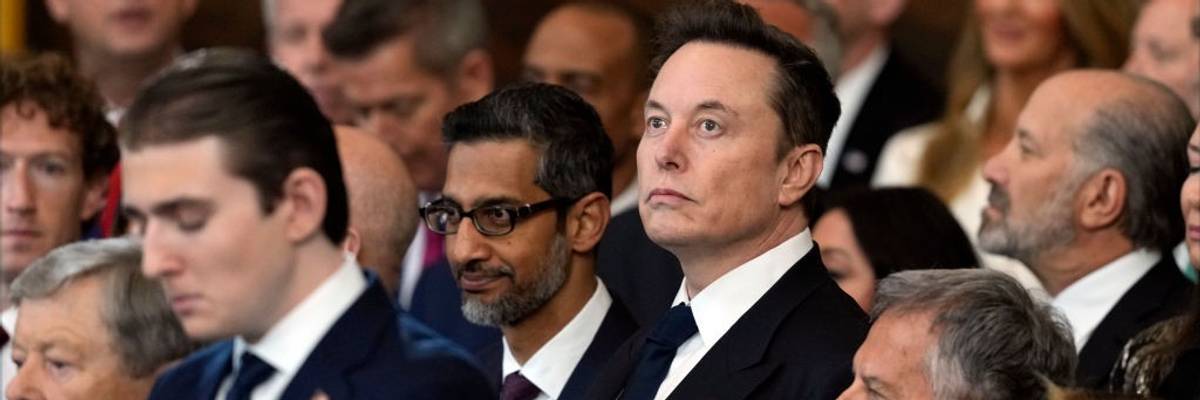
Google CEO Sundar Pichai and Elon Musk attend the inauguration of Donald Trump at the US Capitol Rotunda on January 20, 2025 in Washington, DC.
The United States has no nobility, according to our Constitution. But our tax code does protect the very rich.
Pre-revolutionary French aristocrats—the “Second Estate”—didn’t pay taxes. Amazingly, America too has a second estate, billionaires who pay virtually no taxes. In her very outstanding recent book, law professor Ray D. Madoff shows how they get away with this.
The United States has no nobility, according to our Constitution. But our tax code does protect the very rich.
Federal taxes on income and estates—intended to fund government and prevent development of a hereditary financial aristocracy—were enacted early in the 20th century and originally worked well.
But since about 1980, the estate tax—infested with loopholes—has been nearly abolished for practical purposes and now produces trivial income.
Madoff wants to get rid of the ability of ultra-rich people—billionaires—to avoid having any taxable income in the first place.
Madoff suggests that the estate tax should be completely eliminated because its existence deceives the public about what is really going on. People falsely think that billionaires who pay no federal income tax will at least pay the estate tax when they die. In fact, they are paying neither kind of tax.
Billionaires avoid the income tax by arranging to have no taxable income.
Before 1982 ultra-rich people could not avoid paying income tax. Their income consisted of dividends and capital gains harvested by selling shares of stock, the price of which had increased. Dividends and capital gains are taxable income.
But in 1982 federal regulators weakened a rule prohibiting corporations from buying back their own stock. Since then, many corporations have used profits to buy back stock shares instead of issuing dividends. With fewer shares of stock outstanding and the value of the corporation increasing, the value of each share of stock began increasing dramatically.
What used to be taxable dividends turned into large capital gains benefiting the stock owners, including very rich ones. If shareholders need cash and sell appreciated stock, of course they would owe income taxes on the capital gains (selling price of the stock minus how much the shares cost them). But capital gains are taxed at a much lower rate than normal income like salaries, bank interest, and returns on bonds.
As Madoff points out, however, billionaires need not sell any stock to get cash to live on. Instead, they can borrow the money, using their stock as collateral. Borrowed money is not taxable income, so they owe no tax while living extravagantly.
And when they die, the stock they bequest to their heirs gets a stepped up “basis,” so if their heirs sell the stock they will owe no taxes because the stepped up basis leaves no taxable capital gains.
And inherited money is not considered taxable income. Someone who earns $50,000 pays significant income (and payroll) taxes on it, while someone who inherits $1 billion pays no income or payroll tax on it.
Madoff rightly objects to this situation, but she is not arguing that we should “soak the rich” with higher income tax rates at the top. She points out that there are two kinds of “rich” people. One is the working rich, skilled professionals earning high salaries and, usually, already paying very high taxes. A high percentage of all income tax receipts come from these people.
Increasing the high tax rates these “rich” people are already paying would produce insignificant extra revenue for the government.
Instead, Madoff wants to get rid of the ability of ultra-rich people—billionaires—to avoid having any taxable income in the first place. She wouldn’t tax them while they are alive, but would tax whoever inherits from them.
Rather than trying to fix the estate tax, Madoff would abolish it, eliminate the stepped up basis for inherited stock, and make inherited money and other gifts received taxable income for the recipients.
Assuming an exemption for small gifts (to allow birthday presents and the like), this could be a reasonable reform. It would bring in very large amounts of taxes while reducing today’s extreme economic inequality.
For further details, see Ray D. Madoff, The Second Estate: How The Tax Code Made An American Aristocracy. This is one of the two best books I have read since retiring in 2000.
Dear Common Dreams reader, It’s been nearly 30 years since I co-founded Common Dreams with my late wife, Lina Newhouser. We had the radical notion that journalism should serve the public good, not corporate profits. It was clear to us from the outset what it would take to build such a project. No paid advertisements. No corporate sponsors. No millionaire publisher telling us what to think or do. Many people said we wouldn't last a year, but we proved those doubters wrong. Together with a tremendous team of journalists and dedicated staff, we built an independent media outlet free from the constraints of profits and corporate control. Our mission has always been simple: To inform. To inspire. To ignite change for the common good. Building Common Dreams was not easy. Our survival was never guaranteed. When you take on the most powerful forces—Wall Street greed, fossil fuel industry destruction, Big Tech lobbyists, and uber-rich oligarchs who have spent billions upon billions rigging the economy and democracy in their favor—the only bulwark you have is supporters who believe in your work. But here’s the urgent message from me today. It's never been this bad out there. And it's never been this hard to keep us going. At the very moment Common Dreams is most needed, the threats we face are intensifying. We need your support now more than ever. We don't accept corporate advertising and never will. We don't have a paywall because we don't think people should be blocked from critical news based on their ability to pay. Everything we do is funded by the donations of readers like you. When everyone does the little they can afford, we are strong. But if that support retreats or dries up, so do we. Will you donate now to make sure Common Dreams not only survives but thrives? —Craig Brown, Co-founder |
Pre-revolutionary French aristocrats—the “Second Estate”—didn’t pay taxes. Amazingly, America too has a second estate, billionaires who pay virtually no taxes. In her very outstanding recent book, law professor Ray D. Madoff shows how they get away with this.
The United States has no nobility, according to our Constitution. But our tax code does protect the very rich.
Federal taxes on income and estates—intended to fund government and prevent development of a hereditary financial aristocracy—were enacted early in the 20th century and originally worked well.
But since about 1980, the estate tax—infested with loopholes—has been nearly abolished for practical purposes and now produces trivial income.
Madoff wants to get rid of the ability of ultra-rich people—billionaires—to avoid having any taxable income in the first place.
Madoff suggests that the estate tax should be completely eliminated because its existence deceives the public about what is really going on. People falsely think that billionaires who pay no federal income tax will at least pay the estate tax when they die. In fact, they are paying neither kind of tax.
Billionaires avoid the income tax by arranging to have no taxable income.
Before 1982 ultra-rich people could not avoid paying income tax. Their income consisted of dividends and capital gains harvested by selling shares of stock, the price of which had increased. Dividends and capital gains are taxable income.
But in 1982 federal regulators weakened a rule prohibiting corporations from buying back their own stock. Since then, many corporations have used profits to buy back stock shares instead of issuing dividends. With fewer shares of stock outstanding and the value of the corporation increasing, the value of each share of stock began increasing dramatically.
What used to be taxable dividends turned into large capital gains benefiting the stock owners, including very rich ones. If shareholders need cash and sell appreciated stock, of course they would owe income taxes on the capital gains (selling price of the stock minus how much the shares cost them). But capital gains are taxed at a much lower rate than normal income like salaries, bank interest, and returns on bonds.
As Madoff points out, however, billionaires need not sell any stock to get cash to live on. Instead, they can borrow the money, using their stock as collateral. Borrowed money is not taxable income, so they owe no tax while living extravagantly.
And when they die, the stock they bequest to their heirs gets a stepped up “basis,” so if their heirs sell the stock they will owe no taxes because the stepped up basis leaves no taxable capital gains.
And inherited money is not considered taxable income. Someone who earns $50,000 pays significant income (and payroll) taxes on it, while someone who inherits $1 billion pays no income or payroll tax on it.
Madoff rightly objects to this situation, but she is not arguing that we should “soak the rich” with higher income tax rates at the top. She points out that there are two kinds of “rich” people. One is the working rich, skilled professionals earning high salaries and, usually, already paying very high taxes. A high percentage of all income tax receipts come from these people.
Increasing the high tax rates these “rich” people are already paying would produce insignificant extra revenue for the government.
Instead, Madoff wants to get rid of the ability of ultra-rich people—billionaires—to avoid having any taxable income in the first place. She wouldn’t tax them while they are alive, but would tax whoever inherits from them.
Rather than trying to fix the estate tax, Madoff would abolish it, eliminate the stepped up basis for inherited stock, and make inherited money and other gifts received taxable income for the recipients.
Assuming an exemption for small gifts (to allow birthday presents and the like), this could be a reasonable reform. It would bring in very large amounts of taxes while reducing today’s extreme economic inequality.
For further details, see Ray D. Madoff, The Second Estate: How The Tax Code Made An American Aristocracy. This is one of the two best books I have read since retiring in 2000.
Pre-revolutionary French aristocrats—the “Second Estate”—didn’t pay taxes. Amazingly, America too has a second estate, billionaires who pay virtually no taxes. In her very outstanding recent book, law professor Ray D. Madoff shows how they get away with this.
The United States has no nobility, according to our Constitution. But our tax code does protect the very rich.
Federal taxes on income and estates—intended to fund government and prevent development of a hereditary financial aristocracy—were enacted early in the 20th century and originally worked well.
But since about 1980, the estate tax—infested with loopholes—has been nearly abolished for practical purposes and now produces trivial income.
Madoff wants to get rid of the ability of ultra-rich people—billionaires—to avoid having any taxable income in the first place.
Madoff suggests that the estate tax should be completely eliminated because its existence deceives the public about what is really going on. People falsely think that billionaires who pay no federal income tax will at least pay the estate tax when they die. In fact, they are paying neither kind of tax.
Billionaires avoid the income tax by arranging to have no taxable income.
Before 1982 ultra-rich people could not avoid paying income tax. Their income consisted of dividends and capital gains harvested by selling shares of stock, the price of which had increased. Dividends and capital gains are taxable income.
But in 1982 federal regulators weakened a rule prohibiting corporations from buying back their own stock. Since then, many corporations have used profits to buy back stock shares instead of issuing dividends. With fewer shares of stock outstanding and the value of the corporation increasing, the value of each share of stock began increasing dramatically.
What used to be taxable dividends turned into large capital gains benefiting the stock owners, including very rich ones. If shareholders need cash and sell appreciated stock, of course they would owe income taxes on the capital gains (selling price of the stock minus how much the shares cost them). But capital gains are taxed at a much lower rate than normal income like salaries, bank interest, and returns on bonds.
As Madoff points out, however, billionaires need not sell any stock to get cash to live on. Instead, they can borrow the money, using their stock as collateral. Borrowed money is not taxable income, so they owe no tax while living extravagantly.
And when they die, the stock they bequest to their heirs gets a stepped up “basis,” so if their heirs sell the stock they will owe no taxes because the stepped up basis leaves no taxable capital gains.
And inherited money is not considered taxable income. Someone who earns $50,000 pays significant income (and payroll) taxes on it, while someone who inherits $1 billion pays no income or payroll tax on it.
Madoff rightly objects to this situation, but she is not arguing that we should “soak the rich” with higher income tax rates at the top. She points out that there are two kinds of “rich” people. One is the working rich, skilled professionals earning high salaries and, usually, already paying very high taxes. A high percentage of all income tax receipts come from these people.
Increasing the high tax rates these “rich” people are already paying would produce insignificant extra revenue for the government.
Instead, Madoff wants to get rid of the ability of ultra-rich people—billionaires—to avoid having any taxable income in the first place. She wouldn’t tax them while they are alive, but would tax whoever inherits from them.
Rather than trying to fix the estate tax, Madoff would abolish it, eliminate the stepped up basis for inherited stock, and make inherited money and other gifts received taxable income for the recipients.
Assuming an exemption for small gifts (to allow birthday presents and the like), this could be a reasonable reform. It would bring in very large amounts of taxes while reducing today’s extreme economic inequality.
For further details, see Ray D. Madoff, The Second Estate: How The Tax Code Made An American Aristocracy. This is one of the two best books I have read since retiring in 2000.