April, 10 2024, 10:00am EDT
PFAS Drinking Water Limits Are First Step to Safer Water, But Polluters Must Be Held Accountable
Today, EPA Administrator Michael Regan announced the final regulations that set enforceable limits on six PFAS — the toxic lab-made compounds known as “forever chemicals” — in drinking water. The EPA set maximum contaminant levels (MCLs) for PFOA and PFOS of 4 ppt each; MCLs for PFHxS, PFNA and GenX at 10 ppt, and limits on a combination of four PFAS types (PFNA, PFHxS, PFBS and GenX) based on a hazard index. Utilities will have five years to comply with the new limits.
Water systems serving at least 100 million people are expected to be contaminated with PFAS, and the new rule requires water systems to complete testing within three years. The EPA estimates the total cost of compliance would be $1.5 billion a year; the American Water Works Association puts that figure closer to $3.8 billion.
The EPA has yet to finalize regulations that would designate certain forms of PFAS as “hazardous substances” under the superfund law to facilitate holding polluters accountable for clean-up costs. This topic has been the subject of heavy lobbying from the chemical industry. A Food & Water Watch report found that from 2019 to 2022, PFAS manufacturers spent more than $55 million lobbying on PFAS and other issues, and the American Chemical Council spent an additional $58.7 on lobbying on PFAS and other issues during that period.
In response, Food & Water Watch Executive Director Wenonah Hauter issued the following statement:
“At long last, the EPA has set enforceable limits to remove toxic forever chemicals from drinking water that will help protect public health nationally. These regulations come after decades of community organizing and will save many lives. While we applaud the EPA for not bowing to industry pressure to weaken the regulations, this must mark the beginning — not the culmination — of its efforts to rein in these toxic PFAS.
“The science is clear: No amount of PFAS in water is safe. Today’s action addresses just six of thousands of these toxic chemicals. The EPA must regulate the entire class to remove all PFAS from our drinking water, ban the manufacture of nonessential PFAS, and hold polluters accountable to pay to clean up their toxic mess. The brunt of the compliance costs must be borne by the PFAS polluters, so that households already struggling with unaffordable water bills are not stuck picking up the tab of corporate water pollution.
“Corporate polluters long hid evidence of the toxicity of these chemicals, and they have spent millions of dollars lobbying against regulations that would protect people from this harm. Congress must reject corporate efforts to carve various polluters out of liability, and it must pass the PFAS Action Act to continue the work to address this toxic crisis.
“Communities also need more federal support to comply with these necessary new standards. The Bipartisan Infrastructure Law provided a down payment of $9 billion to address PFAS in drinking water, but our communities deserve a permanent source of federal funding. The WATER Act is the right vision to fully fund our public water infrastructure at the level that is needed to ensure safe and clean water for all.”
Food & Water Watch mobilizes regular people to build political power to move bold and uncompromised solutions to the most pressing food, water, and climate problems of our time. We work to protect people's health, communities, and democracy from the growing destructive power of the most powerful economic interests.
(202) 683-2500LATEST NEWS
Fearing Mass Job Loss, Working-Class US Voters Believe Government Must Act to Prevent Economic Disaster
The findings of a new poll could bolster the case made by many progressive politicians about the need to vigorously regulate the AI industry.
Jun 23, 2026
A poll commissioned by Working Families Power reveals deep anxiety among US workers about the impacts of artificial intelligence, as well as support for the government intervening to prevent potential mass unemployment.
The survey of just over 2,500 working-class American voters, conducted by Justice Research Group, finds that 73% said they were worried that AI would lead to job losses in the US, while 62% said they were concerned that AI would personally affect them or people close to them.
Workers expect that AI will negatively impact a broad number of industries, with majorities saying it will hurt truckers and delivery drivers; retail and service workers; writers, designers, and other creative workers; and office and administrative workers, according to the poll. Pluralities, meanwhile, expect AI to hurt teachers, education workers, and healthcare support workers.
With so many workers fearing massive jobs losses due to AI, they also support major government interventions to alleviate the harms caused by the technology.
Overall, 84% of those surveyed support free training or education for all workers displaced by AI, while 79% support rules to force companies to share AI productivity gains with their workers in the former of higher pay, stronger benefits, and shorter hours.
Even the least popular policy idea presented in the poll—taxing large companies that replace workers with AI and using the money to create a worker unemployment fund—received 69% support among US workers.
The poll's findings could bolster the case made by many progressive politicians about the need to vigorously regulate the AI industry to prevent it from hurting working-class Americans.
Sen. Bernie Sanders (I-Vt.) and Rep. Alexandria Ocasio-Cortez (D-NY) earlier this year introduced a bill that would impose a nationwide moratorium on AI data center construction “until strong national safeguards are in place to protect workers, consumers, and communities, defend privacy and civil rights, and ensure these technologies do not harm our environment."
Sen. Elizabeth Warren (D-Mass.) and Rep. Greg Casar (D-Texas) last month proposed a tax on the use of AI to pay for jobs programs for affected workers.
Keep ReadingShow Less
More Than 5 Million People Have Lost Health Coverage Under Trump-GOP Law
According to a new report, the crisis is "only going to get worse."
Jun 23, 2026
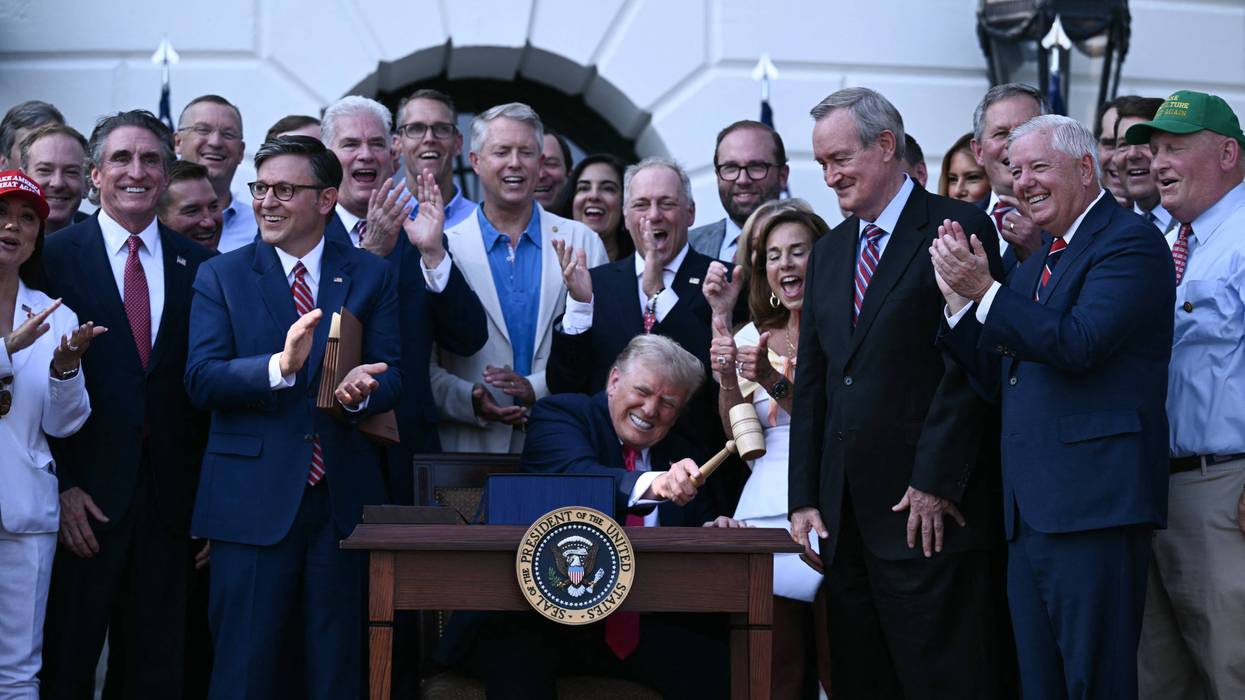
Not even a year after President Donald Trump signed the largest healthcare cuts in US history into law, around five million Americans have lost insurance coverage, according to a report out Monday from Protect Our Care, which predicted that the crisis was "only going to get worse."
The massive budget and tax legislation passed by Republicans last July, known as the One Big Beautiful Bill Act, slashed nearly $1 trillion from Medicaid and the Children's Health Insurance Program (CHIP) over the next decade while introducing tax breaks that are expected to hand an additional $1 trillion to the richest 1% of Americans.
“Five million and counting. That’s the human toll of the spiraling Republican healthcare affordability crisis,” said Protect Our Care president Brad Woodhouse. “Just one year after Trump and congressional Republicans made the largest cuts to healthcare in history to fund tax breaks for billionaires and big corporations on Wall Street, millions have lost the care they depended on to stay alive and healthy."
Citing the most recent data from the Centers for Medicare and Medicaid Services (CMS) and state agencies, the report found that the number of Americans enrolled in Medicaid and CHIP had fallen to just 76.9 million, down from 80.8 million a year before—a decline of more than 3.8 million people.
Another 1.2 million are also estimated to have lost coverage due to the massive spike in premiums after Republicans voted not to renew tax credits for consumers under the Affordable Care Act (ACA) that lowered costs for Americans who purchased coverage through ACA marketplaces.
During open enrollment in 2025, 24.3 million Americans selected insurance plans through the ACA. This year, as the average premium was projected to more than double on average, the number of Americans enrolled through the ACA fell to just 23.1 million—a drop of nearly 1.2 million.
The millions of other families still enrolled in insurance through the ACA exchanges saw an average increase of $780, and according to KFF, it's only been that low because many families have opted to switch to cheaper, less comprehensive plans.
The loss of insurance coverage "is only a small piece of the puzzle," Woodhouse said.
"Millions more are making impossible choices every day to keep their coverage, including skipping rent or cutting back on groceries so they can see a doctor," he said. "Their pain and suffering are incalculable."
The report said the coverage losses over the first year are "just the beginning" and that "millions more will lose coverage once deeper cuts go into effect."
The full slate of changes to Medicaid from the GOP bill has not yet been enacted. Next year, many adult recipients will be required to submit proof that they are doing at least 80 hours of work or other qualifying activity each month in order to maintain benefits, which the nonpartisan Congressional Budget Office (CBO) estimated could increase the uninsured population by 5.3 million by 2034.
Another paperwork hurdle, the requirement that certain Medicaid expansion enrollees prove their eligibility every six months, is expected to result in another 700,000 people becoming uninsured by 2034.
In total, CBO analyses estimate that over the next decade, roughly 15 million Americans would lose their insurance coverage as a result of the legislation.
"These are our neighbors, our friends, our loved ones. These are small business owners and farmers. These are seniors. Veterans. Moms," Woodhouse said. "These are millions of working people now scrambling to find insulin pumps, taking thousands out of retirement just to see a doctor for that cough that’s not getting better, or, worse, not getting care at all."
With healthcare costs now a top concern among voters—66% of whom said they were worried about affording it, according to a KFF poll in January—cuts to healthcare spending appear to be a glaring liability for Republicans entering the midterm elections.
Another KFF poll from April found that 37% of voters said they trusted Democrats to address healthcare costs, while just 26% said they trusted Republicans. Meanwhile, 67% of voters said they disapproved of the Trump administration's handling of healthcare costs.
"Every single day, the affordability crisis mounts, and more Americans will find themselves joining the five million struggling to keep up with skyrocketing healthcare costs," Woodhouse said. "The American people won’t forget this betrayal in November.”
Democrats have seized on Monday's report as part of their election pitch, including Rep. Greg Landsman, who faces a competitive reelection fight in Ohio's 1st Congressional District.
He wrote on social media Tuesday that Republicans "cut healthcare by nearly a trillion to pay for tax cuts for the super wealthy... five million people no longer have healthcare."
"The healthcare crisis in America is dominating the lives of millions, and will soon dominate all of our lives," he said. "We need a new Congress to restore people’s healthcare and to end this crisis. There is no other way."
Keep ReadingShow Less
Trump DOJ's Use of Subpoenas Against Journalists Is 'Straight Out of the Dictator's Playbook': Press Freedom Group
"The potential of the government intruding into the newsgathering process is even greater when you are in the grand jury than it is for a subpoena for documents," said one press freedom advocate.
Jun 23, 2026
The US Department of Justice's attempt to compel journalists to testify before a grand jury is drawing blowback from a top press freedom group, which is accusing President Donald Trump's administration of behaving like an authoritarian regime.
According to a Tuesday report in The New York Times, the DOJ earlier this month issued subpoenas for national security reporters at The Washington Post and The Wall Street Journal related to national security leaks.
Subpoenas against both news organizations were withdrawn after they issued legal challenges in sealed filings.
"The Justice Department had sought information from three reporters at The Journal about an article detailing how top officials warned... Trump of the risks of a major military campaign against Iran," reported the Times. "It also sought information from a reporter at The Post, Ellen Nakashima, about reporting related to US military action in Venezuela."
As the Times noted, it is highly uncommon for government investigators to subpoena journalists when they are probing national security leaks, as such actions are generally seen as having a chilling effect on reporters' ability to gather information.
After the details of the subpoenas and news of their withdrawal broke, Reporters Without Borders slammed the Trump DOJ for hitting a "new low" in its attempt to "suppress information from the American people."
"Subpoenaing journalists to appear before a grand jury under the guise of ‘national security’ is straight out of the dictator's playbook," the group said. "Fortunately, in the United States, newsrooms are fighting back and winning."
A Tuesday CNN report claimed that Trump had personally pushed acting Attorney General Todd Blanche to subpoena the journalists, going so far as to hand Blanche "a sticky note—with the word 'Treason' written in Sharpie—placed atop a stack of printed articles."
CNN also reported that both the Post and the Journal "remain on guard against the possibility that the subpoenas will be reissued in the future."
A spokesperson for the Post ripped the Trump DOJ for issuing "an unwarranted subpoena of our reporter," which the newspaper described as "a clear violation of constitutionally guaranteed press freedom."
"We will continue to stand fully behind the journalism of The Washington Post," the spokesperson added, "and fight all efforts by any administration that violate our First Amendment rights."
Gabe Rottman, vice president of policy at Reporters Committee for Freedom of the Press, said in an interview with the Post that issuing grand jury subpoenas to reporters puts core First Amendment rights at risk because "once you are up in front of the grand jury, the testimony can go in many different ways and can inquire into stories that are unrelated to the underlying investigation."
"The potential of the government intruding into the newsgathering process is even greater when you are in the grand jury than it is for a subpoena for documents," Rottman added.
Keep ReadingShow Less
Most Popular