

SUBSCRIBE TO OUR FREE NEWSLETTER
Daily news & progressive opinion—funded by the people, not the corporations—delivered straight to your inbox.
5
#000000
#FFFFFF
To donate by check, phone, or other method, see our More Ways to Give page.
Daily news & progressive opinion—funded by the people, not the corporations—delivered straight to your inbox.

The Affordable Care Act (ACA), commonly referred to as "Obamacare", is on the path to be repealed, and supposedly replaced. A new report from the Center for Economic and Policy Research (CEPR), shows that the ACA has not only increased the number
The Affordable Care Act (ACA), commonly referred to as "Obamacare", is on the path to be repealed, and supposedly replaced. A new report from the Center for Economic and Policy Research (CEPR), shows that the ACA has not only increased the number of people insured, but also made it so workers have the flexibility to choose the type of job they want and still have the security of having health insurance.
The report, "The Affordable Care Act and the Change in Voluntary Part-Time Employment by States", provides a state-by-state basis for assessing the increase in labor market flexibility as a result of the ACA and what would be lost if the law were repealed without a replacement that provides an equal or better level of security in obtaining health care insurance.
Every month, more than 5 million people leave or lose their job, which often means losing their employer-provided health insurance. Regaining coverage after leaving a job, especially with a pre-existing condition, can be highly unaffordable, if available at all. The ACA has made it possible so people can leave a job they don't want and still have access to health insurance while finding a position they do want.
Since the ACA went into effect, the number of people working part-time by choice has increased by about 1.8 million - predominantly among young parents and older workers who do not qualify for Medicare yet. These data do not rely on a person's opinion on the law, which may be colored by their political affiliation; rather, it answers the question: "Are you working part-time because you want to?" The large gains in voluntary part-time employment indicate that people are taking advantage of the security that the ACA provides and are enjoying more freedom in their work.
Dean Baker, co-author of the report, states that "It seems nonsensical that policymakers would ignore the benefits of the increased worker freedom the ACA has provided. Presumably, if the ACA were repealed without some comparable system of insurance put in its place, these numbers give an indication of how many people would again be forced to seek out full-time employment to get employer-provided health insurance, even though part-time work better fits their needs."
The Center for Economic and Policy Research (CEPR) was established in 1999 to promote democratic debate on the most important economic and social issues that affect people's lives. In order for citizens to effectively exercise their voices in a democracy, they should be informed about the problems and choices that they face. CEPR is committed to presenting issues in an accurate and understandable manner, so that the public is better prepared to choose among the various policy options.
(202) 293-5380
"Every day the consequences of GOP healthcare cuts get worse," said one campaigner.
Health insurance companies that offer plans on the Affordable Care Act marketplace are proposing double-digit premium increases for 2027, signaling the second consecutive year of out-of-pocket cost hikes following President Donald Trump and congressional Republicans' refusal to extend enhanced subsidies that lapsed last December.
The health policy research group KFF and the Peterson Center on Healthcare released an analysis on Wednesday showing that ACA marketplace insurers "are proposing a median premium increase of about 14% in 2027." While that would represent a decrease compared to the median finalized premium increase of 20% for 2026, it marks "the second-highest requested rate change since 2018, as premium growth had been relatively flat in this market for several years," the analysis notes.
"If these early indications of median premium increases for 2027 hold, typical premiums for insurers participating in the ACA marketplaces will have jumped by more than one-third over a two-year period," KFF and the Peterson Center found, pointing to the significance of Trump and the GOP's deciseion to oppose an extension of enhanced ACA premiums that were established in 2021 during the Biden administration.
KFF and the Peterson Center explain:
As anticipated, many healthier enrollees left the ACA Marketplaces in 2026 as their subsidies decreased—leading to an average increase in premium payments after subsidies of 58% this year—leaving behind an enrollee base that is on average somewhat sicker and more expensive to cover. For 2026, this dynamic was estimated to drive rates an average of four percentage points higher than they otherwise would have been, and insurers are now building 2027 rates on top of that adjusted, less-healthy risk pool—compounding the effect into next year’s premiums as well.
Leslie Dach, chair of the advocacy group Protect Our Care, said in a statement Wednesday that the analysis underscores "just the latest hit on hard-working families struggling to get by after Republicans ripped away the tax credits that helped millions of Americans afford coverage."
"Every day the consequences of GOP healthcare cuts get worse," said Dach. "This was a deliberate choice by Republicans who took away affordable coverage from millions of people to help fund tax breaks for billionaires and big corporations. The damage is already being felt at kitchen tables across America, and these new premium hikes show the worst is still ahead. And Republicans will pay the political price. Healthcare is already the driving issue leading up to the elections, and as the consequences mount, it will only mobilize voters further.”
Since the start of President Donald Trump's second White House term, ACA enrollment has declined by more than 5 million people as a growing number of Americans are priced out of coverage by surging premiums.
For 2027, at least 20 insurers across states that have submitted rate filings so far have proposed premium increases exceeding 20%, according to the KFF-Peterson Center analysis.
Kendall Witmer, the Democratic National Committee's rapid response director, said in a statement Wednesday that "healthcare is unaffordable for millions of Americans because Donald Trump and Republicans sold them out to give billionaires even bigger tax cuts."
"Working families are already grappling with sky-high prices for groceries and gas, and growing medical bills are putting them over the edge," said Witmer. "Healthcare for Americans has never been more expensive—and Trump and Republicans are squarely to blame."
Leor Tal, campaign director for the advocacy group Unrig Our Ecnomy, echoed those arguments and called for GOP lawmakers, who still control the House and the Senate, to act.
“Millions have already lost access to health insurance, and these planned premium hikes will only escalate this crisis," said Tal.
"We need Republicans in Congress to restore the health care tax credits they took away from millions. Otherwise, when their premiums rise again, Americans will know who is at fault.”

"People should not wake up to discover their face has become raw material for someone else’s AI experiment. This is another invasion of consumers’ privacy."
Tech giant Meta on Tuesday introduced an artificial intelligence image generation model that critics say is a major potential risk to users' personal privacy.
Meta, the parent company of social networks including Facebook and Instagram, described its new Muse Image model as a "creative partner that knows your world, making it easy to turn your ideas into high-quality visuals that you can download and share anywhere, including directly to your feed, story, or chat."
In its announcement, Meta explained how users can either alter existing images or create new ones from scratch using AI prompts.
"You can describe what you want in simple, conversational language, and Meta AI handles the rest thanks to Muse Image," the company said. "Ask it to mock up an image of you in front of a historical landmark, cleanly erase a photobomber from the background of a shot, or write a custom prompt to build a functional QR code."
However, tech publication The Verge on Tuesday flagged a potentially troublesome feature that could compromise user privacy, noting that "users can... mention other Instagram accounts in Muse Image prompts," which will let the AI model "incorporate their likeness into its output."
According to a Tuesday report from Wired, the feature will let users snatch photos from any public Instagram and Facebook accounts unless those accounts' owners specifically choose to opt out of the system.
What's more, opting out of the system is not a simple one-click operation.
"If you want to avoid these AI generations of your Instagram posts without switching your account to private, you’ll have to dig into the app’s settings," reported Wired. "Open the Instagram app, tap your profile, and then tap the three lines in the top-right corner of the screen. Then, scroll down to the Sharing and reuse tab. Here is where you should see a section labeled 'Allow people to use your content on Instagram and with AI features on Meta,' with a toggle for Posts and one for Reels."
JB Branch, director of federal AI governance and technology policy at Public Citizen, blasted Meta for being careless with its users' privacy by making them jump through hoops to stop others from swiping their photos.
"Meta has once again chosen the creepiest possible path," said Branch. "People should not wake up to discover their face has become raw material for someone else’s AI experiment. This is another invasion of consumers’ privacy. Instead of asking for meaningful consent, Meta quietly defaults users into the system and buries the opt-out in account settings."
Branch added that while Meta had a long history of violating user privacy, forcing them to opt out of its new AI image generation model "crosses what should be a bright line."
"If our faces can be repurposed for AI simply because we posted a public photo, then very little remains off limits," Branch emphasized. "Congress should establish clear privacy protections that require affirmative consent before companies can use a person’s image or likeness for AI products."
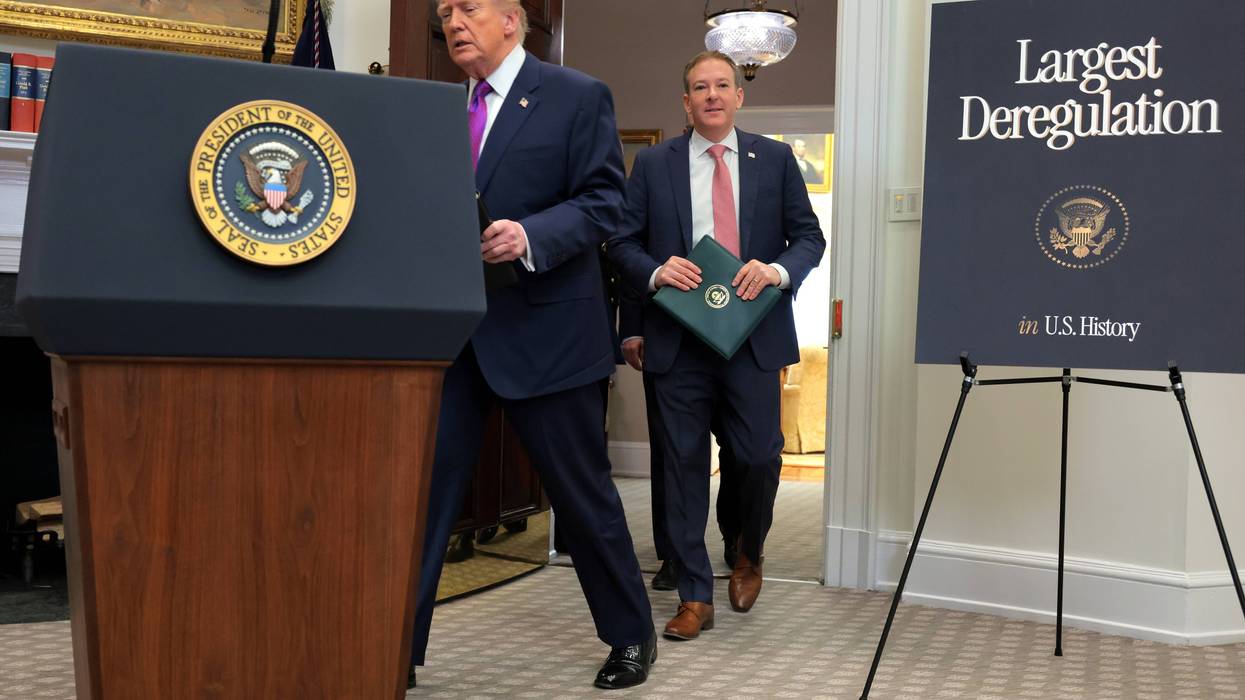
"The fossil fuel industry and this administration's policies are adding fuel to the fire, and ordinary ratepayers are the ones getting burned," said one campaigner.
The Trump administration's rollback of clean energy policies will cost American consumers $650 billion in additional energy bills by 2040, according to an analysis published Wednesday by a nonpartisan think tank.
Energy Innovation, a San Francisco-based energy and climate policy think tank, said in its report that "federal policy changes since January 2025 will increase energy prices, slow economic growth and job creation, increase air pollution and healthcare costs, and worsen grid reliability."
The analysis examines seven major policy shifts during the second term of President Donald Trump, who—for the third time—ran on an aggressively pro-fossil fuel and anti-clean energy platform:
According to the analysis, "Households will pay an additional $650 billion for energy—an average of $460 per household in 2035 and $490 in 2040."
Additionally, the report states that "cutting policies that drive innovation and efficiency in the transportation sector will inflate gasoline prices 14% in 2035 and 26% in 2040, atop near-term upward pressure from the Iran War and other market forces."
"OBBBA and reduced federal support for domestic manufacturing and innovation will cost the US economy 820,000 jobs per year on average over the next decade, in addition to the 144,000 clean energy jobs lost within the past 18 months," the publication forecasts.
"Slowing down electrification and domestic energy manufacturing will lower [gross domestic product] in all years, totaling $2.3 trillion cumulative lost GDP, with effects flowing into other economic sectors," the study warns. "The US economy will lose $150 billion in GDP in 2030, peaking at a $250 billion net loss in 2032, then reverting to losses of $200 billion in 2035 and $120 billion in 2040."
Furthermore, "worsening local air pollution will raise healthcare costs by $43 billion, with annual increases of $4 billion in 2035 and $4.5 billion in 2040, contributing to rising household costs alongside rising energy prices and goods inflation."
Energy Innovation stressed that states must act to mitigate the costs and harms of federal inaction. The report recommends helping wind and solar projects qualify for expiring tax credits under safe harbor rules, removing barriers to additional clean energy development, boosting electric vehicles, supporting energy efficient electrification, and stimulating investment in new clean industries.
The new analysis—whose findings are disputed by the Trump administration—comes amid an unabated affordability crisis that Trump vowed to tackle, and as electricity prices soar in much of the nation as a heat dome, fueled by human burning of fossil fuels, broils large swaths of the country in what many experts warn is the new normal in a worsening climate emergency.
Responding to the analysis, Candice Fortin, US campaigns manager at the climate action group 350.org, said: "This report puts numbers on something households are already feeling in their bills and their blackouts. We were told cutting clean energy would lower costs. Instead, we’re seeing the opposite: rates spiking, grids failing under record heat, and households paying more while data centers’ electricity use explodes."
"You can’t fix an affordability crisis by blocking the cheapest, fastest power we have to build," Fortin added. "The fossil fuel industry and this administration’s policies are adding fuel to the fire, and ordinary ratepayers are the ones getting burned.”