SUBSCRIBE TO OUR FREE NEWSLETTER
Daily news & progressive opinion—funded by the people, not the corporations—delivered straight to your inbox.
5
#000000
#FFFFFF
To donate by check, phone, or other method, see our More Ways to Give page.


Daily news & progressive opinion—funded by the people, not the corporations—delivered straight to your inbox.

Flooding risks around Northern California's Lake Oroville reservoir that forced mass evacuations of people living below the nation's tallest dam in recent days are demonstrating that future infrastructure projects must be capable of withstanding similar catastrophic events, according to the Union of Concerned Scientists.
Below is a statement by Adrienne Alvord:
"The Oroville Dam crisis is dramatic evidence that California must plan for more extreme weather events when designing and building water infrastructure projects because the types of flooding that we have witnessed in recent days will become more frequent due to climate change.
"As we're witnessing now, the risks to lives and property are very real, and the costs for repairing severely damaged infrastructure is much higher than investing in resilient projects from the start. The damage to the Oroville Dam spillways is a case in point of the need for stronger design criteria. Prior warnings to make safety improvements to the dam's structures may well have averted this crisis if they had been heeded.
"Over the past year, we have worked hard to persuade the Department of Water Resources to incorporate the type of science that would help avoid these kinds of catastrophes in the future. In the end, we were baffled that an analysis of more extreme events was not required for new dam projects funded by public dollars through the California water bond.
"This crisis highlights the absolute necessity for the Department of Water Resources and the California Water Commission, as they start to evaluate new water project proposals that are being funded by $2.7 billion in bond funds, to include specifications in their project proposals to handle extreme weather events like the one that led to the spillway damages. Such events are much more likely to occur as global warming intensifies.
"The Union of Concerned Scientists' first concern is for the safety of communities downstream of Oroville Dam, and we commend the rescue workers and those laboring to ensure that the dam spillway does not completely fail and create a true humanitarian catastrophe. We will continue to work with state water officials to ensure these types of life-threatening events can be avoided in the future with water infrastructure planning that can withstand the forces unleashed by a warming planet."
The Union of Concerned Scientists is the leading science-based nonprofit working for a healthy environment and a safer world. UCS combines independent scientific research and citizen action to develop innovative, practical solutions and to secure responsible changes in government policy, corporate practices, and consumer choices.
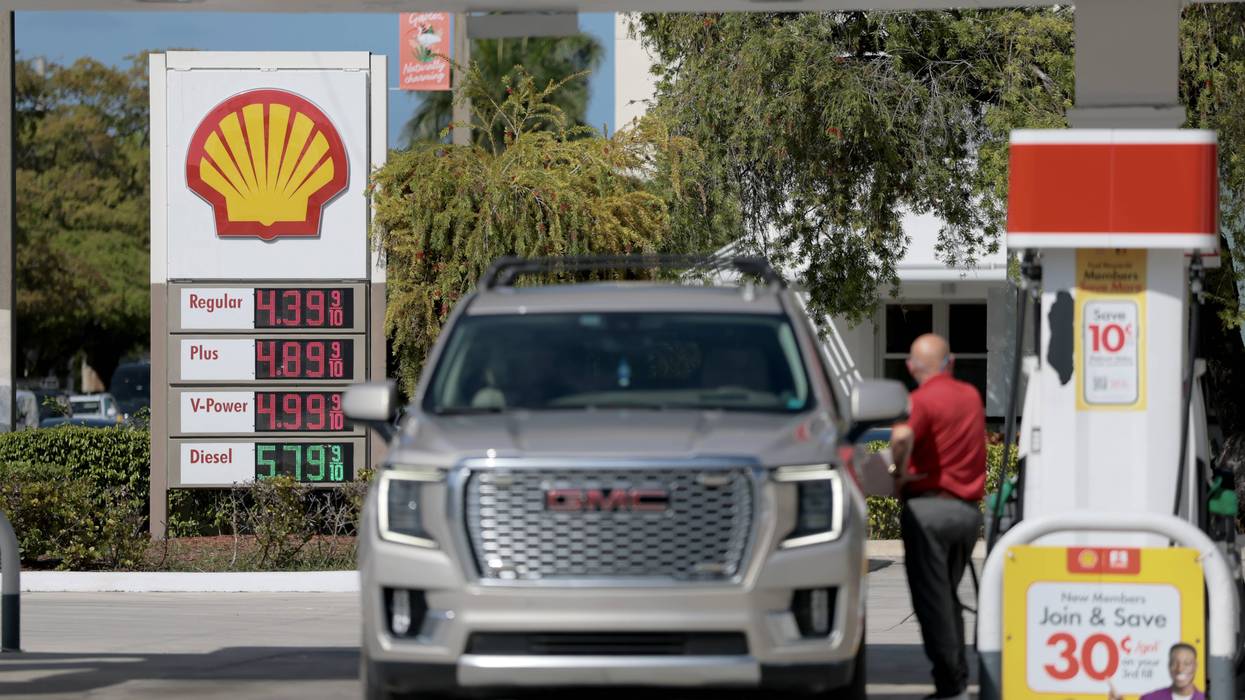
"We are living on borrowed time," said one economist about global oil prices.
With no end in sight to the Strait of Hormuz crisis caused by President Donald Trump's illegal war with Iran, the head of the International Energy Agency warned Monday that global energy supplies are running dangerously low.
IEA executive director Faith Birol told reporters in Paris that the world only has weeks' worth of oil reserves left, raising the likelihood that energy prices will soar even higher in the near future.
Birol said that oil inventories are "declining rapidly" and added that there was "a perception gap in the markets between the physical markets and the financial markets," as the price of oil in futures markets has not yet risen to a level that accurately reflects the coming supply crunch.
In his remarks to the press, given on the sidelines of a G7 gathering taking place this week in France, Birol warned that it's only a matter of time before the supply shortage of fertilizer, which was also caused by the Iran War, leads to a surge in food prices that "might give a big push to inflation numbers."
The Financial Times reported on Sunday that energy markets are approaching a "tipping point" where prices could see another upward surge that would throw the global economy into a recession.
Paul Diggle, chief economist at fund manager Aberdeen, told The Financial Times that he has been modeling the economic impact of oil hitting $180 per barrel, which he said would set off a global inflation crisis.
“We are taking that outcome very seriously,” Diggle said. “We are living on borrowed time."
Oil prices briefly fell last month after the US and Iran announced a ceasefire agreement. However, the Strait of Hormuz has remained closed throughout that period, and Trump is reportedly preparing to restart attacks on Iran in the near future if no deal to reopen the strait is reached.
In a Sunday Truth Social post, Trump again threatened Iran with destruction unless it agrees to his demands.
"For Iran, the Clock is Ticking, and they better get moving, FAST, or there won’t be anything left of them,” the president wrote. “TIME IS OF THE ESSENCE!”
"Shame on European governments who are not acting to stop Israel!" said UN expert Francesca Albanese. "When will Israel's impunity end?"
Israel's raid on a peaceful flotilla of international vessels attempting to bring humanitarian aid to the besieged Gaza Strip was described Monday as an act of brazen piracy and condemned by human rights activists and experts who say the world should no longer stand by in the face of such criminality.
Francesca Albanese, UN special rapporteur on the occupied Palestinian territories, called the operations by Israel "yet another act of piracy by the Israeli army in international waters" that must be condemned by the global community.
Noting that the flotilla is "carrying basic necessities to a desperate population in Gaza," Albanese said: "Shame on European governments who are not acting to stop Israel! When will Israel's impunity end?"
A dispatch was issued by the Global Sumud Flotilla—which has repeatedly tried to break the siege of Gaza—shortly after 10:30 am local time, which said that their vessels off the coast of Cyprus were "currently surrounded and under active interception by Israeli naval warships in international waters, approximately 250 nautical miles from the coast of Gaza."
The Israeli forces reportedly boarded a number of the more than 50 vessels traveling in the flotilla and began detaining those aboard.
"By intercepting the flotilla at a perimeter of 250 nautical miles today and in Cyprus’ SAR zone," said the Flotilla in its statement, "the Israeli regime continues to demonstrate a systematic disregard for international maritime law, freedom of navigation on the high seas, and the United Nations Convention on the Law of the Sea (UNCLOS)."
Thiago Avila, a Brazilian activist who was detained and imprisoned by the Israelis for several days after being kidnapped off a boat on a previous attempt by humanitarians to reach Gaza with relief supplies, said in a video statement on Monday that now was the time for the international community to act.
EXTREMELY URGENT! 🚨 WE NEED YOUR HELP! THE @gbsumudflotilla IS UNDER ATTACK AND THE BOATS ARE BEING INTERCEPTED! pic.twitter.com/sMKgRkedXp
— Thiago Ávila (@thiagoavilabr) May 18, 2026
"Do something," pleaded Avila. "Take to the streets. The world cannot stand a genocide. The world cannot stand a country that violates international law, to continue killing children, assassinating children out of hunger, killing people with drones."
"They want you not to talk about what's happening in Gaza," he continued. "There's no real ceasefire. Seven months of people getting killed, aid still being hindered, more than half the land being taken away, and their plans are the worst for that area—it is complete ethnic cleansing and genocide. We need to stop that."
Ann Wright, a retired US Army colonel who has long been a leading anti-war activist and is currently serving as a member of the support team at the Flotilla's Crisis Center stationed in Istanbul, Turkiye, called the operation to deliver aid the "largest civilian flotilla in the history of support for Palestinians in Gaza" to date.
“Stop the genocide, not the flotilla," said Stephen Bowen, executive Director of Amnesty International Ireland.
Independent journalist Alex Colston, embedded with the flotilla activists and on one of the vessels approached by Israeli forces, reported that he could confirm "people on intercepted boats are being moved to one, maybe two, military prison frigates," though it was not clear where exactly those detained would be taken.
“This alarming spike in the use of the death penalty is due to a small, isolated group of states willing to carry out executions at all costs, despite the continued global trend towards abolition," said Amnesty International's secretary general Agnès Callamard.
With its number of state-sponsored executions nearly doubling in 2025, the United States joined an ignominious handful of nations around the globe that helped bring death penalty punishments worldwide last year to their highest level in nearly half a century.
Amnesty International released its annual review of the death penalty on Monday, showing that the "staggering" overall increase of executions—up from 1,518 in 2024 to at least 2,707 people—was due "to a handful of governments determined to rule by fear."
While 17 nations carried out at least one death sentence in 2025, it was significant increases in five of those countries—the United States, Iran, Saudi Arabia, Kuwait, Egypt, and Singapore—that account for the historic spike. With rates in those countries doubling or even tripling compared to the 2024 figures, Amnesty found, executions overall rose by 78% worldwide in 2025.
As the human rights group notes:
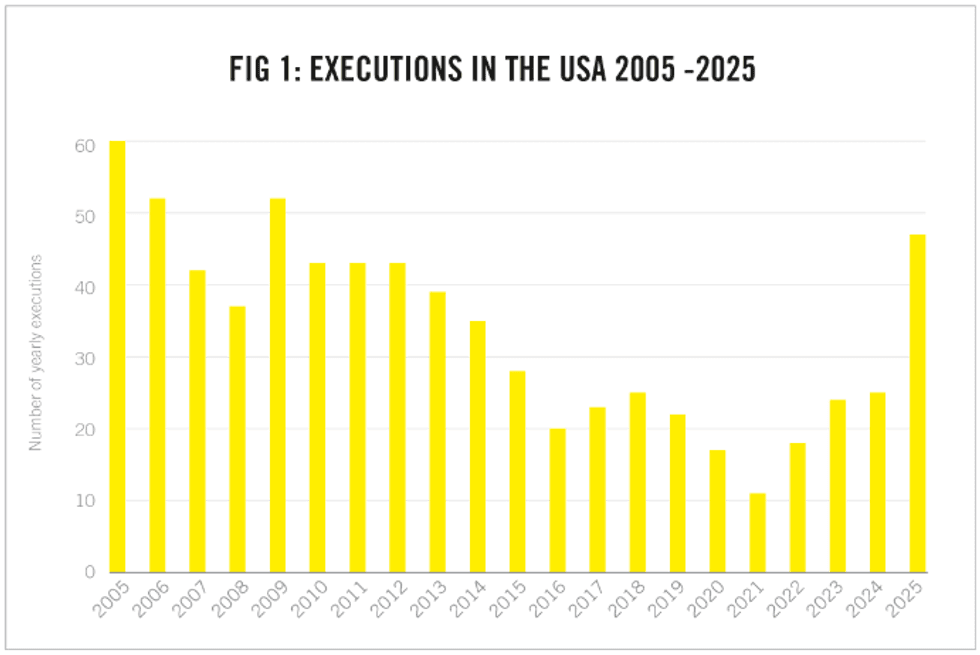
Iranian authorities, the main drivers behind the spike, executed at least 2,159 people, more than double its 2024 figure. Elsewhere, Saudi Arabia raised its execution tally to at least 356, using the death penalty extensively for drug-related offenses. Executions in Kuwait almost tripled (from 6 to 17), while they near doubled in Egypt (from 13 to 23), Singapore (from 9 to 17), and the United States of America (from 25 to 47).
Notably, the 2025 total put forth by Amnesty does not include thousands of executions the human rights group believes were carried out in China, which it says likely carries out thousands each year.
“This alarming spike in the use of the death penalty is due to a small, isolated group of states willing to carry out executions at all costs, despite the continued global trend towards abolition," said Agnès Callamard, Amnesty International’s secretary general. "From China, Iran, North Korea and Saudi Arabia to Yemen, Kuwait, Singapore and the USA, this shameless minority are weaponizing the death penalty to instill fear, crush dissent and show the strength state institutions have over disadvantaged people and marginalized communities."
Under President Donald Trump, who has championed the return of the federal death penalty during both his first and second terms in office, the 47 executions took place across 11 states, with the highest number being carried out in Florida, where 19 people were killed.
Despite the surge in countries like the US and Iran, Amnesty highlighted that "progress was made elsewhere around the world, proving hope is stronger than fear."
The report notes that no "executions or death sentences were recorded in Europe and Central Asia" and that, for the 17th consecutive year, the US remained the "only country in the Americas to execute people, with close to half of all US executions carried out in Florida."
The group celebrated legislative progress in countries like Nigeria and Lebanon, where bills were introduced in the last year to abolish the death penalty once and for all.
“With human rights under threat around the world, millions of people continue to fight against the death penalty each year in a powerful demonstration of our shared humanity,” said Callamard in her statement. “Total abolition is possible if we all stand strong against the isolated few. We must keep the flame of abolition burning bright until the world is entirely free from the shadows of the gallows."