October, 26 2016, 08:30am EDT
For Immediate Release
Contact:
Tel: +44 (0) 20 7413 5566,After hours: +44 7778 472 126,Email:,press@amnesty.org
LONDON
US-led Coalition forces carrying out air strikes in Syria must conduct thorough investigations into reports of civilian casualties from its operations and disclose their findings, said Amnesty International. Eleven Coalition attacks examined by the organization appear to have killed some 300 civilians during two years of strikes targeting the armed group calling itself Islamic State (IS).
So far the US authorities have provided no response to a memorandum Amnesty International sent to the US Department of Defense on 28 September 2016 to raise questions about the conduct of Coalition forces in Syria. The memorandum compiles and analyzes information from
various sources, including eyewitnesses to attacks, which suggests that US Central Command (CENTCOM), which directs Coalition forces in Syria, may have failed to take necessary precautions to spare civilians and carried out unlawful attacks that have killed and injured civilians.
"We fear the US-led Coalition is significantly underestimating the harm caused to civilians in its operations in Syria," said Lynn Maalouf Deputy Director for Research at Amnesty International's Beirut regional office.
"Analysis of available evidence suggests that in each of these cases, Coalition forces failed to take adequate precautions to minimize harm to civilians and damage to civilian objects. Some of these attacks may constitute disproportionate or otherwise indiscriminate attacks.
"It's high time the US authorities came clean about the full extent of the civilian damage caused by Coalition attacks in Syria. Independent and impartial investigations must be carried out into any potential violations of international humanitarian law and the findings should be made public."
Amnesty International has reviewed publicly available information from local human rights organizations and monitoring groups as well as media reports, and where feasible it has interviewed eyewitnesses, carried out analysis of satellite imagery, photographs and video evidence, to piece together as much detail as possible about the circumstances of 11 US-led Coalition attacks in which evidence suggests as many as 300 civilians were killed. To date CENTCOM has only acknowledged one single such death in these attacks.
Research and documentation by leading human rights and monitoring organizations including the Syrian Network for Human Rights, Airwars, the Syrian Observatory for Human Rights and the Violations Documentation Center indicates that the total number of civilians killed by Coalition forces in Syria since operations began could be as high as 600 or more than 1,000.
Civilian casualties
Among the most recent incidents highlighted in the memorandum are three US-led Coalition attacks in June and July 2016 on the Manbij area of Aleppo governorate, in northern Syria. Together the three attacks are suspected to have killed more than 100 civilians in the villages of al-Tukhar, al-Hadhadh and al-Ghandoura.
The attack on al-Tukhar on 19 July is believed to have caused the greatest loss of civilian life of any single US-led Coalition attack. At least 73 civilians were killed, including 27 children, and some 30 were injured.
CENTCOM is investigating the attack. In its memorandum to the US authorities Amnesty International asked serious questions about who the intended targets were and the measures taken to verify intelligence or check whether civilians were present in the vicinity.
Air strikes just over a week later on 28 July killed at least 28 civilians, including seven children, in al-Ghandoura village 25km north west of Manbij. The strikes hit a public market which appears in a video clip that Amnesty International was able to geo-locate in al Ghandoura's main street. The video-clip and other photographs show the bodies of many of the children killed.
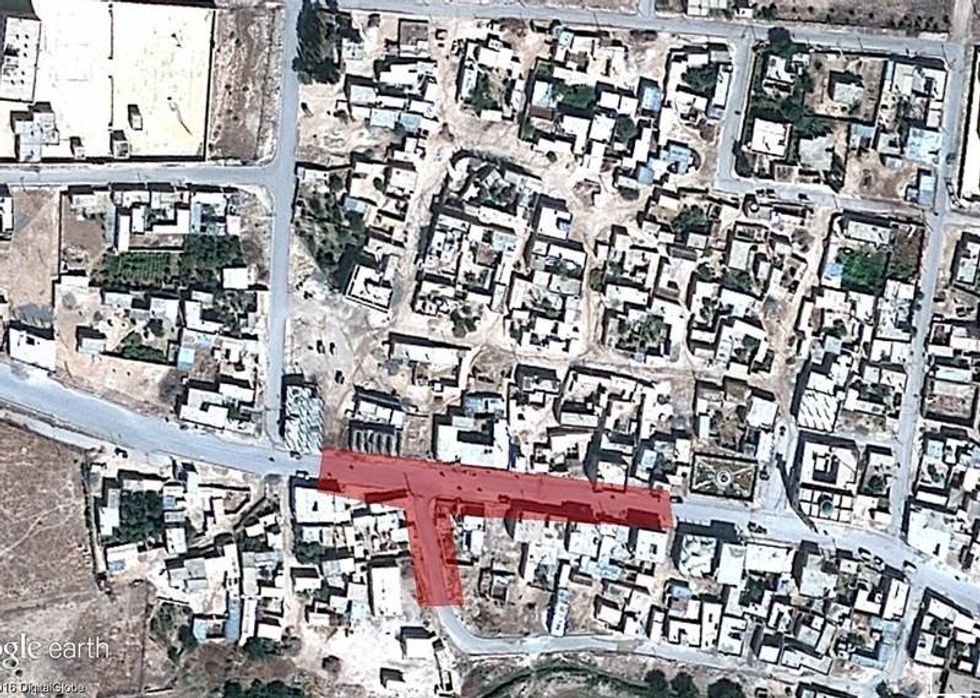
A US-led Coalition attack which struck two houses where civilians were sheltering in the village of Ayn al-Khan, near al-Hawl in al-Hasakah governorate in northern Syria in the early hours of 7 December 2015, killed 40 civilians, including 19 children, and injured at least 30 others according to local human rights organizations. One media report suggests an unknown number of IS fighters were also killed in the attack.
Amnesty International was able to speak to one survivor from the attack who described how he was awoken by a huge explosion and ran out to dig through the rubble for survivors.
"The house shook and began to crumble. The windows shattered...I ran outside and saw my neighbour's house completely destroyed. I could hear people calling out from beneath the rubble," he said.
As he helped to dig out survivors a helicopter gunship launched a second attack.
"At this point I had a two-month-old baby boy in my arms whom I had rescued. The hit caused me to fall and drop him... I fell into the hole made by the air strike. That was what saved me... My mother, aunt, wife and children - a daughter who was four years old and a son who was two and a half were all killed. The woman and her son who I'd rescued were killed. Everyone but me was killed," he said.
He also said that a commander from the Kurdish People's Protection Unit (YPG) forces who villagers spoke to after the attack told them the YPG had warned Coalition forces of civilians in in the area.
The attack is believed to have been targeting a group of IS fighters who had moved into a house on the edge of the village five days earlier and were later joined by more fighters.
Despite evidence indicating multiple civilian casualties were caused, CENTCOM has not acknowledged responsibility, although it admits it carried out air strikes in the vicinity at around the same time. It is unclear whether the investigation promptly set up by CENTCOM has reached any findings.
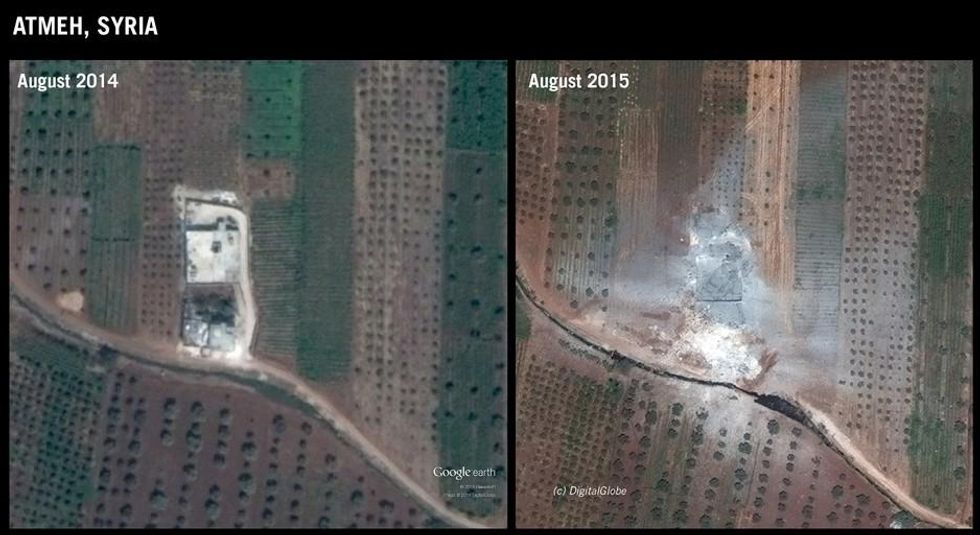
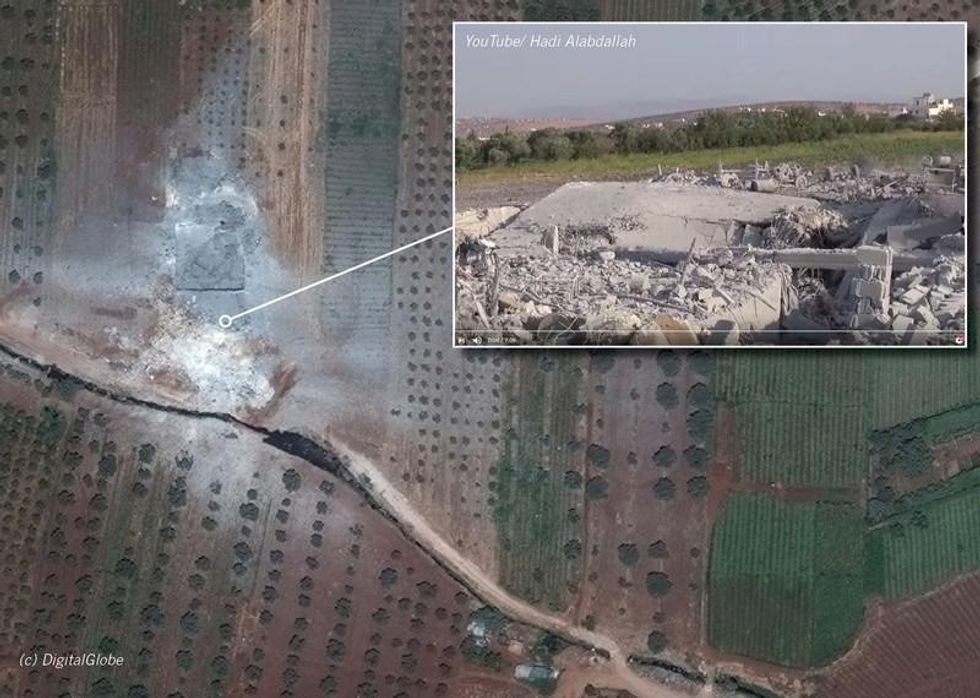
In another attack on 11 August 2015 an air strike hit a building in Atmeh in Aleppo governorate which was being used by an armed group to produce mortars, but also destroyed two adjacent civilian homes, killing eight civilians. Six children aged between four and 17 years old were killed. There are conflicting reports about whether or not 10 fighters were also killed in the attack. CENTCOM has admitted carrying out the strike but denied there were any civilian casualties.
Satellite images obtained and reviewed by Amnesty International indicate that the two civilian houses were completely destroyed in addition to the building being used by the armed group.
Talha al-Amouri an eye-witness told Amnesty International that his sister-in-law, mother of five of the children killed, was eight months' pregnant at the time of the attack and had a stillbirth as a consequence of it. He said he and his brother had gone to a nearby shop a short distance away and returned to find children buried beneath the rubble.
"How could they have known that there was an ammunitions factory but not that there were homes with civilians nearby?" he said.
Although this attack was directed at a legitimate military target it also destroyed neighbouring homes and killed eight civilians and therefore may amount to a disproportionate attack.
"Due to the presence of populated civilian homes adjacent to the target, it should have been clear that the attack would pose a significant risk to civilians, including from secondary explosions. The US authorities should have taken steps to minimize that risk, including by issuing a warning, if feasible, or delaying the attack until civilians could be adequately protected, or cancelling it if it was likely to be disproportionate," said Lynn Maalouf.
As the military campaign to re-take the city of Mosul in northern Iraq from IS enters its second week, fears for civilians there are running high. US-led Coalition forces are providing air and ground support for the operation.
"Given the likely increase in air strikes by the US-led Coalition as part of the Iraqi offensive to recapture Mosul, it is even more pressing that CENTCOM be fully transparent about the impact of their military actions on civilians. And it is crucial that they adhere scrupulously to international humanitarian law, including by taking all feasible precautions to spare civilians and to minimize harm to civilian homes and infrastructure," said Lynn Maalouf.
More than 200 Syrian civilians are believed to have been killed in Coalition attacks during the campaign in Syria to oust IS from Manbij, which is far smaller than Mosul.
Amnesty International's previous research on Pakistan and Afghanistan has also found that the US military has failed to effectively investigate possible violations of international humanitarian law and to acknowledge responsibility for civilian casualties.
The failure to adequately and transparently investigate reports of civilian casualties and of violations of international humanitarian law falls short of international standards and contrasts starkly with commitments by President Barack Obama in a July 2016 Executive Order to address civilian casualties from US military operations. The lack of acknowledgment, apology or compensation is also at odds with this Executive Order, which committed the USA to strengthening post-strike investigations and offering condolence and compensation.
Background
Amnesty International has researched and published findings on violations of international humanitarian law and human rights violations, including war crimes and crimes against humanity, committed by several parties to the conflict in Syria, namely: the Syrian government and its allies (including Russia), who are responsible for the vast majority of violations; the group calling itself Islamic State; the predominantly Kurdish forces of the Autonomous Administration; and several armed opposition groups.
Amnesty International is a worldwide movement of people who campaign for internationally recognized human rights for all. Our supporters are outraged by human rights abuses but inspired by hope for a better world - so we work to improve human rights through campaigning and international solidarity. We have more than 2.2 million members and subscribers in more than 150 countries and regions and we coordinate this support to act for justice on a wide range of issues.
LATEST NEWS





Most Popular