October, 13 2015, 11:45am EDT
For Immediate Release
Contact:
Bob Master, (917) 657-6483, rmaster@cwa-union.org
Michael Rabinowitz-Gold, 646-342-3469, rabinowitz@berlinrosen.com
CJ Macklin, 214-783-4055, cj.macklin@berlinrosen.com
NEW YORK
The Communications Workers of America (CWA) announced today a new TV ad that will air on local broadcast and cable channels slamming Verizon's failure to build out its high-speed FiOS network in New York. The 30-second ad highlights a New York City audit of Verizon's FiOS rollout in New York City that found that Verizon has failed to meet its promise to deliver high-speed fiber optic internet and television to everyone in the city who wanted it [script below and video file can be viewed here]. In a sign of growing concerns about Verizon, the City Council is holding a hearing Wednesday to hear from the Administration, customers who have been unable to get FiOS and the company.

"Verizon should stop breaking promises to its employees and its customers," said Bob Master, Assistant to the President for CWA District One. "Customers want FiOS and our members want a contract that maintains family-supporting jobs. Verizon should stop stalling on both issues."
New York City is not the only city frustrated with Verizon's broken promises. Last week, 13 Northeastern Mayors and the Democratic candidate for Mayor of Philadelphia sent a letter to Verizon expressing anger at Verizon's refusal to build its high-speed FiOS network at all in some cities while in others the company fails to meet contractual and legal requirements to complete universal build-outs. The Mayors also expressed concern about Verizon's treatment of its workforce in ongoing contract negotiations.
The anger has been growing across the East Coast as Verizon systematically refuses to invest in its infrastructure. In a letter to the FCC it admitted that it had only spent $200 million or $3.50 per customer over the last seven years to maintain its copper landline network in eleven states and the District of Columbia. The Communications Workers of America filed letters in six states and Washington, DC calling on them to investigate whether Verizon was neglecting its responsibility.
In August, it was the only major U.S. telecommunications company to turn down federal funding to build broadband in unserved, primarily rural, communities, leaving many residents in eight states and the District of Columbia without access to vital communications options. The company was offered $568 million over six years by the Federal government to bring broadband to 270,000 locations in Washington, DC, Delaware, Massachusetts, Maryland, New Jersey, New York, Pennsylvania, Rhode Island, and Virginia.
In New York State, the company refuses to avail itself of Governor Cuomo's $500 million New New York Broadband Fund, which offers up to 50% subsidies to companies willing to build high-speed service in underserved areas. For years, Verizon has steadfastly refused to bring its high-speed internet service (or FiOS) to areas like Buffalo, Syracuse, Albany, Rome, Utica and numerous other upstate New York cities, as well as much of Eastern Suffolk. At a series of hearings held by New York State, elected officials from Buffalo, Syracuse, Albany, the North Country, the Southern Tier and the Hudson Valley decried the lack of FiOS in their communities.
Campaigns in Pennsylvania and Massachusetts have also called for FiOS to be built in their communities.
Background
39,000 workers are currently negotiating new contracts at Verizon. Fortune Magazine ranked Verizon the 15th largest corporation in America in 2014, with revenues of $127 billion, profits of $9.6 billion, and market capitalization of $198.4 billion. Verizon had profits of $28 billion over the last five years, and paid its top five executives $249 million during that time.
Communication Workers of America (CWA) is America's largest communications & media union. CWA members work in telecommunications and information technology, the airline industry, news media, broadcast and cable television, education, health care, public service and education, law enforcement, manufacturing and other fields.
LATEST NEWS
As Premiums Soar and Millions Lose Coverage, Over Half of Americans Say End Private Health Insurance
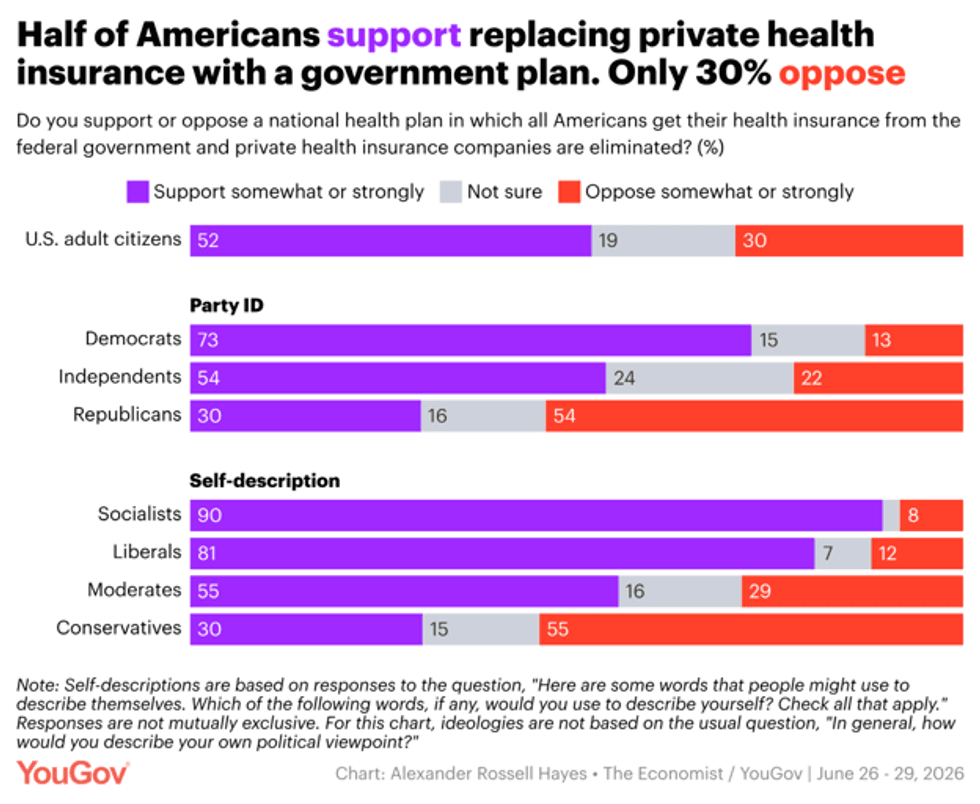
Fifty-two percent expressed support, and the proposal was even more popular than that among respondents under age 45 as well as registered Democrats and Independents. Just 30% of those polled were opposed, while the rest said that they were "not sure."
The polling follows the administration's quiet release of data showing that 4.2 million lost Affordable Care Act (ACA) coverage as of February. Trump and his Republican allies in Congress have come under fire for letting ACA subsidies expire at the end of last year—as well as for enacting the so-called One Big Beautiful Bill Act, which is expected to leave more working-class Americans uninsured over the next decade. Already, Protect Our Care estimates that 3.8 million people have lost coverage under Medicaid and the Children's Health Insurance Program, bringing the total for Trump's term to around 8 million.
"A mind-boggling number of Americans have found themselves joining the ranks of the uninsured," Protect Our Care president Brad Woodhouse said in a Tuesday statement. "And this is just the beginning. As working families continue to get squeezed left and right by GOP-driven healthcare cost hikes and bureaucratic red tape, millions more Americans will lose the care they rely on to stay alive and healthy."
"These are diabetic patients rationing insulin and parents skipping cancer screenings," he continued. "These are small business owners and farmers shutting down their life's work because they can no longer afford to buy insurance on their own. These are moms, veterans, and seniors. These are the millions who will hand Trump and Republicans in Congress a withering rebuke at the ballot box in November for making healthcare unaffordable so they could make billionaires and big corporations richer."
As premiums soar and Americans begin to endure the consequences of the national Republican healthcare agenda, a sweeping coalition of groups that support a universal single-payer system declared earlier this month that "now is the time for Medicare for All."
Sen. Bernie Sanders (I-Vt.) and Reps. Pramila Jayapal (D-Wash.) and Debbie Dingell (D-Mich.) have repeatedly introduced the Medicare for All Act in Congress, and support for it has grown among elected Democrats and the US public—as suggested by the new polling.
In a statement about the healthcare findings, the pollsters explained:
While eliminating insurance companies may sound like a radical change to healthcare, the share of Americans who want to replace private insurance with a government health plan (52%) is larger than the share who want to expand the existing Obamacare (the health coverage system established by the Affordable Care Act) (38%). The share who favor repealing Obamacare (28%) is about as large as the share who oppose replacing private insurance with a government plan (30%).
Americans who support a national healthcare plan do not universally see expanding Obamacare as a step in the right direction. Only a little more than half (56%) of the Americans who support creating a national health plan also support expanding Obamacare. On the other hand, most Americans who support expanding Obamacare would also support a national health plan that replaces private insurance (77%).
Although "only 8% of Americans would describe themselves as socialists," which is "smaller than the shares who describe themselves with several other ideological adjectives offered in a poll question, including progressive (17%), liberal (23%), and conservative (34%)," the pollsters also noted, "many policy proposals championed by democratic socialists draw significant support from Americans."
For example, majorities of respondents endorsed the government covering the cost of college tuition for all students (55%) and building public housing (57%).
When asked, "Do you think Donald Trump has had the right priorities or hasn’t paid enough attention to the country's most important problems?" 60% of respondents said the president "hasn't paid attention to the most important problems."
The polling comes just over four months away from the November midterm elections, in which Democrats hope to reclaim majorities in both chambers of Congress. Some Democratic candidates, including US Senate hopefuls Graham Platner in Maine and Abdul El-Sayed in Michigan, are explicitly running on support for Medicare for All.
After multiple progressives running to represent various New York districts in the US House of Representatives won their primaries last week, Sanders called their victories proof that Americans "are sick and tired of status quo politics," while Jayapal similarly celebrated that "bold, people-powered candidates took on the Democratic establishment and won."
"They ran on Medicare for All. On a public option for housing. On a foreign policy that centers human dignity over political convenience. And they won," Jayapal said. "This is what happens when movements build power. People-powered movements win."
Most Popular