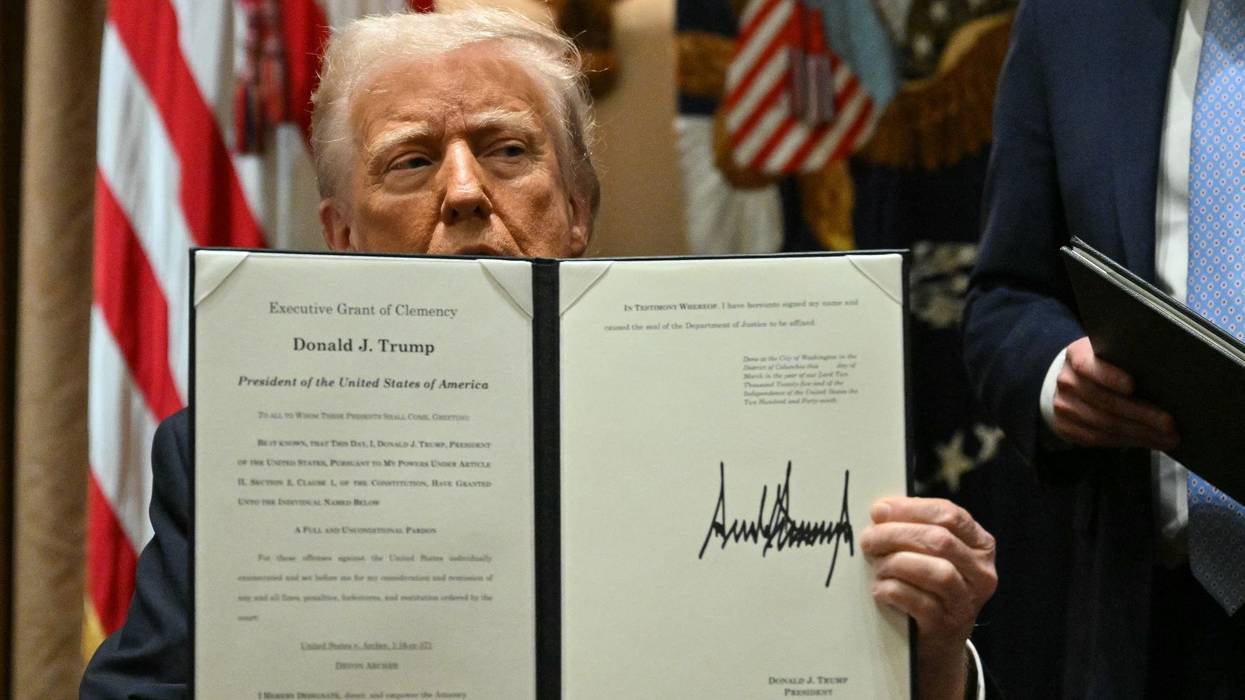
"Donald Trump has taken one of the most solemn constitutional powers of the presidency and turned it into a bustling marketplace for insider political influence and unjust personal enrichment," Raskin said in a statement on Friday.
"Wealthy white-collar criminals and drug traffickers hire Trump insiders, pour money into his political operation or cultivate his family’s financial interests, and suddenly the doors of the White House swing open for a pardon, commutation, and forgiveness of all fines and financial restitution owed," he continued.
Drawing on Reuters' reporting from June, the report examines how Trump has sidelined the traditional Department of Justice guidelines for offering pardons, which long involved career civil servants evaluating petitions for clemency based on the seriousness of the offense, the individual's rehabilitation, and restitution to victims.
In its place, Trump has consolidated control of the pardon power within the White House, where the determining factor has often been a person's connections to Trump's inner circle. This has allowed the clique of people with access to the president to act as gatekeepers and reap the rewards.
According to Reuters:
Reuters identified 290 advocates, or influencers, who publicly or privately helped secure clemency for 197 recipients. Because some of the advocates worked on behalf of multiple candidates, their efforts at times overlapped, representing 624 different acts of influence. Among the influencers, 73 helped secure more than one pardon or sentence commutation. Brett Tolman, a former US attorney now in private practice in Utah, has been involved in at least 12 pardons or commutations. Roger Stone, a veteran political consultant and longtime Trump confidant, had a hand in at least five.
Trump's use of the pardon system to reward friends and donors is widely reported. But Raskin's report sheds new light on the other side of the equation: the victims who were denied compensation after Trump waved away the sentences of those who scammed and stole from them.
Trevor Milton, an auto company executive who was convicted in 2022 of defrauding investors after pretending that one of his company's vehicles had autonomous capabilities, was potentially on the hook for nearly $700 million.
But after he and his wife donated a combined $1.8 million to committees supporting Trump and soon-to-be Health and Human Services Secretary Robert F. Kennedy Jr. in 2024, Milton received a pardon from the president that wiped out his obligation to pay.
Afterward, Trump called Milton personally and told him to "call Bobby [Kennedy] and thank him" for the pardon, according to Reuters.
Paul Walczak, a healthcare executive who funded a lavish lifestyle by stealing millions in payroll taxes from his low-wage employees, got a pardon from Trump weeks after his mother, a top GOP fundraiser, attended a $1-million-a-plate event at Mar-a-Lago. As a result, he got out of paying back $4.5 million in stolen payroll taxes, which go to fund programs like Medicare and Social Security.
Jason Galanis, who was convicted of stealing millions from the Oglala Sioux Nation and defrauding pension funds for union workers in New York State, avoided paying over $84 million in restitution after Trump pardoned him in early 2025.
A longtime associate of former President Joe Biden's son Hunter, Galanis gained favor with Trump after he appeared as a star witness for Republicans during their impeachment effort over the Democratic president's alleged "influence peddling."
Other fraudsters relied directly on the network of pardon lobbyists, like nursing home owner Joseph Schwartz, who also stole payroll taxes from his employees and had separately lost several wrongful death lawsuits for neglecting elderly patients.
While in prison on a three-year sentence, Schwartz spent more than $1.1 million on lobbyists to advocate for his release. This included access to the powerful pro-Trump influencer Laura Loomer, White House “pardon czar” Alice Marie Johnson, and White House Counsel David Warrington.
The report said this got him out of paying $33 million he still owes in federal taxes, and the report also notes his apparent attempts to avoid paying out wrongful death judgments.
The report also details Trump's pardon of former Honduran President Juan Orlando Hernández, who'd been convicted of helping the Sinaloa Cartel import hundreds of tons of drugs into the United States.
He was convicted in 2024 after prosecutors spent more than 15 years building a case against him. But his role in helping rich, MAGA-allied tech moguls, including Peter Thiel and Marc Andreessen, with a project called Próspera—a libertarian “charter city” for cryptocurrency investors—made his case a cause célèbre among Trump’s inner circle.
Roger Stone, who claimed that pardoning Hernández would "save the Próspera experiment," joined former Rep. Matt Gaetz (R-Fla.) and others at Mar-a-Lago to push for the ex-Honduran leader's freedom, and within hours it was granted.
As the report details, "the Bureau of Prisons paid a tactical team overtime to drive Mr. Hernández from his maximum-security prison in West Virginia to the Waldorf Astoria in New York City, where he was treated to a luxury stay at taxpayer expense in one of New York’s finest hotels."
Some of the criminality pardoned by Trump verges on cartoonish. A former Las Vegas City Council member, Michele Fiore, nicknamed "Lady Trump," stole $70,000 from a memorial for police officers killed on duty and used it to pay for rent, cosmetic surgery, and her daughter's wedding. To this day, she refuses to pay the money back.
Adriana and Andres Camberos, meanwhile, escaped having to pay their victims over $50 million and forfeit an additional $30 million in illegal proceeds from an elaborate grocery store fraud scheme that allowed them to pay for luxury sports cars, beachfront properties, investments, and cryptocurrency.
Adriana, who'd previously been convicted for selling counterfeit 5-Hour Energy drinks filled with fake liquid, had already had her sentence commuted at the end of Trump's first term after her brother donated to his 2020 campaign and got the ear of two attorneys close to the president, defense attorney Adam Katz and White House Counsel Stefan Passantino. After she and her brother were convicted of grocery fraud, they went back to Katz and Passantino, who helped secure a pardon for both of them last year.
“In recent months, often to justify immigration crackdowns or cuts to healthcare and food assistance programs, House Republicans have, hilariously, made ‘fighting fraud’ one of their central talking points,” the report concluded. “But convicted fraudster Donald Trump and the MAGA pardon industrial complex are all about committing fraud, protecting fraudulent schemes, and pardoning convicted fraudsters.”