SUBSCRIBE TO OUR FREE NEWSLETTER
Daily news & progressive opinion—funded by the people, not the corporations—delivered straight to your inbox.
5
#000000
#FFFFFF
To donate by check, phone, or other method, see our More Ways to Give page.
Daily news & progressive opinion—funded by the people, not the corporations—delivered straight to your inbox.
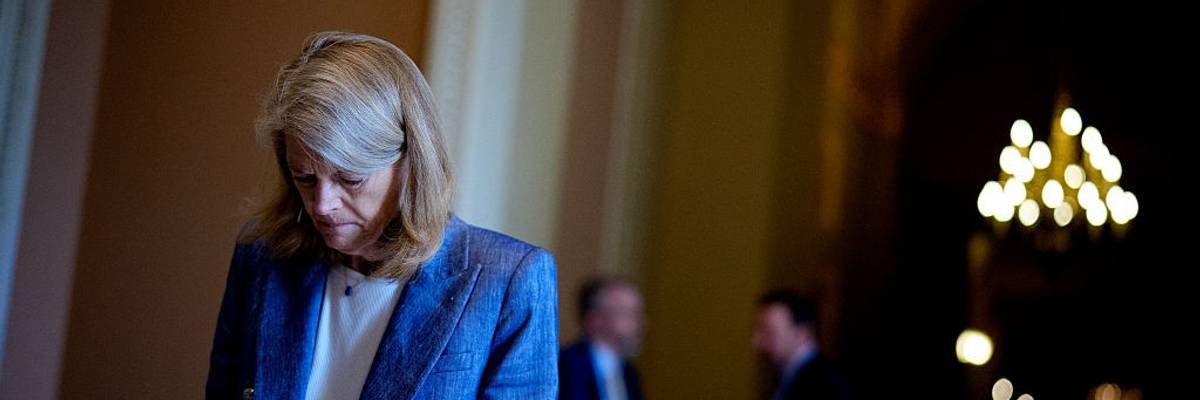
Sen. Lisa Murkowski (R-Alaska) walks toward the Senate floor at the U.S. Capitol Building on June 30, 2025.
Sen. Lisa Murkowski was the deciding vote to pass Republicans' massive social safety net cuts through the Senate. She said she didn't like the bill, but voted for it anyway after getting Alaska exempted from some of its worst harms.
By the thinnest possible margin, the U.S. Senate voted Tuesday to pass a budget that includes the largest cuts to Medicaid and nutrition assistance in U.S. history while giving trillions of dollars of tax cuts to the wealthiest Americans.
The deciding vote was Sen. Lisa Murkowski (R-Alaska), who admitted she didn't like the bill. However, she voted for it regardless after securing relief for her home state from some of its most draconian cuts.
But in an interview immediately afterward, she acknowledged that the rest of the country, where millions are on track to lose their healthcare coverage and food assistance, would not be so lucky.
"Do I like this bill? No," Murkowski told a reporter for MSNBC. "I try to take care of Alaska's interests. I know that in many parts of the country there are Americans that are not going to be advantaged by this bill. I don't like that."
The 887-page bill includes more than $1 trillion in cuts to Medicaid and the Children's Health Insurance Program over the next decade—cuts the Congressional Budget Office (CBO) projects will result in nearly 12 million people losing health coverage. The measure also takes an ax to the Supplemental Nutrition Assistance Program (SNAP)—imperiling food aid for millions.
In recent days, Murkowski—a self-described "Medicaid moderate"—expressed hesitation about signing onto a list of such devastating cuts, calling the vote "agonizing". To get her on board, her Republican colleagues were willing to give her state some shelter from the coming storm.
As David Dayen explained in The American Prospect, Murkowski was able to secure a waiver that exempts Alaska from the newly implemented cost-sharing requirement that will force states to spend more of their budgets on SNAP.
In The New Republic, Robert McCoy described it as a "bribe."
Initially, Republicans attempted to simply write in a carve-out for Alaska and Hawaii. But after this was shot down by the Senate parliamentarian, they tried again with a measure that exempted the 10 states with the highest error rates.
Sen. Amy Klobuchar (D-Minn.) called it "the most absurd example of the hypocrisy of the Republican bill."
"They have now proposed delaying SNAP cuts FOR TWO YEARS ONLY FOR STATES with the highest error rates just to bury their help for Alaska," she said.
Murkowski also got a tax break for Alaskan fishing villages inserted into the bill. She attempted to have Alaska exempted from some Medicaid cuts as well, but the parliamentarian killed the measure.
"Did I get everything that I wanted? Absolutely not," she told reporters outside the Senate chamber.
However, as Dayen wrote, "Murkowski decided that she could live with a bill that takes food and medicine from vulnerable people to fund tax cuts tilted toward the wealthy, as long as it didn't take quite as much food away from Alaskans."
Murkowski showed herself to be well aware of the harms the bill will cause. After voting to pass the bill, she said, "My hope is that the House is gonna look at this and recognize that we're not there yet."
Rep. Pramila Jayapal (D-Wash.) called Murkowski's bargain "selfish," "cruel," and "expensive."
"Voting for the bill because [of] a carve-out for your state is open acknowledgement that people will get kicked off healthcare and will have to go to much more expensive emergency rooms," Jayapal wrote. "Clear you know it's a terrible bill for everyone."
Dear Common Dreams reader, It’s been nearly 30 years since I co-founded Common Dreams with my late wife, Lina Newhouser. We had the radical notion that journalism should serve the public good, not corporate profits. It was clear to us from the outset what it would take to build such a project. No paid advertisements. No corporate sponsors. No millionaire publisher telling us what to think or do. Many people said we wouldn't last a year, but we proved those doubters wrong. Together with a tremendous team of journalists and dedicated staff, we built an independent media outlet free from the constraints of profits and corporate control. Our mission has always been simple: To inform. To inspire. To ignite change for the common good. Building Common Dreams was not easy. Our survival was never guaranteed. When you take on the most powerful forces—Wall Street greed, fossil fuel industry destruction, Big Tech lobbyists, and uber-rich oligarchs who have spent billions upon billions rigging the economy and democracy in their favor—the only bulwark you have is supporters who believe in your work. But here’s the urgent message from me today. It's never been this bad out there. And it's never been this hard to keep us going. At the very moment Common Dreams is most needed, the threats we face are intensifying. We need your support now more than ever. We don't accept corporate advertising and never will. We don't have a paywall because we don't think people should be blocked from critical news based on their ability to pay. Everything we do is funded by the donations of readers like you. When everyone does the little they can afford, we are strong. But if that support retreats or dries up, so do we. Will you donate now to make sure Common Dreams not only survives but thrives? —Craig Brown, Co-founder |
By the thinnest possible margin, the U.S. Senate voted Tuesday to pass a budget that includes the largest cuts to Medicaid and nutrition assistance in U.S. history while giving trillions of dollars of tax cuts to the wealthiest Americans.
The deciding vote was Sen. Lisa Murkowski (R-Alaska), who admitted she didn't like the bill. However, she voted for it regardless after securing relief for her home state from some of its most draconian cuts.
But in an interview immediately afterward, she acknowledged that the rest of the country, where millions are on track to lose their healthcare coverage and food assistance, would not be so lucky.
"Do I like this bill? No," Murkowski told a reporter for MSNBC. "I try to take care of Alaska's interests. I know that in many parts of the country there are Americans that are not going to be advantaged by this bill. I don't like that."
The 887-page bill includes more than $1 trillion in cuts to Medicaid and the Children's Health Insurance Program over the next decade—cuts the Congressional Budget Office (CBO) projects will result in nearly 12 million people losing health coverage. The measure also takes an ax to the Supplemental Nutrition Assistance Program (SNAP)—imperiling food aid for millions.
In recent days, Murkowski—a self-described "Medicaid moderate"—expressed hesitation about signing onto a list of such devastating cuts, calling the vote "agonizing". To get her on board, her Republican colleagues were willing to give her state some shelter from the coming storm.
As David Dayen explained in The American Prospect, Murkowski was able to secure a waiver that exempts Alaska from the newly implemented cost-sharing requirement that will force states to spend more of their budgets on SNAP.
In The New Republic, Robert McCoy described it as a "bribe."
Initially, Republicans attempted to simply write in a carve-out for Alaska and Hawaii. But after this was shot down by the Senate parliamentarian, they tried again with a measure that exempted the 10 states with the highest error rates.
Sen. Amy Klobuchar (D-Minn.) called it "the most absurd example of the hypocrisy of the Republican bill."
"They have now proposed delaying SNAP cuts FOR TWO YEARS ONLY FOR STATES with the highest error rates just to bury their help for Alaska," she said.
Murkowski also got a tax break for Alaskan fishing villages inserted into the bill. She attempted to have Alaska exempted from some Medicaid cuts as well, but the parliamentarian killed the measure.
"Did I get everything that I wanted? Absolutely not," she told reporters outside the Senate chamber.
However, as Dayen wrote, "Murkowski decided that she could live with a bill that takes food and medicine from vulnerable people to fund tax cuts tilted toward the wealthy, as long as it didn't take quite as much food away from Alaskans."
Murkowski showed herself to be well aware of the harms the bill will cause. After voting to pass the bill, she said, "My hope is that the House is gonna look at this and recognize that we're not there yet."
Rep. Pramila Jayapal (D-Wash.) called Murkowski's bargain "selfish," "cruel," and "expensive."
"Voting for the bill because [of] a carve-out for your state is open acknowledgement that people will get kicked off healthcare and will have to go to much more expensive emergency rooms," Jayapal wrote. "Clear you know it's a terrible bill for everyone."
By the thinnest possible margin, the U.S. Senate voted Tuesday to pass a budget that includes the largest cuts to Medicaid and nutrition assistance in U.S. history while giving trillions of dollars of tax cuts to the wealthiest Americans.
The deciding vote was Sen. Lisa Murkowski (R-Alaska), who admitted she didn't like the bill. However, she voted for it regardless after securing relief for her home state from some of its most draconian cuts.
But in an interview immediately afterward, she acknowledged that the rest of the country, where millions are on track to lose their healthcare coverage and food assistance, would not be so lucky.
"Do I like this bill? No," Murkowski told a reporter for MSNBC. "I try to take care of Alaska's interests. I know that in many parts of the country there are Americans that are not going to be advantaged by this bill. I don't like that."
The 887-page bill includes more than $1 trillion in cuts to Medicaid and the Children's Health Insurance Program over the next decade—cuts the Congressional Budget Office (CBO) projects will result in nearly 12 million people losing health coverage. The measure also takes an ax to the Supplemental Nutrition Assistance Program (SNAP)—imperiling food aid for millions.
In recent days, Murkowski—a self-described "Medicaid moderate"—expressed hesitation about signing onto a list of such devastating cuts, calling the vote "agonizing". To get her on board, her Republican colleagues were willing to give her state some shelter from the coming storm.
As David Dayen explained in The American Prospect, Murkowski was able to secure a waiver that exempts Alaska from the newly implemented cost-sharing requirement that will force states to spend more of their budgets on SNAP.
In The New Republic, Robert McCoy described it as a "bribe."
Initially, Republicans attempted to simply write in a carve-out for Alaska and Hawaii. But after this was shot down by the Senate parliamentarian, they tried again with a measure that exempted the 10 states with the highest error rates.
Sen. Amy Klobuchar (D-Minn.) called it "the most absurd example of the hypocrisy of the Republican bill."
"They have now proposed delaying SNAP cuts FOR TWO YEARS ONLY FOR STATES with the highest error rates just to bury their help for Alaska," she said.
Murkowski also got a tax break for Alaskan fishing villages inserted into the bill. She attempted to have Alaska exempted from some Medicaid cuts as well, but the parliamentarian killed the measure.
"Did I get everything that I wanted? Absolutely not," she told reporters outside the Senate chamber.
However, as Dayen wrote, "Murkowski decided that she could live with a bill that takes food and medicine from vulnerable people to fund tax cuts tilted toward the wealthy, as long as it didn't take quite as much food away from Alaskans."
Murkowski showed herself to be well aware of the harms the bill will cause. After voting to pass the bill, she said, "My hope is that the House is gonna look at this and recognize that we're not there yet."
Rep. Pramila Jayapal (D-Wash.) called Murkowski's bargain "selfish," "cruel," and "expensive."
"Voting for the bill because [of] a carve-out for your state is open acknowledgement that people will get kicked off healthcare and will have to go to much more expensive emergency rooms," Jayapal wrote. "Clear you know it's a terrible bill for everyone."