SUBSCRIBE TO OUR FREE NEWSLETTER
Daily news & progressive opinion—funded by the people, not the corporations—delivered straight to your inbox.
5
#000000
#FFFFFF
To donate by check, phone, or other method, see our More Ways to Give page.
Daily news & progressive opinion—funded by the people, not the corporations—delivered straight to your inbox.
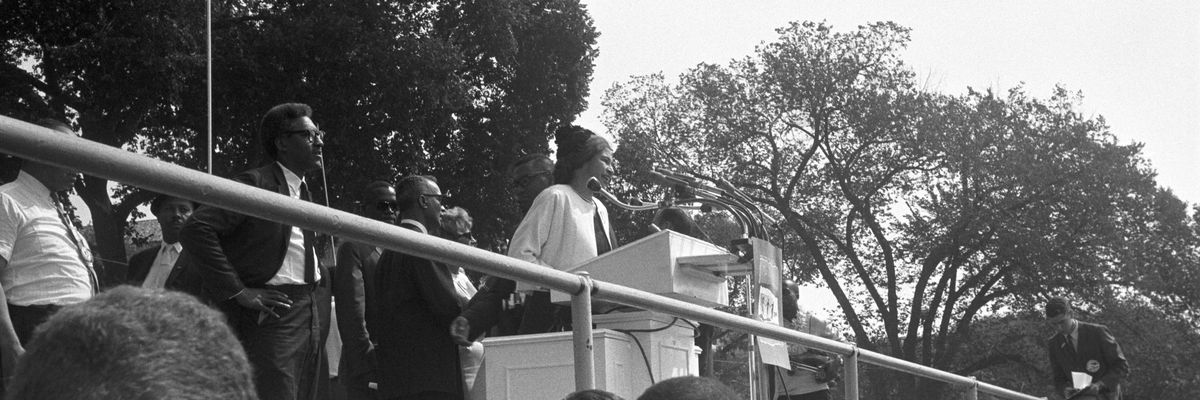
Rosa Parks says hello to a crowd at the March on Washington for Jobs and Freedom in Washington, D.C. on August 23, 1963.
"Extremist lawmakers are using state capitols to subvert our democracy and erode voting rights, denying living wages, and suppressing access to healthcare, all while concentrating this rich nation's wealth," said Hanna Broome of AME Zion Church.
Six decades after civil rights and labor groups held the March on Washington for Jobs and Freedom, women from across the country plan to come together Monday evening for a virtual "She Speaks" mass assembly to honor female leaders from 1963 and draw attention to issues that persist today.
"While numerous brave and brilliant women—including Rosa Parks, Dorothy Day, Fannie Lou Hamer, Anna Arnold Hedgeman, Diane Nash, Dorothy Height, and Mahalia Jackson—were central voices behind the March on Washington, they were not given the chance to speak," organizers said in a statement. "Sixty years later, thousands of women are joining together at the Lincoln Memorial and speaking out to ensure not another anniversary goes by where women's voices aren't central to the conversation."
As Meghan Weaver of Stanford University's Martin Luther King Jr. Research and Education Institute detailed last year, Parks said a quick "hello" and "thank you" to the 1963 crowd, the NAACP's Daisy Bates delivered a couple of brief remarks, and actress and activist Lena Horne shouted "Freedom!" into the microphone. According to the researcher, activist and entertainer Josephine Baker "spoke for just over two minutes, in the longest address that day by a woman."
Speakers for Monday's event include Hanna Broome of AME Zion Church; Rev. Kazimir Brown of Repairers of the Breach; Mary Kay Henry of the Service Employees International Union; Rabbi Sheila Katz of the National Council of Jewish Women; Roz Pelles of the Center for Public Theology & Public Policy at Yale Divinity School; Ai-Jen Poo of the National Domestic Workers Alliance; Joy Reid of MSNBC; Karen Georgia A. Thompson of United Church of Christ; and members of Black Voters Matter, Beloved Community, and the League of Women Voters.
"Women refuse to stay silent as we fight back against the most pressing issues harming our communities today," declared Broome. "Right now across the country, extremist lawmakers are using state capitols to subvert our democracy and erode voting rights, denying living wages, and suppressing access to healthcare, all while concentrating this rich nation's wealth into fewer and fewer hands."
"Until the systemic injustices that have been plaguing our communities end," she vowed, "we will continue to make our voices heard across the nation."
During the assembly—set to be livestreamed at 6:00 ET—speakers plan to "demand a lifesaving agenda that includes living wages, voting rights, reproductive healthcare, and more," according to organizers.
"Sixty years ago, the agenda of the March on Washington was to raise the minimum wage 75% to a living wage, expand and protect voting rights, secure healthcare for all, and expand the Labor Standards Act to end racial discrimination," noted Bishop William Barber, who is expected to speak at the event. "Today, we are not finished with that agenda."
"Right now, 73 million women make up our nation's poor and low-wealth population. And millions of these women continue to be impacted by voter suppression," he added. "At a time when poverty is the fourth leading cause of death in our nation, these women are calling on all people of moral conscience—regardless of race, gender, or political affiliation—to join the fight for the moral soul of our nation and call out these attacks on our rights. We need all voices in this movement. This 60th anniversary is not an occasion just for nostalgia, it is a moment for action."
Dear Common Dreams reader, It’s been nearly 30 years since I co-founded Common Dreams with my late wife, Lina Newhouser. We had the radical notion that journalism should serve the public good, not corporate profits. It was clear to us from the outset what it would take to build such a project. No paid advertisements. No corporate sponsors. No millionaire publisher telling us what to think or do. Many people said we wouldn't last a year, but we proved those doubters wrong. Together with a tremendous team of journalists and dedicated staff, we built an independent media outlet free from the constraints of profits and corporate control. Our mission has always been simple: To inform. To inspire. To ignite change for the common good. Building Common Dreams was not easy. Our survival was never guaranteed. When you take on the most powerful forces—Wall Street greed, fossil fuel industry destruction, Big Tech lobbyists, and uber-rich oligarchs who have spent billions upon billions rigging the economy and democracy in their favor—the only bulwark you have is supporters who believe in your work. But here’s the urgent message from me today. It's never been this bad out there. And it's never been this hard to keep us going. At the very moment Common Dreams is most needed, the threats we face are intensifying. We need your support now more than ever. We don't accept corporate advertising and never will. We don't have a paywall because we don't think people should be blocked from critical news based on their ability to pay. Everything we do is funded by the donations of readers like you. When everyone does the little they can afford, we are strong. But if that support retreats or dries up, so do we. Will you donate now to make sure Common Dreams not only survives but thrives? —Craig Brown, Co-founder |
Six decades after civil rights and labor groups held the March on Washington for Jobs and Freedom, women from across the country plan to come together Monday evening for a virtual "She Speaks" mass assembly to honor female leaders from 1963 and draw attention to issues that persist today.
"While numerous brave and brilliant women—including Rosa Parks, Dorothy Day, Fannie Lou Hamer, Anna Arnold Hedgeman, Diane Nash, Dorothy Height, and Mahalia Jackson—were central voices behind the March on Washington, they were not given the chance to speak," organizers said in a statement. "Sixty years later, thousands of women are joining together at the Lincoln Memorial and speaking out to ensure not another anniversary goes by where women's voices aren't central to the conversation."
As Meghan Weaver of Stanford University's Martin Luther King Jr. Research and Education Institute detailed last year, Parks said a quick "hello" and "thank you" to the 1963 crowd, the NAACP's Daisy Bates delivered a couple of brief remarks, and actress and activist Lena Horne shouted "Freedom!" into the microphone. According to the researcher, activist and entertainer Josephine Baker "spoke for just over two minutes, in the longest address that day by a woman."
Speakers for Monday's event include Hanna Broome of AME Zion Church; Rev. Kazimir Brown of Repairers of the Breach; Mary Kay Henry of the Service Employees International Union; Rabbi Sheila Katz of the National Council of Jewish Women; Roz Pelles of the Center for Public Theology & Public Policy at Yale Divinity School; Ai-Jen Poo of the National Domestic Workers Alliance; Joy Reid of MSNBC; Karen Georgia A. Thompson of United Church of Christ; and members of Black Voters Matter, Beloved Community, and the League of Women Voters.
"Women refuse to stay silent as we fight back against the most pressing issues harming our communities today," declared Broome. "Right now across the country, extremist lawmakers are using state capitols to subvert our democracy and erode voting rights, denying living wages, and suppressing access to healthcare, all while concentrating this rich nation's wealth into fewer and fewer hands."
"Until the systemic injustices that have been plaguing our communities end," she vowed, "we will continue to make our voices heard across the nation."
During the assembly—set to be livestreamed at 6:00 ET—speakers plan to "demand a lifesaving agenda that includes living wages, voting rights, reproductive healthcare, and more," according to organizers.
"Sixty years ago, the agenda of the March on Washington was to raise the minimum wage 75% to a living wage, expand and protect voting rights, secure healthcare for all, and expand the Labor Standards Act to end racial discrimination," noted Bishop William Barber, who is expected to speak at the event. "Today, we are not finished with that agenda."
"Right now, 73 million women make up our nation's poor and low-wealth population. And millions of these women continue to be impacted by voter suppression," he added. "At a time when poverty is the fourth leading cause of death in our nation, these women are calling on all people of moral conscience—regardless of race, gender, or political affiliation—to join the fight for the moral soul of our nation and call out these attacks on our rights. We need all voices in this movement. This 60th anniversary is not an occasion just for nostalgia, it is a moment for action."
Six decades after civil rights and labor groups held the March on Washington for Jobs and Freedom, women from across the country plan to come together Monday evening for a virtual "She Speaks" mass assembly to honor female leaders from 1963 and draw attention to issues that persist today.
"While numerous brave and brilliant women—including Rosa Parks, Dorothy Day, Fannie Lou Hamer, Anna Arnold Hedgeman, Diane Nash, Dorothy Height, and Mahalia Jackson—were central voices behind the March on Washington, they were not given the chance to speak," organizers said in a statement. "Sixty years later, thousands of women are joining together at the Lincoln Memorial and speaking out to ensure not another anniversary goes by where women's voices aren't central to the conversation."
As Meghan Weaver of Stanford University's Martin Luther King Jr. Research and Education Institute detailed last year, Parks said a quick "hello" and "thank you" to the 1963 crowd, the NAACP's Daisy Bates delivered a couple of brief remarks, and actress and activist Lena Horne shouted "Freedom!" into the microphone. According to the researcher, activist and entertainer Josephine Baker "spoke for just over two minutes, in the longest address that day by a woman."
Speakers for Monday's event include Hanna Broome of AME Zion Church; Rev. Kazimir Brown of Repairers of the Breach; Mary Kay Henry of the Service Employees International Union; Rabbi Sheila Katz of the National Council of Jewish Women; Roz Pelles of the Center for Public Theology & Public Policy at Yale Divinity School; Ai-Jen Poo of the National Domestic Workers Alliance; Joy Reid of MSNBC; Karen Georgia A. Thompson of United Church of Christ; and members of Black Voters Matter, Beloved Community, and the League of Women Voters.
"Women refuse to stay silent as we fight back against the most pressing issues harming our communities today," declared Broome. "Right now across the country, extremist lawmakers are using state capitols to subvert our democracy and erode voting rights, denying living wages, and suppressing access to healthcare, all while concentrating this rich nation's wealth into fewer and fewer hands."
"Until the systemic injustices that have been plaguing our communities end," she vowed, "we will continue to make our voices heard across the nation."
During the assembly—set to be livestreamed at 6:00 ET—speakers plan to "demand a lifesaving agenda that includes living wages, voting rights, reproductive healthcare, and more," according to organizers.
"Sixty years ago, the agenda of the March on Washington was to raise the minimum wage 75% to a living wage, expand and protect voting rights, secure healthcare for all, and expand the Labor Standards Act to end racial discrimination," noted Bishop William Barber, who is expected to speak at the event. "Today, we are not finished with that agenda."
"Right now, 73 million women make up our nation's poor and low-wealth population. And millions of these women continue to be impacted by voter suppression," he added. "At a time when poverty is the fourth leading cause of death in our nation, these women are calling on all people of moral conscience—regardless of race, gender, or political affiliation—to join the fight for the moral soul of our nation and call out these attacks on our rights. We need all voices in this movement. This 60th anniversary is not an occasion just for nostalgia, it is a moment for action."