SUBSCRIBE TO OUR FREE NEWSLETTER
Daily news & progressive opinion—funded by the people, not the corporations—delivered straight to your inbox.
5
#000000
#FFFFFF
To donate by check, phone, or other method, see our More Ways to Give page.
Daily news & progressive opinion—funded by the people, not the corporations—delivered straight to your inbox.
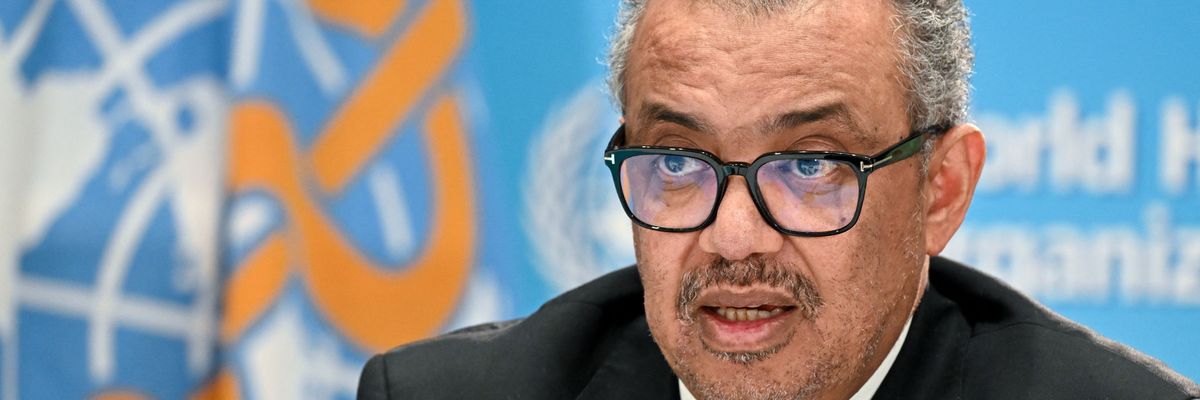
World Health Organization chief Tedros Adhanom Ghebreyesus speaks during a press conference on the WHO's 75th anniversary in Geneva on April 6, 2023.
The agency leader said that "it is time for countries to transition from emergency mode to managing Covid-19 alongside other infectious diseases."
The World Health Organization chief announced Friday that it is "with great hope that I declare Covid-19 over as a global health emergency."
WHO Director-General Tedros Adhanom Ghebreyesus had declared the emergency of international concern on January 30, 2020, when there were fewer than 100 reported cases outside of China.
"In the three years since then, Covid-19 has turned our world upside down," Tedros noted Friday. "Almost 7 million deaths have been reported to WHO, but we know the toll is several times higher—at least 20 million."
"But Covid-19 has been so much more than a health crisis," he continued. "It has caused severe economic upheaval, erasing trillions from GDP, disrupting travel and trade, shuttering businesses, and plunging millions into poverty."
Stressing that the move does not mean the virus "is over as a global health threat," Tedros said that "it is time for countries to transition from emergency mode to managing Covid-19 alongside other infectious diseases."
The public health emergency of international concern (PHEIC) "is a tool created within the International Health Regulations to help the WHO respond to disease events with the potential for global spread," STAT explained.
When a PHEIC is in place, the WHO director-general can make special recommendations, mainly aimed at discouraging countries from closing borders or restricting trade—actions that could deter countries from alerting the WHO if they are dealing with dangerous disease outbreaks.
Didier Houssin, the chair of the emergency committee, said the decision to recommend an end to the PHEIC was in part due to the belief that the tool was not adapted to disease events that are sub-acute or chronic. Houssin acknowledged that there remains a risk that a more pathogenic variant of the SARS-CoV-2 virus may emerge, and that a new PHEIC might need to be declared.The WHO's declaration comes days before the U.S. public health emergency will expire, on May 11.
The Biden administration announced Monday that when the U.S. emergency ends next week, so will Covid-19 vaccine requirements for federal employees and contractors as well as international air travelers—and agencies will start the process to cancel such mandates for Head Start educators, employees of some healthcare facilities, and certain noncitizens at land borders.
"While vaccination remains one of the most important tools in advancing the health and safety of employees and promoting the efficiency of workplaces," the White House said, "we are now in a different phase of our response when these measures are no longer necessary."
Dear Common Dreams reader, It’s been nearly 30 years since I co-founded Common Dreams with my late wife, Lina Newhouser. We had the radical notion that journalism should serve the public good, not corporate profits. It was clear to us from the outset what it would take to build such a project. No paid advertisements. No corporate sponsors. No millionaire publisher telling us what to think or do. Many people said we wouldn't last a year, but we proved those doubters wrong. Together with a tremendous team of journalists and dedicated staff, we built an independent media outlet free from the constraints of profits and corporate control. Our mission has always been simple: To inform. To inspire. To ignite change for the common good. Building Common Dreams was not easy. Our survival was never guaranteed. When you take on the most powerful forces—Wall Street greed, fossil fuel industry destruction, Big Tech lobbyists, and uber-rich oligarchs who have spent billions upon billions rigging the economy and democracy in their favor—the only bulwark you have is supporters who believe in your work. But here’s the urgent message from me today. It's never been this bad out there. And it's never been this hard to keep us going. At the very moment Common Dreams is most needed, the threats we face are intensifying. We need your support now more than ever. We don't accept corporate advertising and never will. We don't have a paywall because we don't think people should be blocked from critical news based on their ability to pay. Everything we do is funded by the donations of readers like you. When everyone does the little they can afford, we are strong. But if that support retreats or dries up, so do we. Will you donate now to make sure Common Dreams not only survives but thrives? —Craig Brown, Co-founder |
The World Health Organization chief announced Friday that it is "with great hope that I declare Covid-19 over as a global health emergency."
WHO Director-General Tedros Adhanom Ghebreyesus had declared the emergency of international concern on January 30, 2020, when there were fewer than 100 reported cases outside of China.
"In the three years since then, Covid-19 has turned our world upside down," Tedros noted Friday. "Almost 7 million deaths have been reported to WHO, but we know the toll is several times higher—at least 20 million."
"But Covid-19 has been so much more than a health crisis," he continued. "It has caused severe economic upheaval, erasing trillions from GDP, disrupting travel and trade, shuttering businesses, and plunging millions into poverty."
Stressing that the move does not mean the virus "is over as a global health threat," Tedros said that "it is time for countries to transition from emergency mode to managing Covid-19 alongside other infectious diseases."
The public health emergency of international concern (PHEIC) "is a tool created within the International Health Regulations to help the WHO respond to disease events with the potential for global spread," STAT explained.
When a PHEIC is in place, the WHO director-general can make special recommendations, mainly aimed at discouraging countries from closing borders or restricting trade—actions that could deter countries from alerting the WHO if they are dealing with dangerous disease outbreaks.
Didier Houssin, the chair of the emergency committee, said the decision to recommend an end to the PHEIC was in part due to the belief that the tool was not adapted to disease events that are sub-acute or chronic. Houssin acknowledged that there remains a risk that a more pathogenic variant of the SARS-CoV-2 virus may emerge, and that a new PHEIC might need to be declared.The WHO's declaration comes days before the U.S. public health emergency will expire, on May 11.
The Biden administration announced Monday that when the U.S. emergency ends next week, so will Covid-19 vaccine requirements for federal employees and contractors as well as international air travelers—and agencies will start the process to cancel such mandates for Head Start educators, employees of some healthcare facilities, and certain noncitizens at land borders.
"While vaccination remains one of the most important tools in advancing the health and safety of employees and promoting the efficiency of workplaces," the White House said, "we are now in a different phase of our response when these measures are no longer necessary."
The World Health Organization chief announced Friday that it is "with great hope that I declare Covid-19 over as a global health emergency."
WHO Director-General Tedros Adhanom Ghebreyesus had declared the emergency of international concern on January 30, 2020, when there were fewer than 100 reported cases outside of China.
"In the three years since then, Covid-19 has turned our world upside down," Tedros noted Friday. "Almost 7 million deaths have been reported to WHO, but we know the toll is several times higher—at least 20 million."
"But Covid-19 has been so much more than a health crisis," he continued. "It has caused severe economic upheaval, erasing trillions from GDP, disrupting travel and trade, shuttering businesses, and plunging millions into poverty."
Stressing that the move does not mean the virus "is over as a global health threat," Tedros said that "it is time for countries to transition from emergency mode to managing Covid-19 alongside other infectious diseases."
The public health emergency of international concern (PHEIC) "is a tool created within the International Health Regulations to help the WHO respond to disease events with the potential for global spread," STAT explained.
When a PHEIC is in place, the WHO director-general can make special recommendations, mainly aimed at discouraging countries from closing borders or restricting trade—actions that could deter countries from alerting the WHO if they are dealing with dangerous disease outbreaks.
Didier Houssin, the chair of the emergency committee, said the decision to recommend an end to the PHEIC was in part due to the belief that the tool was not adapted to disease events that are sub-acute or chronic. Houssin acknowledged that there remains a risk that a more pathogenic variant of the SARS-CoV-2 virus may emerge, and that a new PHEIC might need to be declared.The WHO's declaration comes days before the U.S. public health emergency will expire, on May 11.
The Biden administration announced Monday that when the U.S. emergency ends next week, so will Covid-19 vaccine requirements for federal employees and contractors as well as international air travelers—and agencies will start the process to cancel such mandates for Head Start educators, employees of some healthcare facilities, and certain noncitizens at land borders.
"While vaccination remains one of the most important tools in advancing the health and safety of employees and promoting the efficiency of workplaces," the White House said, "we are now in a different phase of our response when these measures are no longer necessary."