
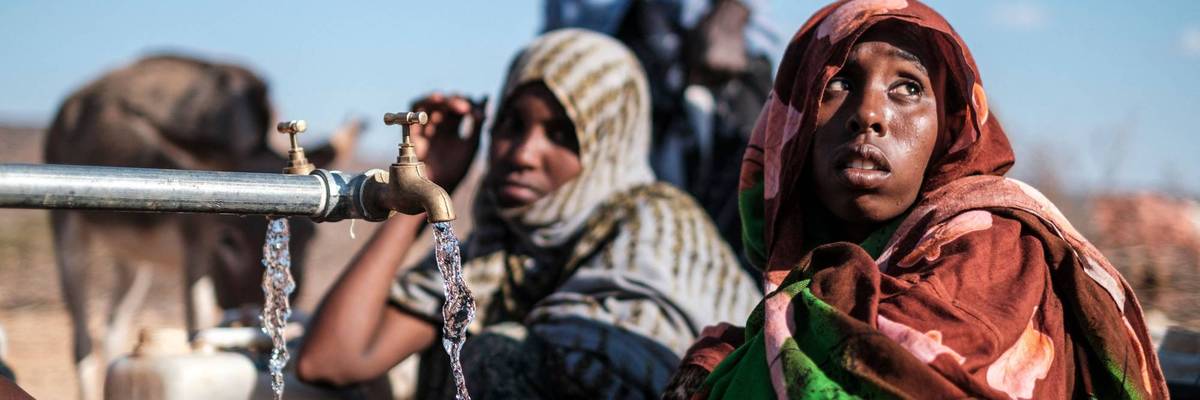
People collect water near Gode, Ethiopia, on January 10, 2023.
UN Warns 'Era of Global Water Bankruptcy' Is Here—But It's Not Too Late to Act
"We cannot rebuild vanished glaciers or reinflate acutely compacted aquifers," the report's lead author said. "But we can prevent further loss of our remaining natural capital."
Overuse and pollution is causing "irreversible damage" to Earth's water, prompting a United Nations body to declare this week that the world has entered an "era of global water bankruptcy"—and to underscore that it's not too late to minimize the damage.
The report by the United Nations University Institute for Water, Environment, and Health (UNU-INWEH) notes that "across regions and levels of development, water systems are under unprecedented pressure," as "rivers, lakes, and wetlands are degrading, groundwater resources are being depleted beyond sustainable limits, and glaciers are retreating at accelerating rates."
"These trends signal not only growing stress, but in many contexts a structural imbalance between water demand and available resources," the publication continues. "This report refers to this condition as 'water bankruptcy' and calls for effective action to protect water-related natural capital before damages become fully irreversible."
UNU-INWEH defines water bankruptcy as “persistent over-withdrawal from surface and groundwater relative to renewable inflows and safe levels of depletion" and "the resulting irreversible or prohibitively costly loss of water-related natural capital."
Water bankruptcy differs from water stress, which "describes conditions where demand and withdrawals are high relative to available renewable supply" and "may be managed through efficiency, recycling and reuse, demand management, and careful allocation so long as the underlying natural capital and hydrological carrying capacity are preserved."
The report explains that "many societies have not only overspent their annual renewable water 'income' from rivers, soils, and snowpack, they have depleted long-term 'savings' in aquifers, glaciers, wetlands, and other natural reservoirs."
The results range from compacted aquifers and subsided land in deltas and coastal cities, to vanished lakes and wetlands and irretrievably lost biodiversity.
The report's release precedes next week's high-level preparatory meeting in Dakar, Senegal ahead of the 2026 UN Water Conference, which is set to be co-hosted by the United Arab Emirates and Senegal in the UAE this December.
“This report tells an uncomfortable truth: Many regions are living beyond their hydrological means, and many critical water systems are already bankrupt,” lead author and UNU-INWEH director Kaveh Madani said in a statement Tuesday.
The news isn't all bad—the report notes that "the world has an important and still largely untapped strategic opportunity to act."
The authors recommend a "new global water agenda" that:
- Formally recognizes the state of water bankruptcy;
- Recognizes water as both a constraint and an opportunity for meeting climate, biodiversity, and land commitments;
- Elevates water issues in climate, biodiversity, and desertification negotiations; development finance; and peace-building processes;
- Embeds water bankruptcy monitoring in global frameworks, using Earth observation, artificial intelligence, and integrated modeling; and
- Uses water as a catalyst to accelerate cooperation between the UN member states.
- Preventing further irreversible damage such as wetland loss, destructive groundwater depletion, and uncontrolled pollution;
- Rebalancing rights, claims, and expectations to match degraded carrying capacity;
- Supporting just transitions for communities whose livelihoods must change;
- Transforming water-intensive sectors—including agriculture and industry—through crop shifts, irrigation reforms, and more efficient urban systems; and
- Building institutions for continuous adaptation, with monitoring systems linked to threshold-based management.
“Bankruptcy management requires honesty, courage, and political will,” said Madani. “We cannot rebuild vanished glaciers or reinflate acutely compacted aquifers. But we can prevent further loss of our remaining natural capital, and redesign institutions to live within new hydrological limits."
We are at a crossroads
This country and this world are at a monumental crossroads. In a few short weeks, US voters will have an opportunity to beat back the forces of fascism and confront the billionaires who are rigging the economy, our media system, and our democracy, making it increasingly impossible for ordinary people to get by. We’re not just talking about the election. We’re talking about what must be done once these fascist elements are vanquished from power. We need a bolder set of solutions than what either major party has so far been willing to offer and a working-class movement ready to fight like hell for it. Trump didn't emerge from nowhere. The conditions that fueled MAGA authoritarianism were created by decades of radical neoliberal economic policies and a corrupt political system dominated by corporate interests. They slashed taxes on the super-rich, promising that the benefits would trickle down. They said giveaways to the corporate titans would make life more affordable for the rest of us. It was all bullshit. And when a bitter, betrayed populace searches for someone to blame, right-wing demagogues have little trouble finding scapegoats. People know when they're being lied to, but you won't hear any of this from the corporate media. Only independent journalism—powered and funded by people who believe in building a better world—can deliver truly trustworthy daily news. Our Fall Campaign is underway, and we need your help. To power our newsroom through the rest of the year, we need to raise $125,000 by midnight on October 31. So if you share our vision, please contribute whatever you can to sustain our work. |
Overuse and pollution is causing "irreversible damage" to Earth's water, prompting a United Nations body to declare this week that the world has entered an "era of global water bankruptcy"—and to underscore that it's not too late to minimize the damage.
The report by the United Nations University Institute for Water, Environment, and Health (UNU-INWEH) notes that "across regions and levels of development, water systems are under unprecedented pressure," as "rivers, lakes, and wetlands are degrading, groundwater resources are being depleted beyond sustainable limits, and glaciers are retreating at accelerating rates."
"These trends signal not only growing stress, but in many contexts a structural imbalance between water demand and available resources," the publication continues. "This report refers to this condition as 'water bankruptcy' and calls for effective action to protect water-related natural capital before damages become fully irreversible."
UNU-INWEH defines water bankruptcy as “persistent over-withdrawal from surface and groundwater relative to renewable inflows and safe levels of depletion" and "the resulting irreversible or prohibitively costly loss of water-related natural capital."
Water bankruptcy differs from water stress, which "describes conditions where demand and withdrawals are high relative to available renewable supply" and "may be managed through efficiency, recycling and reuse, demand management, and careful allocation so long as the underlying natural capital and hydrological carrying capacity are preserved."
The report explains that "many societies have not only overspent their annual renewable water 'income' from rivers, soils, and snowpack, they have depleted long-term 'savings' in aquifers, glaciers, wetlands, and other natural reservoirs."
The results range from compacted aquifers and subsided land in deltas and coastal cities, to vanished lakes and wetlands and irretrievably lost biodiversity.
The report's release precedes next week's high-level preparatory meeting in Dakar, Senegal ahead of the 2026 UN Water Conference, which is set to be co-hosted by the United Arab Emirates and Senegal in the UAE this December.
“This report tells an uncomfortable truth: Many regions are living beyond their hydrological means, and many critical water systems are already bankrupt,” lead author and UNU-INWEH director Kaveh Madani said in a statement Tuesday.
The news isn't all bad—the report notes that "the world has an important and still largely untapped strategic opportunity to act."
The authors recommend a "new global water agenda" that:
- Formally recognizes the state of water bankruptcy;
- Recognizes water as both a constraint and an opportunity for meeting climate, biodiversity, and land commitments;
- Elevates water issues in climate, biodiversity, and desertification negotiations; development finance; and peace-building processes;
- Embeds water bankruptcy monitoring in global frameworks, using Earth observation, artificial intelligence, and integrated modeling; and
- Uses water as a catalyst to accelerate cooperation between the UN member states.
- Preventing further irreversible damage such as wetland loss, destructive groundwater depletion, and uncontrolled pollution;
- Rebalancing rights, claims, and expectations to match degraded carrying capacity;
- Supporting just transitions for communities whose livelihoods must change;
- Transforming water-intensive sectors—including agriculture and industry—through crop shifts, irrigation reforms, and more efficient urban systems; and
- Building institutions for continuous adaptation, with monitoring systems linked to threshold-based management.
“Bankruptcy management requires honesty, courage, and political will,” said Madani. “We cannot rebuild vanished glaciers or reinflate acutely compacted aquifers. But we can prevent further loss of our remaining natural capital, and redesign institutions to live within new hydrological limits."
Overuse and pollution is causing "irreversible damage" to Earth's water, prompting a United Nations body to declare this week that the world has entered an "era of global water bankruptcy"—and to underscore that it's not too late to minimize the damage.
The report by the United Nations University Institute for Water, Environment, and Health (UNU-INWEH) notes that "across regions and levels of development, water systems are under unprecedented pressure," as "rivers, lakes, and wetlands are degrading, groundwater resources are being depleted beyond sustainable limits, and glaciers are retreating at accelerating rates."
"These trends signal not only growing stress, but in many contexts a structural imbalance between water demand and available resources," the publication continues. "This report refers to this condition as 'water bankruptcy' and calls for effective action to protect water-related natural capital before damages become fully irreversible."
UNU-INWEH defines water bankruptcy as “persistent over-withdrawal from surface and groundwater relative to renewable inflows and safe levels of depletion" and "the resulting irreversible or prohibitively costly loss of water-related natural capital."
Water bankruptcy differs from water stress, which "describes conditions where demand and withdrawals are high relative to available renewable supply" and "may be managed through efficiency, recycling and reuse, demand management, and careful allocation so long as the underlying natural capital and hydrological carrying capacity are preserved."
The report explains that "many societies have not only overspent their annual renewable water 'income' from rivers, soils, and snowpack, they have depleted long-term 'savings' in aquifers, glaciers, wetlands, and other natural reservoirs."
The results range from compacted aquifers and subsided land in deltas and coastal cities, to vanished lakes and wetlands and irretrievably lost biodiversity.
The report's release precedes next week's high-level preparatory meeting in Dakar, Senegal ahead of the 2026 UN Water Conference, which is set to be co-hosted by the United Arab Emirates and Senegal in the UAE this December.
“This report tells an uncomfortable truth: Many regions are living beyond their hydrological means, and many critical water systems are already bankrupt,” lead author and UNU-INWEH director Kaveh Madani said in a statement Tuesday.
The news isn't all bad—the report notes that "the world has an important and still largely untapped strategic opportunity to act."
The authors recommend a "new global water agenda" that:
- Formally recognizes the state of water bankruptcy;
- Recognizes water as both a constraint and an opportunity for meeting climate, biodiversity, and land commitments;
- Elevates water issues in climate, biodiversity, and desertification negotiations; development finance; and peace-building processes;
- Embeds water bankruptcy monitoring in global frameworks, using Earth observation, artificial intelligence, and integrated modeling; and
- Uses water as a catalyst to accelerate cooperation between the UN member states.
- Preventing further irreversible damage such as wetland loss, destructive groundwater depletion, and uncontrolled pollution;
- Rebalancing rights, claims, and expectations to match degraded carrying capacity;
- Supporting just transitions for communities whose livelihoods must change;
- Transforming water-intensive sectors—including agriculture and industry—through crop shifts, irrigation reforms, and more efficient urban systems; and
- Building institutions for continuous adaptation, with monitoring systems linked to threshold-based management.
“Bankruptcy management requires honesty, courage, and political will,” said Madani. “We cannot rebuild vanished glaciers or reinflate acutely compacted aquifers. But we can prevent further loss of our remaining natural capital, and redesign institutions to live within new hydrological limits."