SUBSCRIBE TO OUR FREE NEWSLETTER
Daily news & progressive opinion—funded by the people, not the corporations—delivered straight to your inbox.
5
#000000
#FFFFFF
To donate by check, phone, or other method, see our More Ways to Give page.
Daily news & progressive opinion—funded by the people, not the corporations—delivered straight to your inbox.
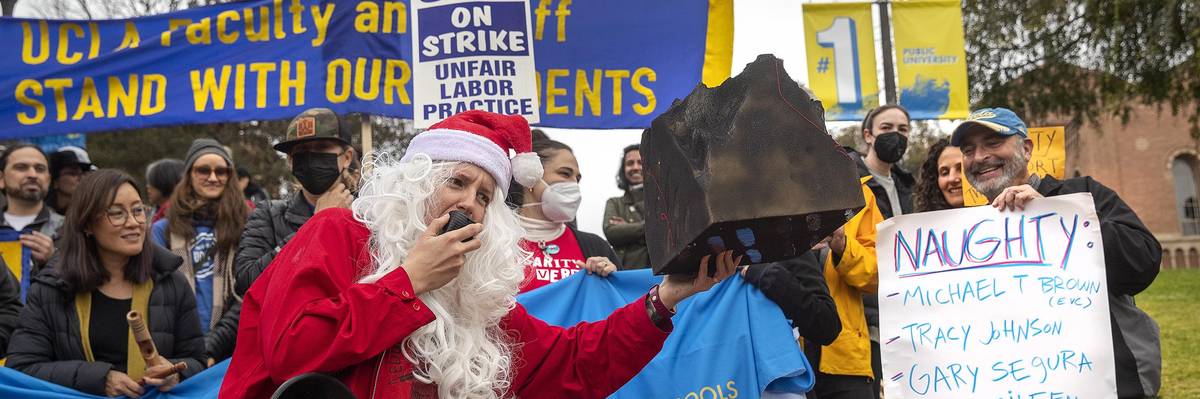
Candace Hansen, a graduate student in musicology and a teacher's assistant at University of California, Los Angeles, dressed up as Santa Claus for a December 2, 2022 demonstration during a strike. Mel Melcon / Los Angeles Times via Getty Images)
One dissenting student negotiator said the tentative agreement "does not come close to our initial demands and it leaves a lot of our co-workers still rent burdened, still impoverished."
While many University of California graduate student workers welcomed Friday's strike-ending ratification of a new labor agreement that delivers increased pay and benefits, other rank-and-file union members expressed anger and disappointment that the deal does not deliver enough.
The Los Angeles Times reports two bargaining units of United Auto Workers—which represent the 48,000 student workers—approved tentative agreements on contracts that will take effect immediately and run through the end of May 2025. The six-week strike—the largest academic employee walkout in U.S. history—will end, and most U.C. graduate workers will return to their jobs after winter break.
"It is disappointing and upsetting that we have enshrined systemic inequity in a union contract."
More than two-thirds (68%) of Student Researchers United (SRU)-UAW members approved the tentative agreement, while about 62% of UAW-2865 members backed the proposal. Support among SRU-UAW voters ranged from 19% at U.C. Santa Cruz to 86% at U.C. Berkeley Lab. For UAW-2865, U.C. San Diego (73%) showed the strongest support for the agreement, while just one in five U.C. Santa Cruz voters approved the deal.
The agreement sets minimum salary scales for student workers, raising base pay from around $23,250 to $34,564.50 for 50% time work by October 1, 2024. U.C. Berkeley, U.C. San Francisco, and UCLA workers will get at least $36,500 due to the higher cost of living in the Bay Area and Los Angeles. Childcare reimbursements, non-residential supplemental tuition, and other benefits are included in the package.
"The dramatic improvements to our salaries and working conditions are the result of tens of thousands of workers striking together in unity," UAW 2865 president Rafael Jaime said in a statement. "These agreements redefine what is possible in terms of how universities support their workers, who are the backbone of their research and education enterprise. They include especially significant improvements for parents and marginalized workers, and will improve the quality of life for every single academic employee at the University of California."
Nick Geiser, one of the student negotiators, said that "I think this represents one of the most successful collective bargaining agreements in academic history and certainly in modern American labor history."
However, many rank-and-file UAW members opposed the agreement. Fifteen of the 40 student negotiators voted against the deal, arguing that "the proposal is inadequate and that a stronger contract is within reach."
"One of the main issues I have is that the major salary increase will not come to fruition until 2024," Samia Errazzouki, a doctoral candidate in history at U.C. Davis, told The New York Times. "When I signed up and voted to authorize the strike, my understanding was that we were negotiating to see the fruits immediately."
Janna Haider, a U.C. Santa Barbara history Ph.D. student and bargaining team member, told the San Francisco Examiner that the contract "does not come close to our initial demands and it leaves a lot of our co-workers still rent burdened, still impoverished, but also now in this weird position where they make slightly too much to qualify for certain public assistance programs."
Speaking to the Los Angeles Times and lamenting the exclusion of accessibility and police defunding provisions from the deal, Haider said that "it is disappointing and upsetting that we have enshrined systemic inequity in a union contract."
"But we will respect the results provided the ballots were counted honestly, and rank-and-file workers will continue to fight for a real cost of living adjustment, for an end to police violence, and a more just U.C. and UAW," she said.
Enrique Olivares Pesante, a UCLA PhD student in English and teaching assistant, told the paper that he voted for the agreement even though he believes it is insufficient.
"Getting this contract wasn't the end of it," he said. "It's just the beginning and the continuation of a very long struggle."
Dear Common Dreams reader, It’s been nearly 30 years since I co-founded Common Dreams with my late wife, Lina Newhouser. We had the radical notion that journalism should serve the public good, not corporate profits. It was clear to us from the outset what it would take to build such a project. No paid advertisements. No corporate sponsors. No millionaire publisher telling us what to think or do. Many people said we wouldn't last a year, but we proved those doubters wrong. Together with a tremendous team of journalists and dedicated staff, we built an independent media outlet free from the constraints of profits and corporate control. Our mission has always been simple: To inform. To inspire. To ignite change for the common good. Building Common Dreams was not easy. Our survival was never guaranteed. When you take on the most powerful forces—Wall Street greed, fossil fuel industry destruction, Big Tech lobbyists, and uber-rich oligarchs who have spent billions upon billions rigging the economy and democracy in their favor—the only bulwark you have is supporters who believe in your work. But here’s the urgent message from me today. It's never been this bad out there. And it's never been this hard to keep us going. At the very moment Common Dreams is most needed, the threats we face are intensifying. We need your support now more than ever. We don't accept corporate advertising and never will. We don't have a paywall because we don't think people should be blocked from critical news based on their ability to pay. Everything we do is funded by the donations of readers like you. When everyone does the little they can afford, we are strong. But if that support retreats or dries up, so do we. Will you donate now to make sure Common Dreams not only survives but thrives? —Craig Brown, Co-founder |
While many University of California graduate student workers welcomed Friday's strike-ending ratification of a new labor agreement that delivers increased pay and benefits, other rank-and-file union members expressed anger and disappointment that the deal does not deliver enough.
The Los Angeles Times reports two bargaining units of United Auto Workers—which represent the 48,000 student workers—approved tentative agreements on contracts that will take effect immediately and run through the end of May 2025. The six-week strike—the largest academic employee walkout in U.S. history—will end, and most U.C. graduate workers will return to their jobs after winter break.
"It is disappointing and upsetting that we have enshrined systemic inequity in a union contract."
More than two-thirds (68%) of Student Researchers United (SRU)-UAW members approved the tentative agreement, while about 62% of UAW-2865 members backed the proposal. Support among SRU-UAW voters ranged from 19% at U.C. Santa Cruz to 86% at U.C. Berkeley Lab. For UAW-2865, U.C. San Diego (73%) showed the strongest support for the agreement, while just one in five U.C. Santa Cruz voters approved the deal.
The agreement sets minimum salary scales for student workers, raising base pay from around $23,250 to $34,564.50 for 50% time work by October 1, 2024. U.C. Berkeley, U.C. San Francisco, and UCLA workers will get at least $36,500 due to the higher cost of living in the Bay Area and Los Angeles. Childcare reimbursements, non-residential supplemental tuition, and other benefits are included in the package.
"The dramatic improvements to our salaries and working conditions are the result of tens of thousands of workers striking together in unity," UAW 2865 president Rafael Jaime said in a statement. "These agreements redefine what is possible in terms of how universities support their workers, who are the backbone of their research and education enterprise. They include especially significant improvements for parents and marginalized workers, and will improve the quality of life for every single academic employee at the University of California."
Nick Geiser, one of the student negotiators, said that "I think this represents one of the most successful collective bargaining agreements in academic history and certainly in modern American labor history."
However, many rank-and-file UAW members opposed the agreement. Fifteen of the 40 student negotiators voted against the deal, arguing that "the proposal is inadequate and that a stronger contract is within reach."
"One of the main issues I have is that the major salary increase will not come to fruition until 2024," Samia Errazzouki, a doctoral candidate in history at U.C. Davis, told The New York Times. "When I signed up and voted to authorize the strike, my understanding was that we were negotiating to see the fruits immediately."
Janna Haider, a U.C. Santa Barbara history Ph.D. student and bargaining team member, told the San Francisco Examiner that the contract "does not come close to our initial demands and it leaves a lot of our co-workers still rent burdened, still impoverished, but also now in this weird position where they make slightly too much to qualify for certain public assistance programs."
Speaking to the Los Angeles Times and lamenting the exclusion of accessibility and police defunding provisions from the deal, Haider said that "it is disappointing and upsetting that we have enshrined systemic inequity in a union contract."
"But we will respect the results provided the ballots were counted honestly, and rank-and-file workers will continue to fight for a real cost of living adjustment, for an end to police violence, and a more just U.C. and UAW," she said.
Enrique Olivares Pesante, a UCLA PhD student in English and teaching assistant, told the paper that he voted for the agreement even though he believes it is insufficient.
"Getting this contract wasn't the end of it," he said. "It's just the beginning and the continuation of a very long struggle."
While many University of California graduate student workers welcomed Friday's strike-ending ratification of a new labor agreement that delivers increased pay and benefits, other rank-and-file union members expressed anger and disappointment that the deal does not deliver enough.
The Los Angeles Times reports two bargaining units of United Auto Workers—which represent the 48,000 student workers—approved tentative agreements on contracts that will take effect immediately and run through the end of May 2025. The six-week strike—the largest academic employee walkout in U.S. history—will end, and most U.C. graduate workers will return to their jobs after winter break.
"It is disappointing and upsetting that we have enshrined systemic inequity in a union contract."
More than two-thirds (68%) of Student Researchers United (SRU)-UAW members approved the tentative agreement, while about 62% of UAW-2865 members backed the proposal. Support among SRU-UAW voters ranged from 19% at U.C. Santa Cruz to 86% at U.C. Berkeley Lab. For UAW-2865, U.C. San Diego (73%) showed the strongest support for the agreement, while just one in five U.C. Santa Cruz voters approved the deal.
The agreement sets minimum salary scales for student workers, raising base pay from around $23,250 to $34,564.50 for 50% time work by October 1, 2024. U.C. Berkeley, U.C. San Francisco, and UCLA workers will get at least $36,500 due to the higher cost of living in the Bay Area and Los Angeles. Childcare reimbursements, non-residential supplemental tuition, and other benefits are included in the package.
"The dramatic improvements to our salaries and working conditions are the result of tens of thousands of workers striking together in unity," UAW 2865 president Rafael Jaime said in a statement. "These agreements redefine what is possible in terms of how universities support their workers, who are the backbone of their research and education enterprise. They include especially significant improvements for parents and marginalized workers, and will improve the quality of life for every single academic employee at the University of California."
Nick Geiser, one of the student negotiators, said that "I think this represents one of the most successful collective bargaining agreements in academic history and certainly in modern American labor history."
However, many rank-and-file UAW members opposed the agreement. Fifteen of the 40 student negotiators voted against the deal, arguing that "the proposal is inadequate and that a stronger contract is within reach."
"One of the main issues I have is that the major salary increase will not come to fruition until 2024," Samia Errazzouki, a doctoral candidate in history at U.C. Davis, told The New York Times. "When I signed up and voted to authorize the strike, my understanding was that we were negotiating to see the fruits immediately."
Janna Haider, a U.C. Santa Barbara history Ph.D. student and bargaining team member, told the San Francisco Examiner that the contract "does not come close to our initial demands and it leaves a lot of our co-workers still rent burdened, still impoverished, but also now in this weird position where they make slightly too much to qualify for certain public assistance programs."
Speaking to the Los Angeles Times and lamenting the exclusion of accessibility and police defunding provisions from the deal, Haider said that "it is disappointing and upsetting that we have enshrined systemic inequity in a union contract."
"But we will respect the results provided the ballots were counted honestly, and rank-and-file workers will continue to fight for a real cost of living adjustment, for an end to police violence, and a more just U.C. and UAW," she said.
Enrique Olivares Pesante, a UCLA PhD student in English and teaching assistant, told the paper that he voted for the agreement even though he believes it is insufficient.
"Getting this contract wasn't the end of it," he said. "It's just the beginning and the continuation of a very long struggle."