SUBSCRIBE TO OUR FREE NEWSLETTER
Daily news & progressive opinion—funded by the people, not the corporations—delivered straight to your inbox.
5
#000000
#FFFFFF
To donate by check, phone, or other method, see our More Ways to Give page.
Daily news & progressive opinion—funded by the people, not the corporations—delivered straight to your inbox.
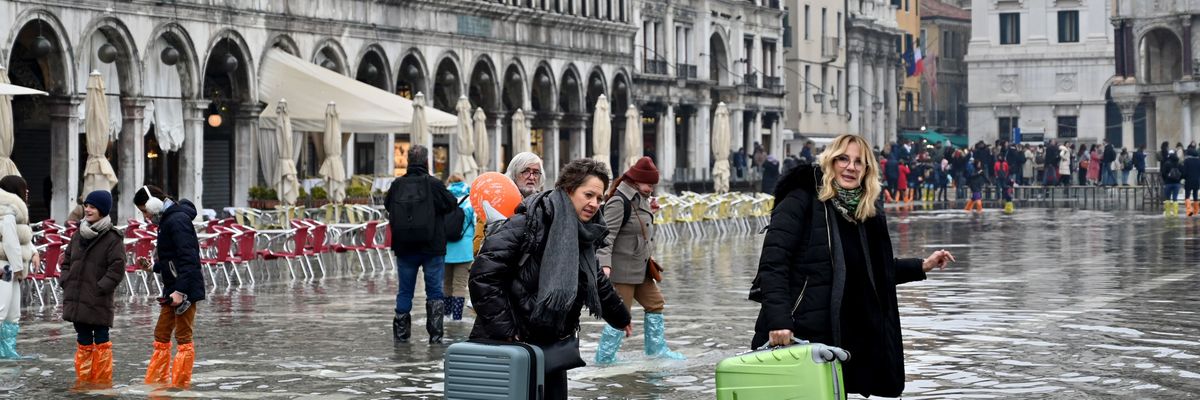
Tourists carry their luggage across a flooded St. Mark's square in Venice on December 10, 2022.
"If nations continue to ignore the existential threat climate change poses to places like Venice, they could be irrevocably damaged or lost forever," said one climate expert.
Climate campaigners expressed dismay Thursday after a United Nations panel declined to place Venice on its list of endangered World Heritage sites—even though the United Nations Educational, Scientific, and Cultural Organization acknowledges that sea-level rise and extreme weather driven by the planetary emergency are increasingly threatening the famed Italian city.
Meeting in Riyadh, Saudi Arabia, the 21 nations on UNESCO's World Heritage Committee for the second time since 2021 did not include Venice—a city of 260,000 residents, 118 islands, 150 canals, and around 10 million annual visitors—on its endangered list. This, despite UNESCO recommending the listing and previously noting that the city "has become vulnerable as a result of irreversible natural and climate changes."
"Italy is an alcoholic in denial over Venice."
UNESCO officials attributed Venice's omission from the World Heritage in Danger list to the city's efforts to mitigate climate and mass tourism risks. Large cruise ships have been banned from Venetian waters, while barriers largely block high tides and other seawater from flooding the city. On Tuesday, Venice city councilmembers approved a pilot program to charge day-trippers a €5 fee to visit the city on days when the number of visitors is expected to be particularly high, such as holidays and weekends in spring and summertime.
Venice Mayor Luigi Brugnaro—a member of the center-right Coraggio Italia party—hailed the UNESCO decision, writing on the social media platform formerly known as Twitter that while "the world has understood all the work we have done to defend our city, some of the opposition in Venice still hasn't!"
Likewise, Italy's far-right government said it was "proud" to have prevented Venice from inclusion on the World Heritage in Danger list.
However, Adam Markham, deputy director of the Climate and Energy Program at the Union of Concerned Scientists, said in a statement that "today's decision by the World Heritage Committee signals an alarming trend of nations not being held accountable for protecting some of the most iconic and irreplaceable natural and historic sites around the globe."
Markham continued:
Venice is a city in crisis facing rising sea levels and flooding that threaten the structural integrity of homes, businesses, critical infrastructure, and world-renowned historical sites. Uncontrolled mass tourism has also made affordable housing scarce for locals as demand for vacation rentals increases and the growth of cruise ship traffic has caused significant damage to the Venice lagoon. If nations continue to ignore the existential threat climate change poses to places like Venice, they could be irrevocably damaged or lost forever. Sadly, climate change and tourism are killing Venice.
Writing last week in The Art Newspaper, Anna Somers Cocks noted that sea levels are predicted to rise 1 meter in Venice by 2100.
"Sea-level rise will destroy Venice by the end of the century unless a major national and international effort is made to save it," she warned. "The city will crumble, bit by bit."
"If Italy objects to listing, like an alcoholic in denial, it will once again have refused to recognize that it has a serious problem," Somers Cocks added. "It will also deal yet another blow to UNESCO's already fading credibility as a protector of the world's heritage, which has been undermined by the member states themselves."
In 2019, floodwaters inundated the chamber where the far-right majority of the Venice City Council had moments earlier voted down a resolution addressing the climate emergency, prompting one concerned observer to quip that nature just did "a mic drop."
Dear Common Dreams reader, It’s been nearly 30 years since I co-founded Common Dreams with my late wife, Lina Newhouser. We had the radical notion that journalism should serve the public good, not corporate profits. It was clear to us from the outset what it would take to build such a project. No paid advertisements. No corporate sponsors. No millionaire publisher telling us what to think or do. Many people said we wouldn't last a year, but we proved those doubters wrong. Together with a tremendous team of journalists and dedicated staff, we built an independent media outlet free from the constraints of profits and corporate control. Our mission has always been simple: To inform. To inspire. To ignite change for the common good. Building Common Dreams was not easy. Our survival was never guaranteed. When you take on the most powerful forces—Wall Street greed, fossil fuel industry destruction, Big Tech lobbyists, and uber-rich oligarchs who have spent billions upon billions rigging the economy and democracy in their favor—the only bulwark you have is supporters who believe in your work. But here’s the urgent message from me today. It's never been this bad out there. And it's never been this hard to keep us going. At the very moment Common Dreams is most needed, the threats we face are intensifying. We need your support now more than ever. We don't accept corporate advertising and never will. We don't have a paywall because we don't think people should be blocked from critical news based on their ability to pay. Everything we do is funded by the donations of readers like you. When everyone does the little they can afford, we are strong. But if that support retreats or dries up, so do we. Will you donate now to make sure Common Dreams not only survives but thrives? —Craig Brown, Co-founder |
Climate campaigners expressed dismay Thursday after a United Nations panel declined to place Venice on its list of endangered World Heritage sites—even though the United Nations Educational, Scientific, and Cultural Organization acknowledges that sea-level rise and extreme weather driven by the planetary emergency are increasingly threatening the famed Italian city.
Meeting in Riyadh, Saudi Arabia, the 21 nations on UNESCO's World Heritage Committee for the second time since 2021 did not include Venice—a city of 260,000 residents, 118 islands, 150 canals, and around 10 million annual visitors—on its endangered list. This, despite UNESCO recommending the listing and previously noting that the city "has become vulnerable as a result of irreversible natural and climate changes."
"Italy is an alcoholic in denial over Venice."
UNESCO officials attributed Venice's omission from the World Heritage in Danger list to the city's efforts to mitigate climate and mass tourism risks. Large cruise ships have been banned from Venetian waters, while barriers largely block high tides and other seawater from flooding the city. On Tuesday, Venice city councilmembers approved a pilot program to charge day-trippers a €5 fee to visit the city on days when the number of visitors is expected to be particularly high, such as holidays and weekends in spring and summertime.
Venice Mayor Luigi Brugnaro—a member of the center-right Coraggio Italia party—hailed the UNESCO decision, writing on the social media platform formerly known as Twitter that while "the world has understood all the work we have done to defend our city, some of the opposition in Venice still hasn't!"
Likewise, Italy's far-right government said it was "proud" to have prevented Venice from inclusion on the World Heritage in Danger list.
However, Adam Markham, deputy director of the Climate and Energy Program at the Union of Concerned Scientists, said in a statement that "today's decision by the World Heritage Committee signals an alarming trend of nations not being held accountable for protecting some of the most iconic and irreplaceable natural and historic sites around the globe."
Markham continued:
Venice is a city in crisis facing rising sea levels and flooding that threaten the structural integrity of homes, businesses, critical infrastructure, and world-renowned historical sites. Uncontrolled mass tourism has also made affordable housing scarce for locals as demand for vacation rentals increases and the growth of cruise ship traffic has caused significant damage to the Venice lagoon. If nations continue to ignore the existential threat climate change poses to places like Venice, they could be irrevocably damaged or lost forever. Sadly, climate change and tourism are killing Venice.
Writing last week in The Art Newspaper, Anna Somers Cocks noted that sea levels are predicted to rise 1 meter in Venice by 2100.
"Sea-level rise will destroy Venice by the end of the century unless a major national and international effort is made to save it," she warned. "The city will crumble, bit by bit."
"If Italy objects to listing, like an alcoholic in denial, it will once again have refused to recognize that it has a serious problem," Somers Cocks added. "It will also deal yet another blow to UNESCO's already fading credibility as a protector of the world's heritage, which has been undermined by the member states themselves."
In 2019, floodwaters inundated the chamber where the far-right majority of the Venice City Council had moments earlier voted down a resolution addressing the climate emergency, prompting one concerned observer to quip that nature just did "a mic drop."
Climate campaigners expressed dismay Thursday after a United Nations panel declined to place Venice on its list of endangered World Heritage sites—even though the United Nations Educational, Scientific, and Cultural Organization acknowledges that sea-level rise and extreme weather driven by the planetary emergency are increasingly threatening the famed Italian city.
Meeting in Riyadh, Saudi Arabia, the 21 nations on UNESCO's World Heritage Committee for the second time since 2021 did not include Venice—a city of 260,000 residents, 118 islands, 150 canals, and around 10 million annual visitors—on its endangered list. This, despite UNESCO recommending the listing and previously noting that the city "has become vulnerable as a result of irreversible natural and climate changes."
"Italy is an alcoholic in denial over Venice."
UNESCO officials attributed Venice's omission from the World Heritage in Danger list to the city's efforts to mitigate climate and mass tourism risks. Large cruise ships have been banned from Venetian waters, while barriers largely block high tides and other seawater from flooding the city. On Tuesday, Venice city councilmembers approved a pilot program to charge day-trippers a €5 fee to visit the city on days when the number of visitors is expected to be particularly high, such as holidays and weekends in spring and summertime.
Venice Mayor Luigi Brugnaro—a member of the center-right Coraggio Italia party—hailed the UNESCO decision, writing on the social media platform formerly known as Twitter that while "the world has understood all the work we have done to defend our city, some of the opposition in Venice still hasn't!"
Likewise, Italy's far-right government said it was "proud" to have prevented Venice from inclusion on the World Heritage in Danger list.
However, Adam Markham, deputy director of the Climate and Energy Program at the Union of Concerned Scientists, said in a statement that "today's decision by the World Heritage Committee signals an alarming trend of nations not being held accountable for protecting some of the most iconic and irreplaceable natural and historic sites around the globe."
Markham continued:
Venice is a city in crisis facing rising sea levels and flooding that threaten the structural integrity of homes, businesses, critical infrastructure, and world-renowned historical sites. Uncontrolled mass tourism has also made affordable housing scarce for locals as demand for vacation rentals increases and the growth of cruise ship traffic has caused significant damage to the Venice lagoon. If nations continue to ignore the existential threat climate change poses to places like Venice, they could be irrevocably damaged or lost forever. Sadly, climate change and tourism are killing Venice.
Writing last week in The Art Newspaper, Anna Somers Cocks noted that sea levels are predicted to rise 1 meter in Venice by 2100.
"Sea-level rise will destroy Venice by the end of the century unless a major national and international effort is made to save it," she warned. "The city will crumble, bit by bit."
"If Italy objects to listing, like an alcoholic in denial, it will once again have refused to recognize that it has a serious problem," Somers Cocks added. "It will also deal yet another blow to UNESCO's already fading credibility as a protector of the world's heritage, which has been undermined by the member states themselves."
In 2019, floodwaters inundated the chamber where the far-right majority of the Venice City Council had moments earlier voted down a resolution addressing the climate emergency, prompting one concerned observer to quip that nature just did "a mic drop."