SUBSCRIBE TO OUR FREE NEWSLETTER
Daily news & progressive opinion—funded by the people, not the corporations—delivered straight to your inbox.
5
#000000
#FFFFFF
To donate by check, phone, or other method, see our More Ways to Give page.
Daily news & progressive opinion—funded by the people, not the corporations—delivered straight to your inbox.
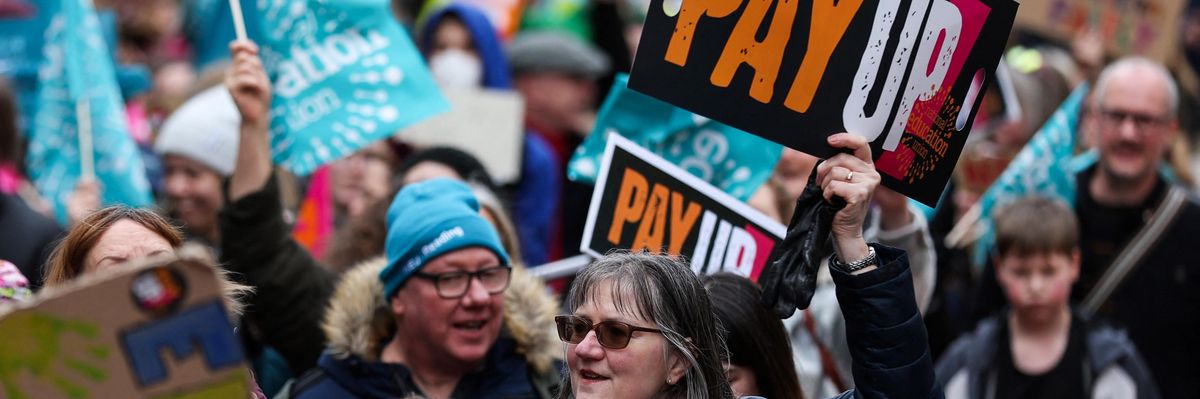
Teachers hold placards during a demonstration in Reading, England on February 1, 2023 during a national strike day.
"We are the working class, and we are back," said one union leader. "We are here, we are demanding change, we refuse to be bought."
With organizers saying it's entirely within the power of the United Kingdom's Conservative government to ensure public sector employees are paid fairly, roughly half a million workers walked out on Wednesday in the country's largest coordinated strike in more than a decade.
About 300,000 of the striking employees are educators, and they were joined by civil servants, railroad workers, university professors, London bus drivers, museum workers, and border officials, among others, with 59% of Britons telling YouGov in a recent poll that they supported the walkout.
The strong support comes even as an estimated 85% of schools across the U.K. were closed on Wednesday. Students and parents stood on picket lines alongside teachers, whose wages have not kept up with inflation and who are struggling to teach in schools where per-pupil spending for the 2024-25 school year is now expected to be 3% lower than it was in 2010.
"It's partly about pay, which has been reduced by 11% over the last 10 years," Jon Voake, a drama teacher in South Gloucestershire, told The Guardian. "But it's also about how our workload's going up. We're all working with bigger groups. Children's education is going to suffer and enough is enough."
In the most economically deprived parts of the country, the National Education Union said, teachers' pay has gone down by more than 20% since 2010 as the rate of inflation in the U.K. stands at 10.5%—"the highest among the G7 group of advanced economies," according to Al Jazeera.
The Trades Union Congress (TUC) says that the average public sector worker in the U.K. now has $250 less per month than they did in 2010, accounting for inflation. A graph the organization shared on social media as the workers walked out showed that teachers' real compensation is now far lower than the range among other countries in the Organization for Economic Cooperation and Development.
A 5% pay raise offered to public sector workers last year is actually a 7% pay cut when accounting for soaring inflation, union leaders say.
The walkout comes a day after members of Parliament passed an anti-strike law that would enforce "minimum service levels" in a railroad sector and emergency services, threatening workers with termination if they take part in a work stoppage. The bill still needs to pass in the House of Lords before becoming law. The TUC has said it could take the government to court over the proposal, which TUC assistant general secretary Kate Bell told The Guardian is "unnecessary, unfair, and almost certainly illegal."
Ambulance drivers and nurses are reportedly planning to stage a work stoppage in the coming days.
Conservative Prime Minister Rishi Sunak told public health workers on Monday, "I would love, nothing more would give me more pleasure than, to wave a magic wand and have all of you paid lots more"—but organizers and labor advocates on Wednesday said Sunak's government simply needs to change its tax policies to mitigate the cost-of-living crisis.
"We just need a fair taxation system," John McDonnell, a Labour MP former shadow chancellor of the exchequer, told The Guardian, calling on the Tories to tax capital gains at the same level of income to pay for raises. "The issue at the moment is that we seem to have a government that is redistributing wealth upwards."
Mark Serwotka, general secretary of the Public and Commercial Services union, told The Guardian that the Tories have claimed it would cost £29 billion ($35 billion) to give raises to public sectors, while the actual amount is about £10 billion ($12 billion).
"And £10 billion in an economy like ours can easily be found," said Serwotka.
Mick Lynch, secretary general of the National Union of Rail, Maritime, and Transport Workers, rallied thousands of teachers outside Downing Street in London.
"We are the working class, and we are back," said Lynch. "We are here, we are demanding change, we refuse to be bought, and we are going to win for our people on our terms."
Dear Common Dreams reader, It’s been nearly 30 years since I co-founded Common Dreams with my late wife, Lina Newhouser. We had the radical notion that journalism should serve the public good, not corporate profits. It was clear to us from the outset what it would take to build such a project. No paid advertisements. No corporate sponsors. No millionaire publisher telling us what to think or do. Many people said we wouldn't last a year, but we proved those doubters wrong. Together with a tremendous team of journalists and dedicated staff, we built an independent media outlet free from the constraints of profits and corporate control. Our mission has always been simple: To inform. To inspire. To ignite change for the common good. Building Common Dreams was not easy. Our survival was never guaranteed. When you take on the most powerful forces—Wall Street greed, fossil fuel industry destruction, Big Tech lobbyists, and uber-rich oligarchs who have spent billions upon billions rigging the economy and democracy in their favor—the only bulwark you have is supporters who believe in your work. But here’s the urgent message from me today. It's never been this bad out there. And it's never been this hard to keep us going. At the very moment Common Dreams is most needed, the threats we face are intensifying. We need your support now more than ever. We don't accept corporate advertising and never will. We don't have a paywall because we don't think people should be blocked from critical news based on their ability to pay. Everything we do is funded by the donations of readers like you. When everyone does the little they can afford, we are strong. But if that support retreats or dries up, so do we. Will you donate now to make sure Common Dreams not only survives but thrives? —Craig Brown, Co-founder |
With organizers saying it's entirely within the power of the United Kingdom's Conservative government to ensure public sector employees are paid fairly, roughly half a million workers walked out on Wednesday in the country's largest coordinated strike in more than a decade.
About 300,000 of the striking employees are educators, and they were joined by civil servants, railroad workers, university professors, London bus drivers, museum workers, and border officials, among others, with 59% of Britons telling YouGov in a recent poll that they supported the walkout.
The strong support comes even as an estimated 85% of schools across the U.K. were closed on Wednesday. Students and parents stood on picket lines alongside teachers, whose wages have not kept up with inflation and who are struggling to teach in schools where per-pupil spending for the 2024-25 school year is now expected to be 3% lower than it was in 2010.
"It's partly about pay, which has been reduced by 11% over the last 10 years," Jon Voake, a drama teacher in South Gloucestershire, told The Guardian. "But it's also about how our workload's going up. We're all working with bigger groups. Children's education is going to suffer and enough is enough."
In the most economically deprived parts of the country, the National Education Union said, teachers' pay has gone down by more than 20% since 2010 as the rate of inflation in the U.K. stands at 10.5%—"the highest among the G7 group of advanced economies," according to Al Jazeera.
The Trades Union Congress (TUC) says that the average public sector worker in the U.K. now has $250 less per month than they did in 2010, accounting for inflation. A graph the organization shared on social media as the workers walked out showed that teachers' real compensation is now far lower than the range among other countries in the Organization for Economic Cooperation and Development.
A 5% pay raise offered to public sector workers last year is actually a 7% pay cut when accounting for soaring inflation, union leaders say.
The walkout comes a day after members of Parliament passed an anti-strike law that would enforce "minimum service levels" in a railroad sector and emergency services, threatening workers with termination if they take part in a work stoppage. The bill still needs to pass in the House of Lords before becoming law. The TUC has said it could take the government to court over the proposal, which TUC assistant general secretary Kate Bell told The Guardian is "unnecessary, unfair, and almost certainly illegal."
Ambulance drivers and nurses are reportedly planning to stage a work stoppage in the coming days.
Conservative Prime Minister Rishi Sunak told public health workers on Monday, "I would love, nothing more would give me more pleasure than, to wave a magic wand and have all of you paid lots more"—but organizers and labor advocates on Wednesday said Sunak's government simply needs to change its tax policies to mitigate the cost-of-living crisis.
"We just need a fair taxation system," John McDonnell, a Labour MP former shadow chancellor of the exchequer, told The Guardian, calling on the Tories to tax capital gains at the same level of income to pay for raises. "The issue at the moment is that we seem to have a government that is redistributing wealth upwards."
Mark Serwotka, general secretary of the Public and Commercial Services union, told The Guardian that the Tories have claimed it would cost £29 billion ($35 billion) to give raises to public sectors, while the actual amount is about £10 billion ($12 billion).
"And £10 billion in an economy like ours can easily be found," said Serwotka.
Mick Lynch, secretary general of the National Union of Rail, Maritime, and Transport Workers, rallied thousands of teachers outside Downing Street in London.
"We are the working class, and we are back," said Lynch. "We are here, we are demanding change, we refuse to be bought, and we are going to win for our people on our terms."
With organizers saying it's entirely within the power of the United Kingdom's Conservative government to ensure public sector employees are paid fairly, roughly half a million workers walked out on Wednesday in the country's largest coordinated strike in more than a decade.
About 300,000 of the striking employees are educators, and they were joined by civil servants, railroad workers, university professors, London bus drivers, museum workers, and border officials, among others, with 59% of Britons telling YouGov in a recent poll that they supported the walkout.
The strong support comes even as an estimated 85% of schools across the U.K. were closed on Wednesday. Students and parents stood on picket lines alongside teachers, whose wages have not kept up with inflation and who are struggling to teach in schools where per-pupil spending for the 2024-25 school year is now expected to be 3% lower than it was in 2010.
"It's partly about pay, which has been reduced by 11% over the last 10 years," Jon Voake, a drama teacher in South Gloucestershire, told The Guardian. "But it's also about how our workload's going up. We're all working with bigger groups. Children's education is going to suffer and enough is enough."
In the most economically deprived parts of the country, the National Education Union said, teachers' pay has gone down by more than 20% since 2010 as the rate of inflation in the U.K. stands at 10.5%—"the highest among the G7 group of advanced economies," according to Al Jazeera.
The Trades Union Congress (TUC) says that the average public sector worker in the U.K. now has $250 less per month than they did in 2010, accounting for inflation. A graph the organization shared on social media as the workers walked out showed that teachers' real compensation is now far lower than the range among other countries in the Organization for Economic Cooperation and Development.
A 5% pay raise offered to public sector workers last year is actually a 7% pay cut when accounting for soaring inflation, union leaders say.
The walkout comes a day after members of Parliament passed an anti-strike law that would enforce "minimum service levels" in a railroad sector and emergency services, threatening workers with termination if they take part in a work stoppage. The bill still needs to pass in the House of Lords before becoming law. The TUC has said it could take the government to court over the proposal, which TUC assistant general secretary Kate Bell told The Guardian is "unnecessary, unfair, and almost certainly illegal."
Ambulance drivers and nurses are reportedly planning to stage a work stoppage in the coming days.
Conservative Prime Minister Rishi Sunak told public health workers on Monday, "I would love, nothing more would give me more pleasure than, to wave a magic wand and have all of you paid lots more"—but organizers and labor advocates on Wednesday said Sunak's government simply needs to change its tax policies to mitigate the cost-of-living crisis.
"We just need a fair taxation system," John McDonnell, a Labour MP former shadow chancellor of the exchequer, told The Guardian, calling on the Tories to tax capital gains at the same level of income to pay for raises. "The issue at the moment is that we seem to have a government that is redistributing wealth upwards."
Mark Serwotka, general secretary of the Public and Commercial Services union, told The Guardian that the Tories have claimed it would cost £29 billion ($35 billion) to give raises to public sectors, while the actual amount is about £10 billion ($12 billion).
"And £10 billion in an economy like ours can easily be found," said Serwotka.
Mick Lynch, secretary general of the National Union of Rail, Maritime, and Transport Workers, rallied thousands of teachers outside Downing Street in London.
"We are the working class, and we are back," said Lynch. "We are here, we are demanding change, we refuse to be bought, and we are going to win for our people on our terms."