SUBSCRIBE TO OUR FREE NEWSLETTER
Daily news & progressive opinion—funded by the people, not the corporations—delivered straight to your inbox.
5
#000000
#FFFFFF
To donate by check, phone, or other method, see our More Ways to Give page.
Daily news & progressive opinion—funded by the people, not the corporations—delivered straight to your inbox.
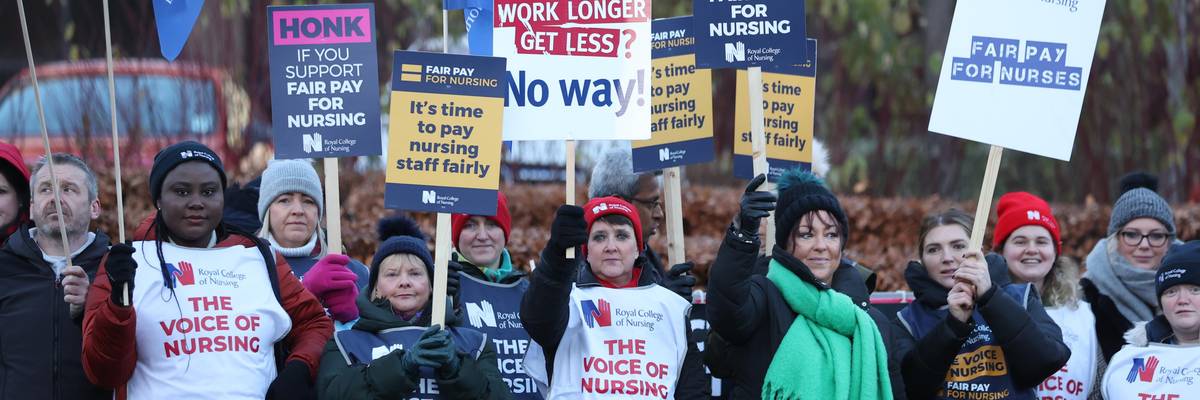
Members of the Royal College of Nursing (RCN) on the picket line outside Belfast City Hospital on December 15, 2022. (Photo: Liam McBurney/PA Images via Getty Images)
Tens of thousands of nurses across the United Kingdom are set to walk off the job Thursday in what's been described as the largest-ever strike by National Health Service workers, who said they were forced to act after the government refused to negotiate over pay amid painfully high inflation.
The walkout represents NHS nurses' first national strike, and it comes as U.K. rail and postal workers are also taking major labor actions in response to falling real pay, meager benefits, and worsening conditions.
Nurses taking part in Thursday's walkouts in England, Wales, and Northern Ireland--one of two scheduled days of action in the week--lamented that a strike became necessary but said they had no choice as inadequate pay and staffing shortages put themselves and patients in danger. Healthcare workers also pointed to years of Tory-imposed funding cuts as a factor harming nurses and compromising the U.K.'s public healthcare system.
"Nurses have had enough--we are underpaid and undervalued," said nurse anesthetist Lyndsay Thompson of Northern Ireland. "Yes, this is a pay dispute but it's also very much about patient safety. The fact we cannot recruit enough nurses means patient safety is being put at risk."
Pat Cullen, general secretary and chief executive of the Royal College of Nursing (RCN)--the union that represents NHS nurses--said in a statement Thursday that "for many of us, this is our first time striking and our emotions are really mixed."
"The NHS is in crisis, the nursing profession can't take any more, our loved ones are already suffering," said Cullen. "It is not unreasonable to demand better. This is not something that can wait."
The RCN said a strike became inevitable after U.K. ministers declined every offer to start formal pay negotiations. Earlier this week, Cullen met with Tory Health Secretary Steve Barclay in a last-ditch effort to discuss pay before launching the national strike, but he refused to budge.
"I asked several times to discuss pay and each time we returned to the same thing--that there was no extra money on the table, and that they would not be discussing pay with me," Cullen said. "I needed to come out of this meeting with something serious to show nursing staff why they should not strike this week. Regrettably, they're not getting an extra penny."
Strike actions had also been planned in Scotland, the RCN noted, but they were put on hold after the Scottish government agreed to negotiate.
According to the Health Foundation, an independent U.K. charity, nurses saw a 5% pay cut between 2011 and 2021 when accounting for inflation.
Earlier this year, the U.K. government backed a 4-5% pay raise for most NHS nurses, but the RCN said that's far from enough given the country's inflation rate of nearly 11%. RCN is demanding a 5% raise on top of inflation, which U.K. officials have rejected as too high.
As a result of the strike Thursday and the next planned action on December 20, parts of the NHS will be shut down but urgent services will remain fully staffed.
A recent survey found that nearly 60% of Britons support the nurses' decision to approve a strike.
"It is a tragic first for nursing, the RCN, and the NHS," Cullen told The Guardian of Thursday's national walkout. "Nursing staff on picket lines is a sign of failure on the part of governments."
Dear Common Dreams reader, It’s been nearly 30 years since I co-founded Common Dreams with my late wife, Lina Newhouser. We had the radical notion that journalism should serve the public good, not corporate profits. It was clear to us from the outset what it would take to build such a project. No paid advertisements. No corporate sponsors. No millionaire publisher telling us what to think or do. Many people said we wouldn't last a year, but we proved those doubters wrong. Together with a tremendous team of journalists and dedicated staff, we built an independent media outlet free from the constraints of profits and corporate control. Our mission has always been simple: To inform. To inspire. To ignite change for the common good. Building Common Dreams was not easy. Our survival was never guaranteed. When you take on the most powerful forces—Wall Street greed, fossil fuel industry destruction, Big Tech lobbyists, and uber-rich oligarchs who have spent billions upon billions rigging the economy and democracy in their favor—the only bulwark you have is supporters who believe in your work. But here’s the urgent message from me today. It's never been this bad out there. And it's never been this hard to keep us going. At the very moment Common Dreams is most needed, the threats we face are intensifying. We need your support now more than ever. We don't accept corporate advertising and never will. We don't have a paywall because we don't think people should be blocked from critical news based on their ability to pay. Everything we do is funded by the donations of readers like you. When everyone does the little they can afford, we are strong. But if that support retreats or dries up, so do we. Will you donate now to make sure Common Dreams not only survives but thrives? —Craig Brown, Co-founder |
Tens of thousands of nurses across the United Kingdom are set to walk off the job Thursday in what's been described as the largest-ever strike by National Health Service workers, who said they were forced to act after the government refused to negotiate over pay amid painfully high inflation.
The walkout represents NHS nurses' first national strike, and it comes as U.K. rail and postal workers are also taking major labor actions in response to falling real pay, meager benefits, and worsening conditions.
Nurses taking part in Thursday's walkouts in England, Wales, and Northern Ireland--one of two scheduled days of action in the week--lamented that a strike became necessary but said they had no choice as inadequate pay and staffing shortages put themselves and patients in danger. Healthcare workers also pointed to years of Tory-imposed funding cuts as a factor harming nurses and compromising the U.K.'s public healthcare system.
"Nurses have had enough--we are underpaid and undervalued," said nurse anesthetist Lyndsay Thompson of Northern Ireland. "Yes, this is a pay dispute but it's also very much about patient safety. The fact we cannot recruit enough nurses means patient safety is being put at risk."
Pat Cullen, general secretary and chief executive of the Royal College of Nursing (RCN)--the union that represents NHS nurses--said in a statement Thursday that "for many of us, this is our first time striking and our emotions are really mixed."
"The NHS is in crisis, the nursing profession can't take any more, our loved ones are already suffering," said Cullen. "It is not unreasonable to demand better. This is not something that can wait."
The RCN said a strike became inevitable after U.K. ministers declined every offer to start formal pay negotiations. Earlier this week, Cullen met with Tory Health Secretary Steve Barclay in a last-ditch effort to discuss pay before launching the national strike, but he refused to budge.
"I asked several times to discuss pay and each time we returned to the same thing--that there was no extra money on the table, and that they would not be discussing pay with me," Cullen said. "I needed to come out of this meeting with something serious to show nursing staff why they should not strike this week. Regrettably, they're not getting an extra penny."
Strike actions had also been planned in Scotland, the RCN noted, but they were put on hold after the Scottish government agreed to negotiate.
According to the Health Foundation, an independent U.K. charity, nurses saw a 5% pay cut between 2011 and 2021 when accounting for inflation.
Earlier this year, the U.K. government backed a 4-5% pay raise for most NHS nurses, but the RCN said that's far from enough given the country's inflation rate of nearly 11%. RCN is demanding a 5% raise on top of inflation, which U.K. officials have rejected as too high.
As a result of the strike Thursday and the next planned action on December 20, parts of the NHS will be shut down but urgent services will remain fully staffed.
A recent survey found that nearly 60% of Britons support the nurses' decision to approve a strike.
"It is a tragic first for nursing, the RCN, and the NHS," Cullen told The Guardian of Thursday's national walkout. "Nursing staff on picket lines is a sign of failure on the part of governments."
Tens of thousands of nurses across the United Kingdom are set to walk off the job Thursday in what's been described as the largest-ever strike by National Health Service workers, who said they were forced to act after the government refused to negotiate over pay amid painfully high inflation.
The walkout represents NHS nurses' first national strike, and it comes as U.K. rail and postal workers are also taking major labor actions in response to falling real pay, meager benefits, and worsening conditions.
Nurses taking part in Thursday's walkouts in England, Wales, and Northern Ireland--one of two scheduled days of action in the week--lamented that a strike became necessary but said they had no choice as inadequate pay and staffing shortages put themselves and patients in danger. Healthcare workers also pointed to years of Tory-imposed funding cuts as a factor harming nurses and compromising the U.K.'s public healthcare system.
"Nurses have had enough--we are underpaid and undervalued," said nurse anesthetist Lyndsay Thompson of Northern Ireland. "Yes, this is a pay dispute but it's also very much about patient safety. The fact we cannot recruit enough nurses means patient safety is being put at risk."
Pat Cullen, general secretary and chief executive of the Royal College of Nursing (RCN)--the union that represents NHS nurses--said in a statement Thursday that "for many of us, this is our first time striking and our emotions are really mixed."
"The NHS is in crisis, the nursing profession can't take any more, our loved ones are already suffering," said Cullen. "It is not unreasonable to demand better. This is not something that can wait."
The RCN said a strike became inevitable after U.K. ministers declined every offer to start formal pay negotiations. Earlier this week, Cullen met with Tory Health Secretary Steve Barclay in a last-ditch effort to discuss pay before launching the national strike, but he refused to budge.
"I asked several times to discuss pay and each time we returned to the same thing--that there was no extra money on the table, and that they would not be discussing pay with me," Cullen said. "I needed to come out of this meeting with something serious to show nursing staff why they should not strike this week. Regrettably, they're not getting an extra penny."
Strike actions had also been planned in Scotland, the RCN noted, but they were put on hold after the Scottish government agreed to negotiate.
According to the Health Foundation, an independent U.K. charity, nurses saw a 5% pay cut between 2011 and 2021 when accounting for inflation.
Earlier this year, the U.K. government backed a 4-5% pay raise for most NHS nurses, but the RCN said that's far from enough given the country's inflation rate of nearly 11%. RCN is demanding a 5% raise on top of inflation, which U.K. officials have rejected as too high.
As a result of the strike Thursday and the next planned action on December 20, parts of the NHS will be shut down but urgent services will remain fully staffed.
A recent survey found that nearly 60% of Britons support the nurses' decision to approve a strike.
"It is a tragic first for nursing, the RCN, and the NHS," Cullen told The Guardian of Thursday's national walkout. "Nursing staff on picket lines is a sign of failure on the part of governments."