
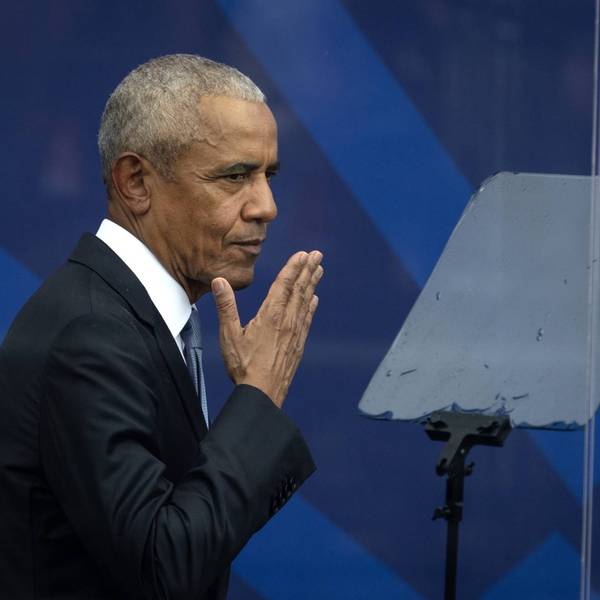

U.S. Director of National Intelligence Tulsi Gabbard arrives at the White House on May 1, 2025 in Washington, D.C.
Gabbard Fires Intel Officials After Memo Counters Trump Lies About Migrants Sent to El Salvador Prison
Critics called the ousters "ominous" and warned that "an intelligence service will not protect you from real-life threats if its members get fired for not lying."
Tulsi Gabbard, U.S. President Donald Trump's controversial director of national intelligence, is generating alarm this week for firing two top officials after a memo contradicting the administration's claims about deported migrants was made public.
As Fox News first reported Tuesday, Gabbard fired Mike Collins, acting chair of the National Intelligence Council, and his deputy, Maria Langan-Riekhof, and moved the NIC from the Central Intelligence Agency (CIA) to the Office of the Director of National Intelligence (ODNI).
As The Hill detailed:
Collins has spent nearly three decades in the intelligence community and has served as chief of staff for the CIA's deputy director. He started his career as an analyst focused on East Asia.
Langan-Riekhof also has more than 30 years of experience in the intelligence community, including as an expert on the Middle East. The ODNI previously listed her as an exceptional analyst. She also previously served as director of the Strategic Futures Group at the National Intelligence Council.
While an ODNI spokesperson told The Hill that "the director is working alongside President Trump to end the weaponization and politicization of the intelligence community," critics framed the firings as "the DEFINITION of politicizing intelligence."
"I am concerned about the apparent removal of senior leadership at the National Intelligence Council without any explanation except vague accusations made in the media," Congressman Jim Himes (D-Conn.), the ranking member on the House Intelligence Committee, told The Washington Post. "Absent evidence to justify the firings, the workforce can only conclude that their jobs are contingent on producing analysis that is aligned with the president's agenda, rather than truthful and apolitical."
The NIC leaders were fired after last week's release of an NIC memo confirming that U.S. intelligence agencies never agreed with Trump's claim that Venezuelan President Nicolás Maduro controls the criminal gang Tren de Aragua. The April 7 document states that "while Venezuela's permissive environment enables TDA to operate, the Maduro regime probably does not have a policy of cooperating with TDA and is not directing TDA movement to and operations in the United States."
Although, as the Post noted, "it was unclear what, if any, direct role Collins or Langan-Riekhof had in drafting the assessment," its release provoked pushback from Gabbard, who said last week that it was "outrageous that as President Trump and his administration work hard every day to make America safe by deporting these violent criminals, some in the media remain intent on twisting and manipulating intelligence assessments to undermine the president's agenda to keep the American people safe."
Trump has used dubious claims about Maduro controlling the gang to justify invoking the Alien Enemies Act to send hundreds of Venezuelan migrants to El Salvador's notorious Terrorism Confinement Center as part of his mass deportation agenda.
Senate Intelligence Committee Vice Chair Mark Warner (D-Va.) said on social media Wednesday: "Gabbard is purging intelligence officials over a report that the Trump administration finds politically inconvenient. Whatever the administration is trying to protect... it's not our national security."
Other critics called Gabbard's moves "ominous" and warned that "an intelligence service will not protect you from real-life threats if its members get fired for not lying."
The U.S. intelligence community (IC) "provides analysis independent of policy preferences," said James Madison University professor and former CIA analyst Stephen Marrin. "When those in power do not want to hear inconvenient facts and unwanted interpretation and punish messengers that provide it, that undermines the reason the IC was created in the first place."
Jonathan Panikoff, a former career U.S. intelligence officer who is now a director in the Atlantic Council's Middle East Program, said that "having spent five years working at the NIC, I can personally attest the [organization] is the heartbeat of apolitical U.S. all-source analysis, traditionally drawing the best of the IC's analysts together to tackle and produce assessments on the hardest issues. Anything that reduces its independence because policymakers don't like the independent conclusions it reaches, is the definition of politicization they are decrying. Mike and Maria are unbelievable leaders and IC professionals, not political actors."
Eric Brewer, who also worked for NIC, expressed full agreement with Panikoff's "excellent comments" and issued his own warning.
"This is a big deal. The result will be an IC less willing to tell the president and other leaders what they need to know rather than what they want to hear. America will be less secure because of it," Brewer said. "The professionals in the IC can withstand a lot, and will no doubt do their utmost to continue to provide objective assessments. But this act is blatant politicization and will have a chilling effect."
The memo that seemingly led to the NIC firings was revealed as a result of a Freedom of Information Act (FOIA) request filed by the Freedom of the Press Foundation. Lauren Harper, the group's Daniel Ellsberg chair on government secrecy, shared the Post's reporting about the ousters on social media Wednesday along with an observation.
"The director of national intelligence's FOIA website (which has reappeared after the entire site was briefly down) no longer has a reading room of released documents or links to its FOIA regulations which, were we to be picky, violates the EFOIA amendments of 1996," Harper highlighted. "Amazing timing."
We are at a crossroads
This country and this world are at a monumental crossroads. In a few short weeks, US voters will have an opportunity to beat back the forces of fascism and confront the billionaires who are rigging the economy, our media system, and our democracy, making it increasingly impossible for ordinary people to get by. We’re not just talking about the election. We’re talking about what must be done once these fascist elements are vanquished from power. We need a bolder set of solutions than what either major party has so far been willing to offer and a working-class movement ready to fight like hell for it. Trump didn't emerge from nowhere. The conditions that fueled MAGA authoritarianism were created by decades of radical neoliberal economic policies and a corrupt political system dominated by corporate interests. They slashed taxes on the super-rich, promising that the benefits would trickle down. They said giveaways to the corporate titans would make life more affordable for the rest of us. It was all bullshit. And when a bitter, betrayed populace searches for someone to blame, right-wing demagogues have little trouble finding scapegoats. People know when they're being lied to, but you won't hear any of this from the corporate media. Only independent journalism—powered and funded by people who believe in building a better world—can deliver truly trustworthy daily news. Our Fall Campaign is underway, and we need your help. To power our newsroom through the rest of the year, we need to raise $125,000 by midnight on October 31. So if you share our vision, please contribute whatever you can to sustain our work. |
Tulsi Gabbard, U.S. President Donald Trump's controversial director of national intelligence, is generating alarm this week for firing two top officials after a memo contradicting the administration's claims about deported migrants was made public.
As Fox News first reported Tuesday, Gabbard fired Mike Collins, acting chair of the National Intelligence Council, and his deputy, Maria Langan-Riekhof, and moved the NIC from the Central Intelligence Agency (CIA) to the Office of the Director of National Intelligence (ODNI).
As The Hill detailed:
Collins has spent nearly three decades in the intelligence community and has served as chief of staff for the CIA's deputy director. He started his career as an analyst focused on East Asia.
Langan-Riekhof also has more than 30 years of experience in the intelligence community, including as an expert on the Middle East. The ODNI previously listed her as an exceptional analyst. She also previously served as director of the Strategic Futures Group at the National Intelligence Council.
While an ODNI spokesperson told The Hill that "the director is working alongside President Trump to end the weaponization and politicization of the intelligence community," critics framed the firings as "the DEFINITION of politicizing intelligence."
"I am concerned about the apparent removal of senior leadership at the National Intelligence Council without any explanation except vague accusations made in the media," Congressman Jim Himes (D-Conn.), the ranking member on the House Intelligence Committee, told The Washington Post. "Absent evidence to justify the firings, the workforce can only conclude that their jobs are contingent on producing analysis that is aligned with the president's agenda, rather than truthful and apolitical."
The NIC leaders were fired after last week's release of an NIC memo confirming that U.S. intelligence agencies never agreed with Trump's claim that Venezuelan President Nicolás Maduro controls the criminal gang Tren de Aragua. The April 7 document states that "while Venezuela's permissive environment enables TDA to operate, the Maduro regime probably does not have a policy of cooperating with TDA and is not directing TDA movement to and operations in the United States."
Although, as the Post noted, "it was unclear what, if any, direct role Collins or Langan-Riekhof had in drafting the assessment," its release provoked pushback from Gabbard, who said last week that it was "outrageous that as President Trump and his administration work hard every day to make America safe by deporting these violent criminals, some in the media remain intent on twisting and manipulating intelligence assessments to undermine the president's agenda to keep the American people safe."
Trump has used dubious claims about Maduro controlling the gang to justify invoking the Alien Enemies Act to send hundreds of Venezuelan migrants to El Salvador's notorious Terrorism Confinement Center as part of his mass deportation agenda.
Senate Intelligence Committee Vice Chair Mark Warner (D-Va.) said on social media Wednesday: "Gabbard is purging intelligence officials over a report that the Trump administration finds politically inconvenient. Whatever the administration is trying to protect... it's not our national security."
Other critics called Gabbard's moves "ominous" and warned that "an intelligence service will not protect you from real-life threats if its members get fired for not lying."
The U.S. intelligence community (IC) "provides analysis independent of policy preferences," said James Madison University professor and former CIA analyst Stephen Marrin. "When those in power do not want to hear inconvenient facts and unwanted interpretation and punish messengers that provide it, that undermines the reason the IC was created in the first place."
Jonathan Panikoff, a former career U.S. intelligence officer who is now a director in the Atlantic Council's Middle East Program, said that "having spent five years working at the NIC, I can personally attest the [organization] is the heartbeat of apolitical U.S. all-source analysis, traditionally drawing the best of the IC's analysts together to tackle and produce assessments on the hardest issues. Anything that reduces its independence because policymakers don't like the independent conclusions it reaches, is the definition of politicization they are decrying. Mike and Maria are unbelievable leaders and IC professionals, not political actors."
Eric Brewer, who also worked for NIC, expressed full agreement with Panikoff's "excellent comments" and issued his own warning.
"This is a big deal. The result will be an IC less willing to tell the president and other leaders what they need to know rather than what they want to hear. America will be less secure because of it," Brewer said. "The professionals in the IC can withstand a lot, and will no doubt do their utmost to continue to provide objective assessments. But this act is blatant politicization and will have a chilling effect."
The memo that seemingly led to the NIC firings was revealed as a result of a Freedom of Information Act (FOIA) request filed by the Freedom of the Press Foundation. Lauren Harper, the group's Daniel Ellsberg chair on government secrecy, shared the Post's reporting about the ousters on social media Wednesday along with an observation.
"The director of national intelligence's FOIA website (which has reappeared after the entire site was briefly down) no longer has a reading room of released documents or links to its FOIA regulations which, were we to be picky, violates the EFOIA amendments of 1996," Harper highlighted. "Amazing timing."