SUBSCRIBE TO OUR FREE NEWSLETTER
Daily news & progressive opinion—funded by the people, not the corporations—delivered straight to your inbox.
5
#000000
#FFFFFF
To donate by check, phone, or other method, see our More Ways to Give page.
Daily news & progressive opinion—funded by the people, not the corporations—delivered straight to your inbox.
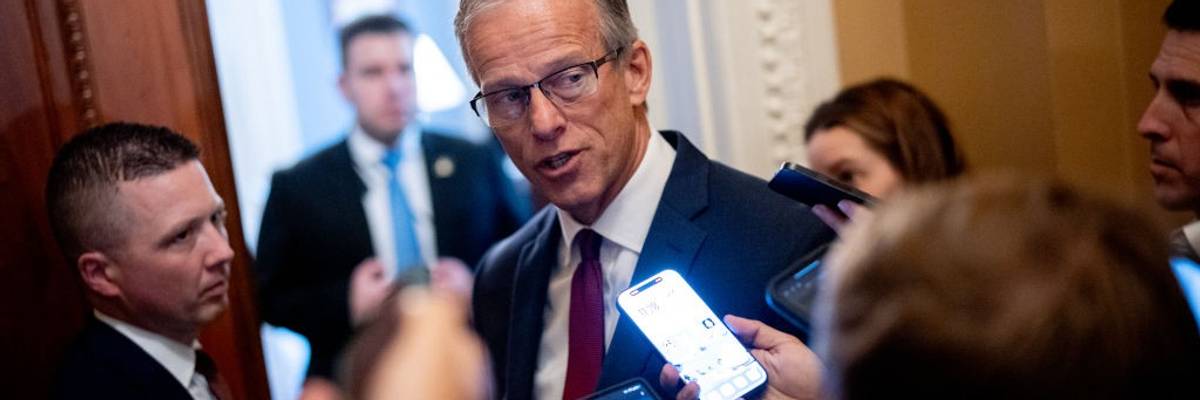
Sen. John Thune (R-S.D.) speaks to reporters following a news conference on November 19, 2024 in Washington, D.C.
"If you're trying to ram through nominees without Senate and public scrutiny, it's a pretty good guess that you have something to hide."
Dozens of civil rights and pro-democracy organizations teamed up Wednesday to express opposition to President-elect Donald Trump's push to use recess appointments to evade the Senate confirmation process for his political nominees, many of which have
glaring conflicts of interest.
The 70 groups—including People For the American Way, Public Citizen, the Constitutional Accountability Center, and the NAACP—sent a letter to U.S. senators arguing that Senate confirmation procedures provide "crucial data" that helps lawmakers and the public "evaluate nominees' fitness for the important positions to which they are nominated."
"The framers of the Constitution included the requirement of Senate 'Advice and Consent' for high-ranking officers for a reason: The requirement can protect our freedom, just as the Bill of Rights does, by providing an indispensable check on presidential power," reads the new letter. "None of that would happen with recess appointments. The American people would be kept in the dark."
Since his victory in last month's election, Trump has publicly expressed his desire to bypass the often time-consuming Senate confirmation process via recess appointments, which are allowed under the Constitution and have been used in the past by presidents of both parties. The need for Senate confirmation is already proving to be a significant obstacle for the incoming administration: Trump's first attorney general nominee, Matt Gaetz, withdrew amid seemingly insurmountable Senate opposition, and Pentagon nominee Pete Hegseth appears to be on the ropes.
"Giving in to the president-elect's demand for recess appointments under the current circumstances would dramatically depart from how important positions have always been filled at the start of an administration," the groups wrote in their letter. "The confirmation process gathers important information that helps ensure that nominees who will be dangerous or ineffective for the American people are not confirmed and given great power, and that those who are confirmed meet at least a minimum standard of acceptability."
"The American people deserve full vetting of every person selected to serve in our nation's highest offices, and Trump's nominees are no exception."
Scholars argue recess appointments were intended as a way for presidents to appoint officials to key posts under unusual circumstances, not as an exploit for presidents whose nominees run up against significant opposition.
The Senate could prevent recess appointments by refusing to officially go on recess and making use of pro forma sessions, but incoming Senate Majority Leader John Thune (R-S.D.) has said that "we have to have all the options on the table" to push through Trump's nominees.
"We are not going to allow the Democrats to thwart the will of the American people in giving President Trump the people that he wants in those positions to implement his agenda," Thune said last month.
Trump has also previously threatened to invoke a never-before-used provision of the Constitution that he claims would allow him to force both chambers of Congress to adjourn, paving the way for recess appointments.
Conservative scholar Edward Whelan, a distinguished senior fellow of the Ethics and Public Policy Center, denounced that proposed route as a "cockamamie scheme" that would mean "eviscerating the Senate's advice-and-consent role."
Svante Myrick, president of People For the American Way, said in a statement Wednesday that "if you're trying to ram through nominees without Senate and public scrutiny, it's a pretty good guess that you have something to hide."
"The American people deserve full vetting of every person selected to serve in our nation's highest offices," said Myrick, "and Trump's nominees are no exception."
Dear Common Dreams reader, It’s been nearly 30 years since I co-founded Common Dreams with my late wife, Lina Newhouser. We had the radical notion that journalism should serve the public good, not corporate profits. It was clear to us from the outset what it would take to build such a project. No paid advertisements. No corporate sponsors. No millionaire publisher telling us what to think or do. Many people said we wouldn't last a year, but we proved those doubters wrong. Together with a tremendous team of journalists and dedicated staff, we built an independent media outlet free from the constraints of profits and corporate control. Our mission has always been simple: To inform. To inspire. To ignite change for the common good. Building Common Dreams was not easy. Our survival was never guaranteed. When you take on the most powerful forces—Wall Street greed, fossil fuel industry destruction, Big Tech lobbyists, and uber-rich oligarchs who have spent billions upon billions rigging the economy and democracy in their favor—the only bulwark you have is supporters who believe in your work. But here’s the urgent message from me today. It's never been this bad out there. And it's never been this hard to keep us going. At the very moment Common Dreams is most needed, the threats we face are intensifying. We need your support now more than ever. We don't accept corporate advertising and never will. We don't have a paywall because we don't think people should be blocked from critical news based on their ability to pay. Everything we do is funded by the donations of readers like you. When everyone does the little they can afford, we are strong. But if that support retreats or dries up, so do we. Will you donate now to make sure Common Dreams not only survives but thrives? —Craig Brown, Co-founder |
Dozens of civil rights and pro-democracy organizations teamed up Wednesday to express opposition to President-elect Donald Trump's push to use recess appointments to evade the Senate confirmation process for his political nominees, many of which have
glaring conflicts of interest.
The 70 groups—including People For the American Way, Public Citizen, the Constitutional Accountability Center, and the NAACP—sent a letter to U.S. senators arguing that Senate confirmation procedures provide "crucial data" that helps lawmakers and the public "evaluate nominees' fitness for the important positions to which they are nominated."
"The framers of the Constitution included the requirement of Senate 'Advice and Consent' for high-ranking officers for a reason: The requirement can protect our freedom, just as the Bill of Rights does, by providing an indispensable check on presidential power," reads the new letter. "None of that would happen with recess appointments. The American people would be kept in the dark."
Since his victory in last month's election, Trump has publicly expressed his desire to bypass the often time-consuming Senate confirmation process via recess appointments, which are allowed under the Constitution and have been used in the past by presidents of both parties. The need for Senate confirmation is already proving to be a significant obstacle for the incoming administration: Trump's first attorney general nominee, Matt Gaetz, withdrew amid seemingly insurmountable Senate opposition, and Pentagon nominee Pete Hegseth appears to be on the ropes.
"Giving in to the president-elect's demand for recess appointments under the current circumstances would dramatically depart from how important positions have always been filled at the start of an administration," the groups wrote in their letter. "The confirmation process gathers important information that helps ensure that nominees who will be dangerous or ineffective for the American people are not confirmed and given great power, and that those who are confirmed meet at least a minimum standard of acceptability."
"The American people deserve full vetting of every person selected to serve in our nation's highest offices, and Trump's nominees are no exception."
Scholars argue recess appointments were intended as a way for presidents to appoint officials to key posts under unusual circumstances, not as an exploit for presidents whose nominees run up against significant opposition.
The Senate could prevent recess appointments by refusing to officially go on recess and making use of pro forma sessions, but incoming Senate Majority Leader John Thune (R-S.D.) has said that "we have to have all the options on the table" to push through Trump's nominees.
"We are not going to allow the Democrats to thwart the will of the American people in giving President Trump the people that he wants in those positions to implement his agenda," Thune said last month.
Trump has also previously threatened to invoke a never-before-used provision of the Constitution that he claims would allow him to force both chambers of Congress to adjourn, paving the way for recess appointments.
Conservative scholar Edward Whelan, a distinguished senior fellow of the Ethics and Public Policy Center, denounced that proposed route as a "cockamamie scheme" that would mean "eviscerating the Senate's advice-and-consent role."
Svante Myrick, president of People For the American Way, said in a statement Wednesday that "if you're trying to ram through nominees without Senate and public scrutiny, it's a pretty good guess that you have something to hide."
"The American people deserve full vetting of every person selected to serve in our nation's highest offices," said Myrick, "and Trump's nominees are no exception."
Dozens of civil rights and pro-democracy organizations teamed up Wednesday to express opposition to President-elect Donald Trump's push to use recess appointments to evade the Senate confirmation process for his political nominees, many of which have
glaring conflicts of interest.
The 70 groups—including People For the American Way, Public Citizen, the Constitutional Accountability Center, and the NAACP—sent a letter to U.S. senators arguing that Senate confirmation procedures provide "crucial data" that helps lawmakers and the public "evaluate nominees' fitness for the important positions to which they are nominated."
"The framers of the Constitution included the requirement of Senate 'Advice and Consent' for high-ranking officers for a reason: The requirement can protect our freedom, just as the Bill of Rights does, by providing an indispensable check on presidential power," reads the new letter. "None of that would happen with recess appointments. The American people would be kept in the dark."
Since his victory in last month's election, Trump has publicly expressed his desire to bypass the often time-consuming Senate confirmation process via recess appointments, which are allowed under the Constitution and have been used in the past by presidents of both parties. The need for Senate confirmation is already proving to be a significant obstacle for the incoming administration: Trump's first attorney general nominee, Matt Gaetz, withdrew amid seemingly insurmountable Senate opposition, and Pentagon nominee Pete Hegseth appears to be on the ropes.
"Giving in to the president-elect's demand for recess appointments under the current circumstances would dramatically depart from how important positions have always been filled at the start of an administration," the groups wrote in their letter. "The confirmation process gathers important information that helps ensure that nominees who will be dangerous or ineffective for the American people are not confirmed and given great power, and that those who are confirmed meet at least a minimum standard of acceptability."
"The American people deserve full vetting of every person selected to serve in our nation's highest offices, and Trump's nominees are no exception."
Scholars argue recess appointments were intended as a way for presidents to appoint officials to key posts under unusual circumstances, not as an exploit for presidents whose nominees run up against significant opposition.
The Senate could prevent recess appointments by refusing to officially go on recess and making use of pro forma sessions, but incoming Senate Majority Leader John Thune (R-S.D.) has said that "we have to have all the options on the table" to push through Trump's nominees.
"We are not going to allow the Democrats to thwart the will of the American people in giving President Trump the people that he wants in those positions to implement his agenda," Thune said last month.
Trump has also previously threatened to invoke a never-before-used provision of the Constitution that he claims would allow him to force both chambers of Congress to adjourn, paving the way for recess appointments.
Conservative scholar Edward Whelan, a distinguished senior fellow of the Ethics and Public Policy Center, denounced that proposed route as a "cockamamie scheme" that would mean "eviscerating the Senate's advice-and-consent role."
Svante Myrick, president of People For the American Way, said in a statement Wednesday that "if you're trying to ram through nominees without Senate and public scrutiny, it's a pretty good guess that you have something to hide."
"The American people deserve full vetting of every person selected to serve in our nation's highest offices," said Myrick, "and Trump's nominees are no exception."