SUBSCRIBE TO OUR FREE NEWSLETTER
Daily news & progressive opinion—funded by the people, not the corporations—delivered straight to your inbox.
5
#000000
#FFFFFF
To donate by check, phone, or other method, see our More Ways to Give page.
Daily news & progressive opinion—funded by the people, not the corporations—delivered straight to your inbox.
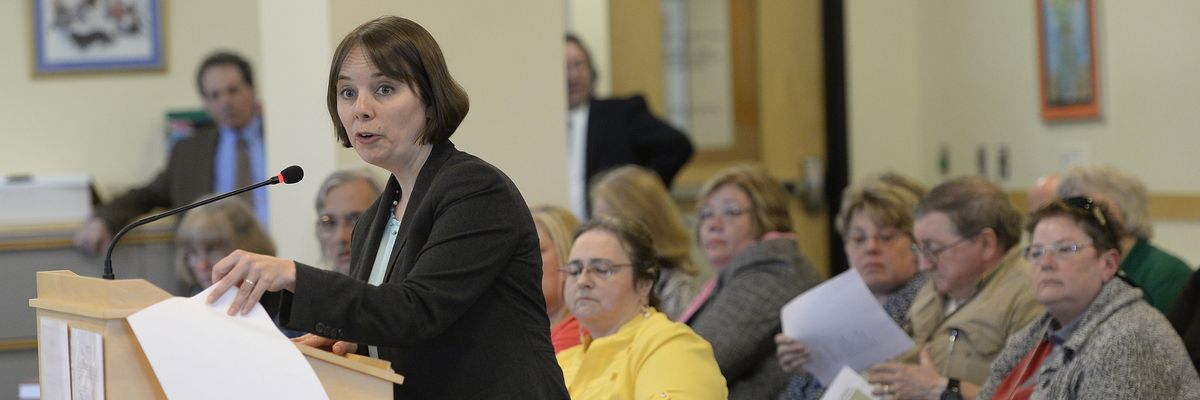
Shenna Bellows, then a Democratic Maine state senator, spoke at a hearing in Augusta on May 2, 2017.
"The weight of the evidence makes clear that Mr. Trump was aware of the tinder laid by his multimonth effort to delegitimize a democratic election, and then chose to light a match."
Maine Democratic Secretary of State Shenna Bellows on Thursday barred former U.S. President Trump from the Republican 2024 primary ballot, determining that "he is not qualified to hold the office of the president under Section 3 of the 14th Amendment" to the country's Constitution.
Despite several ongoing criminal cases, Trump is currently the Republican front-runner for next year's presidential contest, in which Democratic President Joe Biden, who beat him in 2020, is seeking reelection.
The decision in Maine comes just weeks away from the Iowa caucuses and amid multiple legal battles aiming to boot Trump from ballots for inciting the January 6, 2021 insurrection—including in Colorado, where the state Supreme Court disqualified him last week, a decision that could soon be reviewed by the U.S. Supreme Court, to which he appointed three justices.
"Mr. Trump was aware of the likelihood for violence and at least initially supported its use given he both encouraged it with incendiary rhetoric and took no timely action to stop it."
Bellows' move—which will ultimately be decided in the courts—came in response to three challenges filed to Trump's nomination, two based on the 14th Amendment and one citing the 22nd Amendment. The former bars anyone who has taken an oath to the Constitution and then engaged in insurrection from holding office again, while the latter sets a two-term limit for presidents.
The Maine official said Thursday that "there appears to be no dispute between any of the parties that President Biden prevailed over Mr. Trump. Therefore, given Mr. Trump has only won a single election for president, he is not barred from being elected to the same office again under the 22nd Amendment."
However, regarding the 14th Amendment arguments, she found that "the record establishes that Mr. Trump, over the course of several months and culminating on January 6, 2021, used a false narrative of election fraud to inflame his supporters and direct them to the Capitol to prevent certification of the 2020 election and the peaceful transfer of power."
"I likewise conclude that Mr. Trump was aware of the likelihood for violence and at least initially supported its use given he both encouraged it with incendiary rhetoric and took no timely action to stop it," she wrote in the 34-page decision.
Bellows stressed that "Mr. Trump's occasional requests that rioters be peaceful and support law enforcement do not immunize his actions. A brief call to obey the law does not erase conduct over the course of months, culminating in his speech on the Ellipse. The weight of the evidence makes clear that Mr. Trump was aware of the tinder laid by his multimonth effort to delegitimize a democratic election, and then chose to light a match."
"I am mindful that no secretary of state has ever deprived a presidential candidate of ballot access based on Section 3 of the 14th Amendment. I am also mindful, however, that no presidential candidate has ever before engaged in insurrection," she wrote.
Citing a relevant state law, Bellows said that "the oath I swore to uphold the Constitution comes first above all, and my duty under Maine's election laws, when presented with a Section 336 challenge, is to ensure that candidates who appear on the primary ballot are qualified for the office they seek."
"The events of January 6, 2021 were unprecedented and tragic," she added. "They were an attack not only upon the Capitol and government officials, but also an attack on the rule of law. The evidence here demonstrates that they occurred at the behest of, and with the knowledge and support of, the outgoing president. The U.S. Constitution does not tolerate an assault on the foundations of our government, and Section 336 requires me to act in response."
The secretary suspended the effect of her decision until the Maine Superior Court rules on any appeal, or the appeal period expires.
In a lengthy statement noting similar fights in other states, Trump campaign spokesperson Steven Cheung said that "we will quickly file a legal objection in state court to prevent this atrocious decision in Maine from taking effect."
He also took aim at Bellows, saying that "the Maine secretary of state is a former ACLU attorney, a virulent leftist, and a hyperpartisan Biden-supporting Democrat who has decided to interfere in the presidential election on behalf of Crooked Joe Biden."
Former U.S. Labor Secretary Robert Reich, now a professor at the University of California, Berkeley, said on social media that the U.S. Supreme Court "will surely have the final word."
As Common Dreams reported earlier Thursday, the government watchdog Citizens for Responsibility and Ethics in Washington (CREW) and law firms representing six Republican and unaffiliated Colorado voters who brought the 14th Amendment challenge in the state are asking the U.S. Supreme Court to weigh in on their case by February 11, given the timeline for mailing ballots.
Law Dork's Chris Geidner said Thursday that a Supreme Court review "is made almost certain given a new ruling from Maine's secretary of state."
Dear Common Dreams reader, It’s been nearly 30 years since I co-founded Common Dreams with my late wife, Lina Newhouser. We had the radical notion that journalism should serve the public good, not corporate profits. It was clear to us from the outset what it would take to build such a project. No paid advertisements. No corporate sponsors. No millionaire publisher telling us what to think or do. Many people said we wouldn't last a year, but we proved those doubters wrong. Together with a tremendous team of journalists and dedicated staff, we built an independent media outlet free from the constraints of profits and corporate control. Our mission has always been simple: To inform. To inspire. To ignite change for the common good. Building Common Dreams was not easy. Our survival was never guaranteed. When you take on the most powerful forces—Wall Street greed, fossil fuel industry destruction, Big Tech lobbyists, and uber-rich oligarchs who have spent billions upon billions rigging the economy and democracy in their favor—the only bulwark you have is supporters who believe in your work. But here’s the urgent message from me today. It's never been this bad out there. And it's never been this hard to keep us going. At the very moment Common Dreams is most needed, the threats we face are intensifying. We need your support now more than ever. We don't accept corporate advertising and never will. We don't have a paywall because we don't think people should be blocked from critical news based on their ability to pay. Everything we do is funded by the donations of readers like you. When everyone does the little they can afford, we are strong. But if that support retreats or dries up, so do we. Will you donate now to make sure Common Dreams not only survives but thrives? —Craig Brown, Co-founder |
Maine Democratic Secretary of State Shenna Bellows on Thursday barred former U.S. President Trump from the Republican 2024 primary ballot, determining that "he is not qualified to hold the office of the president under Section 3 of the 14th Amendment" to the country's Constitution.
Despite several ongoing criminal cases, Trump is currently the Republican front-runner for next year's presidential contest, in which Democratic President Joe Biden, who beat him in 2020, is seeking reelection.
The decision in Maine comes just weeks away from the Iowa caucuses and amid multiple legal battles aiming to boot Trump from ballots for inciting the January 6, 2021 insurrection—including in Colorado, where the state Supreme Court disqualified him last week, a decision that could soon be reviewed by the U.S. Supreme Court, to which he appointed three justices.
"Mr. Trump was aware of the likelihood for violence and at least initially supported its use given he both encouraged it with incendiary rhetoric and took no timely action to stop it."
Bellows' move—which will ultimately be decided in the courts—came in response to three challenges filed to Trump's nomination, two based on the 14th Amendment and one citing the 22nd Amendment. The former bars anyone who has taken an oath to the Constitution and then engaged in insurrection from holding office again, while the latter sets a two-term limit for presidents.
The Maine official said Thursday that "there appears to be no dispute between any of the parties that President Biden prevailed over Mr. Trump. Therefore, given Mr. Trump has only won a single election for president, he is not barred from being elected to the same office again under the 22nd Amendment."
However, regarding the 14th Amendment arguments, she found that "the record establishes that Mr. Trump, over the course of several months and culminating on January 6, 2021, used a false narrative of election fraud to inflame his supporters and direct them to the Capitol to prevent certification of the 2020 election and the peaceful transfer of power."
"I likewise conclude that Mr. Trump was aware of the likelihood for violence and at least initially supported its use given he both encouraged it with incendiary rhetoric and took no timely action to stop it," she wrote in the 34-page decision.
Bellows stressed that "Mr. Trump's occasional requests that rioters be peaceful and support law enforcement do not immunize his actions. A brief call to obey the law does not erase conduct over the course of months, culminating in his speech on the Ellipse. The weight of the evidence makes clear that Mr. Trump was aware of the tinder laid by his multimonth effort to delegitimize a democratic election, and then chose to light a match."
"I am mindful that no secretary of state has ever deprived a presidential candidate of ballot access based on Section 3 of the 14th Amendment. I am also mindful, however, that no presidential candidate has ever before engaged in insurrection," she wrote.
Citing a relevant state law, Bellows said that "the oath I swore to uphold the Constitution comes first above all, and my duty under Maine's election laws, when presented with a Section 336 challenge, is to ensure that candidates who appear on the primary ballot are qualified for the office they seek."
"The events of January 6, 2021 were unprecedented and tragic," she added. "They were an attack not only upon the Capitol and government officials, but also an attack on the rule of law. The evidence here demonstrates that they occurred at the behest of, and with the knowledge and support of, the outgoing president. The U.S. Constitution does not tolerate an assault on the foundations of our government, and Section 336 requires me to act in response."
The secretary suspended the effect of her decision until the Maine Superior Court rules on any appeal, or the appeal period expires.
In a lengthy statement noting similar fights in other states, Trump campaign spokesperson Steven Cheung said that "we will quickly file a legal objection in state court to prevent this atrocious decision in Maine from taking effect."
He also took aim at Bellows, saying that "the Maine secretary of state is a former ACLU attorney, a virulent leftist, and a hyperpartisan Biden-supporting Democrat who has decided to interfere in the presidential election on behalf of Crooked Joe Biden."
Former U.S. Labor Secretary Robert Reich, now a professor at the University of California, Berkeley, said on social media that the U.S. Supreme Court "will surely have the final word."
As Common Dreams reported earlier Thursday, the government watchdog Citizens for Responsibility and Ethics in Washington (CREW) and law firms representing six Republican and unaffiliated Colorado voters who brought the 14th Amendment challenge in the state are asking the U.S. Supreme Court to weigh in on their case by February 11, given the timeline for mailing ballots.
Law Dork's Chris Geidner said Thursday that a Supreme Court review "is made almost certain given a new ruling from Maine's secretary of state."
Maine Democratic Secretary of State Shenna Bellows on Thursday barred former U.S. President Trump from the Republican 2024 primary ballot, determining that "he is not qualified to hold the office of the president under Section 3 of the 14th Amendment" to the country's Constitution.
Despite several ongoing criminal cases, Trump is currently the Republican front-runner for next year's presidential contest, in which Democratic President Joe Biden, who beat him in 2020, is seeking reelection.
The decision in Maine comes just weeks away from the Iowa caucuses and amid multiple legal battles aiming to boot Trump from ballots for inciting the January 6, 2021 insurrection—including in Colorado, where the state Supreme Court disqualified him last week, a decision that could soon be reviewed by the U.S. Supreme Court, to which he appointed three justices.
"Mr. Trump was aware of the likelihood for violence and at least initially supported its use given he both encouraged it with incendiary rhetoric and took no timely action to stop it."
Bellows' move—which will ultimately be decided in the courts—came in response to three challenges filed to Trump's nomination, two based on the 14th Amendment and one citing the 22nd Amendment. The former bars anyone who has taken an oath to the Constitution and then engaged in insurrection from holding office again, while the latter sets a two-term limit for presidents.
The Maine official said Thursday that "there appears to be no dispute between any of the parties that President Biden prevailed over Mr. Trump. Therefore, given Mr. Trump has only won a single election for president, he is not barred from being elected to the same office again under the 22nd Amendment."
However, regarding the 14th Amendment arguments, she found that "the record establishes that Mr. Trump, over the course of several months and culminating on January 6, 2021, used a false narrative of election fraud to inflame his supporters and direct them to the Capitol to prevent certification of the 2020 election and the peaceful transfer of power."
"I likewise conclude that Mr. Trump was aware of the likelihood for violence and at least initially supported its use given he both encouraged it with incendiary rhetoric and took no timely action to stop it," she wrote in the 34-page decision.
Bellows stressed that "Mr. Trump's occasional requests that rioters be peaceful and support law enforcement do not immunize his actions. A brief call to obey the law does not erase conduct over the course of months, culminating in his speech on the Ellipse. The weight of the evidence makes clear that Mr. Trump was aware of the tinder laid by his multimonth effort to delegitimize a democratic election, and then chose to light a match."
"I am mindful that no secretary of state has ever deprived a presidential candidate of ballot access based on Section 3 of the 14th Amendment. I am also mindful, however, that no presidential candidate has ever before engaged in insurrection," she wrote.
Citing a relevant state law, Bellows said that "the oath I swore to uphold the Constitution comes first above all, and my duty under Maine's election laws, when presented with a Section 336 challenge, is to ensure that candidates who appear on the primary ballot are qualified for the office they seek."
"The events of January 6, 2021 were unprecedented and tragic," she added. "They were an attack not only upon the Capitol and government officials, but also an attack on the rule of law. The evidence here demonstrates that they occurred at the behest of, and with the knowledge and support of, the outgoing president. The U.S. Constitution does not tolerate an assault on the foundations of our government, and Section 336 requires me to act in response."
The secretary suspended the effect of her decision until the Maine Superior Court rules on any appeal, or the appeal period expires.
In a lengthy statement noting similar fights in other states, Trump campaign spokesperson Steven Cheung said that "we will quickly file a legal objection in state court to prevent this atrocious decision in Maine from taking effect."
He also took aim at Bellows, saying that "the Maine secretary of state is a former ACLU attorney, a virulent leftist, and a hyperpartisan Biden-supporting Democrat who has decided to interfere in the presidential election on behalf of Crooked Joe Biden."
Former U.S. Labor Secretary Robert Reich, now a professor at the University of California, Berkeley, said on social media that the U.S. Supreme Court "will surely have the final word."
As Common Dreams reported earlier Thursday, the government watchdog Citizens for Responsibility and Ethics in Washington (CREW) and law firms representing six Republican and unaffiliated Colorado voters who brought the 14th Amendment challenge in the state are asking the U.S. Supreme Court to weigh in on their case by February 11, given the timeline for mailing ballots.
Law Dork's Chris Geidner said Thursday that a Supreme Court review "is made almost certain given a new ruling from Maine's secretary of state."