SUBSCRIBE TO OUR FREE NEWSLETTER
Daily news & progressive opinion—funded by the people, not the corporations—delivered straight to your inbox.
5
#000000
#FFFFFF
To donate by check, phone, or other method, see our More Ways to Give page.
Daily news & progressive opinion—funded by the people, not the corporations—delivered straight to your inbox.
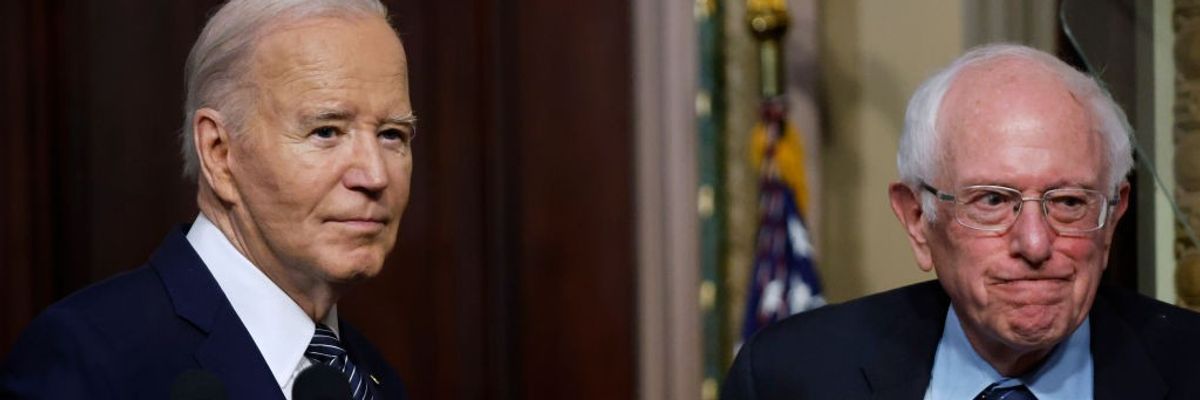
U.S. President Joe Biden and Sen. Bernie Sanders (I-Vt.) deliver remarks about prescription drug prices on April 3, 2024 in Washington, D.C.
"We will soon find out," said Sen. Bernie Sanders.
U.S. Sen. Bernie Sanders welcomed news Friday that the Biden administration included the expensive and increasingly popular drugs Ozempic and Wegovy on a slate of 15 medications that will soon be subject to price negotiations.
That is, if President-elect Donald Trump allows the Medicare price-negotiation program to continue.
"Will Trump make sure that all Americans—not just those on Medicare—pay no more than people in other countries for Ozempic and Wegovy?" Sanders (I-Vt.), ranking member of the Senate Committee on Health, Education, Labor, and Pensions (HELP), asked in a statement Friday, pointing to the president-elect's previous criticism of Big Pharma. "Or will Trump back down on his commitment and continue to allow the pharmaceutical industry to get away with murder by taking away the government's power to negotiate prices?"
"We will soon find out," said Sanders, who has publicly grilled pharmaceutical giant Novo Nordisk's CEO over the exorbitant prices of the obesity and diabetes drugs Ozempic and Wegovy.
Reuters reported that shortly following the 2024 election, the pharmaceutical industry began pushing Trump's team to weaken the price negotiation program, which was put in place by the Inflation Reduction Act.
"Pharma expects to piggyback on Republican moves to scrap some of the energy and green subsidy provisions in the legislation," Reuters reported.
The drug industry is reportedly not lobbying senators to block the confirmation of Robert F. Kennedy Jr., Trump's pick to lead the Department of Health and Human Services (HHS). If confirmed, Kennedy would oversee the price-negotiation program.
"The Trump administration could go in one of three directions with the Medicare negotiations program: stay the course, water it down, or repeal it altogether," KFF senior vice president Tricia Neuman wrote Friday. "There are potential tradeoffs with each, but the first would be most popular."
"We must keep pushing to expand the wildly popular Medicare negotiation program. Patients fought extremely hard for the passage of these reforms."
HHS said Friday that the 15 newly selected drugs—which add to the 10 medications that have already faced price negotiations—"accounted for about $41 billion in total gross covered prescription drug costs under Medicare Part D."
"When combined with the total gross covered prescription drug costs under Medicare Part D of the 10 drugs selected for the first cycle of negotiations over that same time period, this represents over a third of total gross covered prescription drug costs under Medicare Part D," the agency said.
If the Trump administration allows negotiations on the 15 drugs to proceed, the new prices would take effect in 2027.
"For the last twenty years, drug corporations have rigged the system in their favor—hiking prices at will and leaving millions of patients at their mercy," said Merith Basey, executive director of Patients for Affordable Drugs. "Thanks to the 2022 prescription drug law, last year Medicare negotiated a better deal on 10 of some of the most expensive and most commonly used drugs covered by the program."
"Today's announcement of 15 additional high-cost drugs builds on that historic progress and will lower costs for millions more patients in 2027," Basey added. "But let's be clear: We must keep pushing to expand the wildly popular Medicare negotiation program. Patients fought extremely hard for the passage of these reforms and they continue to vigorously defend them against pharma's attacks—because nobody should have to choose between life-saving drugs and their basic needs."
Dear Common Dreams reader, It’s been nearly 30 years since I co-founded Common Dreams with my late wife, Lina Newhouser. We had the radical notion that journalism should serve the public good, not corporate profits. It was clear to us from the outset what it would take to build such a project. No paid advertisements. No corporate sponsors. No millionaire publisher telling us what to think or do. Many people said we wouldn't last a year, but we proved those doubters wrong. Together with a tremendous team of journalists and dedicated staff, we built an independent media outlet free from the constraints of profits and corporate control. Our mission has always been simple: To inform. To inspire. To ignite change for the common good. Building Common Dreams was not easy. Our survival was never guaranteed. When you take on the most powerful forces—Wall Street greed, fossil fuel industry destruction, Big Tech lobbyists, and uber-rich oligarchs who have spent billions upon billions rigging the economy and democracy in their favor—the only bulwark you have is supporters who believe in your work. But here’s the urgent message from me today. It's never been this bad out there. And it's never been this hard to keep us going. At the very moment Common Dreams is most needed, the threats we face are intensifying. We need your support now more than ever. We don't accept corporate advertising and never will. We don't have a paywall because we don't think people should be blocked from critical news based on their ability to pay. Everything we do is funded by the donations of readers like you. When everyone does the little they can afford, we are strong. But if that support retreats or dries up, so do we. Will you donate now to make sure Common Dreams not only survives but thrives? —Craig Brown, Co-founder |
U.S. Sen. Bernie Sanders welcomed news Friday that the Biden administration included the expensive and increasingly popular drugs Ozempic and Wegovy on a slate of 15 medications that will soon be subject to price negotiations.
That is, if President-elect Donald Trump allows the Medicare price-negotiation program to continue.
"Will Trump make sure that all Americans—not just those on Medicare—pay no more than people in other countries for Ozempic and Wegovy?" Sanders (I-Vt.), ranking member of the Senate Committee on Health, Education, Labor, and Pensions (HELP), asked in a statement Friday, pointing to the president-elect's previous criticism of Big Pharma. "Or will Trump back down on his commitment and continue to allow the pharmaceutical industry to get away with murder by taking away the government's power to negotiate prices?"
"We will soon find out," said Sanders, who has publicly grilled pharmaceutical giant Novo Nordisk's CEO over the exorbitant prices of the obesity and diabetes drugs Ozempic and Wegovy.
Reuters reported that shortly following the 2024 election, the pharmaceutical industry began pushing Trump's team to weaken the price negotiation program, which was put in place by the Inflation Reduction Act.
"Pharma expects to piggyback on Republican moves to scrap some of the energy and green subsidy provisions in the legislation," Reuters reported.
The drug industry is reportedly not lobbying senators to block the confirmation of Robert F. Kennedy Jr., Trump's pick to lead the Department of Health and Human Services (HHS). If confirmed, Kennedy would oversee the price-negotiation program.
"The Trump administration could go in one of three directions with the Medicare negotiations program: stay the course, water it down, or repeal it altogether," KFF senior vice president Tricia Neuman wrote Friday. "There are potential tradeoffs with each, but the first would be most popular."
"We must keep pushing to expand the wildly popular Medicare negotiation program. Patients fought extremely hard for the passage of these reforms."
HHS said Friday that the 15 newly selected drugs—which add to the 10 medications that have already faced price negotiations—"accounted for about $41 billion in total gross covered prescription drug costs under Medicare Part D."
"When combined with the total gross covered prescription drug costs under Medicare Part D of the 10 drugs selected for the first cycle of negotiations over that same time period, this represents over a third of total gross covered prescription drug costs under Medicare Part D," the agency said.
If the Trump administration allows negotiations on the 15 drugs to proceed, the new prices would take effect in 2027.
"For the last twenty years, drug corporations have rigged the system in their favor—hiking prices at will and leaving millions of patients at their mercy," said Merith Basey, executive director of Patients for Affordable Drugs. "Thanks to the 2022 prescription drug law, last year Medicare negotiated a better deal on 10 of some of the most expensive and most commonly used drugs covered by the program."
"Today's announcement of 15 additional high-cost drugs builds on that historic progress and will lower costs for millions more patients in 2027," Basey added. "But let's be clear: We must keep pushing to expand the wildly popular Medicare negotiation program. Patients fought extremely hard for the passage of these reforms and they continue to vigorously defend them against pharma's attacks—because nobody should have to choose between life-saving drugs and their basic needs."
U.S. Sen. Bernie Sanders welcomed news Friday that the Biden administration included the expensive and increasingly popular drugs Ozempic and Wegovy on a slate of 15 medications that will soon be subject to price negotiations.
That is, if President-elect Donald Trump allows the Medicare price-negotiation program to continue.
"Will Trump make sure that all Americans—not just those on Medicare—pay no more than people in other countries for Ozempic and Wegovy?" Sanders (I-Vt.), ranking member of the Senate Committee on Health, Education, Labor, and Pensions (HELP), asked in a statement Friday, pointing to the president-elect's previous criticism of Big Pharma. "Or will Trump back down on his commitment and continue to allow the pharmaceutical industry to get away with murder by taking away the government's power to negotiate prices?"
"We will soon find out," said Sanders, who has publicly grilled pharmaceutical giant Novo Nordisk's CEO over the exorbitant prices of the obesity and diabetes drugs Ozempic and Wegovy.
Reuters reported that shortly following the 2024 election, the pharmaceutical industry began pushing Trump's team to weaken the price negotiation program, which was put in place by the Inflation Reduction Act.
"Pharma expects to piggyback on Republican moves to scrap some of the energy and green subsidy provisions in the legislation," Reuters reported.
The drug industry is reportedly not lobbying senators to block the confirmation of Robert F. Kennedy Jr., Trump's pick to lead the Department of Health and Human Services (HHS). If confirmed, Kennedy would oversee the price-negotiation program.
"The Trump administration could go in one of three directions with the Medicare negotiations program: stay the course, water it down, or repeal it altogether," KFF senior vice president Tricia Neuman wrote Friday. "There are potential tradeoffs with each, but the first would be most popular."
"We must keep pushing to expand the wildly popular Medicare negotiation program. Patients fought extremely hard for the passage of these reforms."
HHS said Friday that the 15 newly selected drugs—which add to the 10 medications that have already faced price negotiations—"accounted for about $41 billion in total gross covered prescription drug costs under Medicare Part D."
"When combined with the total gross covered prescription drug costs under Medicare Part D of the 10 drugs selected for the first cycle of negotiations over that same time period, this represents over a third of total gross covered prescription drug costs under Medicare Part D," the agency said.
If the Trump administration allows negotiations on the 15 drugs to proceed, the new prices would take effect in 2027.
"For the last twenty years, drug corporations have rigged the system in their favor—hiking prices at will and leaving millions of patients at their mercy," said Merith Basey, executive director of Patients for Affordable Drugs. "Thanks to the 2022 prescription drug law, last year Medicare negotiated a better deal on 10 of some of the most expensive and most commonly used drugs covered by the program."
"Today's announcement of 15 additional high-cost drugs builds on that historic progress and will lower costs for millions more patients in 2027," Basey added. "But let's be clear: We must keep pushing to expand the wildly popular Medicare negotiation program. Patients fought extremely hard for the passage of these reforms and they continue to vigorously defend them against pharma's attacks—because nobody should have to choose between life-saving drugs and their basic needs."