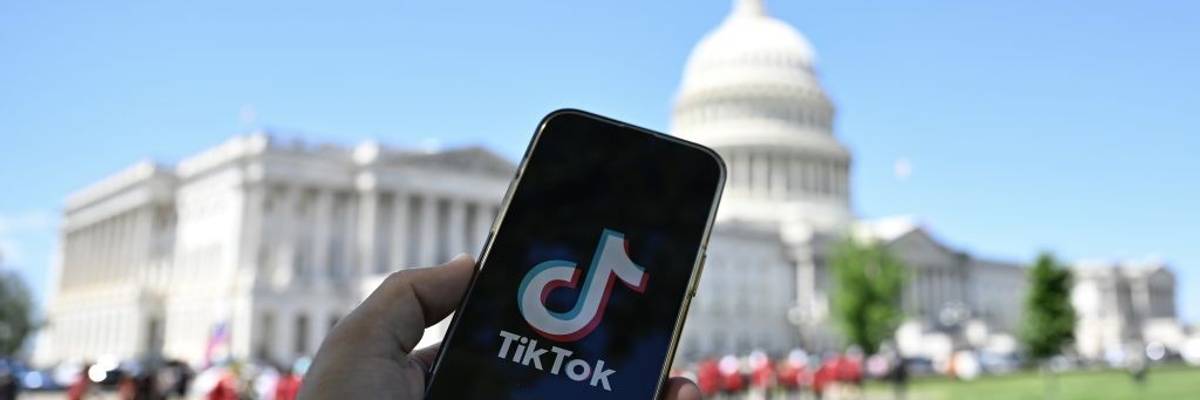
The illustration logo of TikTok is displayed on a mobile phone screen in front of The White House in Washington D.C., United States on April 20, 2024.
'Completely Out of Touch... Both Parties': Supreme Court Looks Ready to OK TikTok Ban
"Banning TikTok in this way sets a dangerous precedent that could pave the way to future government interventions against online speech," said one advocate.
To the chagrin of First Amendment defenders and content creators, the Supreme Court on Friday appeared poised to uphold a law passed by Congress last year that would shut down the widely popular social media app TikTok in the U.S. unless its owner, the Chinese company ByteDance, sells it.
The de facto ban on TikTok was tucked into a $95 billion legislative package for aid to Ukraine and Israel that was passed by the Senate in April 2024. A standalone version of the legislation cleared the House with bipartisan support a month earlier. It is set to go into effect on January 19, barring a sale by ByteDance or intervention by the Supreme Court.
The law was justified on national security grounds, which were fueled by fears that national security laws in China could compel ByteDance to give the Chinese government access to data on TikTok users.
Nina Turner, a senior fellow at the Institute on Race, Power, and Political Economy, wrote Thursday: "The U.S. government stood up to TikTok before they stood up to [Israeli Prime Minister Benjamin] Netanyahu, or the health insurance lobby, orBig Pharma, or Big Oil—no. TikTok. Completely out of touch with the American people. Both parties."
During oral arguments, "justices across the ideological spectrum asked tough questions of both sides, [but] the overall tone and thrust appeared to suggest greater skepticism toward the arguments by lawyers for TikTok and its users that the First Amendment barred Congress from enacting the law," according to Friday reporting from The New York Times.
However, the Times also noted that "several justices were skeptical about a major part of the government's justification for the law: the risk that China might 'covertly' make TikTok manipulate the content shown to Americans or collect user data to achieve its geopolitical aims."
Ahead of the U.S. Supreme Court's hearing on TikTok's appeal of the ban, three bipartisan lawmakers were among the First Amendment advocates who filed amicus briefs in support of the app in late December. Rep. Ro Khanna (D-Calif.) and Sens. Ed Markey (D-Mass.) and Rand Paul (R-Ky.) asked the court to grant TikTok an emergency injunction to block the Protecting Americans from Foreign Adversary Controlled Applications Act.
The ACLU, the Center for Democracy & Technology (CDT), and the Freedom of the Press Foundation were among several civil liberties groups that also filed an amicus brief in late December, arguing that the government has not presented sufficient evidence that the app, which is used by 170 million Americans, causes "ongoing or imminent harm."
In a statement released Friday, the Free Press policy counsel Yanni Chen said that "as with repressive laws from oppressive regimes around the world, the real toll of the ban will be on everyday people... TikTok users, many of whom use the platform to organize communities and express views that legacy media often ignore."
"Banning TikTok in this way sets a dangerous precedent that could pave the way to future government interventions against online speech," she added.
We are at a crossroads
This country and this world are at a monumental crossroads. In a few short weeks, US voters will have an opportunity to beat back the forces of fascism and confront the billionaires who are rigging the economy, our media system, and our democracy, making it increasingly impossible for ordinary people to get by. We’re not just talking about the election. We’re talking about what must be done once these fascist elements are vanquished from power. We need a bolder set of solutions than what either major party has so far been willing to offer and a working-class movement ready to fight like hell for it. Trump didn't emerge from nowhere. The conditions that fueled MAGA authoritarianism were created by decades of radical neoliberal economic policies and a corrupt political system dominated by corporate interests. They slashed taxes on the super-rich, promising that the benefits would trickle down. They said giveaways to the corporate titans would make life more affordable for the rest of us. It was all bullshit. And when a bitter, betrayed populace searches for someone to blame, right-wing demagogues have little trouble finding scapegoats. People know when they're being lied to, but you won't hear any of this from the corporate media. Only independent journalism—powered and funded by people who believe in building a better world—can deliver truly trustworthy daily news. Our Fall Campaign is underway, and we need your help. To power our newsroom through the rest of the year, we need to raise $125,000 by midnight on October 31. So if you share our vision, please contribute whatever you can to sustain our work. |
To the chagrin of First Amendment defenders and content creators, the Supreme Court on Friday appeared poised to uphold a law passed by Congress last year that would shut down the widely popular social media app TikTok in the U.S. unless its owner, the Chinese company ByteDance, sells it.
The de facto ban on TikTok was tucked into a $95 billion legislative package for aid to Ukraine and Israel that was passed by the Senate in April 2024. A standalone version of the legislation cleared the House with bipartisan support a month earlier. It is set to go into effect on January 19, barring a sale by ByteDance or intervention by the Supreme Court.
The law was justified on national security grounds, which were fueled by fears that national security laws in China could compel ByteDance to give the Chinese government access to data on TikTok users.
Nina Turner, a senior fellow at the Institute on Race, Power, and Political Economy, wrote Thursday: "The U.S. government stood up to TikTok before they stood up to [Israeli Prime Minister Benjamin] Netanyahu, or the health insurance lobby, orBig Pharma, or Big Oil—no. TikTok. Completely out of touch with the American people. Both parties."
During oral arguments, "justices across the ideological spectrum asked tough questions of both sides, [but] the overall tone and thrust appeared to suggest greater skepticism toward the arguments by lawyers for TikTok and its users that the First Amendment barred Congress from enacting the law," according to Friday reporting from The New York Times.
However, the Times also noted that "several justices were skeptical about a major part of the government's justification for the law: the risk that China might 'covertly' make TikTok manipulate the content shown to Americans or collect user data to achieve its geopolitical aims."
Ahead of the U.S. Supreme Court's hearing on TikTok's appeal of the ban, three bipartisan lawmakers were among the First Amendment advocates who filed amicus briefs in support of the app in late December. Rep. Ro Khanna (D-Calif.) and Sens. Ed Markey (D-Mass.) and Rand Paul (R-Ky.) asked the court to grant TikTok an emergency injunction to block the Protecting Americans from Foreign Adversary Controlled Applications Act.
The ACLU, the Center for Democracy & Technology (CDT), and the Freedom of the Press Foundation were among several civil liberties groups that also filed an amicus brief in late December, arguing that the government has not presented sufficient evidence that the app, which is used by 170 million Americans, causes "ongoing or imminent harm."
In a statement released Friday, the Free Press policy counsel Yanni Chen said that "as with repressive laws from oppressive regimes around the world, the real toll of the ban will be on everyday people... TikTok users, many of whom use the platform to organize communities and express views that legacy media often ignore."
"Banning TikTok in this way sets a dangerous precedent that could pave the way to future government interventions against online speech," she added.
- 'Major Blow to Freedom of Expression': US Supreme Court Upholds TikTok Ban | Common Dreams ›
- Democrats Set Up Trump to 'Save' TikTok After His Effort to Ban It | Common Dreams ›
To the chagrin of First Amendment defenders and content creators, the Supreme Court on Friday appeared poised to uphold a law passed by Congress last year that would shut down the widely popular social media app TikTok in the U.S. unless its owner, the Chinese company ByteDance, sells it.
The de facto ban on TikTok was tucked into a $95 billion legislative package for aid to Ukraine and Israel that was passed by the Senate in April 2024. A standalone version of the legislation cleared the House with bipartisan support a month earlier. It is set to go into effect on January 19, barring a sale by ByteDance or intervention by the Supreme Court.
The law was justified on national security grounds, which were fueled by fears that national security laws in China could compel ByteDance to give the Chinese government access to data on TikTok users.
Nina Turner, a senior fellow at the Institute on Race, Power, and Political Economy, wrote Thursday: "The U.S. government stood up to TikTok before they stood up to [Israeli Prime Minister Benjamin] Netanyahu, or the health insurance lobby, orBig Pharma, or Big Oil—no. TikTok. Completely out of touch with the American people. Both parties."
During oral arguments, "justices across the ideological spectrum asked tough questions of both sides, [but] the overall tone and thrust appeared to suggest greater skepticism toward the arguments by lawyers for TikTok and its users that the First Amendment barred Congress from enacting the law," according to Friday reporting from The New York Times.
However, the Times also noted that "several justices were skeptical about a major part of the government's justification for the law: the risk that China might 'covertly' make TikTok manipulate the content shown to Americans or collect user data to achieve its geopolitical aims."
Ahead of the U.S. Supreme Court's hearing on TikTok's appeal of the ban, three bipartisan lawmakers were among the First Amendment advocates who filed amicus briefs in support of the app in late December. Rep. Ro Khanna (D-Calif.) and Sens. Ed Markey (D-Mass.) and Rand Paul (R-Ky.) asked the court to grant TikTok an emergency injunction to block the Protecting Americans from Foreign Adversary Controlled Applications Act.
The ACLU, the Center for Democracy & Technology (CDT), and the Freedom of the Press Foundation were among several civil liberties groups that also filed an amicus brief in late December, arguing that the government has not presented sufficient evidence that the app, which is used by 170 million Americans, causes "ongoing or imminent harm."
In a statement released Friday, the Free Press policy counsel Yanni Chen said that "as with repressive laws from oppressive regimes around the world, the real toll of the ban will be on everyday people... TikTok users, many of whom use the platform to organize communities and express views that legacy media often ignore."
"Banning TikTok in this way sets a dangerous precedent that could pave the way to future government interventions against online speech," she added.
- 'Major Blow to Freedom of Expression': US Supreme Court Upholds TikTok Ban | Common Dreams ›
- Democrats Set Up Trump to 'Save' TikTok After His Effort to Ban It | Common Dreams ›