SUBSCRIBE TO OUR FREE NEWSLETTER
Daily news & progressive opinion—funded by the people, not the corporations—delivered straight to your inbox.
5
#000000
#FFFFFF
To donate by check, phone, or other method, see our More Ways to Give page.
Daily news & progressive opinion—funded by the people, not the corporations—delivered straight to your inbox.
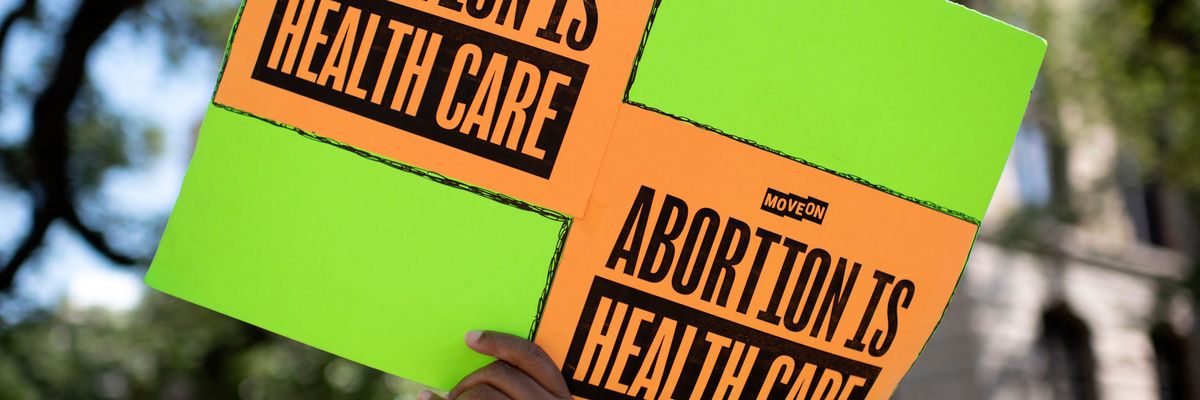
An abortion rights demonstrator holds a sign outside of the Harris County Courthouse during the Women's Wave march in Houston, Texas, on October 8, 2022.
The state ban that took effect last year ostensibly allows pregnant people to obtain care if their life or that of their fetus is at risk, but one critic said the suit shows that "there is no such thing as an abortion exception."
Five Texas women are scheduled to speak on the steps of the state Capitol on Tuesday about the life-threatening risks posed by the state's abortion ban and their struggles to obtain necessary healthcare since it went into effect, a day after filing an unprecedented lawsuit challenging the law.
While a number of abortion rights groups, religious organizations, and healthcare providers have filed legal challenges to state abortion bans, the Center for Reproductive Rights (CRR), which is representing the plaintiffs, called the lawsuit "groundbreaking" because it has been filed by people who claim an abortion ban put them at risk.
"I don't think we've ever seen anything like this in the nation, having people with pregnancy complications having to sue the state," Nancy Northup, president of CRR, told The New York Times. "It puts a face on the reality of what it means when you criminalize abortion care. It shows that abortion care is healthcare."
"These five brave women are fighting for their right to live and get the care and treatment they need from doctors."
The five women—Amanda Zurawski, Lauren Miller, Lauren Hall, Anna Zargarian, and Ashley Brandt—are suing officials including state Attorney General Ken Paxton and state medical board executive director Stephen Brint Carlton, and are calling on a state court in Travis County to confirm that the state's abortion ban allows medical professionals to provide abortion care in cases where the pregnant person has a "physical emergent medical condition" or "where the pregnancy is unlikely to result in the birth of a living child with sustained life."
The near-total ban on abortion care that went into effect in Texas after Roe v. Wade was overturned in June 2022 ostensibly includes "exceptions," allowing abortion care to prevent a pregnant patient's death or "substantial impairment of major bodily function."
The women represented by CRR say they were denied care despite being pregnant with fetuses that had significant abnormalities, and in some cases developing life-threatening medical conditions.
As Common Dreams reported last October, Zurawski discovered that her cervical membranes has begun to prolapse in her 17th week of pregnancy—a condition that her fetus would not survive. Despite this, doctors told her they could only perform an abortion if she became acutely ill or if the fetal heartbeat stopped. Her water broke soon after learning the news, but she was still told to remain at home, where she developed a fever. Her husband called their local hospital and pleaded for a doctor to provide the care Zurawski needed, only to be told the hospital's ethics board would have to approve the procedure.
When Zurawski was finally admitted to the hospital, doctors discovered she had developed a blood infection. She later needed a blood transfusion after developing a secondary infection and was ultimately left with scar tissue completely blocking one fallopian tube, likely making it difficult to become pregnant again.
With Texas doctors desperate to avoid a potential prison sentence, a $100,000 fine, and the loss of their medical license that would result from providing an abortion illegally, journalist Jessica Valenti said the stories of Zurawski and her co-plaintiffs "don't just demonstrate how dangerous abortion bans are—but that abortion 'exceptions' ARE NOT REAL."
"If fatally ill women can't get abortions, do you really believe rape victims will be able to?" said Valenti. "It's not going to happen. Ever. And any time we allow Republicans to say they're 'compromising' by adding exceptions to a ban, we're allowing that (very dangerous) lie [to] flourish."
Other plaintiffs were forced to travel to other states to get care after learning their fetuses had serious complications. Hall, who found out at 18 weeks pregnant that her fetus had no skull and an undeveloped brain, was warned by a doctor not to tell anyone where she was going or why, for fear of being reported to an anti-abortion hotline.
"Just because Roe v. Wade is no longer the law of the land does not mean that women and pregnant people are without constitutional and basic human rights," Molly Duane, senior staff attorney at CRR, told NPR. "We're talking about people who are in medical emergencies, who need urgent medical care, and whose physicians are too scared to provide that care because of the state's laws and because of the state's failure to provide any clarification around what its law means."
Brandt found out when she was 12 weeks pregnant with twins that one twin was not developing properly, and received abortion care in Colorado to save the life of the healthy fetus. She began bleeding after returning home and had to go to the emergency room.
"She was terrified that she would lose both babies and that she would somehow be in trouble for going out of state for the fetal reduction procedure," reads the lawsuit. "In the emergency room, Ashley felt a distinct uneasiness and confusion. It appeared that the medical staff thought they were not supposed to know about Ashley’s abortion or discuss it with her."
Brandt's medical records showed that her doctor omitted discussions they had had about fetal reduction to save the life of her healthy baby, and claimed one twin had been lost to "vanishing twin syndrome," likely to protect both Brandt and the doctor from prosecution.
"These five brave women are fighting for their right to live and get the care and treatment they need from doctors," said Maya Wiley, executive director of the Leadership Conference on Civil and Human Rights.
According to the Times, outcry over the impact of abortion bans on women whose lives were threatened "helped build momentum for legalized abortion in heavily Catholic Ireland and in South America."
The women in the Texas lawsuit are scheduled to speak about their experiences at the state Capitol at 1:30 pm ET on Tuesday.
Dear Common Dreams reader, It’s been nearly 30 years since I co-founded Common Dreams with my late wife, Lina Newhouser. We had the radical notion that journalism should serve the public good, not corporate profits. It was clear to us from the outset what it would take to build such a project. No paid advertisements. No corporate sponsors. No millionaire publisher telling us what to think or do. Many people said we wouldn't last a year, but we proved those doubters wrong. Together with a tremendous team of journalists and dedicated staff, we built an independent media outlet free from the constraints of profits and corporate control. Our mission has always been simple: To inform. To inspire. To ignite change for the common good. Building Common Dreams was not easy. Our survival was never guaranteed. When you take on the most powerful forces—Wall Street greed, fossil fuel industry destruction, Big Tech lobbyists, and uber-rich oligarchs who have spent billions upon billions rigging the economy and democracy in their favor—the only bulwark you have is supporters who believe in your work. But here’s the urgent message from me today. It's never been this bad out there. And it's never been this hard to keep us going. At the very moment Common Dreams is most needed, the threats we face are intensifying. We need your support now more than ever. We don't accept corporate advertising and never will. We don't have a paywall because we don't think people should be blocked from critical news based on their ability to pay. Everything we do is funded by the donations of readers like you. When everyone does the little they can afford, we are strong. But if that support retreats or dries up, so do we. Will you donate now to make sure Common Dreams not only survives but thrives? —Craig Brown, Co-founder |
Five Texas women are scheduled to speak on the steps of the state Capitol on Tuesday about the life-threatening risks posed by the state's abortion ban and their struggles to obtain necessary healthcare since it went into effect, a day after filing an unprecedented lawsuit challenging the law.
While a number of abortion rights groups, religious organizations, and healthcare providers have filed legal challenges to state abortion bans, the Center for Reproductive Rights (CRR), which is representing the plaintiffs, called the lawsuit "groundbreaking" because it has been filed by people who claim an abortion ban put them at risk.
"I don't think we've ever seen anything like this in the nation, having people with pregnancy complications having to sue the state," Nancy Northup, president of CRR, told The New York Times. "It puts a face on the reality of what it means when you criminalize abortion care. It shows that abortion care is healthcare."
"These five brave women are fighting for their right to live and get the care and treatment they need from doctors."
The five women—Amanda Zurawski, Lauren Miller, Lauren Hall, Anna Zargarian, and Ashley Brandt—are suing officials including state Attorney General Ken Paxton and state medical board executive director Stephen Brint Carlton, and are calling on a state court in Travis County to confirm that the state's abortion ban allows medical professionals to provide abortion care in cases where the pregnant person has a "physical emergent medical condition" or "where the pregnancy is unlikely to result in the birth of a living child with sustained life."
The near-total ban on abortion care that went into effect in Texas after Roe v. Wade was overturned in June 2022 ostensibly includes "exceptions," allowing abortion care to prevent a pregnant patient's death or "substantial impairment of major bodily function."
The women represented by CRR say they were denied care despite being pregnant with fetuses that had significant abnormalities, and in some cases developing life-threatening medical conditions.
As Common Dreams reported last October, Zurawski discovered that her cervical membranes has begun to prolapse in her 17th week of pregnancy—a condition that her fetus would not survive. Despite this, doctors told her they could only perform an abortion if she became acutely ill or if the fetal heartbeat stopped. Her water broke soon after learning the news, but she was still told to remain at home, where she developed a fever. Her husband called their local hospital and pleaded for a doctor to provide the care Zurawski needed, only to be told the hospital's ethics board would have to approve the procedure.
When Zurawski was finally admitted to the hospital, doctors discovered she had developed a blood infection. She later needed a blood transfusion after developing a secondary infection and was ultimately left with scar tissue completely blocking one fallopian tube, likely making it difficult to become pregnant again.
With Texas doctors desperate to avoid a potential prison sentence, a $100,000 fine, and the loss of their medical license that would result from providing an abortion illegally, journalist Jessica Valenti said the stories of Zurawski and her co-plaintiffs "don't just demonstrate how dangerous abortion bans are—but that abortion 'exceptions' ARE NOT REAL."
"If fatally ill women can't get abortions, do you really believe rape victims will be able to?" said Valenti. "It's not going to happen. Ever. And any time we allow Republicans to say they're 'compromising' by adding exceptions to a ban, we're allowing that (very dangerous) lie [to] flourish."
Other plaintiffs were forced to travel to other states to get care after learning their fetuses had serious complications. Hall, who found out at 18 weeks pregnant that her fetus had no skull and an undeveloped brain, was warned by a doctor not to tell anyone where she was going or why, for fear of being reported to an anti-abortion hotline.
"Just because Roe v. Wade is no longer the law of the land does not mean that women and pregnant people are without constitutional and basic human rights," Molly Duane, senior staff attorney at CRR, told NPR. "We're talking about people who are in medical emergencies, who need urgent medical care, and whose physicians are too scared to provide that care because of the state's laws and because of the state's failure to provide any clarification around what its law means."
Brandt found out when she was 12 weeks pregnant with twins that one twin was not developing properly, and received abortion care in Colorado to save the life of the healthy fetus. She began bleeding after returning home and had to go to the emergency room.
"She was terrified that she would lose both babies and that she would somehow be in trouble for going out of state for the fetal reduction procedure," reads the lawsuit. "In the emergency room, Ashley felt a distinct uneasiness and confusion. It appeared that the medical staff thought they were not supposed to know about Ashley’s abortion or discuss it with her."
Brandt's medical records showed that her doctor omitted discussions they had had about fetal reduction to save the life of her healthy baby, and claimed one twin had been lost to "vanishing twin syndrome," likely to protect both Brandt and the doctor from prosecution.
"These five brave women are fighting for their right to live and get the care and treatment they need from doctors," said Maya Wiley, executive director of the Leadership Conference on Civil and Human Rights.
According to the Times, outcry over the impact of abortion bans on women whose lives were threatened "helped build momentum for legalized abortion in heavily Catholic Ireland and in South America."
The women in the Texas lawsuit are scheduled to speak about their experiences at the state Capitol at 1:30 pm ET on Tuesday.
Five Texas women are scheduled to speak on the steps of the state Capitol on Tuesday about the life-threatening risks posed by the state's abortion ban and their struggles to obtain necessary healthcare since it went into effect, a day after filing an unprecedented lawsuit challenging the law.
While a number of abortion rights groups, religious organizations, and healthcare providers have filed legal challenges to state abortion bans, the Center for Reproductive Rights (CRR), which is representing the plaintiffs, called the lawsuit "groundbreaking" because it has been filed by people who claim an abortion ban put them at risk.
"I don't think we've ever seen anything like this in the nation, having people with pregnancy complications having to sue the state," Nancy Northup, president of CRR, told The New York Times. "It puts a face on the reality of what it means when you criminalize abortion care. It shows that abortion care is healthcare."
"These five brave women are fighting for their right to live and get the care and treatment they need from doctors."
The five women—Amanda Zurawski, Lauren Miller, Lauren Hall, Anna Zargarian, and Ashley Brandt—are suing officials including state Attorney General Ken Paxton and state medical board executive director Stephen Brint Carlton, and are calling on a state court in Travis County to confirm that the state's abortion ban allows medical professionals to provide abortion care in cases where the pregnant person has a "physical emergent medical condition" or "where the pregnancy is unlikely to result in the birth of a living child with sustained life."
The near-total ban on abortion care that went into effect in Texas after Roe v. Wade was overturned in June 2022 ostensibly includes "exceptions," allowing abortion care to prevent a pregnant patient's death or "substantial impairment of major bodily function."
The women represented by CRR say they were denied care despite being pregnant with fetuses that had significant abnormalities, and in some cases developing life-threatening medical conditions.
As Common Dreams reported last October, Zurawski discovered that her cervical membranes has begun to prolapse in her 17th week of pregnancy—a condition that her fetus would not survive. Despite this, doctors told her they could only perform an abortion if she became acutely ill or if the fetal heartbeat stopped. Her water broke soon after learning the news, but she was still told to remain at home, where she developed a fever. Her husband called their local hospital and pleaded for a doctor to provide the care Zurawski needed, only to be told the hospital's ethics board would have to approve the procedure.
When Zurawski was finally admitted to the hospital, doctors discovered she had developed a blood infection. She later needed a blood transfusion after developing a secondary infection and was ultimately left with scar tissue completely blocking one fallopian tube, likely making it difficult to become pregnant again.
With Texas doctors desperate to avoid a potential prison sentence, a $100,000 fine, and the loss of their medical license that would result from providing an abortion illegally, journalist Jessica Valenti said the stories of Zurawski and her co-plaintiffs "don't just demonstrate how dangerous abortion bans are—but that abortion 'exceptions' ARE NOT REAL."
"If fatally ill women can't get abortions, do you really believe rape victims will be able to?" said Valenti. "It's not going to happen. Ever. And any time we allow Republicans to say they're 'compromising' by adding exceptions to a ban, we're allowing that (very dangerous) lie [to] flourish."
Other plaintiffs were forced to travel to other states to get care after learning their fetuses had serious complications. Hall, who found out at 18 weeks pregnant that her fetus had no skull and an undeveloped brain, was warned by a doctor not to tell anyone where she was going or why, for fear of being reported to an anti-abortion hotline.
"Just because Roe v. Wade is no longer the law of the land does not mean that women and pregnant people are without constitutional and basic human rights," Molly Duane, senior staff attorney at CRR, told NPR. "We're talking about people who are in medical emergencies, who need urgent medical care, and whose physicians are too scared to provide that care because of the state's laws and because of the state's failure to provide any clarification around what its law means."
Brandt found out when she was 12 weeks pregnant with twins that one twin was not developing properly, and received abortion care in Colorado to save the life of the healthy fetus. She began bleeding after returning home and had to go to the emergency room.
"She was terrified that she would lose both babies and that she would somehow be in trouble for going out of state for the fetal reduction procedure," reads the lawsuit. "In the emergency room, Ashley felt a distinct uneasiness and confusion. It appeared that the medical staff thought they were not supposed to know about Ashley’s abortion or discuss it with her."
Brandt's medical records showed that her doctor omitted discussions they had had about fetal reduction to save the life of her healthy baby, and claimed one twin had been lost to "vanishing twin syndrome," likely to protect both Brandt and the doctor from prosecution.
"These five brave women are fighting for their right to live and get the care and treatment they need from doctors," said Maya Wiley, executive director of the Leadership Conference on Civil and Human Rights.
According to the Times, outcry over the impact of abortion bans on women whose lives were threatened "helped build momentum for legalized abortion in heavily Catholic Ireland and in South America."
The women in the Texas lawsuit are scheduled to speak about their experiences at the state Capitol at 1:30 pm ET on Tuesday.