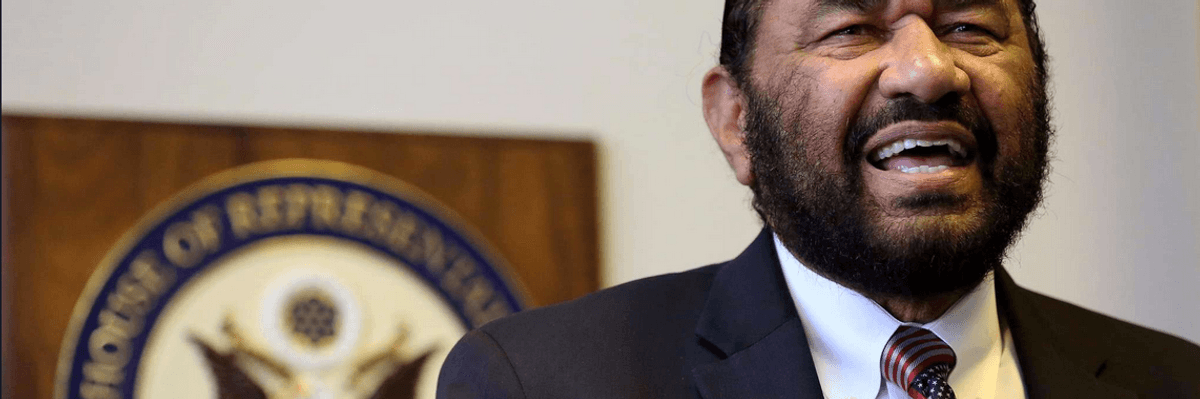
Rep. Al Green (D-Texas) speaks on November 8, 2017 in Washington, D.C.
Congressman Proposes Bill to Block GOP States' Property Ownership Bans
"Banning buying homes based on citizenship and registering your property did not bode well in history," said one lawmaker. "This is the Republicans rewriting the Chinese Exclusion Act."
Days after a group of Chinese citizens sued Florida's government over its new law restricting Chinese citizens from purchasing property in the state, U.S. Rep. Al Green this week warned of a "proliferation" of such bans and unveiled federal legislation to prohibit them.
The proposal would affirm that federal law, such as the Fair Housing Act, takes precedence over state bans restricting who can and cannot legally purchase real estate or farmland. It would also allow people to sue in federal court and have a right to court-ordered relief including an injunction if they've been harmed by bans like the one approved by Republican Florida Gov. Ron DeSantis.
The Fair Housing Act explicitly prohibits discrimination in housing based on national origin, race, sex, gender identity, religion, and disability.
Despite the long-standing law, Florida this month became the latest state to pass restrictions on property ownership, targeting Chinese, Russian, Iranian, Syrian, Cuban, Venezuelan, and North Korean citizens. DeSantis claimed Chinese people have been "gobbling up" land in the state and said the law is intended to stop the Chinese Communist Party from gaining influence and spying in the state.
"That is not in the best interests of Florida to have the Chinese Communist Party owning farmland, owning land close to military bases," said the governor, who announced his 2024 presidential campaign this week.
Utah Gov. Spencer Cox, also a Republican, signed a ban on Chinese companies buying property in March, and the Texas Legislature had advanced a similar bill targeting companies and government entities headquartered in China, Russia, North Korea, and Iran.
According to the National Agricultural Law Center, 21 states have laws restricting foreign ownership of farmland. More than 30 states have drafted or advanced legislation to either tighten those restrictions or introduce new ones.
"I don't think we ought to allow 50 states to have the opportunity to pass laws that can impact foreign affairs, which really is the province of the executive branch of the federal government," Green told HuffPost on Thursday. "I don't think we should wait until we get 30, 50, whatever number of different laws to act."
The measures have drawn comparisons to the so-called "alien land laws" that were in place in the early 20th century before being struck down by courts and state legislatures. The laws prohibited Chinese and Japanese immigrants from owning land and "severely exacerbated violence and discrimination against Asian communities," according to the ACLU, which is representing the plaintiffs in the lawsuit filed in Florida this week.
"Banning buying homes based on citizenship and registering your property did not bode well in history... This is the Republicans rewriting the Chinese Exclusion Act," said Rep. Grace Meng (D-N.Y.) this week, referring to the 1882 law that banned Chinese workers from immigrating to the United States.
Contrary to DeSantis' claim that Chinese citizens are buying large amounts of property across Florida, according to the U.S. Department of Agriculture's Farm Service Agency, foreigners owned only 3.1% of farmland at the end of 2021, and about a third of that land was owned by Canadians. Less than 1% of the land—0.03% of all farmland in the U.S.—was owned by Chinese citizens or entities.
We are at a crossroads
This country and this world are at a monumental crossroads. In a few short weeks, US voters will have an opportunity to beat back the forces of fascism and confront the billionaires who are rigging the economy, our media system, and our democracy, making it increasingly impossible for ordinary people to get by. We’re not just talking about the election. We’re talking about what must be done once these fascist elements are vanquished from power. We need a bolder set of solutions than what either major party has so far been willing to offer and a working-class movement ready to fight like hell for it. Trump didn't emerge from nowhere. The conditions that fueled MAGA authoritarianism were created by decades of radical neoliberal economic policies and a corrupt political system dominated by corporate interests. They slashed taxes on the super-rich, promising that the benefits would trickle down. They said giveaways to the corporate titans would make life more affordable for the rest of us. It was all bullshit. And when a bitter, betrayed populace searches for someone to blame, right-wing demagogues have little trouble finding scapegoats. People know when they're being lied to, but you won't hear any of this from the corporate media. Only independent journalism—powered and funded by people who believe in building a better world—can deliver truly trustworthy daily news. Our Fall Campaign is underway, and we need your help. To power our newsroom through the rest of the year, we need to raise $125,000 by midnight on October 31. So if you share our vision, please contribute whatever you can to sustain our work. |
Days after a group of Chinese citizens sued Florida's government over its new law restricting Chinese citizens from purchasing property in the state, U.S. Rep. Al Green this week warned of a "proliferation" of such bans and unveiled federal legislation to prohibit them.
The proposal would affirm that federal law, such as the Fair Housing Act, takes precedence over state bans restricting who can and cannot legally purchase real estate or farmland. It would also allow people to sue in federal court and have a right to court-ordered relief including an injunction if they've been harmed by bans like the one approved by Republican Florida Gov. Ron DeSantis.
The Fair Housing Act explicitly prohibits discrimination in housing based on national origin, race, sex, gender identity, religion, and disability.
Despite the long-standing law, Florida this month became the latest state to pass restrictions on property ownership, targeting Chinese, Russian, Iranian, Syrian, Cuban, Venezuelan, and North Korean citizens. DeSantis claimed Chinese people have been "gobbling up" land in the state and said the law is intended to stop the Chinese Communist Party from gaining influence and spying in the state.
"That is not in the best interests of Florida to have the Chinese Communist Party owning farmland, owning land close to military bases," said the governor, who announced his 2024 presidential campaign this week.
Utah Gov. Spencer Cox, also a Republican, signed a ban on Chinese companies buying property in March, and the Texas Legislature had advanced a similar bill targeting companies and government entities headquartered in China, Russia, North Korea, and Iran.
According to the National Agricultural Law Center, 21 states have laws restricting foreign ownership of farmland. More than 30 states have drafted or advanced legislation to either tighten those restrictions or introduce new ones.
"I don't think we ought to allow 50 states to have the opportunity to pass laws that can impact foreign affairs, which really is the province of the executive branch of the federal government," Green told HuffPost on Thursday. "I don't think we should wait until we get 30, 50, whatever number of different laws to act."
The measures have drawn comparisons to the so-called "alien land laws" that were in place in the early 20th century before being struck down by courts and state legislatures. The laws prohibited Chinese and Japanese immigrants from owning land and "severely exacerbated violence and discrimination against Asian communities," according to the ACLU, which is representing the plaintiffs in the lawsuit filed in Florida this week.
"Banning buying homes based on citizenship and registering your property did not bode well in history... This is the Republicans rewriting the Chinese Exclusion Act," said Rep. Grace Meng (D-N.Y.) this week, referring to the 1882 law that banned Chinese workers from immigrating to the United States.
Contrary to DeSantis' claim that Chinese citizens are buying large amounts of property across Florida, according to the U.S. Department of Agriculture's Farm Service Agency, foreigners owned only 3.1% of farmland at the end of 2021, and about a third of that land was owned by Canadians. Less than 1% of the land—0.03% of all farmland in the U.S.—was owned by Chinese citizens or entities.
Days after a group of Chinese citizens sued Florida's government over its new law restricting Chinese citizens from purchasing property in the state, U.S. Rep. Al Green this week warned of a "proliferation" of such bans and unveiled federal legislation to prohibit them.
The proposal would affirm that federal law, such as the Fair Housing Act, takes precedence over state bans restricting who can and cannot legally purchase real estate or farmland. It would also allow people to sue in federal court and have a right to court-ordered relief including an injunction if they've been harmed by bans like the one approved by Republican Florida Gov. Ron DeSantis.
The Fair Housing Act explicitly prohibits discrimination in housing based on national origin, race, sex, gender identity, religion, and disability.
Despite the long-standing law, Florida this month became the latest state to pass restrictions on property ownership, targeting Chinese, Russian, Iranian, Syrian, Cuban, Venezuelan, and North Korean citizens. DeSantis claimed Chinese people have been "gobbling up" land in the state and said the law is intended to stop the Chinese Communist Party from gaining influence and spying in the state.
"That is not in the best interests of Florida to have the Chinese Communist Party owning farmland, owning land close to military bases," said the governor, who announced his 2024 presidential campaign this week.
Utah Gov. Spencer Cox, also a Republican, signed a ban on Chinese companies buying property in March, and the Texas Legislature had advanced a similar bill targeting companies and government entities headquartered in China, Russia, North Korea, and Iran.
According to the National Agricultural Law Center, 21 states have laws restricting foreign ownership of farmland. More than 30 states have drafted or advanced legislation to either tighten those restrictions or introduce new ones.
"I don't think we ought to allow 50 states to have the opportunity to pass laws that can impact foreign affairs, which really is the province of the executive branch of the federal government," Green told HuffPost on Thursday. "I don't think we should wait until we get 30, 50, whatever number of different laws to act."
The measures have drawn comparisons to the so-called "alien land laws" that were in place in the early 20th century before being struck down by courts and state legislatures. The laws prohibited Chinese and Japanese immigrants from owning land and "severely exacerbated violence and discrimination against Asian communities," according to the ACLU, which is representing the plaintiffs in the lawsuit filed in Florida this week.
"Banning buying homes based on citizenship and registering your property did not bode well in history... This is the Republicans rewriting the Chinese Exclusion Act," said Rep. Grace Meng (D-N.Y.) this week, referring to the 1882 law that banned Chinese workers from immigrating to the United States.
Contrary to DeSantis' claim that Chinese citizens are buying large amounts of property across Florida, according to the U.S. Department of Agriculture's Farm Service Agency, foreigners owned only 3.1% of farmland at the end of 2021, and about a third of that land was owned by Canadians. Less than 1% of the land—0.03% of all farmland in the U.S.—was owned by Chinese citizens or entities.