SUBSCRIBE TO OUR FREE NEWSLETTER
Daily news & progressive opinion—funded by the people, not the corporations—delivered straight to your inbox.
5
#000000
#FFFFFF
To donate by check, phone, or other method, see our More Ways to Give page.
Daily news & progressive opinion—funded by the people, not the corporations—delivered straight to your inbox.
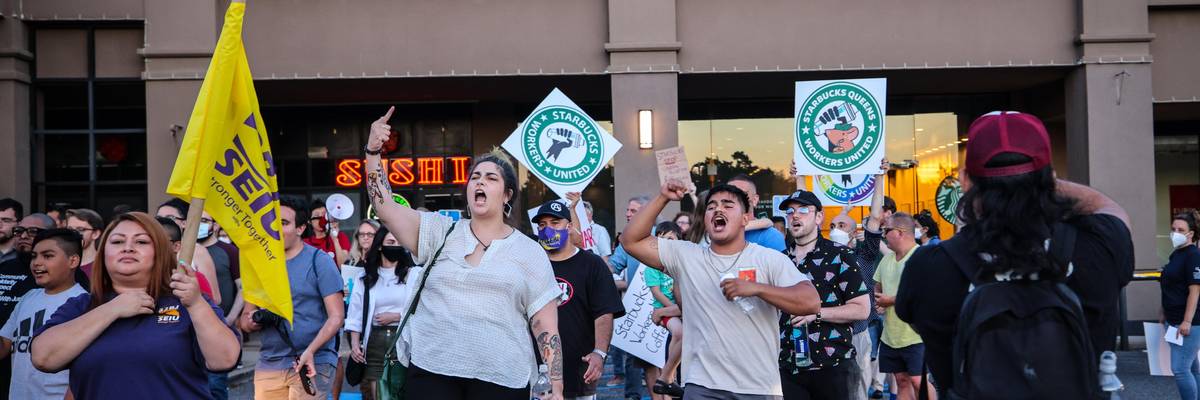
Protesters rally against Starbucks union-busting outside one of the global coffee chain's locations in Great Neck, New York on August 15, 2022.
"This complaint is the latest confirmation of Starbucks' determination to illegally oppose workers' organizing," said one unionized employee.
Like its alleged intimidation tactics and firing of workers who have led unionization efforts, Starbucks' closure of at least 23 stores amid a nationwide workers' rights push last year did not go unnoticed by federal regulators, who said Wednesday they will seek a judge's order for the global coffee chain to reopen the locations.
The National Labor Relations Board (NLRB) issued a complaint saying that eight of the shuttered stores were among the more than 360 Starbucks locations that have voted to unionize, and that executives did not notify the union, Starbucks Workers United, about the closures ahead of time—robbing organizers of an opportunity to bargain over the decision.
The agency asked an administrative judge to order Starbucks to reopen the locations—which are located in cities including Los Angeles, Philadelphia, Seattle, and Portland, Maine—and to re-hire fired employees, provide them with lost pay and benefits, and bargain with the unions at stores that have organized.
If the company does not settle the matter, an administrative judge will hear the case next summer, The New York Times reported.
The NLRB has issued more than 100 complaints against Starbucks for illegal union-busting, including threatening and retaliating against employees and refusing to bargain over union contracts. An administrative judge ruled in July that Starbucks unlawfully shut down a store in Ithaca, New York, and the company appealed that decision.
The company notified the union last week that it wants to resume contract negotiations after a six-month deadlock.
Also on Wednesday, Starbucks released a report that had been requested by shareholders and completed by independent consultant Thomas Mackall, who analyzed the $111 billion company's labor practices.
Mackall determined that Starbucks executives who have responded to the nationwide unionization push may have violated the company's own Global Human Rights Statement, which states that the company will respect employees' rights to participate in collective bargaining.
The NLRB's latest action against Starbucks was applauded on Thursday by the AFL-CIO, which said executives at the coffee giant "thought they could mess around" with workers' rights.
"This complaint is the latest confirmation of Starbucks' determination to illegally oppose workers' organizing," said Mari Cosgrove, a member of Starbucks Workers United who works at a location in Seattle, on Wednesday. "It adds to the litany of complaints detailed in the company's own report released this morning. If Starbucks is sincere in its overtures in recent days to forge a different relationship with its partners, this is exactly the kind of illegal behavior it needs to stop."
Note: This article has been corrected to state that federal regulators did not order Starbucks to reopen the stores, but sought a judge's order to reopen them.
Dear Common Dreams reader, It’s been nearly 30 years since I co-founded Common Dreams with my late wife, Lina Newhouser. We had the radical notion that journalism should serve the public good, not corporate profits. It was clear to us from the outset what it would take to build such a project. No paid advertisements. No corporate sponsors. No millionaire publisher telling us what to think or do. Many people said we wouldn't last a year, but we proved those doubters wrong. Together with a tremendous team of journalists and dedicated staff, we built an independent media outlet free from the constraints of profits and corporate control. Our mission has always been simple: To inform. To inspire. To ignite change for the common good. Building Common Dreams was not easy. Our survival was never guaranteed. When you take on the most powerful forces—Wall Street greed, fossil fuel industry destruction, Big Tech lobbyists, and uber-rich oligarchs who have spent billions upon billions rigging the economy and democracy in their favor—the only bulwark you have is supporters who believe in your work. But here’s the urgent message from me today. It's never been this bad out there. And it's never been this hard to keep us going. At the very moment Common Dreams is most needed, the threats we face are intensifying. We need your support now more than ever. We don't accept corporate advertising and never will. We don't have a paywall because we don't think people should be blocked from critical news based on their ability to pay. Everything we do is funded by the donations of readers like you. When everyone does the little they can afford, we are strong. But if that support retreats or dries up, so do we. Will you donate now to make sure Common Dreams not only survives but thrives? —Craig Brown, Co-founder |
Like its alleged intimidation tactics and firing of workers who have led unionization efforts, Starbucks' closure of at least 23 stores amid a nationwide workers' rights push last year did not go unnoticed by federal regulators, who said Wednesday they will seek a judge's order for the global coffee chain to reopen the locations.
The National Labor Relations Board (NLRB) issued a complaint saying that eight of the shuttered stores were among the more than 360 Starbucks locations that have voted to unionize, and that executives did not notify the union, Starbucks Workers United, about the closures ahead of time—robbing organizers of an opportunity to bargain over the decision.
The agency asked an administrative judge to order Starbucks to reopen the locations—which are located in cities including Los Angeles, Philadelphia, Seattle, and Portland, Maine—and to re-hire fired employees, provide them with lost pay and benefits, and bargain with the unions at stores that have organized.
If the company does not settle the matter, an administrative judge will hear the case next summer, The New York Times reported.
The NLRB has issued more than 100 complaints against Starbucks for illegal union-busting, including threatening and retaliating against employees and refusing to bargain over union contracts. An administrative judge ruled in July that Starbucks unlawfully shut down a store in Ithaca, New York, and the company appealed that decision.
The company notified the union last week that it wants to resume contract negotiations after a six-month deadlock.
Also on Wednesday, Starbucks released a report that had been requested by shareholders and completed by independent consultant Thomas Mackall, who analyzed the $111 billion company's labor practices.
Mackall determined that Starbucks executives who have responded to the nationwide unionization push may have violated the company's own Global Human Rights Statement, which states that the company will respect employees' rights to participate in collective bargaining.
The NLRB's latest action against Starbucks was applauded on Thursday by the AFL-CIO, which said executives at the coffee giant "thought they could mess around" with workers' rights.
"This complaint is the latest confirmation of Starbucks' determination to illegally oppose workers' organizing," said Mari Cosgrove, a member of Starbucks Workers United who works at a location in Seattle, on Wednesday. "It adds to the litany of complaints detailed in the company's own report released this morning. If Starbucks is sincere in its overtures in recent days to forge a different relationship with its partners, this is exactly the kind of illegal behavior it needs to stop."
Note: This article has been corrected to state that federal regulators did not order Starbucks to reopen the stores, but sought a judge's order to reopen them.
Like its alleged intimidation tactics and firing of workers who have led unionization efforts, Starbucks' closure of at least 23 stores amid a nationwide workers' rights push last year did not go unnoticed by federal regulators, who said Wednesday they will seek a judge's order for the global coffee chain to reopen the locations.
The National Labor Relations Board (NLRB) issued a complaint saying that eight of the shuttered stores were among the more than 360 Starbucks locations that have voted to unionize, and that executives did not notify the union, Starbucks Workers United, about the closures ahead of time—robbing organizers of an opportunity to bargain over the decision.
The agency asked an administrative judge to order Starbucks to reopen the locations—which are located in cities including Los Angeles, Philadelphia, Seattle, and Portland, Maine—and to re-hire fired employees, provide them with lost pay and benefits, and bargain with the unions at stores that have organized.
If the company does not settle the matter, an administrative judge will hear the case next summer, The New York Times reported.
The NLRB has issued more than 100 complaints against Starbucks for illegal union-busting, including threatening and retaliating against employees and refusing to bargain over union contracts. An administrative judge ruled in July that Starbucks unlawfully shut down a store in Ithaca, New York, and the company appealed that decision.
The company notified the union last week that it wants to resume contract negotiations after a six-month deadlock.
Also on Wednesday, Starbucks released a report that had been requested by shareholders and completed by independent consultant Thomas Mackall, who analyzed the $111 billion company's labor practices.
Mackall determined that Starbucks executives who have responded to the nationwide unionization push may have violated the company's own Global Human Rights Statement, which states that the company will respect employees' rights to participate in collective bargaining.
The NLRB's latest action against Starbucks was applauded on Thursday by the AFL-CIO, which said executives at the coffee giant "thought they could mess around" with workers' rights.
"This complaint is the latest confirmation of Starbucks' determination to illegally oppose workers' organizing," said Mari Cosgrove, a member of Starbucks Workers United who works at a location in Seattle, on Wednesday. "It adds to the litany of complaints detailed in the company's own report released this morning. If Starbucks is sincere in its overtures in recent days to forge a different relationship with its partners, this is exactly the kind of illegal behavior it needs to stop."
Note: This article has been corrected to state that federal regulators did not order Starbucks to reopen the stores, but sought a judge's order to reopen them.