SUBSCRIBE TO OUR FREE NEWSLETTER
Daily news & progressive opinion—funded by the people, not the corporations—delivered straight to your inbox.
5
#000000
#FFFFFF
To donate by check, phone, or other method, see our More Ways to Give page.
Daily news & progressive opinion—funded by the people, not the corporations—delivered straight to your inbox.
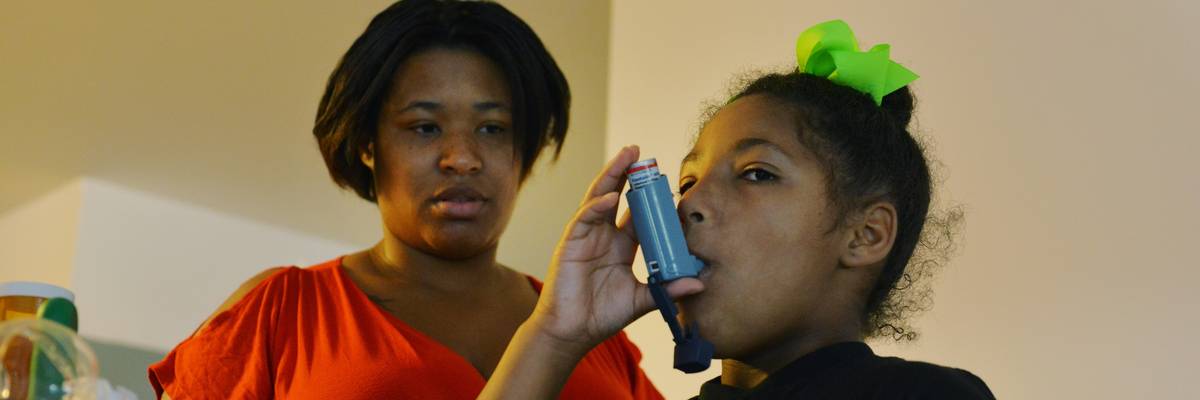
A 9-year-old girl takes her asthma medicine on September 29, 2013 in Washington, D.C.
"No child in America should be sick or die because their parents cannot afford or access the inhalers they need to breathe," said Sen. Bernie Sanders.
U.S. Sen. Bernie Sanders on Tuesday urged a pair of pharmaceutical corporations to immediately slash the price tag of the generic version of the most commonly prescribed inhaler for children, continuing a pressure campaign that the Vermont Independent and his Democratic colleagues have been waging throughout the year with remarkable results.
Sanders' latest call was directed at GlaxoSmithKline (GSK) and Prasco Laboratories, which sells the authorized generic of Flovent—an inhaler that GSK pulled from the U.S. market earlier this year.
In March, after the Sanders-led Senate Health, Education, Labor, and Pensions (HELP) Committee launched an investigation into the high costs of inhalers, GSK announced it would join other companies in capping out-of-pocket costs for its asthma medications at $35 a month.
But GSK's pledge did not extend to Flovent's generic, which currently costs patients up to hundreds of dollars per month. Prasco Laboratories sells the generic product under a deal with GSK.
"Unfortunately, the retail price of this inhaler is between $172 and $313, and many insurance companies are refusing to cover it because the net price is more expensive than the brand-name version of Flovent," Sanders noted in a statement Tuesday. "Facing high prices and a lack of insurance coverage, families throughout the country are having a very difficult time purchasing inhalers for their children."
"The result: Pediatricians have observed a major increase in the number of children with asthma who have been admitted to hospitals," Sanders continued. "There are also reports that more children are dying. That is absolutely unacceptable. No child in America should be sick or die because their parents cannot afford or access the inhalers they need to breathe."
Nearly five million children in the U.S. have asthma, according to data from the Centers for Disease Control and Prevention, and an estimated 300 children and young adults in the country die from asthma attacks each year.
CNN reported earlier this year that GSK's decision to pull Flovent off the market in the U.S. put kids in danger of asthma flare-ups and visits to the ER."
Experts and lawmakers have accused GSK of yanking Flovent from the U.S. market to avoid paying significant federal penalties for raising the product's price tag above the rate of inflation.
"Instead of paying Medicaid the rebates it owed in 2024, GSK appears to have used a loophole to preserve its profits from years of exorbitant price increases," Sen. Maggie Hassan (D-N.H.) wrote in a letter to GSK's chief executive in early May. "GSK replaced both of its brand Flovent inhalers with an identical line of products licensed to a different manufacturer—a company that is conveniently exempt from Medicaid rebates, since it has no existing price history."
"Through your arrangement with Prasco Laboratories," Hassan added, "GSK appears to be circumventing Medicaid rebates to protect decades of profits gained by price gouging patients and public programs."
Sanders said Tuesday that, going forward, the focus of his Senate committee's investigation into inhaler costs and corporate price gouging will be on "the crisis of infants and children with asthma who have been struggling to receive the inhalers they need."
"These companies have a responsibility to make sure that children with asthma in America have access to the inhalers they need," said Sanders. "As the chairman of the HELP Committee, I will continue to do everything I can to make sure that the American people no longer pay, by far, the highest prices in the world for prescription drugs."
Dear Common Dreams reader, It’s been nearly 30 years since I co-founded Common Dreams with my late wife, Lina Newhouser. We had the radical notion that journalism should serve the public good, not corporate profits. It was clear to us from the outset what it would take to build such a project. No paid advertisements. No corporate sponsors. No millionaire publisher telling us what to think or do. Many people said we wouldn't last a year, but we proved those doubters wrong. Together with a tremendous team of journalists and dedicated staff, we built an independent media outlet free from the constraints of profits and corporate control. Our mission has always been simple: To inform. To inspire. To ignite change for the common good. Building Common Dreams was not easy. Our survival was never guaranteed. When you take on the most powerful forces—Wall Street greed, fossil fuel industry destruction, Big Tech lobbyists, and uber-rich oligarchs who have spent billions upon billions rigging the economy and democracy in their favor—the only bulwark you have is supporters who believe in your work. But here’s the urgent message from me today. It's never been this bad out there. And it's never been this hard to keep us going. At the very moment Common Dreams is most needed, the threats we face are intensifying. We need your support now more than ever. We don't accept corporate advertising and never will. We don't have a paywall because we don't think people should be blocked from critical news based on their ability to pay. Everything we do is funded by the donations of readers like you. When everyone does the little they can afford, we are strong. But if that support retreats or dries up, so do we. Will you donate now to make sure Common Dreams not only survives but thrives? —Craig Brown, Co-founder |
U.S. Sen. Bernie Sanders on Tuesday urged a pair of pharmaceutical corporations to immediately slash the price tag of the generic version of the most commonly prescribed inhaler for children, continuing a pressure campaign that the Vermont Independent and his Democratic colleagues have been waging throughout the year with remarkable results.
Sanders' latest call was directed at GlaxoSmithKline (GSK) and Prasco Laboratories, which sells the authorized generic of Flovent—an inhaler that GSK pulled from the U.S. market earlier this year.
In March, after the Sanders-led Senate Health, Education, Labor, and Pensions (HELP) Committee launched an investigation into the high costs of inhalers, GSK announced it would join other companies in capping out-of-pocket costs for its asthma medications at $35 a month.
But GSK's pledge did not extend to Flovent's generic, which currently costs patients up to hundreds of dollars per month. Prasco Laboratories sells the generic product under a deal with GSK.
"Unfortunately, the retail price of this inhaler is between $172 and $313, and many insurance companies are refusing to cover it because the net price is more expensive than the brand-name version of Flovent," Sanders noted in a statement Tuesday. "Facing high prices and a lack of insurance coverage, families throughout the country are having a very difficult time purchasing inhalers for their children."
"The result: Pediatricians have observed a major increase in the number of children with asthma who have been admitted to hospitals," Sanders continued. "There are also reports that more children are dying. That is absolutely unacceptable. No child in America should be sick or die because their parents cannot afford or access the inhalers they need to breathe."
Nearly five million children in the U.S. have asthma, according to data from the Centers for Disease Control and Prevention, and an estimated 300 children and young adults in the country die from asthma attacks each year.
CNN reported earlier this year that GSK's decision to pull Flovent off the market in the U.S. put kids in danger of asthma flare-ups and visits to the ER."
Experts and lawmakers have accused GSK of yanking Flovent from the U.S. market to avoid paying significant federal penalties for raising the product's price tag above the rate of inflation.
"Instead of paying Medicaid the rebates it owed in 2024, GSK appears to have used a loophole to preserve its profits from years of exorbitant price increases," Sen. Maggie Hassan (D-N.H.) wrote in a letter to GSK's chief executive in early May. "GSK replaced both of its brand Flovent inhalers with an identical line of products licensed to a different manufacturer—a company that is conveniently exempt from Medicaid rebates, since it has no existing price history."
"Through your arrangement with Prasco Laboratories," Hassan added, "GSK appears to be circumventing Medicaid rebates to protect decades of profits gained by price gouging patients and public programs."
Sanders said Tuesday that, going forward, the focus of his Senate committee's investigation into inhaler costs and corporate price gouging will be on "the crisis of infants and children with asthma who have been struggling to receive the inhalers they need."
"These companies have a responsibility to make sure that children with asthma in America have access to the inhalers they need," said Sanders. "As the chairman of the HELP Committee, I will continue to do everything I can to make sure that the American people no longer pay, by far, the highest prices in the world for prescription drugs."
U.S. Sen. Bernie Sanders on Tuesday urged a pair of pharmaceutical corporations to immediately slash the price tag of the generic version of the most commonly prescribed inhaler for children, continuing a pressure campaign that the Vermont Independent and his Democratic colleagues have been waging throughout the year with remarkable results.
Sanders' latest call was directed at GlaxoSmithKline (GSK) and Prasco Laboratories, which sells the authorized generic of Flovent—an inhaler that GSK pulled from the U.S. market earlier this year.
In March, after the Sanders-led Senate Health, Education, Labor, and Pensions (HELP) Committee launched an investigation into the high costs of inhalers, GSK announced it would join other companies in capping out-of-pocket costs for its asthma medications at $35 a month.
But GSK's pledge did not extend to Flovent's generic, which currently costs patients up to hundreds of dollars per month. Prasco Laboratories sells the generic product under a deal with GSK.
"Unfortunately, the retail price of this inhaler is between $172 and $313, and many insurance companies are refusing to cover it because the net price is more expensive than the brand-name version of Flovent," Sanders noted in a statement Tuesday. "Facing high prices and a lack of insurance coverage, families throughout the country are having a very difficult time purchasing inhalers for their children."
"The result: Pediatricians have observed a major increase in the number of children with asthma who have been admitted to hospitals," Sanders continued. "There are also reports that more children are dying. That is absolutely unacceptable. No child in America should be sick or die because their parents cannot afford or access the inhalers they need to breathe."
Nearly five million children in the U.S. have asthma, according to data from the Centers for Disease Control and Prevention, and an estimated 300 children and young adults in the country die from asthma attacks each year.
CNN reported earlier this year that GSK's decision to pull Flovent off the market in the U.S. put kids in danger of asthma flare-ups and visits to the ER."
Experts and lawmakers have accused GSK of yanking Flovent from the U.S. market to avoid paying significant federal penalties for raising the product's price tag above the rate of inflation.
"Instead of paying Medicaid the rebates it owed in 2024, GSK appears to have used a loophole to preserve its profits from years of exorbitant price increases," Sen. Maggie Hassan (D-N.H.) wrote in a letter to GSK's chief executive in early May. "GSK replaced both of its brand Flovent inhalers with an identical line of products licensed to a different manufacturer—a company that is conveniently exempt from Medicaid rebates, since it has no existing price history."
"Through your arrangement with Prasco Laboratories," Hassan added, "GSK appears to be circumventing Medicaid rebates to protect decades of profits gained by price gouging patients and public programs."
Sanders said Tuesday that, going forward, the focus of his Senate committee's investigation into inhaler costs and corporate price gouging will be on "the crisis of infants and children with asthma who have been struggling to receive the inhalers they need."
"These companies have a responsibility to make sure that children with asthma in America have access to the inhalers they need," said Sanders. "As the chairman of the HELP Committee, I will continue to do everything I can to make sure that the American people no longer pay, by far, the highest prices in the world for prescription drugs."