SUBSCRIBE TO OUR FREE NEWSLETTER
Daily news & progressive opinion—funded by the people, not the corporations—delivered straight to your inbox.
5
#000000
#FFFFFF
To donate by check, phone, or other method, see our More Ways to Give page.
Daily news & progressive opinion—funded by the people, not the corporations—delivered straight to your inbox.
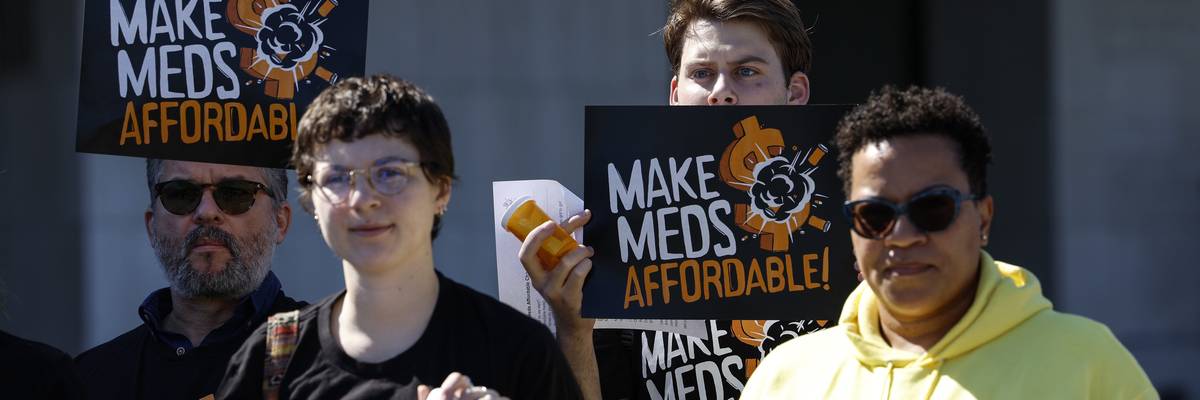
Activists protest prescription drug costs in front of the U.S. Department of Health and Human Services building on October 6, 2022 in Washington, D.C.
"Politicians for years have talked about the high cost of prescription drugs, relatively little has been done, and it's time that we act decisively."
Sen. Bernie Sanders pledged Monday to oppose all of President Joe Biden's health nominees until his administration takes more aggressive action to cut the costs of prescription drugs, which are often developed with the help of government money and scientists.
In an interview with The Washington Post, Sanders (I-Vt.) said he "will oppose all nominations until we have a very clear strategy on the part of the government... as to how we're going to lower the outrageously high cost of prescription drugs."
"My goal is to change government in general, policy in terms of the pharmaceutical industry, and demand that the cost of prescription drugs in this country are significantly lowered," said the Vermont senator. "Politicians for years have talked about the high cost of prescription drugs, relatively little has been done, and it's time that we act decisively."
As chair of the Senate Health, Education, Labor, and Pensions (HELP) Committee, Sanders "controls when his panel reviews nominees for positions in the Department of Health and Human Services," the Post noted Monday. "Without the support of the senator from Vermont, the Biden administration will not be able to confirm current and future health agency nominees."
Sanders' issued his pledge as the HELP Committee released a report showing that the median price of new treatments developed with the critical assistance of National Institutes of Health (NIH) scientists over the past two decades is a staggering $111,000.
Last month, Biden announced his intent to nominate Dr. Monica Bertagnolli, a surgical oncologist and the current head of the National Cancer Institute, to lead the NIH, but Sanders is likely to block the pick unless the Biden administration releases a more sweeping plan to reduce drug prices.
"Now is the time for the Biden administration to take executive action to substantially lower the price of prescription drugs."
In a statement to the Post, the White House responded to Sanders by touting the Inflation Reduction Act (IRA), calling the recently enacted measure "the most consequential law addressing the high cost of prescription drugs."
But Sanders has argued that the IRA's prescription drug provisions are inadequate to the massive task of challenging the pharmaceutical industry's pricing power. The IRA requires Medicare to negotiate the prices of just a small number of drugs directly with pharmaceutical companies—one of which is challenging the law in court.
New prices for the 10 Medicare Part D drugs that will initially be subject to direct negotiation aren't set to take effect until 2026.
With the Republican-controlled House likely to block further legislative action on drug prices, Sanders is urging the Biden administration to make full use of its executive authority to slash drug costs, which are forcing millions across the United States to skip doses and delay refills.
"Now is the time for the Biden administration to take executive action to substantially lower the price of prescription drugs and to take on the unacceptable corporate greed of the pharmaceutical industry," Sanders said Monday, specifically urging the NIH to "reinstate and strengthen a 'reasonable pricing clause' in all future collaboration, funding, and licensing agreements for medical research."
One recent analysis found that U.S. taxpayers "have been footing the bill for every new drug approved between 2010 and 2019."
The Vermont senator was among the lawmakers and patient advocates who criticized the Biden administration earlier this year for declining to use its existing authority to force the manufacturer of Xtandi—a lifesaving prostate cancer drug developed with taxpayer funding—to cut the $189,800 annual price tag for the medicine in the U.S.
"How many prostate cancer patients will die," Sanders asked, "because they cannot afford this unacceptable price?"
Dear Common Dreams reader, It’s been nearly 30 years since I co-founded Common Dreams with my late wife, Lina Newhouser. We had the radical notion that journalism should serve the public good, not corporate profits. It was clear to us from the outset what it would take to build such a project. No paid advertisements. No corporate sponsors. No millionaire publisher telling us what to think or do. Many people said we wouldn't last a year, but we proved those doubters wrong. Together with a tremendous team of journalists and dedicated staff, we built an independent media outlet free from the constraints of profits and corporate control. Our mission has always been simple: To inform. To inspire. To ignite change for the common good. Building Common Dreams was not easy. Our survival was never guaranteed. When you take on the most powerful forces—Wall Street greed, fossil fuel industry destruction, Big Tech lobbyists, and uber-rich oligarchs who have spent billions upon billions rigging the economy and democracy in their favor—the only bulwark you have is supporters who believe in your work. But here’s the urgent message from me today. It's never been this bad out there. And it's never been this hard to keep us going. At the very moment Common Dreams is most needed, the threats we face are intensifying. We need your support now more than ever. We don't accept corporate advertising and never will. We don't have a paywall because we don't think people should be blocked from critical news based on their ability to pay. Everything we do is funded by the donations of readers like you. When everyone does the little they can afford, we are strong. But if that support retreats or dries up, so do we. Will you donate now to make sure Common Dreams not only survives but thrives? —Craig Brown, Co-founder |
Sen. Bernie Sanders pledged Monday to oppose all of President Joe Biden's health nominees until his administration takes more aggressive action to cut the costs of prescription drugs, which are often developed with the help of government money and scientists.
In an interview with The Washington Post, Sanders (I-Vt.) said he "will oppose all nominations until we have a very clear strategy on the part of the government... as to how we're going to lower the outrageously high cost of prescription drugs."
"My goal is to change government in general, policy in terms of the pharmaceutical industry, and demand that the cost of prescription drugs in this country are significantly lowered," said the Vermont senator. "Politicians for years have talked about the high cost of prescription drugs, relatively little has been done, and it's time that we act decisively."
As chair of the Senate Health, Education, Labor, and Pensions (HELP) Committee, Sanders "controls when his panel reviews nominees for positions in the Department of Health and Human Services," the Post noted Monday. "Without the support of the senator from Vermont, the Biden administration will not be able to confirm current and future health agency nominees."
Sanders' issued his pledge as the HELP Committee released a report showing that the median price of new treatments developed with the critical assistance of National Institutes of Health (NIH) scientists over the past two decades is a staggering $111,000.
Last month, Biden announced his intent to nominate Dr. Monica Bertagnolli, a surgical oncologist and the current head of the National Cancer Institute, to lead the NIH, but Sanders is likely to block the pick unless the Biden administration releases a more sweeping plan to reduce drug prices.
"Now is the time for the Biden administration to take executive action to substantially lower the price of prescription drugs."
In a statement to the Post, the White House responded to Sanders by touting the Inflation Reduction Act (IRA), calling the recently enacted measure "the most consequential law addressing the high cost of prescription drugs."
But Sanders has argued that the IRA's prescription drug provisions are inadequate to the massive task of challenging the pharmaceutical industry's pricing power. The IRA requires Medicare to negotiate the prices of just a small number of drugs directly with pharmaceutical companies—one of which is challenging the law in court.
New prices for the 10 Medicare Part D drugs that will initially be subject to direct negotiation aren't set to take effect until 2026.
With the Republican-controlled House likely to block further legislative action on drug prices, Sanders is urging the Biden administration to make full use of its executive authority to slash drug costs, which are forcing millions across the United States to skip doses and delay refills.
"Now is the time for the Biden administration to take executive action to substantially lower the price of prescription drugs and to take on the unacceptable corporate greed of the pharmaceutical industry," Sanders said Monday, specifically urging the NIH to "reinstate and strengthen a 'reasonable pricing clause' in all future collaboration, funding, and licensing agreements for medical research."
One recent analysis found that U.S. taxpayers "have been footing the bill for every new drug approved between 2010 and 2019."
The Vermont senator was among the lawmakers and patient advocates who criticized the Biden administration earlier this year for declining to use its existing authority to force the manufacturer of Xtandi—a lifesaving prostate cancer drug developed with taxpayer funding—to cut the $189,800 annual price tag for the medicine in the U.S.
"How many prostate cancer patients will die," Sanders asked, "because they cannot afford this unacceptable price?"
Sen. Bernie Sanders pledged Monday to oppose all of President Joe Biden's health nominees until his administration takes more aggressive action to cut the costs of prescription drugs, which are often developed with the help of government money and scientists.
In an interview with The Washington Post, Sanders (I-Vt.) said he "will oppose all nominations until we have a very clear strategy on the part of the government... as to how we're going to lower the outrageously high cost of prescription drugs."
"My goal is to change government in general, policy in terms of the pharmaceutical industry, and demand that the cost of prescription drugs in this country are significantly lowered," said the Vermont senator. "Politicians for years have talked about the high cost of prescription drugs, relatively little has been done, and it's time that we act decisively."
As chair of the Senate Health, Education, Labor, and Pensions (HELP) Committee, Sanders "controls when his panel reviews nominees for positions in the Department of Health and Human Services," the Post noted Monday. "Without the support of the senator from Vermont, the Biden administration will not be able to confirm current and future health agency nominees."
Sanders' issued his pledge as the HELP Committee released a report showing that the median price of new treatments developed with the critical assistance of National Institutes of Health (NIH) scientists over the past two decades is a staggering $111,000.
Last month, Biden announced his intent to nominate Dr. Monica Bertagnolli, a surgical oncologist and the current head of the National Cancer Institute, to lead the NIH, but Sanders is likely to block the pick unless the Biden administration releases a more sweeping plan to reduce drug prices.
"Now is the time for the Biden administration to take executive action to substantially lower the price of prescription drugs."
In a statement to the Post, the White House responded to Sanders by touting the Inflation Reduction Act (IRA), calling the recently enacted measure "the most consequential law addressing the high cost of prescription drugs."
But Sanders has argued that the IRA's prescription drug provisions are inadequate to the massive task of challenging the pharmaceutical industry's pricing power. The IRA requires Medicare to negotiate the prices of just a small number of drugs directly with pharmaceutical companies—one of which is challenging the law in court.
New prices for the 10 Medicare Part D drugs that will initially be subject to direct negotiation aren't set to take effect until 2026.
With the Republican-controlled House likely to block further legislative action on drug prices, Sanders is urging the Biden administration to make full use of its executive authority to slash drug costs, which are forcing millions across the United States to skip doses and delay refills.
"Now is the time for the Biden administration to take executive action to substantially lower the price of prescription drugs and to take on the unacceptable corporate greed of the pharmaceutical industry," Sanders said Monday, specifically urging the NIH to "reinstate and strengthen a 'reasonable pricing clause' in all future collaboration, funding, and licensing agreements for medical research."
One recent analysis found that U.S. taxpayers "have been footing the bill for every new drug approved between 2010 and 2019."
The Vermont senator was among the lawmakers and patient advocates who criticized the Biden administration earlier this year for declining to use its existing authority to force the manufacturer of Xtandi—a lifesaving prostate cancer drug developed with taxpayer funding—to cut the $189,800 annual price tag for the medicine in the U.S.
"How many prostate cancer patients will die," Sanders asked, "because they cannot afford this unacceptable price?"