SUBSCRIBE TO OUR FREE NEWSLETTER
Daily news & progressive opinion—funded by the people, not the corporations—delivered straight to your inbox.
5
#000000
#FFFFFF
To donate by check, phone, or other method, see our More Ways to Give page.
Daily news & progressive opinion—funded by the people, not the corporations—delivered straight to your inbox.
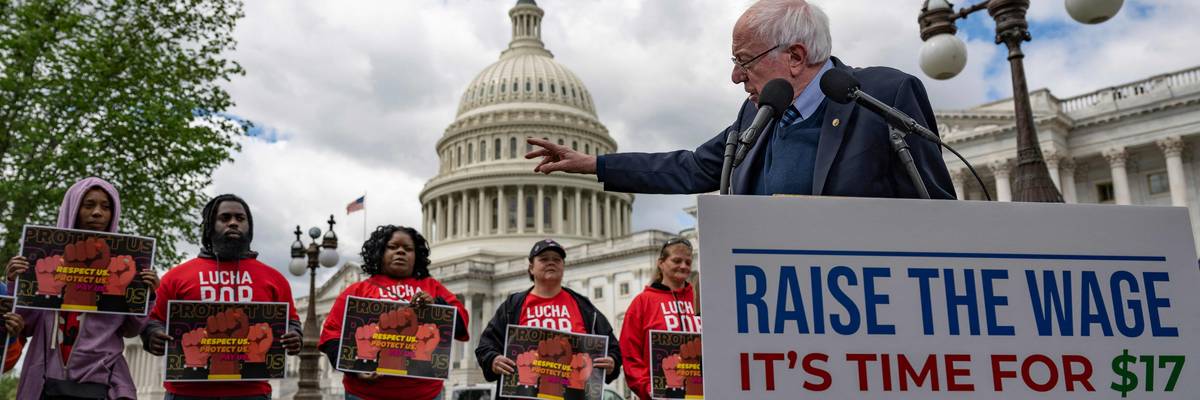
Sen. Bernie Sanders (I-Vt.) speaks during a news conference with labor leaders and service workers on Capitol Hill in Washington, D.C. on May 4, 2023.
"The overwhelming majority of Americans support raising the minimum wage to a living wage."
Decrying the "national disgrace" of poverty wages in the world's richest country, Sen. Bernie Sanders on Thursday introduced legislation that would raise the federal minimum wage to $17 an hour over a period of five years.
Sanders (I-Vt.), the chair of the Senate Health, Education, Labor, and Pensions (HELP) Committee, lamented that Congress hasn't raised the federal minimum wage in more than a decade, leaving tens of millions of workers with what the senator described as "starvation wages."
"Now is the time to raise the minimum wage," Sanders (I-Vt.) said at a Capitol Hill press conference alongside union leaders and service workers. "Let's be clear: This is not a radical idea. The overwhelming majority of Americans support raising the minimum wage to a living wage."
"It is not acceptable today that nearly 35 million American workers earn less than $17 an hour," the senator added.
Sanders pledged to push his legislation "as quickly and as hard" as possible in the Senate, where the bill faces long odds given likely opposition from several members of the chamber's Democratic caucus and every Republican. The Senate HELP Committee will hold a mark-up hearing for the new legislation on June 14, Sanders announced Thursday.
The full text of the bill is not yet available.
Mary Kay Henry, president of the Service Employees International Union (SEIU), said during Thursday's press conference that "we are going to be watching any congressperson—senator or in the House—that dares to say that they are not going to vote yes for Senator Sanders' bill."
"They need to be held accountable at the ballot box," said Henry.
More than a decade has passed since Congress last raised the federal minimum wage, and efforts in recent years to enact a $15-an-hour wage floor nationally have fallen short amid opposition from the GOP, corporate-friendly Democrats, and the business lobby.
While some lawmakers are sure to balk at the idea of more than doubling the federal minimum wage, a working paper released this week showed that counties that have enacted large minimum wage increases have seen higher employment, higher earnings for workers, and lower inequality.
"Nobody in this country can survive on $7.25 an hour," Sanders said Thursday. "Maybe some of my colleagues in Congress might want to live for a month on seven-and-a-quarter an hour and see what that's like."
As Congress has failed to act, many states, cities, and counties across the U.S. have raised their minimum wages substantially, with progress continuing this year. According to a recent report by the National Employment Law Project, a record 86 U.S. jurisdictions are set to raise their minimum wages in 2023.
But 15 states have their minimum wages set at the federal floor of $7.25 an hour, according to the Economic Policy Institute's Minimum Wage Tracker, and five other states have no minimum wage laws—meaning the federal minimum applies.
"As it becomes more and more expensive to get by in America, $15 is no longer an adequate goal. We need to go higher to reflect what it actually costs to live in America."
In an analysis earlier this year, EPI estimated that "a worker in one of the 20 states with a $7.25 minimum wage is 46% more likely to make less than $15 an hour than a worker in the other 30 states or District of Columbia with higher minimum wages."
"There is no part of this country where even a single adult without children can achieve an adequate standard of living with a wage of less than $15 an hour," EPI noted. "With the lack of congressional action, the federal minimum wage has lost more than a third of its value since its inflation-adjusted high point of 1968."
Sanders said Thursday that with living costs rising across the country, a $15 minimum wage would still be insufficient—a point that supporters of the new legislation echoed.
"As it becomes more and more expensive to get by in America, $15 is no longer an adequate goal," Stephen Prince, vice chair of the Patriotic Millionaires, said in a statement. "We need to go higher to reflect what it actually costs to live in America. Sanders is right to revise his minimum wage push to $17 an hour to save workers across the country from further suffocation."
"On a larger scale, raising the minimum wage would give millions of people more money to buy more products and services from businesses around the country, which is good for our bottom lines," said Prince. "From a business standpoint, 60% of the country living paycheck to paycheck is unsustainable and precarious. Sanders' $17 minimum wage will change this reality and I’m all for it."
Dear Common Dreams reader, It’s been nearly 30 years since I co-founded Common Dreams with my late wife, Lina Newhouser. We had the radical notion that journalism should serve the public good, not corporate profits. It was clear to us from the outset what it would take to build such a project. No paid advertisements. No corporate sponsors. No millionaire publisher telling us what to think or do. Many people said we wouldn't last a year, but we proved those doubters wrong. Together with a tremendous team of journalists and dedicated staff, we built an independent media outlet free from the constraints of profits and corporate control. Our mission has always been simple: To inform. To inspire. To ignite change for the common good. Building Common Dreams was not easy. Our survival was never guaranteed. When you take on the most powerful forces—Wall Street greed, fossil fuel industry destruction, Big Tech lobbyists, and uber-rich oligarchs who have spent billions upon billions rigging the economy and democracy in their favor—the only bulwark you have is supporters who believe in your work. But here’s the urgent message from me today. It's never been this bad out there. And it's never been this hard to keep us going. At the very moment Common Dreams is most needed, the threats we face are intensifying. We need your support now more than ever. We don't accept corporate advertising and never will. We don't have a paywall because we don't think people should be blocked from critical news based on their ability to pay. Everything we do is funded by the donations of readers like you. When everyone does the little they can afford, we are strong. But if that support retreats or dries up, so do we. Will you donate now to make sure Common Dreams not only survives but thrives? —Craig Brown, Co-founder |
Decrying the "national disgrace" of poverty wages in the world's richest country, Sen. Bernie Sanders on Thursday introduced legislation that would raise the federal minimum wage to $17 an hour over a period of five years.
Sanders (I-Vt.), the chair of the Senate Health, Education, Labor, and Pensions (HELP) Committee, lamented that Congress hasn't raised the federal minimum wage in more than a decade, leaving tens of millions of workers with what the senator described as "starvation wages."
"Now is the time to raise the minimum wage," Sanders (I-Vt.) said at a Capitol Hill press conference alongside union leaders and service workers. "Let's be clear: This is not a radical idea. The overwhelming majority of Americans support raising the minimum wage to a living wage."
"It is not acceptable today that nearly 35 million American workers earn less than $17 an hour," the senator added.
Sanders pledged to push his legislation "as quickly and as hard" as possible in the Senate, where the bill faces long odds given likely opposition from several members of the chamber's Democratic caucus and every Republican. The Senate HELP Committee will hold a mark-up hearing for the new legislation on June 14, Sanders announced Thursday.
The full text of the bill is not yet available.
Mary Kay Henry, president of the Service Employees International Union (SEIU), said during Thursday's press conference that "we are going to be watching any congressperson—senator or in the House—that dares to say that they are not going to vote yes for Senator Sanders' bill."
"They need to be held accountable at the ballot box," said Henry.
More than a decade has passed since Congress last raised the federal minimum wage, and efforts in recent years to enact a $15-an-hour wage floor nationally have fallen short amid opposition from the GOP, corporate-friendly Democrats, and the business lobby.
While some lawmakers are sure to balk at the idea of more than doubling the federal minimum wage, a working paper released this week showed that counties that have enacted large minimum wage increases have seen higher employment, higher earnings for workers, and lower inequality.
"Nobody in this country can survive on $7.25 an hour," Sanders said Thursday. "Maybe some of my colleagues in Congress might want to live for a month on seven-and-a-quarter an hour and see what that's like."
As Congress has failed to act, many states, cities, and counties across the U.S. have raised their minimum wages substantially, with progress continuing this year. According to a recent report by the National Employment Law Project, a record 86 U.S. jurisdictions are set to raise their minimum wages in 2023.
But 15 states have their minimum wages set at the federal floor of $7.25 an hour, according to the Economic Policy Institute's Minimum Wage Tracker, and five other states have no minimum wage laws—meaning the federal minimum applies.
"As it becomes more and more expensive to get by in America, $15 is no longer an adequate goal. We need to go higher to reflect what it actually costs to live in America."
In an analysis earlier this year, EPI estimated that "a worker in one of the 20 states with a $7.25 minimum wage is 46% more likely to make less than $15 an hour than a worker in the other 30 states or District of Columbia with higher minimum wages."
"There is no part of this country where even a single adult without children can achieve an adequate standard of living with a wage of less than $15 an hour," EPI noted. "With the lack of congressional action, the federal minimum wage has lost more than a third of its value since its inflation-adjusted high point of 1968."
Sanders said Thursday that with living costs rising across the country, a $15 minimum wage would still be insufficient—a point that supporters of the new legislation echoed.
"As it becomes more and more expensive to get by in America, $15 is no longer an adequate goal," Stephen Prince, vice chair of the Patriotic Millionaires, said in a statement. "We need to go higher to reflect what it actually costs to live in America. Sanders is right to revise his minimum wage push to $17 an hour to save workers across the country from further suffocation."
"On a larger scale, raising the minimum wage would give millions of people more money to buy more products and services from businesses around the country, which is good for our bottom lines," said Prince. "From a business standpoint, 60% of the country living paycheck to paycheck is unsustainable and precarious. Sanders' $17 minimum wage will change this reality and I’m all for it."
Decrying the "national disgrace" of poverty wages in the world's richest country, Sen. Bernie Sanders on Thursday introduced legislation that would raise the federal minimum wage to $17 an hour over a period of five years.
Sanders (I-Vt.), the chair of the Senate Health, Education, Labor, and Pensions (HELP) Committee, lamented that Congress hasn't raised the federal minimum wage in more than a decade, leaving tens of millions of workers with what the senator described as "starvation wages."
"Now is the time to raise the minimum wage," Sanders (I-Vt.) said at a Capitol Hill press conference alongside union leaders and service workers. "Let's be clear: This is not a radical idea. The overwhelming majority of Americans support raising the minimum wage to a living wage."
"It is not acceptable today that nearly 35 million American workers earn less than $17 an hour," the senator added.
Sanders pledged to push his legislation "as quickly and as hard" as possible in the Senate, where the bill faces long odds given likely opposition from several members of the chamber's Democratic caucus and every Republican. The Senate HELP Committee will hold a mark-up hearing for the new legislation on June 14, Sanders announced Thursday.
The full text of the bill is not yet available.
Mary Kay Henry, president of the Service Employees International Union (SEIU), said during Thursday's press conference that "we are going to be watching any congressperson—senator or in the House—that dares to say that they are not going to vote yes for Senator Sanders' bill."
"They need to be held accountable at the ballot box," said Henry.
More than a decade has passed since Congress last raised the federal minimum wage, and efforts in recent years to enact a $15-an-hour wage floor nationally have fallen short amid opposition from the GOP, corporate-friendly Democrats, and the business lobby.
While some lawmakers are sure to balk at the idea of more than doubling the federal minimum wage, a working paper released this week showed that counties that have enacted large minimum wage increases have seen higher employment, higher earnings for workers, and lower inequality.
"Nobody in this country can survive on $7.25 an hour," Sanders said Thursday. "Maybe some of my colleagues in Congress might want to live for a month on seven-and-a-quarter an hour and see what that's like."
As Congress has failed to act, many states, cities, and counties across the U.S. have raised their minimum wages substantially, with progress continuing this year. According to a recent report by the National Employment Law Project, a record 86 U.S. jurisdictions are set to raise their minimum wages in 2023.
But 15 states have their minimum wages set at the federal floor of $7.25 an hour, according to the Economic Policy Institute's Minimum Wage Tracker, and five other states have no minimum wage laws—meaning the federal minimum applies.
"As it becomes more and more expensive to get by in America, $15 is no longer an adequate goal. We need to go higher to reflect what it actually costs to live in America."
In an analysis earlier this year, EPI estimated that "a worker in one of the 20 states with a $7.25 minimum wage is 46% more likely to make less than $15 an hour than a worker in the other 30 states or District of Columbia with higher minimum wages."
"There is no part of this country where even a single adult without children can achieve an adequate standard of living with a wage of less than $15 an hour," EPI noted. "With the lack of congressional action, the federal minimum wage has lost more than a third of its value since its inflation-adjusted high point of 1968."
Sanders said Thursday that with living costs rising across the country, a $15 minimum wage would still be insufficient—a point that supporters of the new legislation echoed.
"As it becomes more and more expensive to get by in America, $15 is no longer an adequate goal," Stephen Prince, vice chair of the Patriotic Millionaires, said in a statement. "We need to go higher to reflect what it actually costs to live in America. Sanders is right to revise his minimum wage push to $17 an hour to save workers across the country from further suffocation."
"On a larger scale, raising the minimum wage would give millions of people more money to buy more products and services from businesses around the country, which is good for our bottom lines," said Prince. "From a business standpoint, 60% of the country living paycheck to paycheck is unsustainable and precarious. Sanders' $17 minimum wage will change this reality and I’m all for it."