SUBSCRIBE TO OUR FREE NEWSLETTER
Daily news & progressive opinion—funded by the people, not the corporations—delivered straight to your inbox.
5
#000000
#FFFFFF
To donate by check, phone, or other method, see our More Ways to Give page.
Daily news & progressive opinion—funded by the people, not the corporations—delivered straight to your inbox.
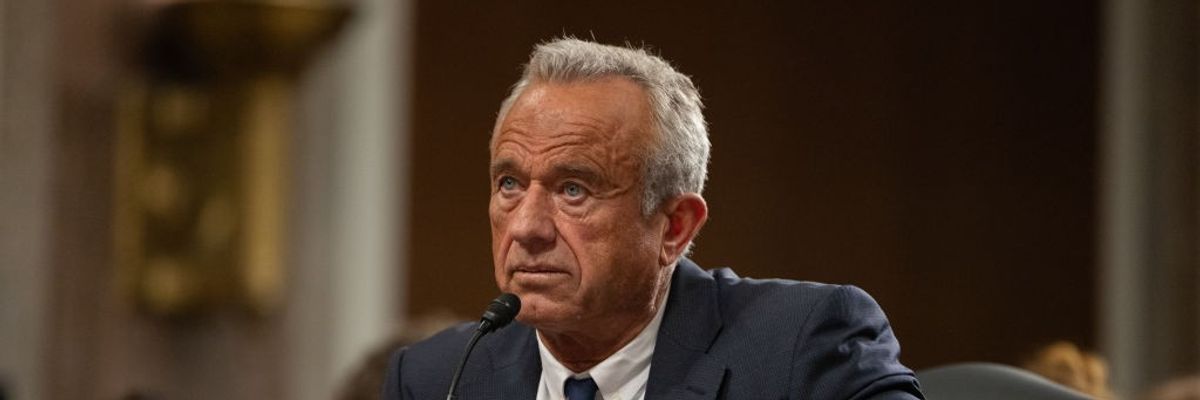
Robert F. Kennedy Jr., President Donald Trump's nominee to be secretary of the Health and Human Services Department, testifies in front of the Senate Finance Committee on January 29, 2025.
"Will you defend the law in the Inflation Reduction Act which already is negotiating prescription drug prices?" Sen. Bernie Sanders asked Kennedy during his second confirmation hearing.
Senate Democrats and Independent Sen. Bernie Sanders on Thursday pressed Robert F. Kennedy Jr., President Donald Trump's pick to lead the Health and Human Services Department, to pledge that the new administration won't give in to the pharmaceutical industry's attacks on a popular Medicare drug price negotiation program that has already yielded significant results.
Sanders raised the matter during Kennedy's confirmation hearing before the Senate Health, Education, Labor, and Pensions Committee, on which the Vermont senator serves as the ranking member.
"Will you defend the law in the Inflation Reduction Act which already is negotiating prescription drug prices?" Sanders asked, referring to the Biden-era measure that empowered Medicare to negotiate the prices of a select number of prescription drugs directly with pharmaceutical companies.
Declining to provide a yes or no answer to Sanders' question, Kennedy replied that "President Trump wants us to negotiate drug prices" and added that, if confirmed as Health and Human Services (HHS) secretary, he would "comply with the laws."
Watch:
The exchange came after the Centers for Medicare and Medicaid Services (CMS), an agency within HHS, issued a statement Wednesday declaring that "lowering the cost of prescription drugs for Americans is a top priority of President Trump and his administration" and expressing commitment to "incorporating lessons learned to date from the [Inflation Reduction Act] program and to considering opportunities to bring greater transparency in the negotiation program."
"CMS intends to provide opportunities for stakeholders to provide specific ideas to improve the negotiation program, consistent with the goals of achieving greater value for beneficiaries and taxpayers and continuing to foster innovation," the agency added.
While some advocates for lower drug prices cautiously welcomed the CMS statement, Senate Democrats warned Thursday that its choice of language "appeared to open the door to Big Pharma's requests."
"If confirmed as secretary, you will be under tremendous pressure to cave to Big Pharma and undermine Medicare drug price negotiation Republicans have worked in lock-step with Big Pharma by relentlessly attacking Medicare drug price negotiation at every turn," a group of 12 Senate Democrats and Sanders wrote in a letter to Kennedy. "Now, Republicans have unified control of the federal government. They will undoubtedly try to leverage this power to walk back the progress Democrats made to lower drug prices through this important new authority."
The letter pushes Kennedy to answer a number of questions related to the drug price negotiation program, including whether he would recommend that the Trump administration defend the program from the pharmaceutical industry's ongoing legal assault.
"On behalf of the tens of millions of Americans who count on Medicare," the new letter states, "Democrats on the Senate Finance Committee want to know whether the Trump administration will follow through on negotiating with Big Pharma to deliver the lower costs promised to the American people."
After Trump announced his intent to nominate Kennedy as HHS chief late last year, the pharmaceutical lobby made clear its plan to push the new administration to undercut the price negotiation program that is poised to deliver billions of dollars in savings by bringing down the prices of expensive and widely used medications.
Earlier this month, the CEO of pharmaceutical giant Eli Lilly said his company and other drugmakers would ask the Trump administration to pause the price-negotiation program, claiming that "they need to fix it" before proceeding to talks over the next slate of 15 drugs selected in the final days of the Biden administration.
In their letter on Thursday, the senators demanded that Kennedy "confirm in writing" that he "will follow the law and reject
Big Pharma's request to pause Medicare drug price negotiation."
Dear Common Dreams reader, It’s been nearly 30 years since I co-founded Common Dreams with my late wife, Lina Newhouser. We had the radical notion that journalism should serve the public good, not corporate profits. It was clear to us from the outset what it would take to build such a project. No paid advertisements. No corporate sponsors. No millionaire publisher telling us what to think or do. Many people said we wouldn't last a year, but we proved those doubters wrong. Together with a tremendous team of journalists and dedicated staff, we built an independent media outlet free from the constraints of profits and corporate control. Our mission has always been simple: To inform. To inspire. To ignite change for the common good. Building Common Dreams was not easy. Our survival was never guaranteed. When you take on the most powerful forces—Wall Street greed, fossil fuel industry destruction, Big Tech lobbyists, and uber-rich oligarchs who have spent billions upon billions rigging the economy and democracy in their favor—the only bulwark you have is supporters who believe in your work. But here’s the urgent message from me today. It's never been this bad out there. And it's never been this hard to keep us going. At the very moment Common Dreams is most needed, the threats we face are intensifying. We need your support now more than ever. We don't accept corporate advertising and never will. We don't have a paywall because we don't think people should be blocked from critical news based on their ability to pay. Everything we do is funded by the donations of readers like you. When everyone does the little they can afford, we are strong. But if that support retreats or dries up, so do we. Will you donate now to make sure Common Dreams not only survives but thrives? —Craig Brown, Co-founder |
Senate Democrats and Independent Sen. Bernie Sanders on Thursday pressed Robert F. Kennedy Jr., President Donald Trump's pick to lead the Health and Human Services Department, to pledge that the new administration won't give in to the pharmaceutical industry's attacks on a popular Medicare drug price negotiation program that has already yielded significant results.
Sanders raised the matter during Kennedy's confirmation hearing before the Senate Health, Education, Labor, and Pensions Committee, on which the Vermont senator serves as the ranking member.
"Will you defend the law in the Inflation Reduction Act which already is negotiating prescription drug prices?" Sanders asked, referring to the Biden-era measure that empowered Medicare to negotiate the prices of a select number of prescription drugs directly with pharmaceutical companies.
Declining to provide a yes or no answer to Sanders' question, Kennedy replied that "President Trump wants us to negotiate drug prices" and added that, if confirmed as Health and Human Services (HHS) secretary, he would "comply with the laws."
Watch:
The exchange came after the Centers for Medicare and Medicaid Services (CMS), an agency within HHS, issued a statement Wednesday declaring that "lowering the cost of prescription drugs for Americans is a top priority of President Trump and his administration" and expressing commitment to "incorporating lessons learned to date from the [Inflation Reduction Act] program and to considering opportunities to bring greater transparency in the negotiation program."
"CMS intends to provide opportunities for stakeholders to provide specific ideas to improve the negotiation program, consistent with the goals of achieving greater value for beneficiaries and taxpayers and continuing to foster innovation," the agency added.
While some advocates for lower drug prices cautiously welcomed the CMS statement, Senate Democrats warned Thursday that its choice of language "appeared to open the door to Big Pharma's requests."
"If confirmed as secretary, you will be under tremendous pressure to cave to Big Pharma and undermine Medicare drug price negotiation Republicans have worked in lock-step with Big Pharma by relentlessly attacking Medicare drug price negotiation at every turn," a group of 12 Senate Democrats and Sanders wrote in a letter to Kennedy. "Now, Republicans have unified control of the federal government. They will undoubtedly try to leverage this power to walk back the progress Democrats made to lower drug prices through this important new authority."
The letter pushes Kennedy to answer a number of questions related to the drug price negotiation program, including whether he would recommend that the Trump administration defend the program from the pharmaceutical industry's ongoing legal assault.
"On behalf of the tens of millions of Americans who count on Medicare," the new letter states, "Democrats on the Senate Finance Committee want to know whether the Trump administration will follow through on negotiating with Big Pharma to deliver the lower costs promised to the American people."
After Trump announced his intent to nominate Kennedy as HHS chief late last year, the pharmaceutical lobby made clear its plan to push the new administration to undercut the price negotiation program that is poised to deliver billions of dollars in savings by bringing down the prices of expensive and widely used medications.
Earlier this month, the CEO of pharmaceutical giant Eli Lilly said his company and other drugmakers would ask the Trump administration to pause the price-negotiation program, claiming that "they need to fix it" before proceeding to talks over the next slate of 15 drugs selected in the final days of the Biden administration.
In their letter on Thursday, the senators demanded that Kennedy "confirm in writing" that he "will follow the law and reject
Big Pharma's request to pause Medicare drug price negotiation."
Senate Democrats and Independent Sen. Bernie Sanders on Thursday pressed Robert F. Kennedy Jr., President Donald Trump's pick to lead the Health and Human Services Department, to pledge that the new administration won't give in to the pharmaceutical industry's attacks on a popular Medicare drug price negotiation program that has already yielded significant results.
Sanders raised the matter during Kennedy's confirmation hearing before the Senate Health, Education, Labor, and Pensions Committee, on which the Vermont senator serves as the ranking member.
"Will you defend the law in the Inflation Reduction Act which already is negotiating prescription drug prices?" Sanders asked, referring to the Biden-era measure that empowered Medicare to negotiate the prices of a select number of prescription drugs directly with pharmaceutical companies.
Declining to provide a yes or no answer to Sanders' question, Kennedy replied that "President Trump wants us to negotiate drug prices" and added that, if confirmed as Health and Human Services (HHS) secretary, he would "comply with the laws."
Watch:
The exchange came after the Centers for Medicare and Medicaid Services (CMS), an agency within HHS, issued a statement Wednesday declaring that "lowering the cost of prescription drugs for Americans is a top priority of President Trump and his administration" and expressing commitment to "incorporating lessons learned to date from the [Inflation Reduction Act] program and to considering opportunities to bring greater transparency in the negotiation program."
"CMS intends to provide opportunities for stakeholders to provide specific ideas to improve the negotiation program, consistent with the goals of achieving greater value for beneficiaries and taxpayers and continuing to foster innovation," the agency added.
While some advocates for lower drug prices cautiously welcomed the CMS statement, Senate Democrats warned Thursday that its choice of language "appeared to open the door to Big Pharma's requests."
"If confirmed as secretary, you will be under tremendous pressure to cave to Big Pharma and undermine Medicare drug price negotiation Republicans have worked in lock-step with Big Pharma by relentlessly attacking Medicare drug price negotiation at every turn," a group of 12 Senate Democrats and Sanders wrote in a letter to Kennedy. "Now, Republicans have unified control of the federal government. They will undoubtedly try to leverage this power to walk back the progress Democrats made to lower drug prices through this important new authority."
The letter pushes Kennedy to answer a number of questions related to the drug price negotiation program, including whether he would recommend that the Trump administration defend the program from the pharmaceutical industry's ongoing legal assault.
"On behalf of the tens of millions of Americans who count on Medicare," the new letter states, "Democrats on the Senate Finance Committee want to know whether the Trump administration will follow through on negotiating with Big Pharma to deliver the lower costs promised to the American people."
After Trump announced his intent to nominate Kennedy as HHS chief late last year, the pharmaceutical lobby made clear its plan to push the new administration to undercut the price negotiation program that is poised to deliver billions of dollars in savings by bringing down the prices of expensive and widely used medications.
Earlier this month, the CEO of pharmaceutical giant Eli Lilly said his company and other drugmakers would ask the Trump administration to pause the price-negotiation program, claiming that "they need to fix it" before proceeding to talks over the next slate of 15 drugs selected in the final days of the Biden administration.
In their letter on Thursday, the senators demanded that Kennedy "confirm in writing" that he "will follow the law and reject
Big Pharma's request to pause Medicare drug price negotiation."