

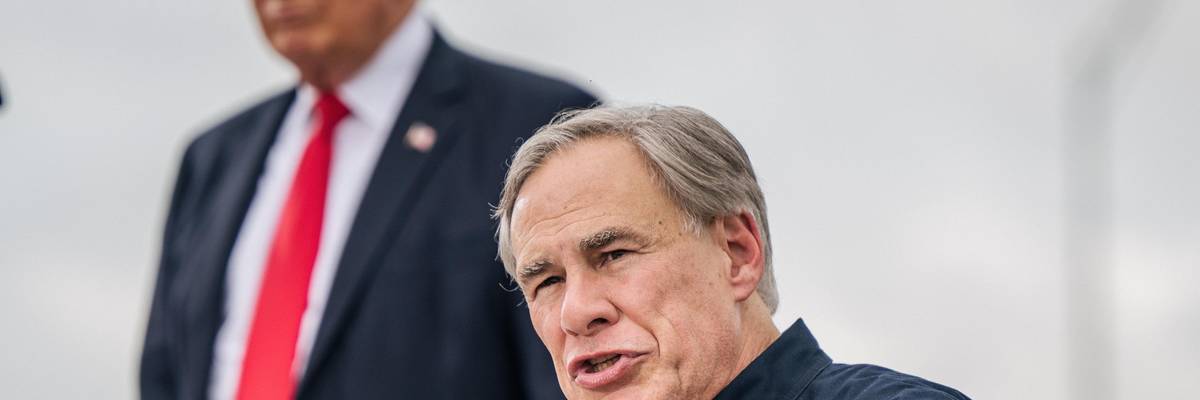
Texas Gov. Greg Abbott speaks alongside former President Donald Trump on June 30, 2021 in Pharr, Texas
State Republicans Have Introduced Nearly 200 'Election Subversion' Bills This Year
"The decisions being made in statehouses this year and next will help determine how the 2024 election is conducted," a new report warns.
Republican legislators in more than three dozen states have introduced nearly 200 bills this year that would make it easier for them to rig electoral outcomes, according to a report published Thursday.
A Democracy Crisis in the Making—compiled by the States United Democracy Center, Protect Democracy, and Law Forward—found that right-wing lawmakers in 38 states unveiled 185 bills from January 1 through May 3 that would enable legislatures to "politicize, criminalize, or interfere with elections." Of those proposals, 15 were enacted or adopted into law in 11 states while three others were vetoed by Arizona's new Democratic governor, Katie Hobbs.
Thursday's report—the latest update of an analysis originally published two years ago—makes clear that "the subversion threat is very much still alive." The number of "election subversion" bills introduced during the first four months of 2023 is roughly on par with the hundreds put forward in the early months of 2021 and 2022. Eventually, 56 of those anti-democratic proposals from the past two years became law in 26 states.
"Legislators are trying to make it harder for trusted election officials to do their jobs, and easier for partisan politicians to overturn the will of the voters."
Since former President Donald Trump launched his deadly coup attempt following his loss in the 2020 presidential contest, GOP-controlled states have enacted dozens of voter suppression laws and redrawn congressional and state legislative maps in ways that disenfranchise Democratic-leaning communities of color and give Republicans outsized representation, which could help the far-right secure minority rule for years to come.
In addition to impeding ballot access, Republican lawmakers are further undermining the country's procedural democracy by obstructing the administration of free and fair elections, the new report notes.
Researchers identified five forms of interference that increase the risk of "election subversion," which they defined as instances when "the declared outcome of an election does not reflect the true choice of the voters." The methods are:
- Usurping control over election results (three new bills introduced as of May 3);
- Requiring partisan or unprofessional election "audits" or reviews (25);
- Seizing power over election responsibilities (31);
- Creating unworkable burdens in election administration (104); and
- Imposing disproportionate criminal or other penalties (73).
"Legislators are trying to make it harder for trusted election officials to do their jobs, and easier for partisan politicians to overturn the will of the voters. While many may think this threat abated after the midterms, it most certainly did not," Maya Ingram, a senior policy development counsel at the States United Democracy Center, told NBC News on Thursday. "In fact, legislators are coming up with new ways to interfere with elections."
Several Republican candidates who parroted Trump's incessant lies about President Joe Biden's 2020 victory lost in last year's midterms. But more than 210 others—including at least two who participated in the January 6 rally that descended into an attack on the U.S. Capitol—won congressional seats and races for governor, secretary of state, and attorney general, underscoring how election denialism is now entrenched in the GOP and poses a threat to U.S. democracy for the foreseeable future.
"The decisions being made in statehouses this year and next will help determine how the 2024 election is conducted," the report warns. "Many of these bills are designed to inject confusion and delays into the election process, which increases the likelihood of attempted subversion and can give rise to disinformation, further eroding public trust and confidence in election results."
"Although a few of the bills that we have tracked would explicitly allow state legislatures or other actors to overturn the will of voters—what we sometimes refer to as direct subversion—the vast majority do not," says the report. "Bills that indirectly make subversion more likely are far more prevalent. A more probable scenario is a relatively close election, followed by efforts to create confusion and doubt about the results. Partisan actors could then claim that the true will of the voters cannot be determined, and engineer the outcome of their choice."
Nevertheless, "this legislative session has seen an increase in bills pushed by election deniers that would nullify election results if certain conditions are met," the report continues. "These bills are closely related to some of the direct subversion bills that we've seen in the past, in that they would allow the will of the voters to be disregarded."
NBC News summarized how two pieces of recently unveiled legislation could wreak havoc:
Republican legislators in Texas proposed a bill—H.B. 5082—that would give state officials the authority to order new elections in counties whose populations exceed 1 million people if there is "good cause" to conclude that 2% of polling places ran out of ballots and did not receive replacements. Such counties—like Harris County, which includes Houston—are home to a large share of the state's Democratic voters.
Arizona Republicans introduced a bill—H.B. 2078—that would, if it is enacted, allow candidates, political party county chairs, and certain ballot measure state committees to request post-election investigations that, under the law, would result in audits by the secretary of state.
While such audits should, in theory, be straightforward affairs, critics of the Arizona bill, and bills like it, note that election deniers were on the ballot in secretary of state races last year in 12 states—including Mark Finchem in Arizona. While Finchem lost, the scenario prompted enormous concerns about how such an audit might be conducted with an election denier overseeing it.
"The decisions that states make today will determine how elections are run in 2024," Ingram told the outlet. "Even when these bills don't become law, they keep lies and conspiracy theories alive and sustain the election denier movement."
According to a survey conducted in early 2022 by the Brennan Center for Justice, one in six election officials nationwide have experienced threats related to their job, and 77% say they feel such threats have increased in recent years. This spring, the Brennan Center found that 11% of current election officials are "very or somewhat likely" to step down before November 2024.
The new report urges voters to "be awake" to the "persistent threat" of election subversion and calls on state legislatures to "focus their efforts on the nonpartisan administration of elections, protecting election officials, and respecting the will of the people."
"Until they do," it warns, "our democracy is still far too close to a crisis."
We are at a crossroads
This country and this world are at a monumental crossroads. In a few short weeks, US voters will have an opportunity to beat back the forces of fascism and confront the billionaires who are rigging the economy, our media system, and our democracy, making it increasingly impossible for ordinary people to get by. We’re not just talking about the election. We’re talking about what must be done once these fascist elements are vanquished from power. We need a bolder set of solutions than what either major party has so far been willing to offer and a working-class movement ready to fight like hell for it. Trump didn't emerge from nowhere. The conditions that fueled MAGA authoritarianism were created by decades of radical neoliberal economic policies and a corrupt political system dominated by corporate interests. They slashed taxes on the super-rich, promising that the benefits would trickle down. They said giveaways to the corporate titans would make life more affordable for the rest of us. It was all bullshit. And when a bitter, betrayed populace searches for someone to blame, right-wing demagogues have little trouble finding scapegoats. People know when they're being lied to, but you won't hear any of this from the corporate media. Only independent journalism—powered and funded by people who believe in building a better world—can deliver truly trustworthy daily news. Our Fall Campaign is underway, and we need your help. To power our newsroom through the rest of the year, we need to raise $125,000 by midnight on October 31. So if you share our vision, please contribute whatever you can to sustain our work. |
Republican legislators in more than three dozen states have introduced nearly 200 bills this year that would make it easier for them to rig electoral outcomes, according to a report published Thursday.
A Democracy Crisis in the Making—compiled by the States United Democracy Center, Protect Democracy, and Law Forward—found that right-wing lawmakers in 38 states unveiled 185 bills from January 1 through May 3 that would enable legislatures to "politicize, criminalize, or interfere with elections." Of those proposals, 15 were enacted or adopted into law in 11 states while three others were vetoed by Arizona's new Democratic governor, Katie Hobbs.
Thursday's report—the latest update of an analysis originally published two years ago—makes clear that "the subversion threat is very much still alive." The number of "election subversion" bills introduced during the first four months of 2023 is roughly on par with the hundreds put forward in the early months of 2021 and 2022. Eventually, 56 of those anti-democratic proposals from the past two years became law in 26 states.
"Legislators are trying to make it harder for trusted election officials to do their jobs, and easier for partisan politicians to overturn the will of the voters."
Since former President Donald Trump launched his deadly coup attempt following his loss in the 2020 presidential contest, GOP-controlled states have enacted dozens of voter suppression laws and redrawn congressional and state legislative maps in ways that disenfranchise Democratic-leaning communities of color and give Republicans outsized representation, which could help the far-right secure minority rule for years to come.
In addition to impeding ballot access, Republican lawmakers are further undermining the country's procedural democracy by obstructing the administration of free and fair elections, the new report notes.
Researchers identified five forms of interference that increase the risk of "election subversion," which they defined as instances when "the declared outcome of an election does not reflect the true choice of the voters." The methods are:
- Usurping control over election results (three new bills introduced as of May 3);
- Requiring partisan or unprofessional election "audits" or reviews (25);
- Seizing power over election responsibilities (31);
- Creating unworkable burdens in election administration (104); and
- Imposing disproportionate criminal or other penalties (73).
"Legislators are trying to make it harder for trusted election officials to do their jobs, and easier for partisan politicians to overturn the will of the voters. While many may think this threat abated after the midterms, it most certainly did not," Maya Ingram, a senior policy development counsel at the States United Democracy Center, told NBC News on Thursday. "In fact, legislators are coming up with new ways to interfere with elections."
Several Republican candidates who parroted Trump's incessant lies about President Joe Biden's 2020 victory lost in last year's midterms. But more than 210 others—including at least two who participated in the January 6 rally that descended into an attack on the U.S. Capitol—won congressional seats and races for governor, secretary of state, and attorney general, underscoring how election denialism is now entrenched in the GOP and poses a threat to U.S. democracy for the foreseeable future.
"The decisions being made in statehouses this year and next will help determine how the 2024 election is conducted," the report warns. "Many of these bills are designed to inject confusion and delays into the election process, which increases the likelihood of attempted subversion and can give rise to disinformation, further eroding public trust and confidence in election results."
"Although a few of the bills that we have tracked would explicitly allow state legislatures or other actors to overturn the will of voters—what we sometimes refer to as direct subversion—the vast majority do not," says the report. "Bills that indirectly make subversion more likely are far more prevalent. A more probable scenario is a relatively close election, followed by efforts to create confusion and doubt about the results. Partisan actors could then claim that the true will of the voters cannot be determined, and engineer the outcome of their choice."
Nevertheless, "this legislative session has seen an increase in bills pushed by election deniers that would nullify election results if certain conditions are met," the report continues. "These bills are closely related to some of the direct subversion bills that we've seen in the past, in that they would allow the will of the voters to be disregarded."
NBC News summarized how two pieces of recently unveiled legislation could wreak havoc:
Republican legislators in Texas proposed a bill—H.B. 5082—that would give state officials the authority to order new elections in counties whose populations exceed 1 million people if there is "good cause" to conclude that 2% of polling places ran out of ballots and did not receive replacements. Such counties—like Harris County, which includes Houston—are home to a large share of the state's Democratic voters.
Arizona Republicans introduced a bill—H.B. 2078—that would, if it is enacted, allow candidates, political party county chairs, and certain ballot measure state committees to request post-election investigations that, under the law, would result in audits by the secretary of state.
While such audits should, in theory, be straightforward affairs, critics of the Arizona bill, and bills like it, note that election deniers were on the ballot in secretary of state races last year in 12 states—including Mark Finchem in Arizona. While Finchem lost, the scenario prompted enormous concerns about how such an audit might be conducted with an election denier overseeing it.
"The decisions that states make today will determine how elections are run in 2024," Ingram told the outlet. "Even when these bills don't become law, they keep lies and conspiracy theories alive and sustain the election denier movement."
According to a survey conducted in early 2022 by the Brennan Center for Justice, one in six election officials nationwide have experienced threats related to their job, and 77% say they feel such threats have increased in recent years. This spring, the Brennan Center found that 11% of current election officials are "very or somewhat likely" to step down before November 2024.
The new report urges voters to "be awake" to the "persistent threat" of election subversion and calls on state legislatures to "focus their efforts on the nonpartisan administration of elections, protecting election officials, and respecting the will of the people."
"Until they do," it warns, "our democracy is still far too close to a crisis."
- Texas GOP Passes Bills Allowing Abbott Appointee to Take Over Democratic County's Elections ›
- Opinion | Beyond Indicting Trump, We Must Do More to Protect Our Democracy From Election Lies | Common Dreams ›
- Opinion | Fighting Back Against Texas’s Voter Suppression Law | Common Dreams ›
Republican legislators in more than three dozen states have introduced nearly 200 bills this year that would make it easier for them to rig electoral outcomes, according to a report published Thursday.
A Democracy Crisis in the Making—compiled by the States United Democracy Center, Protect Democracy, and Law Forward—found that right-wing lawmakers in 38 states unveiled 185 bills from January 1 through May 3 that would enable legislatures to "politicize, criminalize, or interfere with elections." Of those proposals, 15 were enacted or adopted into law in 11 states while three others were vetoed by Arizona's new Democratic governor, Katie Hobbs.
Thursday's report—the latest update of an analysis originally published two years ago—makes clear that "the subversion threat is very much still alive." The number of "election subversion" bills introduced during the first four months of 2023 is roughly on par with the hundreds put forward in the early months of 2021 and 2022. Eventually, 56 of those anti-democratic proposals from the past two years became law in 26 states.
"Legislators are trying to make it harder for trusted election officials to do their jobs, and easier for partisan politicians to overturn the will of the voters."
Since former President Donald Trump launched his deadly coup attempt following his loss in the 2020 presidential contest, GOP-controlled states have enacted dozens of voter suppression laws and redrawn congressional and state legislative maps in ways that disenfranchise Democratic-leaning communities of color and give Republicans outsized representation, which could help the far-right secure minority rule for years to come.
In addition to impeding ballot access, Republican lawmakers are further undermining the country's procedural democracy by obstructing the administration of free and fair elections, the new report notes.
Researchers identified five forms of interference that increase the risk of "election subversion," which they defined as instances when "the declared outcome of an election does not reflect the true choice of the voters." The methods are:
- Usurping control over election results (three new bills introduced as of May 3);
- Requiring partisan or unprofessional election "audits" or reviews (25);
- Seizing power over election responsibilities (31);
- Creating unworkable burdens in election administration (104); and
- Imposing disproportionate criminal or other penalties (73).
"Legislators are trying to make it harder for trusted election officials to do their jobs, and easier for partisan politicians to overturn the will of the voters. While many may think this threat abated after the midterms, it most certainly did not," Maya Ingram, a senior policy development counsel at the States United Democracy Center, told NBC News on Thursday. "In fact, legislators are coming up with new ways to interfere with elections."
Several Republican candidates who parroted Trump's incessant lies about President Joe Biden's 2020 victory lost in last year's midterms. But more than 210 others—including at least two who participated in the January 6 rally that descended into an attack on the U.S. Capitol—won congressional seats and races for governor, secretary of state, and attorney general, underscoring how election denialism is now entrenched in the GOP and poses a threat to U.S. democracy for the foreseeable future.
"The decisions being made in statehouses this year and next will help determine how the 2024 election is conducted," the report warns. "Many of these bills are designed to inject confusion and delays into the election process, which increases the likelihood of attempted subversion and can give rise to disinformation, further eroding public trust and confidence in election results."
"Although a few of the bills that we have tracked would explicitly allow state legislatures or other actors to overturn the will of voters—what we sometimes refer to as direct subversion—the vast majority do not," says the report. "Bills that indirectly make subversion more likely are far more prevalent. A more probable scenario is a relatively close election, followed by efforts to create confusion and doubt about the results. Partisan actors could then claim that the true will of the voters cannot be determined, and engineer the outcome of their choice."
Nevertheless, "this legislative session has seen an increase in bills pushed by election deniers that would nullify election results if certain conditions are met," the report continues. "These bills are closely related to some of the direct subversion bills that we've seen in the past, in that they would allow the will of the voters to be disregarded."
NBC News summarized how two pieces of recently unveiled legislation could wreak havoc:
Republican legislators in Texas proposed a bill—H.B. 5082—that would give state officials the authority to order new elections in counties whose populations exceed 1 million people if there is "good cause" to conclude that 2% of polling places ran out of ballots and did not receive replacements. Such counties—like Harris County, which includes Houston—are home to a large share of the state's Democratic voters.
Arizona Republicans introduced a bill—H.B. 2078—that would, if it is enacted, allow candidates, political party county chairs, and certain ballot measure state committees to request post-election investigations that, under the law, would result in audits by the secretary of state.
While such audits should, in theory, be straightforward affairs, critics of the Arizona bill, and bills like it, note that election deniers were on the ballot in secretary of state races last year in 12 states—including Mark Finchem in Arizona. While Finchem lost, the scenario prompted enormous concerns about how such an audit might be conducted with an election denier overseeing it.
"The decisions that states make today will determine how elections are run in 2024," Ingram told the outlet. "Even when these bills don't become law, they keep lies and conspiracy theories alive and sustain the election denier movement."
According to a survey conducted in early 2022 by the Brennan Center for Justice, one in six election officials nationwide have experienced threats related to their job, and 77% say they feel such threats have increased in recent years. This spring, the Brennan Center found that 11% of current election officials are "very or somewhat likely" to step down before November 2024.
The new report urges voters to "be awake" to the "persistent threat" of election subversion and calls on state legislatures to "focus their efforts on the nonpartisan administration of elections, protecting election officials, and respecting the will of the people."
"Until they do," it warns, "our democracy is still far too close to a crisis."
- Texas GOP Passes Bills Allowing Abbott Appointee to Take Over Democratic County's Elections ›
- Opinion | Beyond Indicting Trump, We Must Do More to Protect Our Democracy From Election Lies | Common Dreams ›
- Opinion | Fighting Back Against Texas’s Voter Suppression Law | Common Dreams ›