SUBSCRIBE TO OUR FREE NEWSLETTER
Daily news & progressive opinion—funded by the people, not the corporations—delivered straight to your inbox.
5
#000000
#FFFFFF
To donate by check, phone, or other method, see our More Ways to Give page.
Daily news & progressive opinion—funded by the people, not the corporations—delivered straight to your inbox.
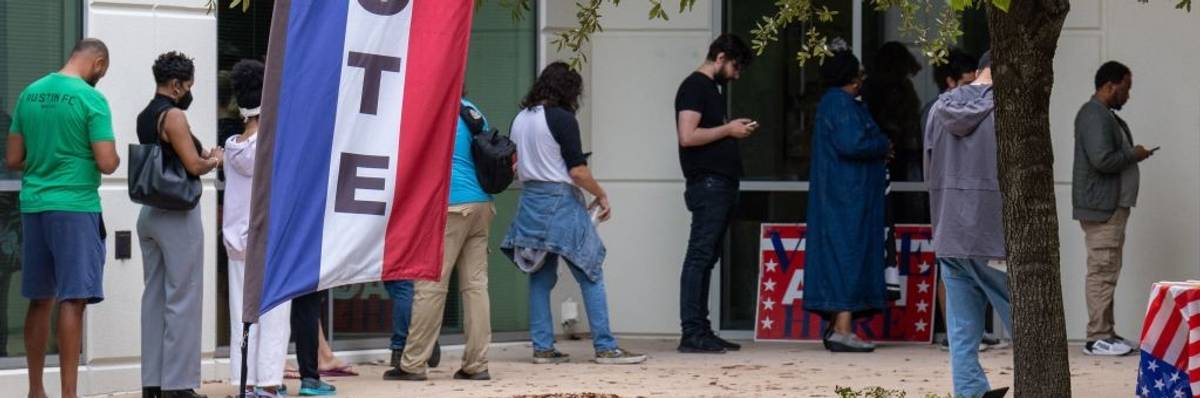
Voters wait to cast their ballots at the Disability Right Texas polling station on November 8, 2022 in Austin, Texas.
While SB1 is one of many antidemocracy laws enacted by 19 states in the year after the 2020 election, it stands out for its sheer number of restrictive and discriminatory provisions, which largely target Latino and Black voters.
Trial began Monday in a major federal lawsuit challenging a wide-ranging and discriminatory voter suppression law Texas enacted in 2021. The Brennan Center, the Mexican American Legal Defense and Educational Fund, and our other co-counsel represent a wide swath of Texans, including election administrators, community groups, civil rights and voting organizations, and faith-based groups. Over the course of the trial, we will show how Senate Bill 1 violates the Constitution, the Voting Rights Act, and the Americans with Disabilities Act.
While SB1 is one of many antidemocracy laws enacted by 19 states in the year after the 2020 election, it stands out for its sheer number of restrictive and discriminatory provisions, which largely target Latino and Black voters. This is likely the only challenge to such an extensive restrictive voting law that will go to trial between now and the 2024 election.
Among its host of restrictive provisions, the law establishes onerous new rules for voting by mail and curbs voter outreach activities. It also hinders voting assistance for people with language barriers or disabilities and restricts election officials’ and judges’ ability to protect voters from harassment by poll watchers. Like the dozens of restrictive state voting laws that have been enacted nationwide in the last three years, SB1’s proponents claim that it is intended to fight voter fraud. Indeed, its myriad provisions appear to respond directly to baseless claims peddled by Donald Trump and his fellow election deniers about the security of mail-in voting and election administration.
In a state that was already the toughest in the nation to register and vote, Texans now have an even harder time staying on the voter rolls, casting their ballots, and ensuring their ballots are counted.
Yet Texas has never found evidence of widespread fraud—and not for lack of trying. Without the pretext of making elections more secure, SB1 is simply an unconstitutional effort to suppress eligible voters in marginalized communities. It seems no coincidence that after people of color surged in turnout in Texas’s 2018 and 2020 elections, the legislature passed a law that restricts methods of voting favored by Black and Latino voters and impairs voter assistance to those with limited English proficiency or limited literacy.
The plaintiffs in the case, LUPE v. Texas, can attest to the various ways SB1 has created obstacles to the ballot box that infringe on the constitutional right to vote. Voters of color have been disproportionately impacted by these burdens, violating their right to equal protection, the 15th Amendment’s protection against race-based disenfranchisement, and the Voting Rights Act. Our plaintiffs’ anecdotal experiences are backed by state voting records in the wake of the law’s enactment. Brennan Center research shows that just a single provision—which has recently been blocked by a judge—led to massive disenfranchisement with major racial disparities in Texas’s 2022 primaries.
The law’s new rules for mail-in voting required people to write the last four digits of their driver’s license number or social security number on their mail ballot application and mail ballot envelope. Officials had to reject an application or ballot if the number provided didn’t match the number on file in a voter’s registration record, even if that person was eligible to vote. These mismatches weren’t always the result of someone writing the number incorrectly but rather providing a correct number that didn’t coincide with the ID they used when they registered to vote—which could have been more than a decade ago. Tens of thousands of applications and mail ballots were tossed solely for having a missing or mismatched ID number, and nonwhite voters were at least 30% more likely than white voters to have their application or mail ballot rejected. A significant portion of those prevented from voting by mail ultimately didn’t vote at all.
Similarly, the law curtails the ability of people with disabilities or with limited English or literacy skills to get help voting, denying them the equal voting access and assistance they’re entitled to under the Americans with Disabilities Act and the Voting Rights Act. In particular, SB1 imposes new requirements and penalties for voter assisters that have deterred volunteers from aiding voters at the polls. It also makes it a crime to compensate or receive compensation for helping people vote by mail, which prohibits civic organizations from supporting community members who have trouble filling out the forms. Several witnesses will speak to how these provisions made it difficult for them to secure the help they needed to vote in the 2022 election.
Voters aren’t the only ones struggling under SB1. The law also targets election officials and poll workers, who are already facing a torrent of threats, harassment, and abuse. One provision makes it a crime for poll workers to “take any action” that would make a partisan poll watcher’s observation “not reasonably effective.” This unconstitutionally vague directive gives poll workers no clear sense of what they can and can’t do to stop poll watchers from harassing or intimidating voters, leaving poll workers fearful of being prosecuted just for doing their jobs. In the face of this uncertainty, some experienced poll workers have declined to sign up for future elections.
The heavy burdens that Texas’s law imposes at every stage of voting are becoming increasingly apparent. In a state that was already the toughest in the nation to register and vote, Texans now have an even harder time staying on the voter rolls, casting their ballots, and ensuring their ballots are counted. And in the two years since SB1’s enactment, state legislators around the country have continued to push legislation aimed at restricting voting access for Black, Latino, and vulnerable voters and making elections more susceptible to partisan meddling. Leaving these unconstitutional voter suppression measures unchallenged can only serve to spur further attacks on the freedom to vote in Texas and beyond.
Dear Common Dreams reader, It’s been nearly 30 years since I co-founded Common Dreams with my late wife, Lina Newhouser. We had the radical notion that journalism should serve the public good, not corporate profits. It was clear to us from the outset what it would take to build such a project. No paid advertisements. No corporate sponsors. No millionaire publisher telling us what to think or do. Many people said we wouldn't last a year, but we proved those doubters wrong. Together with a tremendous team of journalists and dedicated staff, we built an independent media outlet free from the constraints of profits and corporate control. Our mission has always been simple: To inform. To inspire. To ignite change for the common good. Building Common Dreams was not easy. Our survival was never guaranteed. When you take on the most powerful forces—Wall Street greed, fossil fuel industry destruction, Big Tech lobbyists, and uber-rich oligarchs who have spent billions upon billions rigging the economy and democracy in their favor—the only bulwark you have is supporters who believe in your work. But here’s the urgent message from me today. It's never been this bad out there. And it's never been this hard to keep us going. At the very moment Common Dreams is most needed, the threats we face are intensifying. We need your support now more than ever. We don't accept corporate advertising and never will. We don't have a paywall because we don't think people should be blocked from critical news based on their ability to pay. Everything we do is funded by the donations of readers like you. When everyone does the little they can afford, we are strong. But if that support retreats or dries up, so do we. Will you donate now to make sure Common Dreams not only survives but thrives? —Craig Brown, Co-founder |
Trial began Monday in a major federal lawsuit challenging a wide-ranging and discriminatory voter suppression law Texas enacted in 2021. The Brennan Center, the Mexican American Legal Defense and Educational Fund, and our other co-counsel represent a wide swath of Texans, including election administrators, community groups, civil rights and voting organizations, and faith-based groups. Over the course of the trial, we will show how Senate Bill 1 violates the Constitution, the Voting Rights Act, and the Americans with Disabilities Act.
While SB1 is one of many antidemocracy laws enacted by 19 states in the year after the 2020 election, it stands out for its sheer number of restrictive and discriminatory provisions, which largely target Latino and Black voters. This is likely the only challenge to such an extensive restrictive voting law that will go to trial between now and the 2024 election.
Among its host of restrictive provisions, the law establishes onerous new rules for voting by mail and curbs voter outreach activities. It also hinders voting assistance for people with language barriers or disabilities and restricts election officials’ and judges’ ability to protect voters from harassment by poll watchers. Like the dozens of restrictive state voting laws that have been enacted nationwide in the last three years, SB1’s proponents claim that it is intended to fight voter fraud. Indeed, its myriad provisions appear to respond directly to baseless claims peddled by Donald Trump and his fellow election deniers about the security of mail-in voting and election administration.
In a state that was already the toughest in the nation to register and vote, Texans now have an even harder time staying on the voter rolls, casting their ballots, and ensuring their ballots are counted.
Yet Texas has never found evidence of widespread fraud—and not for lack of trying. Without the pretext of making elections more secure, SB1 is simply an unconstitutional effort to suppress eligible voters in marginalized communities. It seems no coincidence that after people of color surged in turnout in Texas’s 2018 and 2020 elections, the legislature passed a law that restricts methods of voting favored by Black and Latino voters and impairs voter assistance to those with limited English proficiency or limited literacy.
The plaintiffs in the case, LUPE v. Texas, can attest to the various ways SB1 has created obstacles to the ballot box that infringe on the constitutional right to vote. Voters of color have been disproportionately impacted by these burdens, violating their right to equal protection, the 15th Amendment’s protection against race-based disenfranchisement, and the Voting Rights Act. Our plaintiffs’ anecdotal experiences are backed by state voting records in the wake of the law’s enactment. Brennan Center research shows that just a single provision—which has recently been blocked by a judge—led to massive disenfranchisement with major racial disparities in Texas’s 2022 primaries.
The law’s new rules for mail-in voting required people to write the last four digits of their driver’s license number or social security number on their mail ballot application and mail ballot envelope. Officials had to reject an application or ballot if the number provided didn’t match the number on file in a voter’s registration record, even if that person was eligible to vote. These mismatches weren’t always the result of someone writing the number incorrectly but rather providing a correct number that didn’t coincide with the ID they used when they registered to vote—which could have been more than a decade ago. Tens of thousands of applications and mail ballots were tossed solely for having a missing or mismatched ID number, and nonwhite voters were at least 30% more likely than white voters to have their application or mail ballot rejected. A significant portion of those prevented from voting by mail ultimately didn’t vote at all.
Similarly, the law curtails the ability of people with disabilities or with limited English or literacy skills to get help voting, denying them the equal voting access and assistance they’re entitled to under the Americans with Disabilities Act and the Voting Rights Act. In particular, SB1 imposes new requirements and penalties for voter assisters that have deterred volunteers from aiding voters at the polls. It also makes it a crime to compensate or receive compensation for helping people vote by mail, which prohibits civic organizations from supporting community members who have trouble filling out the forms. Several witnesses will speak to how these provisions made it difficult for them to secure the help they needed to vote in the 2022 election.
Voters aren’t the only ones struggling under SB1. The law also targets election officials and poll workers, who are already facing a torrent of threats, harassment, and abuse. One provision makes it a crime for poll workers to “take any action” that would make a partisan poll watcher’s observation “not reasonably effective.” This unconstitutionally vague directive gives poll workers no clear sense of what they can and can’t do to stop poll watchers from harassing or intimidating voters, leaving poll workers fearful of being prosecuted just for doing their jobs. In the face of this uncertainty, some experienced poll workers have declined to sign up for future elections.
The heavy burdens that Texas’s law imposes at every stage of voting are becoming increasingly apparent. In a state that was already the toughest in the nation to register and vote, Texans now have an even harder time staying on the voter rolls, casting their ballots, and ensuring their ballots are counted. And in the two years since SB1’s enactment, state legislators around the country have continued to push legislation aimed at restricting voting access for Black, Latino, and vulnerable voters and making elections more susceptible to partisan meddling. Leaving these unconstitutional voter suppression measures unchallenged can only serve to spur further attacks on the freedom to vote in Texas and beyond.
Trial began Monday in a major federal lawsuit challenging a wide-ranging and discriminatory voter suppression law Texas enacted in 2021. The Brennan Center, the Mexican American Legal Defense and Educational Fund, and our other co-counsel represent a wide swath of Texans, including election administrators, community groups, civil rights and voting organizations, and faith-based groups. Over the course of the trial, we will show how Senate Bill 1 violates the Constitution, the Voting Rights Act, and the Americans with Disabilities Act.
While SB1 is one of many antidemocracy laws enacted by 19 states in the year after the 2020 election, it stands out for its sheer number of restrictive and discriminatory provisions, which largely target Latino and Black voters. This is likely the only challenge to such an extensive restrictive voting law that will go to trial between now and the 2024 election.
Among its host of restrictive provisions, the law establishes onerous new rules for voting by mail and curbs voter outreach activities. It also hinders voting assistance for people with language barriers or disabilities and restricts election officials’ and judges’ ability to protect voters from harassment by poll watchers. Like the dozens of restrictive state voting laws that have been enacted nationwide in the last three years, SB1’s proponents claim that it is intended to fight voter fraud. Indeed, its myriad provisions appear to respond directly to baseless claims peddled by Donald Trump and his fellow election deniers about the security of mail-in voting and election administration.
In a state that was already the toughest in the nation to register and vote, Texans now have an even harder time staying on the voter rolls, casting their ballots, and ensuring their ballots are counted.
Yet Texas has never found evidence of widespread fraud—and not for lack of trying. Without the pretext of making elections more secure, SB1 is simply an unconstitutional effort to suppress eligible voters in marginalized communities. It seems no coincidence that after people of color surged in turnout in Texas’s 2018 and 2020 elections, the legislature passed a law that restricts methods of voting favored by Black and Latino voters and impairs voter assistance to those with limited English proficiency or limited literacy.
The plaintiffs in the case, LUPE v. Texas, can attest to the various ways SB1 has created obstacles to the ballot box that infringe on the constitutional right to vote. Voters of color have been disproportionately impacted by these burdens, violating their right to equal protection, the 15th Amendment’s protection against race-based disenfranchisement, and the Voting Rights Act. Our plaintiffs’ anecdotal experiences are backed by state voting records in the wake of the law’s enactment. Brennan Center research shows that just a single provision—which has recently been blocked by a judge—led to massive disenfranchisement with major racial disparities in Texas’s 2022 primaries.
The law’s new rules for mail-in voting required people to write the last four digits of their driver’s license number or social security number on their mail ballot application and mail ballot envelope. Officials had to reject an application or ballot if the number provided didn’t match the number on file in a voter’s registration record, even if that person was eligible to vote. These mismatches weren’t always the result of someone writing the number incorrectly but rather providing a correct number that didn’t coincide with the ID they used when they registered to vote—which could have been more than a decade ago. Tens of thousands of applications and mail ballots were tossed solely for having a missing or mismatched ID number, and nonwhite voters were at least 30% more likely than white voters to have their application or mail ballot rejected. A significant portion of those prevented from voting by mail ultimately didn’t vote at all.
Similarly, the law curtails the ability of people with disabilities or with limited English or literacy skills to get help voting, denying them the equal voting access and assistance they’re entitled to under the Americans with Disabilities Act and the Voting Rights Act. In particular, SB1 imposes new requirements and penalties for voter assisters that have deterred volunteers from aiding voters at the polls. It also makes it a crime to compensate or receive compensation for helping people vote by mail, which prohibits civic organizations from supporting community members who have trouble filling out the forms. Several witnesses will speak to how these provisions made it difficult for them to secure the help they needed to vote in the 2022 election.
Voters aren’t the only ones struggling under SB1. The law also targets election officials and poll workers, who are already facing a torrent of threats, harassment, and abuse. One provision makes it a crime for poll workers to “take any action” that would make a partisan poll watcher’s observation “not reasonably effective.” This unconstitutionally vague directive gives poll workers no clear sense of what they can and can’t do to stop poll watchers from harassing or intimidating voters, leaving poll workers fearful of being prosecuted just for doing their jobs. In the face of this uncertainty, some experienced poll workers have declined to sign up for future elections.
The heavy burdens that Texas’s law imposes at every stage of voting are becoming increasingly apparent. In a state that was already the toughest in the nation to register and vote, Texans now have an even harder time staying on the voter rolls, casting their ballots, and ensuring their ballots are counted. And in the two years since SB1’s enactment, state legislators around the country have continued to push legislation aimed at restricting voting access for Black, Latino, and vulnerable voters and making elections more susceptible to partisan meddling. Leaving these unconstitutional voter suppression measures unchallenged can only serve to spur further attacks on the freedom to vote in Texas and beyond.