SUBSCRIBE TO OUR FREE NEWSLETTER
Daily news & progressive opinion—funded by the people, not the corporations—delivered straight to your inbox.
5
#000000
#FFFFFF
To donate by check, phone, or other method, see our More Ways to Give page.
Daily news & progressive opinion—funded by the people, not the corporations—delivered straight to your inbox.
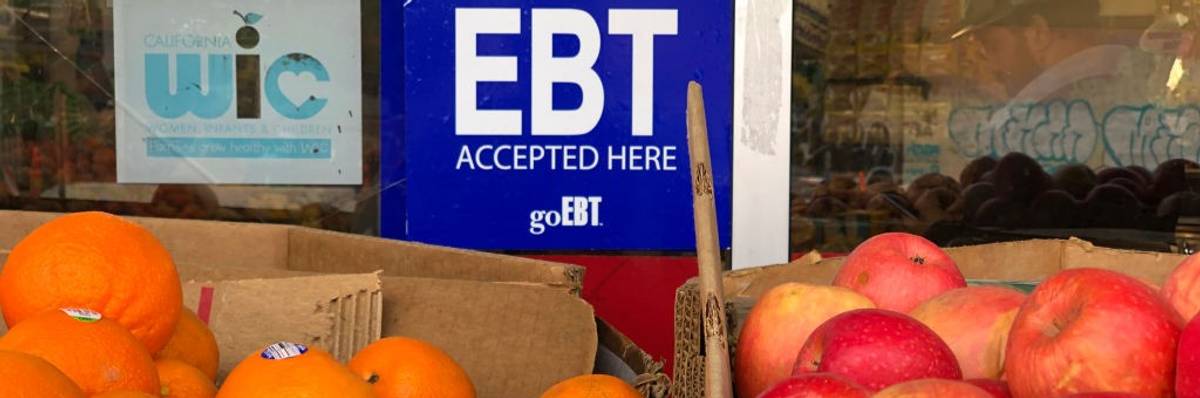
A sign at a grocery store in California notes the acceptance of electronic benefit transfer (EBT) cards that are used by governments to help feed low-income people.
"When the school year ends, millions of low-income children lose access to the school meals they depend on," an expert said.
An advocacy group on Tuesday published a report showing that only a fraction of children who receive free or reduced-price lunches during the school year get such benefits through United States Department of Agriculture programs in the summer, leaving many families with school-age children food insecure.
Only 15.3% of the number of children who receive subsidized school lunches received a summer meal in 2023, the last year for which data was available, the Food Research & Action Center (FRAC) report, Hunger Doesn't Take a Vacation, says. The findings highlight the difficulty of reaching children outside of school.
"When the school year ends, millions of low-income children lose access to the school meals they depend on," Kelsey Boone, a FRAC policy analyst and report co-author, told Common Dreams.
The report assesses the 2023 impact of two long-standing USDA programs that were rebranded this year under the name SUN Meals. The USDA also added two new summer meals programs this year, SUN Meals To-Go and SUN Bucks, the latter of which has been the subject of political controversy.
The SUN Bucks program provides a modest $120 per child for the summer to low-income families in electronic benefit transfers (EBTs), similar to the way food stamp money is distributed. The program is administered by states, territories, and tribes and is expected to bring $2.5 billion in grocery benefits to 21 million children this summer.
But it could reach even more children: 13 Republican-controlled states have opted out. They cite reasons including philosophical opposition to "welfare," other summer lunch programs already on offer in their states, and high administrative costs. All of the EBT money comes directly from the federal government, but states are required to pay 50% of the costs of running the program.
Democratic California Gov. Gavin Newsom's press office responded to news of the Republican opt-outs by writing on social media earlier this month that "California has fed over 3.2 million kids through summer meal programs while Republican states refuse free federal dollars."
Connecticut State Sen. Bob Duff, a Democrat, responded by writing, "Is being cruel part of the [Republican] party platform?"
In Florida, where the Republican administration opted out of SUN Bucks, families who could have benefited expressed disbelief.
Crystal Ripolio, a woman in Tallahassee who said she struggles to feed her 8-year-old daughter, told The Associated Press that her state should offer the same summer meal money that other states do.
"If other states are able to do it, why can't we?" she said, standing outside a food bank that happened to be near Republican Gov. Ron DeSantis' official residence in Tallahassee. "That doesn't make sense."
Some Republican-controlled states, such as Louisiana and Nebraska, initially declined to opt in but ultimately decided to do so. States that opted out of SUN Bucks in 2024 may enroll next year.
The USDA's other programs, including those addressed in the new report, face challenges that are not as explicitly political. Though the summer programs did reach 2.8 million children per day in 2023, logistical challenges abound.
"We believe that the low ratio of summer lunch to school year lunch is due to many factors including barriers to participation such as lack of transportation and lack of meal sites in a child's area and high area eligibility thresholds, meaning an open site (a site that serves all children that come to it regardless of income status) must be in an area where 50% or more of the population of children are eligible for free or reduced-price school lunch," Boone said.
"It is much easier to access meals when children are already at school," she added.
The FRAC report calls on Congress to allow more communities to offer summer meals and to let more sites operate year-round and provide three meals a day.
Dear Common Dreams reader, It’s been nearly 30 years since I co-founded Common Dreams with my late wife, Lina Newhouser. We had the radical notion that journalism should serve the public good, not corporate profits. It was clear to us from the outset what it would take to build such a project. No paid advertisements. No corporate sponsors. No millionaire publisher telling us what to think or do. Many people said we wouldn't last a year, but we proved those doubters wrong. Together with a tremendous team of journalists and dedicated staff, we built an independent media outlet free from the constraints of profits and corporate control. Our mission has always been simple: To inform. To inspire. To ignite change for the common good. Building Common Dreams was not easy. Our survival was never guaranteed. When you take on the most powerful forces—Wall Street greed, fossil fuel industry destruction, Big Tech lobbyists, and uber-rich oligarchs who have spent billions upon billions rigging the economy and democracy in their favor—the only bulwark you have is supporters who believe in your work. But here’s the urgent message from me today. It's never been this bad out there. And it's never been this hard to keep us going. At the very moment Common Dreams is most needed, the threats we face are intensifying. We need your support now more than ever. We don't accept corporate advertising and never will. We don't have a paywall because we don't think people should be blocked from critical news based on their ability to pay. Everything we do is funded by the donations of readers like you. When everyone does the little they can afford, we are strong. But if that support retreats or dries up, so do we. Will you donate now to make sure Common Dreams not only survives but thrives? —Craig Brown, Co-founder |
An advocacy group on Tuesday published a report showing that only a fraction of children who receive free or reduced-price lunches during the school year get such benefits through United States Department of Agriculture programs in the summer, leaving many families with school-age children food insecure.
Only 15.3% of the number of children who receive subsidized school lunches received a summer meal in 2023, the last year for which data was available, the Food Research & Action Center (FRAC) report, Hunger Doesn't Take a Vacation, says. The findings highlight the difficulty of reaching children outside of school.
"When the school year ends, millions of low-income children lose access to the school meals they depend on," Kelsey Boone, a FRAC policy analyst and report co-author, told Common Dreams.
The report assesses the 2023 impact of two long-standing USDA programs that were rebranded this year under the name SUN Meals. The USDA also added two new summer meals programs this year, SUN Meals To-Go and SUN Bucks, the latter of which has been the subject of political controversy.
The SUN Bucks program provides a modest $120 per child for the summer to low-income families in electronic benefit transfers (EBTs), similar to the way food stamp money is distributed. The program is administered by states, territories, and tribes and is expected to bring $2.5 billion in grocery benefits to 21 million children this summer.
But it could reach even more children: 13 Republican-controlled states have opted out. They cite reasons including philosophical opposition to "welfare," other summer lunch programs already on offer in their states, and high administrative costs. All of the EBT money comes directly from the federal government, but states are required to pay 50% of the costs of running the program.
Democratic California Gov. Gavin Newsom's press office responded to news of the Republican opt-outs by writing on social media earlier this month that "California has fed over 3.2 million kids through summer meal programs while Republican states refuse free federal dollars."
Connecticut State Sen. Bob Duff, a Democrat, responded by writing, "Is being cruel part of the [Republican] party platform?"
In Florida, where the Republican administration opted out of SUN Bucks, families who could have benefited expressed disbelief.
Crystal Ripolio, a woman in Tallahassee who said she struggles to feed her 8-year-old daughter, told The Associated Press that her state should offer the same summer meal money that other states do.
"If other states are able to do it, why can't we?" she said, standing outside a food bank that happened to be near Republican Gov. Ron DeSantis' official residence in Tallahassee. "That doesn't make sense."
Some Republican-controlled states, such as Louisiana and Nebraska, initially declined to opt in but ultimately decided to do so. States that opted out of SUN Bucks in 2024 may enroll next year.
The USDA's other programs, including those addressed in the new report, face challenges that are not as explicitly political. Though the summer programs did reach 2.8 million children per day in 2023, logistical challenges abound.
"We believe that the low ratio of summer lunch to school year lunch is due to many factors including barriers to participation such as lack of transportation and lack of meal sites in a child's area and high area eligibility thresholds, meaning an open site (a site that serves all children that come to it regardless of income status) must be in an area where 50% or more of the population of children are eligible for free or reduced-price school lunch," Boone said.
"It is much easier to access meals when children are already at school," she added.
The FRAC report calls on Congress to allow more communities to offer summer meals and to let more sites operate year-round and provide three meals a day.
An advocacy group on Tuesday published a report showing that only a fraction of children who receive free or reduced-price lunches during the school year get such benefits through United States Department of Agriculture programs in the summer, leaving many families with school-age children food insecure.
Only 15.3% of the number of children who receive subsidized school lunches received a summer meal in 2023, the last year for which data was available, the Food Research & Action Center (FRAC) report, Hunger Doesn't Take a Vacation, says. The findings highlight the difficulty of reaching children outside of school.
"When the school year ends, millions of low-income children lose access to the school meals they depend on," Kelsey Boone, a FRAC policy analyst and report co-author, told Common Dreams.
The report assesses the 2023 impact of two long-standing USDA programs that were rebranded this year under the name SUN Meals. The USDA also added two new summer meals programs this year, SUN Meals To-Go and SUN Bucks, the latter of which has been the subject of political controversy.
The SUN Bucks program provides a modest $120 per child for the summer to low-income families in electronic benefit transfers (EBTs), similar to the way food stamp money is distributed. The program is administered by states, territories, and tribes and is expected to bring $2.5 billion in grocery benefits to 21 million children this summer.
But it could reach even more children: 13 Republican-controlled states have opted out. They cite reasons including philosophical opposition to "welfare," other summer lunch programs already on offer in their states, and high administrative costs. All of the EBT money comes directly from the federal government, but states are required to pay 50% of the costs of running the program.
Democratic California Gov. Gavin Newsom's press office responded to news of the Republican opt-outs by writing on social media earlier this month that "California has fed over 3.2 million kids through summer meal programs while Republican states refuse free federal dollars."
Connecticut State Sen. Bob Duff, a Democrat, responded by writing, "Is being cruel part of the [Republican] party platform?"
In Florida, where the Republican administration opted out of SUN Bucks, families who could have benefited expressed disbelief.
Crystal Ripolio, a woman in Tallahassee who said she struggles to feed her 8-year-old daughter, told The Associated Press that her state should offer the same summer meal money that other states do.
"If other states are able to do it, why can't we?" she said, standing outside a food bank that happened to be near Republican Gov. Ron DeSantis' official residence in Tallahassee. "That doesn't make sense."
Some Republican-controlled states, such as Louisiana and Nebraska, initially declined to opt in but ultimately decided to do so. States that opted out of SUN Bucks in 2024 may enroll next year.
The USDA's other programs, including those addressed in the new report, face challenges that are not as explicitly political. Though the summer programs did reach 2.8 million children per day in 2023, logistical challenges abound.
"We believe that the low ratio of summer lunch to school year lunch is due to many factors including barriers to participation such as lack of transportation and lack of meal sites in a child's area and high area eligibility thresholds, meaning an open site (a site that serves all children that come to it regardless of income status) must be in an area where 50% or more of the population of children are eligible for free or reduced-price school lunch," Boone said.
"It is much easier to access meals when children are already at school," she added.
The FRAC report calls on Congress to allow more communities to offer summer meals and to let more sites operate year-round and provide three meals a day.