5
#000000
#FFFFFF
To donate by check, phone, or other method, see our More Ways to Give page.
Daily news & progressive opinion—funded by the people, not the corporations—delivered straight to your inbox.
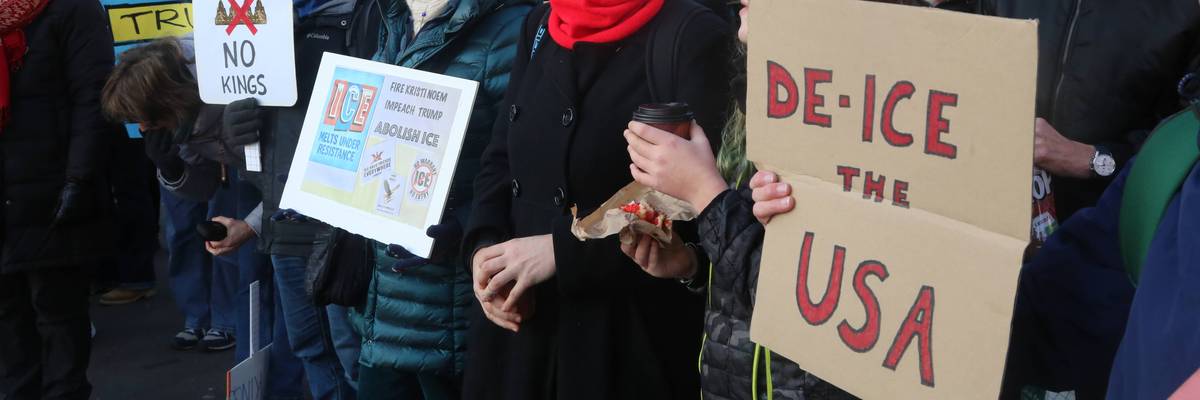
People hold various posters, including one that reads "DE-ICE THE USA," during a protest against US Immigration and Customs Enforcement on February 14, 2026 in Paris, France.
"Federal incentives to target and profile will harm immigrant communities and have spillover effects on other communities already targeted by local law enforcement impacting immigrants and citizens alike."
The US Department of Homeland Security is partially shut down due to a congressional funding fight, but armed with an extra $75 billion from last year's Republican budget package, Immigration and Customs Enforcement is not only expanding its concentration camp network but also working to deputize thousands of police officers across the country.
Two decades ago, Congress authorized the US attorney general to enter into agreements allowing local and state law enforcement officers to carry out certain immigration enforcement actions under section 287(g) of the Immigration and Nationality Act. A brief published Monday by the policy group FWD.us details how ICE is pumping money into "an old, and once rejected, idea—the 287(g) Task Force Model."
As NBC News—which first reported on the brief—noted Monday, the model "was discontinued by the Obama administration in 2012 in part over accusations of racial profiling by local officers in Maricopa County, Arizona, and Alamance County, North Carolina."
Pointing to Maricopa County Sheriff Joe Arpaio as an example, FWD.us president Todd Schulte said in a statement that "over a decade ago, we saw how deputizing local law enforcement to do immigration enforcement could result in disaster."
"Federal incentives to target and profile will harm immigrant communities and have spillover effects on other communities already targeted by local law enforcement impacting immigrants and citizens alike," Schulte warned.
Despite such warnings, the model has been embraced by both of President Donald Trump's administrations. During the Republican's first term—partly defined by his widely denounced forced separation of immigrant families at the southern border—there were approximately 150 total 287(g) agreements across the United States, according to FWD.us.
Trump lost reelection in 2020, and as he returned to power early last year, there were only about 135 agreements still in effect. The president had campaigned on a promise of mass deportations, and he's since tried to deliver on it by dispatching thousands of DHS agents to various US communities. Some recently targeted cities, such as Chicago and Minneapolis, officially prohibit local police from collaborating with ICE on civil enforcement, but FWD.us found 1,372 agreements across 1,169 agencies as of late January.
BREAKING: "Agreements between Immigration and Customs Enforcement and local law enforcement that allow officers to make federal immigration arrests have increased by 950% in the first year of President Donald Trump’s second term, according to a new analysis of ICE data."
[image or embed]
— Attorney Kathleen Martinez (@attorneymartinez.bsky.social) February 16, 2026 at 11:06 AM
The publication explains that "Task Force Model sign-ups began to climb sharply" after the second Trump administration announced a new funding model for such agreements last September. ICE previously paid for training and information technology infrastructure, but now, it will "pay for the full salary and benefits of any trained and certified officer, one-time start-up costs to the agency, overtime, and bonuses based on 'performance,' i.e. how many immigration arrests officers make."
"This comes despite the Immigration and Nationality Act that lays out 287(g) powers stating that any designated officer 'may carry out such function at the expense of the state or political subdivision,'" the document points out.
According to the brief:
When announcing the new funding model in September 2025, ICE reported that 8,501 local law enforcement officers had already been trained under the Task Force Model—or approximately 18 per agency—and that 2,000 more were being trained. Since then, an additional 296 agencies have signed up for the Task Force Model. If they send similar numbers of officers for training, this would mean that between 13,800 and 15,800 police officers and deputies across the country are now deputized by ICE and trained to target immigrants, or anyone who they think looks like an immigrant. This is an even larger increase in force than the 12,000 new officers and agents hired directly by ICE since Trump's second inauguration.
"Based on current participation," the document warns, "we estimate ICE could distribute between $1.4 billion and $2 billion to local and state law enforcement agencies in 2026, adding thousands of additional law enforcement officers with immigration enforcement powers and putting communities throughout the country at increased risk of criminalization and incarceration."
"If the current pace of sign-ups continues for an additional year," it adds, "funding could grow to a total of $3.6 billion in 2027, funding 31,000 law enforcement officers deputized by ICE across the country."
Felicity Rose, vice president of criminal justice research and policy at FWD.us, said that "this would be by far the largest infusion of federal funding into local law enforcement since the 1990s COPS grants, which increased low-level arrests while having no significant impact on crime."
"Research on the 287(g) Task Force Model showed it too caused massive harm to communities while failing to reduce crime," she stressed. "This program is a confluence of two bad ideas that should be left in the past where they belong."
Dear Common Dreams reader, The U.S. is on a fast track to authoritarianism like nothing I've ever seen. Meanwhile, corporate news outlets are utterly capitulating to Trump, twisting their coverage to avoid drawing his ire while lining up to stuff cash in his pockets. That's why I believe that Common Dreams is doing the best and most consequential reporting that we've ever done. Our small but mighty team is a progressive reporting powerhouse, covering the news every day that the corporate media never will. Our mission has always been simple: To inform. To inspire. And to ignite change for the common good. Now here's the key piece that I want all our readers to understand: None of this would be possible without your financial support. That's not just some fundraising cliche. It's the absolute and literal truth. We don't accept corporate advertising and never will. We don't have a paywall because we don't think people should be blocked from critical news based on their ability to pay. Everything we do is funded by the donations of readers like you. Will you donate now to help power the nonprofit, independent reporting of Common Dreams? Thank you for being a vital member of our community. Together, we can keep independent journalism alive when it’s needed most. - Craig Brown, Co-founder |
The US Department of Homeland Security is partially shut down due to a congressional funding fight, but armed with an extra $75 billion from last year's Republican budget package, Immigration and Customs Enforcement is not only expanding its concentration camp network but also working to deputize thousands of police officers across the country.
Two decades ago, Congress authorized the US attorney general to enter into agreements allowing local and state law enforcement officers to carry out certain immigration enforcement actions under section 287(g) of the Immigration and Nationality Act. A brief published Monday by the policy group FWD.us details how ICE is pumping money into "an old, and once rejected, idea—the 287(g) Task Force Model."
As NBC News—which first reported on the brief—noted Monday, the model "was discontinued by the Obama administration in 2012 in part over accusations of racial profiling by local officers in Maricopa County, Arizona, and Alamance County, North Carolina."
Pointing to Maricopa County Sheriff Joe Arpaio as an example, FWD.us president Todd Schulte said in a statement that "over a decade ago, we saw how deputizing local law enforcement to do immigration enforcement could result in disaster."
"Federal incentives to target and profile will harm immigrant communities and have spillover effects on other communities already targeted by local law enforcement impacting immigrants and citizens alike," Schulte warned.
Despite such warnings, the model has been embraced by both of President Donald Trump's administrations. During the Republican's first term—partly defined by his widely denounced forced separation of immigrant families at the southern border—there were approximately 150 total 287(g) agreements across the United States, according to FWD.us.
Trump lost reelection in 2020, and as he returned to power early last year, there were only about 135 agreements still in effect. The president had campaigned on a promise of mass deportations, and he's since tried to deliver on it by dispatching thousands of DHS agents to various US communities. Some recently targeted cities, such as Chicago and Minneapolis, officially prohibit local police from collaborating with ICE on civil enforcement, but FWD.us found 1,372 agreements across 1,169 agencies as of late January.
BREAKING: "Agreements between Immigration and Customs Enforcement and local law enforcement that allow officers to make federal immigration arrests have increased by 950% in the first year of President Donald Trump’s second term, according to a new analysis of ICE data."
[image or embed]
— Attorney Kathleen Martinez (@attorneymartinez.bsky.social) February 16, 2026 at 11:06 AM
The publication explains that "Task Force Model sign-ups began to climb sharply" after the second Trump administration announced a new funding model for such agreements last September. ICE previously paid for training and information technology infrastructure, but now, it will "pay for the full salary and benefits of any trained and certified officer, one-time start-up costs to the agency, overtime, and bonuses based on 'performance,' i.e. how many immigration arrests officers make."
"This comes despite the Immigration and Nationality Act that lays out 287(g) powers stating that any designated officer 'may carry out such function at the expense of the state or political subdivision,'" the document points out.
According to the brief:
When announcing the new funding model in September 2025, ICE reported that 8,501 local law enforcement officers had already been trained under the Task Force Model—or approximately 18 per agency—and that 2,000 more were being trained. Since then, an additional 296 agencies have signed up for the Task Force Model. If they send similar numbers of officers for training, this would mean that between 13,800 and 15,800 police officers and deputies across the country are now deputized by ICE and trained to target immigrants, or anyone who they think looks like an immigrant. This is an even larger increase in force than the 12,000 new officers and agents hired directly by ICE since Trump's second inauguration.
"Based on current participation," the document warns, "we estimate ICE could distribute between $1.4 billion and $2 billion to local and state law enforcement agencies in 2026, adding thousands of additional law enforcement officers with immigration enforcement powers and putting communities throughout the country at increased risk of criminalization and incarceration."
"If the current pace of sign-ups continues for an additional year," it adds, "funding could grow to a total of $3.6 billion in 2027, funding 31,000 law enforcement officers deputized by ICE across the country."
Felicity Rose, vice president of criminal justice research and policy at FWD.us, said that "this would be by far the largest infusion of federal funding into local law enforcement since the 1990s COPS grants, which increased low-level arrests while having no significant impact on crime."
"Research on the 287(g) Task Force Model showed it too caused massive harm to communities while failing to reduce crime," she stressed. "This program is a confluence of two bad ideas that should be left in the past where they belong."
The US Department of Homeland Security is partially shut down due to a congressional funding fight, but armed with an extra $75 billion from last year's Republican budget package, Immigration and Customs Enforcement is not only expanding its concentration camp network but also working to deputize thousands of police officers across the country.
Two decades ago, Congress authorized the US attorney general to enter into agreements allowing local and state law enforcement officers to carry out certain immigration enforcement actions under section 287(g) of the Immigration and Nationality Act. A brief published Monday by the policy group FWD.us details how ICE is pumping money into "an old, and once rejected, idea—the 287(g) Task Force Model."
As NBC News—which first reported on the brief—noted Monday, the model "was discontinued by the Obama administration in 2012 in part over accusations of racial profiling by local officers in Maricopa County, Arizona, and Alamance County, North Carolina."
Pointing to Maricopa County Sheriff Joe Arpaio as an example, FWD.us president Todd Schulte said in a statement that "over a decade ago, we saw how deputizing local law enforcement to do immigration enforcement could result in disaster."
"Federal incentives to target and profile will harm immigrant communities and have spillover effects on other communities already targeted by local law enforcement impacting immigrants and citizens alike," Schulte warned.
Despite such warnings, the model has been embraced by both of President Donald Trump's administrations. During the Republican's first term—partly defined by his widely denounced forced separation of immigrant families at the southern border—there were approximately 150 total 287(g) agreements across the United States, according to FWD.us.
Trump lost reelection in 2020, and as he returned to power early last year, there were only about 135 agreements still in effect. The president had campaigned on a promise of mass deportations, and he's since tried to deliver on it by dispatching thousands of DHS agents to various US communities. Some recently targeted cities, such as Chicago and Minneapolis, officially prohibit local police from collaborating with ICE on civil enforcement, but FWD.us found 1,372 agreements across 1,169 agencies as of late January.
BREAKING: "Agreements between Immigration and Customs Enforcement and local law enforcement that allow officers to make federal immigration arrests have increased by 950% in the first year of President Donald Trump’s second term, according to a new analysis of ICE data."
[image or embed]
— Attorney Kathleen Martinez (@attorneymartinez.bsky.social) February 16, 2026 at 11:06 AM
The publication explains that "Task Force Model sign-ups began to climb sharply" after the second Trump administration announced a new funding model for such agreements last September. ICE previously paid for training and information technology infrastructure, but now, it will "pay for the full salary and benefits of any trained and certified officer, one-time start-up costs to the agency, overtime, and bonuses based on 'performance,' i.e. how many immigration arrests officers make."
"This comes despite the Immigration and Nationality Act that lays out 287(g) powers stating that any designated officer 'may carry out such function at the expense of the state or political subdivision,'" the document points out.
According to the brief:
When announcing the new funding model in September 2025, ICE reported that 8,501 local law enforcement officers had already been trained under the Task Force Model—or approximately 18 per agency—and that 2,000 more were being trained. Since then, an additional 296 agencies have signed up for the Task Force Model. If they send similar numbers of officers for training, this would mean that between 13,800 and 15,800 police officers and deputies across the country are now deputized by ICE and trained to target immigrants, or anyone who they think looks like an immigrant. This is an even larger increase in force than the 12,000 new officers and agents hired directly by ICE since Trump's second inauguration.
"Based on current participation," the document warns, "we estimate ICE could distribute between $1.4 billion and $2 billion to local and state law enforcement agencies in 2026, adding thousands of additional law enforcement officers with immigration enforcement powers and putting communities throughout the country at increased risk of criminalization and incarceration."
"If the current pace of sign-ups continues for an additional year," it adds, "funding could grow to a total of $3.6 billion in 2027, funding 31,000 law enforcement officers deputized by ICE across the country."
Felicity Rose, vice president of criminal justice research and policy at FWD.us, said that "this would be by far the largest infusion of federal funding into local law enforcement since the 1990s COPS grants, which increased low-level arrests while having no significant impact on crime."
"Research on the 287(g) Task Force Model showed it too caused massive harm to communities while failing to reduce crime," she stressed. "This program is a confluence of two bad ideas that should be left in the past where they belong."