SUBSCRIBE TO OUR FREE NEWSLETTER
Daily news & progressive opinion—funded by the people, not the corporations—delivered straight to your inbox.
5
#000000
#FFFFFF
To donate by check, phone, or other method, see our More Ways to Give page.
Daily news & progressive opinion—funded by the people, not the corporations—delivered straight to your inbox.
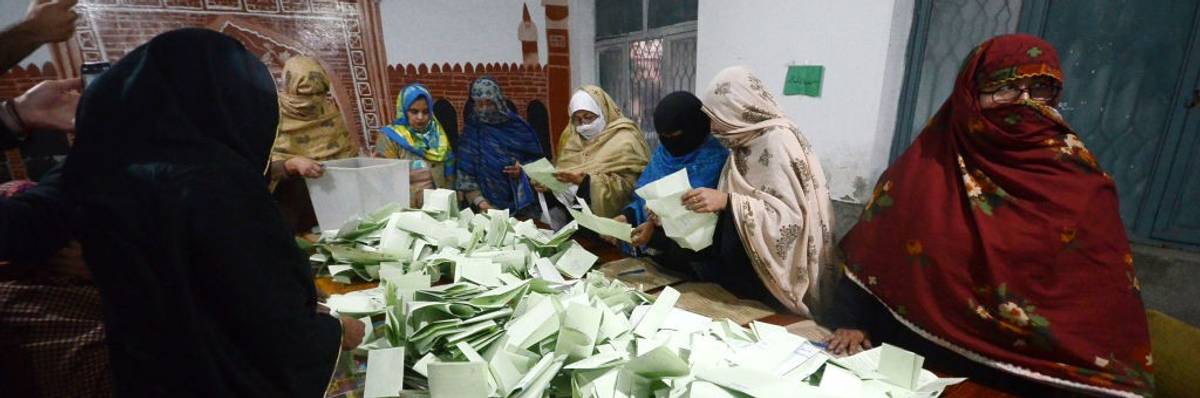
Pakistani election officials begin counting of votes after polling stations closed in Peshawar on February 8, 2024.
"This is one of the most controversial and most rigged elections in Pakistan's history," said one parliamentary candidate from jailed former Prime Minister Imran Khan's PTI party.
As polling stations closed across Pakistan on Thursday evening, democracy defenders accused the South Asian nation's U.S.-backed government—which banned the country's most popular politician from running for office—of conducting a general election rife with voter suppression and violence.
"This is one of the most controversial and most rigged elections in Pakistan's history," Taimur Jhagra, a parliamentary candidate from the populist Pakistan Tehreek-e-Insaf (PTI) party, told Al Jazeera. "This is yet another black mark, and it's only because of the fear of the people of Pakistan voting for Imran Khan."
Jhagra was referring to the PTI founder and former prime minister who is imprisoned on what his supporters say are politically motivated charges that disqualified him from seeking office. Khan remains Pakistan's most popular politician.
As preliminary results showed Khan's PTI leading in a strong majority of Pakistan's constituencies, local and international media reported increased presence of military and police forces at polling places. Some observers reported ballot counts being stopped and videos posted on social media showed violence erupting at some polling places.
"After clear and visible chances of victory of Imran Khan's candidates in the preliminary results, the process of results got slowed down alarmingly," PTI chief organizer Omar Ayub Khan and PTI Sen. Syed Ali Zafar said in a joint statement.
"Pakistan elections are a sham without Imran Khan," exiled Pakistani politician and former Khan adviser Shahzad Akbar asserted in an opinion piece published Thursday by Middle East Eye.
Akbar added that "Pakistan has witnessed a terrible time for political dissent."
"The army has launched a massive crackdown on Khan's PTI, with leaders picked up on random charges or reported missing," he noted. "Journalists covering the saga have also
disappeared or turned up dead."
Additionally, the PTI's party offices and candidates' homes have been raided by police. Voters have reportedly been assigned to polling stations that don't match where they live, and Pakistani media outlets have reported faults in the vote tabulation system.
"Pakistan elections are a sham without Imran Khan."
One of the government's most controversial moves was the imposition of a telecommunications blackout that blocked cell phone and internet service across the country. Alp Toker, director of the London-based digital rights group NetBlocks, called the blackout "inherently undemocratic."
Government officials claimed the blackout was ordered for national security reasons following Wednesday's
bombings in Balochistan that killed and wounded scores of people. However, critics noted the nationwide nature of the telecom suspension in refuting the government's rationale.
"I condemn the internet blackout," candidate Bilawal Bhutto Zardari of the center-left Pakistan People's Party told Al Jazeera. "I ask the election commission, the government, and the judiciary to restore it. It will have an impact on voter turnout and coordination."
In the United States—whose government stands accused of playing a key role in ousting Khan—Democratic Michigan Congresswoman Rashida Tlaib asserted on social media that "we must stand with the Pakistani people as their democracy is at serious risk."
"They should be able to elect their leaders without interference and tampering with the process, and the U.S. must ensure our tax dollars don't go to anyone undermining that," she added.
U.S. Rep. Greg Casar (D-Texas) said that "Pakistanis have the right to elect their leaders without cell phone service shutdowns and other authoritarian practices aimed at undermining election results."
"The U.S. must stand with the Pakistani people and make clear we will not support anyone working to undermine democracy," he added.
Dear Common Dreams reader, It’s been nearly 30 years since I co-founded Common Dreams with my late wife, Lina Newhouser. We had the radical notion that journalism should serve the public good, not corporate profits. It was clear to us from the outset what it would take to build such a project. No paid advertisements. No corporate sponsors. No millionaire publisher telling us what to think or do. Many people said we wouldn't last a year, but we proved those doubters wrong. Together with a tremendous team of journalists and dedicated staff, we built an independent media outlet free from the constraints of profits and corporate control. Our mission has always been simple: To inform. To inspire. To ignite change for the common good. Building Common Dreams was not easy. Our survival was never guaranteed. When you take on the most powerful forces—Wall Street greed, fossil fuel industry destruction, Big Tech lobbyists, and uber-rich oligarchs who have spent billions upon billions rigging the economy and democracy in their favor—the only bulwark you have is supporters who believe in your work. But here’s the urgent message from me today. It's never been this bad out there. And it's never been this hard to keep us going. At the very moment Common Dreams is most needed, the threats we face are intensifying. We need your support now more than ever. We don't accept corporate advertising and never will. We don't have a paywall because we don't think people should be blocked from critical news based on their ability to pay. Everything we do is funded by the donations of readers like you. When everyone does the little they can afford, we are strong. But if that support retreats or dries up, so do we. Will you donate now to make sure Common Dreams not only survives but thrives? —Craig Brown, Co-founder |
As polling stations closed across Pakistan on Thursday evening, democracy defenders accused the South Asian nation's U.S.-backed government—which banned the country's most popular politician from running for office—of conducting a general election rife with voter suppression and violence.
"This is one of the most controversial and most rigged elections in Pakistan's history," Taimur Jhagra, a parliamentary candidate from the populist Pakistan Tehreek-e-Insaf (PTI) party, told Al Jazeera. "This is yet another black mark, and it's only because of the fear of the people of Pakistan voting for Imran Khan."
Jhagra was referring to the PTI founder and former prime minister who is imprisoned on what his supporters say are politically motivated charges that disqualified him from seeking office. Khan remains Pakistan's most popular politician.
As preliminary results showed Khan's PTI leading in a strong majority of Pakistan's constituencies, local and international media reported increased presence of military and police forces at polling places. Some observers reported ballot counts being stopped and videos posted on social media showed violence erupting at some polling places.
"After clear and visible chances of victory of Imran Khan's candidates in the preliminary results, the process of results got slowed down alarmingly," PTI chief organizer Omar Ayub Khan and PTI Sen. Syed Ali Zafar said in a joint statement.
"Pakistan elections are a sham without Imran Khan," exiled Pakistani politician and former Khan adviser Shahzad Akbar asserted in an opinion piece published Thursday by Middle East Eye.
Akbar added that "Pakistan has witnessed a terrible time for political dissent."
"The army has launched a massive crackdown on Khan's PTI, with leaders picked up on random charges or reported missing," he noted. "Journalists covering the saga have also
disappeared or turned up dead."
Additionally, the PTI's party offices and candidates' homes have been raided by police. Voters have reportedly been assigned to polling stations that don't match where they live, and Pakistani media outlets have reported faults in the vote tabulation system.
"Pakistan elections are a sham without Imran Khan."
One of the government's most controversial moves was the imposition of a telecommunications blackout that blocked cell phone and internet service across the country. Alp Toker, director of the London-based digital rights group NetBlocks, called the blackout "inherently undemocratic."
Government officials claimed the blackout was ordered for national security reasons following Wednesday's
bombings in Balochistan that killed and wounded scores of people. However, critics noted the nationwide nature of the telecom suspension in refuting the government's rationale.
"I condemn the internet blackout," candidate Bilawal Bhutto Zardari of the center-left Pakistan People's Party told Al Jazeera. "I ask the election commission, the government, and the judiciary to restore it. It will have an impact on voter turnout and coordination."
In the United States—whose government stands accused of playing a key role in ousting Khan—Democratic Michigan Congresswoman Rashida Tlaib asserted on social media that "we must stand with the Pakistani people as their democracy is at serious risk."
"They should be able to elect their leaders without interference and tampering with the process, and the U.S. must ensure our tax dollars don't go to anyone undermining that," she added.
U.S. Rep. Greg Casar (D-Texas) said that "Pakistanis have the right to elect their leaders without cell phone service shutdowns and other authoritarian practices aimed at undermining election results."
"The U.S. must stand with the Pakistani people and make clear we will not support anyone working to undermine democracy," he added.
As polling stations closed across Pakistan on Thursday evening, democracy defenders accused the South Asian nation's U.S.-backed government—which banned the country's most popular politician from running for office—of conducting a general election rife with voter suppression and violence.
"This is one of the most controversial and most rigged elections in Pakistan's history," Taimur Jhagra, a parliamentary candidate from the populist Pakistan Tehreek-e-Insaf (PTI) party, told Al Jazeera. "This is yet another black mark, and it's only because of the fear of the people of Pakistan voting for Imran Khan."
Jhagra was referring to the PTI founder and former prime minister who is imprisoned on what his supporters say are politically motivated charges that disqualified him from seeking office. Khan remains Pakistan's most popular politician.
As preliminary results showed Khan's PTI leading in a strong majority of Pakistan's constituencies, local and international media reported increased presence of military and police forces at polling places. Some observers reported ballot counts being stopped and videos posted on social media showed violence erupting at some polling places.
"After clear and visible chances of victory of Imran Khan's candidates in the preliminary results, the process of results got slowed down alarmingly," PTI chief organizer Omar Ayub Khan and PTI Sen. Syed Ali Zafar said in a joint statement.
"Pakistan elections are a sham without Imran Khan," exiled Pakistani politician and former Khan adviser Shahzad Akbar asserted in an opinion piece published Thursday by Middle East Eye.
Akbar added that "Pakistan has witnessed a terrible time for political dissent."
"The army has launched a massive crackdown on Khan's PTI, with leaders picked up on random charges or reported missing," he noted. "Journalists covering the saga have also
disappeared or turned up dead."
Additionally, the PTI's party offices and candidates' homes have been raided by police. Voters have reportedly been assigned to polling stations that don't match where they live, and Pakistani media outlets have reported faults in the vote tabulation system.
"Pakistan elections are a sham without Imran Khan."
One of the government's most controversial moves was the imposition of a telecommunications blackout that blocked cell phone and internet service across the country. Alp Toker, director of the London-based digital rights group NetBlocks, called the blackout "inherently undemocratic."
Government officials claimed the blackout was ordered for national security reasons following Wednesday's
bombings in Balochistan that killed and wounded scores of people. However, critics noted the nationwide nature of the telecom suspension in refuting the government's rationale.
"I condemn the internet blackout," candidate Bilawal Bhutto Zardari of the center-left Pakistan People's Party told Al Jazeera. "I ask the election commission, the government, and the judiciary to restore it. It will have an impact on voter turnout and coordination."
In the United States—whose government stands accused of playing a key role in ousting Khan—Democratic Michigan Congresswoman Rashida Tlaib asserted on social media that "we must stand with the Pakistani people as their democracy is at serious risk."
"They should be able to elect their leaders without interference and tampering with the process, and the U.S. must ensure our tax dollars don't go to anyone undermining that," she added.
U.S. Rep. Greg Casar (D-Texas) said that "Pakistanis have the right to elect their leaders without cell phone service shutdowns and other authoritarian practices aimed at undermining election results."
"The U.S. must stand with the Pakistani people and make clear we will not support anyone working to undermine democracy," he added.