SUBSCRIBE TO OUR FREE NEWSLETTER
Daily news & progressive opinion—funded by the people, not the corporations—delivered straight to your inbox.
5
#000000
#FFFFFF
To donate by check, phone, or other method, see our More Ways to Give page.
Daily news & progressive opinion—funded by the people, not the corporations—delivered straight to your inbox.
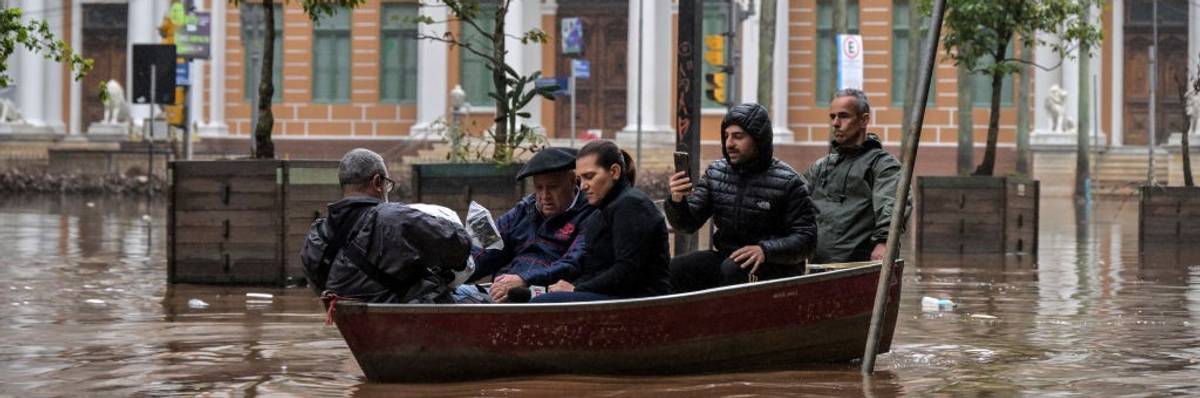
Journalists travel by boat through a flooded street in downtown Porto Alegre, Brazil, on May 19, 2024.
"This is not a disaster of Brazil's making. The whole planet is experiencing increasingly rapid climate changes due largely to the greenhouse gases produced by a handful of wealthy nations," one expert said.
Experts emphasized the escalating risks of climate-related disasters and their disproportionate impacts on low-income people on Monday following flooding in Brazil that has killed at least 150 people and displaced more than 600,000.
The floods that hit over recent days and weeks have knocked out bridges and the main airport in Porto Alegre, a port city in southern Brazil. More than 460 of the 497 municipalities in the southern state of Rio Grande do Sol have been affected, with more than 2 million people impacted, according to provisional government data.
"The situation is catastrophic," said Rachel Soeiro, Médecins Sans Frontières (MSF) medical coordinator in Brazil, who visited the area by helicopter. "We were able to view the towns from above and noticed that in some cases we couldn't even see the roofs of houses.”
More than two feet of rain has fallen so far this month, according Brazil's national weather service, inundating large areas.
"Whole towns and large, urban city centers are in some cases almost completely underwater," the BBC reported on Saturday.
We joined an emergency services helicopter rescuing people from Brazil's floods. The rescues themselves are fraught with risks. More than half a million people are displaced.
Watch on @BBCNews at 6 today (on at 1705) or catch up on the News at One.
Whole cities are destroyed👇 pic.twitter.com/hxZYSVDDmz
— Ione Wells (@ionewells) May 19, 2024
Experts connected the extreme rainfall to climate change, which increases the likelihood of such weather events. Incidents of extreme flooding have increased "sharply" across the planet in the last two decades, according to a study in Nature Water released last year.
"In many ways, this is not a disaster of Brazil’s making. The whole planet is experiencing increasingly rapid climate changes due largely to the greenhouse gases produced by a handful of wealthy nations," Cristiane Fontes (Krika), executive director of World Resources Institute (WRI) Brasil, wrote in a commentary earlier this month in which she called the situation a "wake-up call for the world."
In recent weeks, flooding has also hit China, the United Arab Emirates, and Australia, and WRI's staff in Kenya are dealing with dam breaches from heavy rains, Fontes noted.
A Brazilian expert indicated that the flooding, catastrophic as it has been, should not come as a surprise.
"People on the streets here in Brazil, they've attributed this change to global climate change driven by the increase of fossil fuels," Paulo Artaxo, a physics professor at the University of Sao Paulo, and a member of the Intergovernmental Panel on Climate Change (IPCC), told the Canadian Broadcasting Corporation. He explained that was in line with IPCC projections showing that southern Brazil would face more extreme rainfall due to tropical and polar currents.
In Brazil, as elsewhere, climate impacts are not evenly distributed. MSF relief efforts are focused on the most vulnerable, including Indigenous communities, one of which had been isolated by rising waters and without help for 10 days before being reached by the humanitarian group.
"Assisting those who are most vulnerable is one of our main concerns in such situations," Soeiro said. "These people were already facing difficult situations before the flooding. But their needs have risen further and access to them has become more difficult."
Some wealthy people in Porto Alegre have choices such as escaping to a second home, but in "rundown towns" on the city's periphery, low-income people have no such options, according to CNN.
Brazilian left-wing President Luiz Inácio Lula da Silva has pledged to provide relief money to families that lost their homes. Brazil is one of most unequal countries in the world, according to World Bank data.
Dear Common Dreams reader, It’s been nearly 30 years since I co-founded Common Dreams with my late wife, Lina Newhouser. We had the radical notion that journalism should serve the public good, not corporate profits. It was clear to us from the outset what it would take to build such a project. No paid advertisements. No corporate sponsors. No millionaire publisher telling us what to think or do. Many people said we wouldn't last a year, but we proved those doubters wrong. Together with a tremendous team of journalists and dedicated staff, we built an independent media outlet free from the constraints of profits and corporate control. Our mission has always been simple: To inform. To inspire. To ignite change for the common good. Building Common Dreams was not easy. Our survival was never guaranteed. When you take on the most powerful forces—Wall Street greed, fossil fuel industry destruction, Big Tech lobbyists, and uber-rich oligarchs who have spent billions upon billions rigging the economy and democracy in their favor—the only bulwark you have is supporters who believe in your work. But here’s the urgent message from me today. It's never been this bad out there. And it's never been this hard to keep us going. At the very moment Common Dreams is most needed, the threats we face are intensifying. We need your support now more than ever. We don't accept corporate advertising and never will. We don't have a paywall because we don't think people should be blocked from critical news based on their ability to pay. Everything we do is funded by the donations of readers like you. When everyone does the little they can afford, we are strong. But if that support retreats or dries up, so do we. Will you donate now to make sure Common Dreams not only survives but thrives? —Craig Brown, Co-founder |
Experts emphasized the escalating risks of climate-related disasters and their disproportionate impacts on low-income people on Monday following flooding in Brazil that has killed at least 150 people and displaced more than 600,000.
The floods that hit over recent days and weeks have knocked out bridges and the main airport in Porto Alegre, a port city in southern Brazil. More than 460 of the 497 municipalities in the southern state of Rio Grande do Sol have been affected, with more than 2 million people impacted, according to provisional government data.
"The situation is catastrophic," said Rachel Soeiro, Médecins Sans Frontières (MSF) medical coordinator in Brazil, who visited the area by helicopter. "We were able to view the towns from above and noticed that in some cases we couldn't even see the roofs of houses.”
More than two feet of rain has fallen so far this month, according Brazil's national weather service, inundating large areas.
"Whole towns and large, urban city centers are in some cases almost completely underwater," the BBC reported on Saturday.
We joined an emergency services helicopter rescuing people from Brazil's floods. The rescues themselves are fraught with risks. More than half a million people are displaced.
Watch on @BBCNews at 6 today (on at 1705) or catch up on the News at One.
Whole cities are destroyed👇 pic.twitter.com/hxZYSVDDmz
— Ione Wells (@ionewells) May 19, 2024
Experts connected the extreme rainfall to climate change, which increases the likelihood of such weather events. Incidents of extreme flooding have increased "sharply" across the planet in the last two decades, according to a study in Nature Water released last year.
"In many ways, this is not a disaster of Brazil’s making. The whole planet is experiencing increasingly rapid climate changes due largely to the greenhouse gases produced by a handful of wealthy nations," Cristiane Fontes (Krika), executive director of World Resources Institute (WRI) Brasil, wrote in a commentary earlier this month in which she called the situation a "wake-up call for the world."
In recent weeks, flooding has also hit China, the United Arab Emirates, and Australia, and WRI's staff in Kenya are dealing with dam breaches from heavy rains, Fontes noted.
A Brazilian expert indicated that the flooding, catastrophic as it has been, should not come as a surprise.
"People on the streets here in Brazil, they've attributed this change to global climate change driven by the increase of fossil fuels," Paulo Artaxo, a physics professor at the University of Sao Paulo, and a member of the Intergovernmental Panel on Climate Change (IPCC), told the Canadian Broadcasting Corporation. He explained that was in line with IPCC projections showing that southern Brazil would face more extreme rainfall due to tropical and polar currents.
In Brazil, as elsewhere, climate impacts are not evenly distributed. MSF relief efforts are focused on the most vulnerable, including Indigenous communities, one of which had been isolated by rising waters and without help for 10 days before being reached by the humanitarian group.
"Assisting those who are most vulnerable is one of our main concerns in such situations," Soeiro said. "These people were already facing difficult situations before the flooding. But their needs have risen further and access to them has become more difficult."
Some wealthy people in Porto Alegre have choices such as escaping to a second home, but in "rundown towns" on the city's periphery, low-income people have no such options, according to CNN.
Brazilian left-wing President Luiz Inácio Lula da Silva has pledged to provide relief money to families that lost their homes. Brazil is one of most unequal countries in the world, according to World Bank data.
Experts emphasized the escalating risks of climate-related disasters and their disproportionate impacts on low-income people on Monday following flooding in Brazil that has killed at least 150 people and displaced more than 600,000.
The floods that hit over recent days and weeks have knocked out bridges and the main airport in Porto Alegre, a port city in southern Brazil. More than 460 of the 497 municipalities in the southern state of Rio Grande do Sol have been affected, with more than 2 million people impacted, according to provisional government data.
"The situation is catastrophic," said Rachel Soeiro, Médecins Sans Frontières (MSF) medical coordinator in Brazil, who visited the area by helicopter. "We were able to view the towns from above and noticed that in some cases we couldn't even see the roofs of houses.”
More than two feet of rain has fallen so far this month, according Brazil's national weather service, inundating large areas.
"Whole towns and large, urban city centers are in some cases almost completely underwater," the BBC reported on Saturday.
We joined an emergency services helicopter rescuing people from Brazil's floods. The rescues themselves are fraught with risks. More than half a million people are displaced.
Watch on @BBCNews at 6 today (on at 1705) or catch up on the News at One.
Whole cities are destroyed👇 pic.twitter.com/hxZYSVDDmz
— Ione Wells (@ionewells) May 19, 2024
Experts connected the extreme rainfall to climate change, which increases the likelihood of such weather events. Incidents of extreme flooding have increased "sharply" across the planet in the last two decades, according to a study in Nature Water released last year.
"In many ways, this is not a disaster of Brazil’s making. The whole planet is experiencing increasingly rapid climate changes due largely to the greenhouse gases produced by a handful of wealthy nations," Cristiane Fontes (Krika), executive director of World Resources Institute (WRI) Brasil, wrote in a commentary earlier this month in which she called the situation a "wake-up call for the world."
In recent weeks, flooding has also hit China, the United Arab Emirates, and Australia, and WRI's staff in Kenya are dealing with dam breaches from heavy rains, Fontes noted.
A Brazilian expert indicated that the flooding, catastrophic as it has been, should not come as a surprise.
"People on the streets here in Brazil, they've attributed this change to global climate change driven by the increase of fossil fuels," Paulo Artaxo, a physics professor at the University of Sao Paulo, and a member of the Intergovernmental Panel on Climate Change (IPCC), told the Canadian Broadcasting Corporation. He explained that was in line with IPCC projections showing that southern Brazil would face more extreme rainfall due to tropical and polar currents.
In Brazil, as elsewhere, climate impacts are not evenly distributed. MSF relief efforts are focused on the most vulnerable, including Indigenous communities, one of which had been isolated by rising waters and without help for 10 days before being reached by the humanitarian group.
"Assisting those who are most vulnerable is one of our main concerns in such situations," Soeiro said. "These people were already facing difficult situations before the flooding. But their needs have risen further and access to them has become more difficult."
Some wealthy people in Porto Alegre have choices such as escaping to a second home, but in "rundown towns" on the city's periphery, low-income people have no such options, according to CNN.
Brazilian left-wing President Luiz Inácio Lula da Silva has pledged to provide relief money to families that lost their homes. Brazil is one of most unequal countries in the world, according to World Bank data.